NOTE:Nothing controversial about this post — it only involves race, gender, and religion!
A few decades ago, the standard history of rock and roll went something like this: In the mid 1950s. black R&B and white country music collided. White kids went apeshit. Rock happened.
That may hold a bit of water as sociological history, in the sense that, yes, white kids got hip to R&B in the ’50s, and the term “rock & roll” was adopted to describe the resulting craze. But as musicological analysis, it’s bullshit.
Today the knowledgable listener is likelier to realize that all the ingredients of early rock and roll percolated throughout African-American music decades before Elvis. (How can anyone with ears not perceive Louis Jordan’s 1949 recording of “Saturday Night Fish Fry” as a fully realized rock & roll track?)
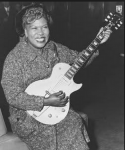
Nowhere is “white guy-centric” rock history more apparent than when discussing the legacy of Sister Rosetta Tharpe (1915-1973). How is it that she is perceived as anything other than a genre-defining rock guitar innovator? If you don’t know Tharpe’s astonishing guitar work, check this out (especially the segment that starts around 1:45):
Watching the footage of Tharpe’s 1964 performance in Manchester, England, you can practically feel her spawning a thousand British rock bands. (And how telling is it that one of her goldtop Les Pauls wound up in the possession of Big Jim Sullivan, the preeminent British session player of the ’60s?) (more…)