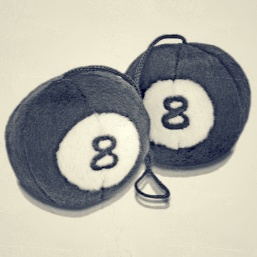
They’re fuzzy eight balls, okay? Eight as in octave. Fuzzy as in fuzz. Get it? GET IT? Oh, never mind.
Anyone have any strong feelings about octave fuzz? I’m guessing so, because not many effects produce stronger feelings. It’s not a path for the faint-hearted. Or control freaks. Or frankly, most guitar players.
I rounded up all my octave fuzz pedals and made an amazing discovery: I have way too many of them! I’m putting together a video demo of some faves, and will post it in a couple of days. But I couldn’t wait to start talking about it this quirkiest of effects.
I’m 200 years old, but I can still kick your ass, punk!
UPDATE: I’m proud to announce that my fingerstyle video lesson based on the 200-year-old etudes of Mauro Giuliani has been selected to appear in the debut issue of Pure Guitar, a new digital guitar mag whose editorial staff includes my two music journo mentors : Tom Wheeler and Jas Obrecht. Also on board: jazz ace Wayne Goins, session superhero Tim Pierce, Nashville’s leading guitar tech, Joe Glaser, and other preeminent axe experts.
You’ll find my article here — but frankly, I recommend starting at the homepage of issue #1 and reading all the way through!
Congrats, guys, on the new mag. I’m psyched to be part of it. :beer:
“Do you have a central core concept or inspiration that drives your playing? Are you squirrelled away with obscure harmony texts, or practising modes till your fingers bleed? Do you have go-to chord substitutions that define your sound? Do you have a creamy harmonic centre?”
Like most great questions, it’s really hard to answer (though some folks managed to reply in extremely articulate and compelling ways). I’ve been pondering it myself for the last few days, and the best answer I can come up with is something along the lines of what I hinted at in this recent post on chromaticism, namely a liquid sense of modality based on the notion that most of us Westerners really only perceive two modes — major and minor — but that there’s a vast amount if “wiggle room” when it comes to placing individual scale degrees.
To put it another way, most of what I play is based on simple tonic triads, major or minor, but the placement of all the other scale degrees is highly negotiable. For me, the advantage of viewing scales this way is that they remain grounded in harmony, and vice-versa. As opposed to the way many of us were taught modes: as purely mathematical sets of intervals divorced from their chordal implications — or just a bunch of diatonic scales that start on the “wrong” notes.
Hey, why is everyone nodding off, staring out the window, or checking their phones? Wake up and talk about the methods of your madness!
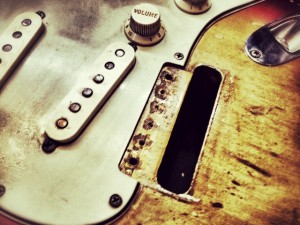
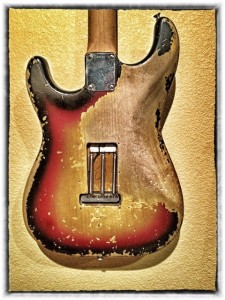
This photo was digitally altered to make the guitar look even dirtier than it was — but not by much.
Sometimes only the threat of public exposure can inspire a proper clean-up job. Case in point: I hadn’t groomed my battered ’63 Strat in years, and when I pupped it from the wall for my recent post on the instrument, the fact that I was about to show it to the world you guys made me finally admit how gross it had become.
Now, it’s not like I wanted it to sparkle or anything — seems to me that an old guitar should look old, and removing 100% of the grime would be a little too much like those octogenarians with preternaturally white teeth. I mainly just wanted to remove the sticky crud that had accu
Last weekend I went to a memorial service for a music pal I hadn’t seen since the ’80s. Judging by the pictures I saw and the stories I heard, Brett remained the gentle, generous music lover I’d remembered till he died in his sleep a few weeks ago.
I ran into lots of old music friends and bandmates, and we alternately smiled and winced as our old photos and concert videos flashed on the big screen. Were we really that skinny? Did we actually wear that stuff without being coerced at gunpoint?
Like we tend to do at such moments, I left brimming with resolutions: Appreciate life. Cherish friends. Remember that music is a joy as well as a job. And do something nice for my sad old Strat, the guitar in all those old photos and videos.
See, back then I only had one guitar — an all-original ’63 Strat I’d picked up in 1980, when pre-CBS Fenders were still perched on the precipice between collectible and affordable. (I paid $450, a staggering investment for me at the time.) It remained my only serious guitar for a decade. It was in near-perfect condition when I bought it, and it was a battered ruin by decade’s end. (The ’80s were a tough time for guitars, what with all those studded belts.) I was a young player with a bad attitude and little concern for collectibility, as opposed to the middle-aged player with a bad attitude and little concern for collectibility that I am today.
I’ll some thoughts about Strats then and now. But first, have a listen:
Writers and musician always steal from each other. How many great novels and stories take their titles from music? How many great songs and compositions are inspired by works of literature? (Answer: a metric buttload!)
But strangely, musicians have been slow to pick up on one of best practices of modern writers. I refer to the writers group, a gathering of struggling authors (they all struggle) who share their work in progress with each other, seeking constructive criticism, general encouragement, and a chance to schmooze with their peers.
For years I participated in a novel-writers group here in San Francisco. It was a fantastic experience, and one that made me regret the fact that musicians usually don’t have similar outlets. Sure, you can play your work in progress for friends and family, but that’s not the same as sharing it with other artists who are grappling with similar issues.
Submitting your work for peer critique can be scary. The feedback is occasionally misguided. Egos can intrude. But in my experience, at least, the helpful conversations outweigh hurtful ones by a hundred to one.
A quick update to last week’s post about bronze and nickel strings: Over in the forum, Bear suggested trying 80/20 bronze strings. It’s a little embarrassing to admit, but I thought some of the strings I’d stocked up on and tried were 80/20s, but just realized they were another variety of phosphor bronze. D’oh!
So I got a nice, simple set of uncoated 80/20 Martin Marquis, popped them on, and realized that I don’t hate bronze strings — just phosphor bronze (and just on my particular guitars). I’m happy now.
Anyway, if you’re curious, I’ve updated the audio examples to include this third string type along with the phosphor bronze and nickels. Have a listen if you’re curious:
Of the dozens of videos I’ve posted at the tonefiend YouTube channel, most have dealt with gear, and a few with general technique. But this is the first one I’ve done dealing with music theory. Which is sort of odd, since I’m a terminal music theory geek.
Aside from covering a cool and underused melodic/harmonic device, this video opens a Pandora’s box of modal theory. I have some crackpot interesting theories about this, and I enjoy sharing them, especially when I’m trying to get house guests to depart after a long party.
I’d like to post more stuff along these lines if folks find it useful. Let me know!
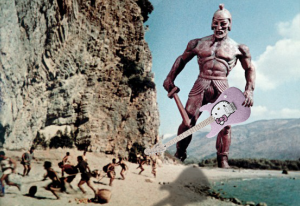
Like Talos the Giant from Jason & the Argonauts, most modern acoustic strings are made from bronze. Like him, they can be cruel and inflexible.
UPDATE: I’ve updated the audio examples to include 80/20 bronze strings, as detailed in this newer post.
Can I share my steel-string psychodrama?
I’m lucky enough to own many electric guitars, but I’ve played one steel-string acoustic almost exclusively for many years — a small-bodied Lowden with a tone that a very famous manufacturer of acoustic pickups once described as “like a f%^$ing cannon!” Its sizzling-bright treble and modest low-end make it a great recording instrument. (Engineers often boost highs and roll off lows when processing acoustic guitar, but this model is practically “pre-EQ’ed.”)
But it’s not an easy guitar to play. It seems to amplify string noise, flubbed notes, and all other playing imperfections. “This is a ‘tough love’ guitar,” muttered one singer/songwriter friend.
So when I bought a second steel-string recently, I wanted something warmer, softer, and more flattering, and I found it in a pretty old small-bodied Martin. The day I bought it, I restrung it with treble strings to record my recent Nashville high-strung demo, then popped on a set of the phosphor-bronze strings I’ve been using for years on the Lowden.
The problem was, my sweet, soft antique suddenly sounded a hell of a lot like the Lowden, with blistering treble and cruel string noise. And I realized in a flash that a lot of the qualities I’d attributed to the Lowden were, in fact, a result of the modern, coated phosphor bronze string I’d been using. So I ordered some alternatives and made a few test recordings to demonstrate how dramatic the differences are.
One cool thing about going indie with tonefiend is that fact that I can finally host my own geek forum! It’s already up and running — but it’s a sad, vacant space that desperately needs to be populated by cool people and cool ideas.
How to get there? Sleazy bribes! Cool prizes!
Here’s the deal: I’ve pre-populated the forum with a few topics and threads. Just come on over, register, and chime in on any thread that interests you — or better yet, start one of your own. And on September 1st, 2012, the three forum members who have consistently contributed the liveliest content as judged by some dork me will get a bitchin’ stompbox laboriously hand-built by the same dork me. I can’t disclose exactly what the pedals will do, but I can promise they will be cool, useful, and genuinely unique — original designs, not some lame-ass Screamer clones. And if I manage not to vaporize my hand with the TechShop laser-cutter I’ve been learning to use, they’ll even have wicked laser-etched enclosures.
Naturally, I hope the tonefiend forum will also be cool and unique, and that you’ll enjoy geeking out there even when there’s no contest. But hey, I’m not above greasing the skids with free stompboxes as needed.