Low-Voltage Chunk from Diode Distortion!
Did you know you can add a simple circuit to your guitar or bass that produces onboard distortion — without using a battery?
The idea is pretty simple — you attach a pair of diodes to the guitar’s output via a pot or switch. With the diodes connected to ground, you get a fairly nice distortion sound. With the connection to ground broken, you get your regular tones. It’s the same method used to create distortion in a several ’70s distortion pedals, notable the MXR Distortion+ and the DOD 250.
You can purchase the necessary components in a sleek black housing under the name Black Ice for $27.50, or you can do a DIY version for about $2 in parts. I’ll explain how after this brief video demo:
My reactions: It’s a pretty cool effect, though the volume drop when engaging the distortion might be an issue. If would be great, however, in any context where you need a crunch sound at restrained levels, like when playing in a stage pit band. It’s not a terribly refined tone, but definitely a usable one.
Before recording this demo, I tried a Black Ice in a vintage-voiced Strat. It definitely created a distortion effect, but it’s much more gratifying here with the higher output P-90s and humbuckers.
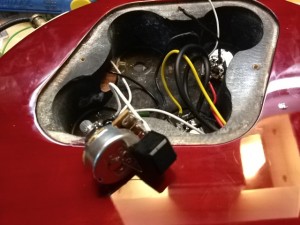
This dual-pickup guitar is wired for two volumes and one tone. The fourth pot adds the Black Ice distortion — that ominous black cube.
I rewired the demo guitar — which you may recognize from this post about makeovers for cheapo axes — for two volume knobs and a single tone, freeing up the fourth pot for the Black Ice circuit. But I don’t think I’d repeat this method.
The blended settings just don’t do much for me — the pot acts more as a clean/dirty blend than a distortion control per se, and the mixed settings strike me as a thin trickle of distortion suspended over a clean sound. Furthermore, the recommended A250K pot seems like a poor choice, since all the usable sounds are clumped together at one end of the pot’s range. In the future, I’ll experiment with other pot values — or more likely, just attach the diodes to a SPST switch and consider it an all-or-nothing effect. This wiring will work great for the latter approach:
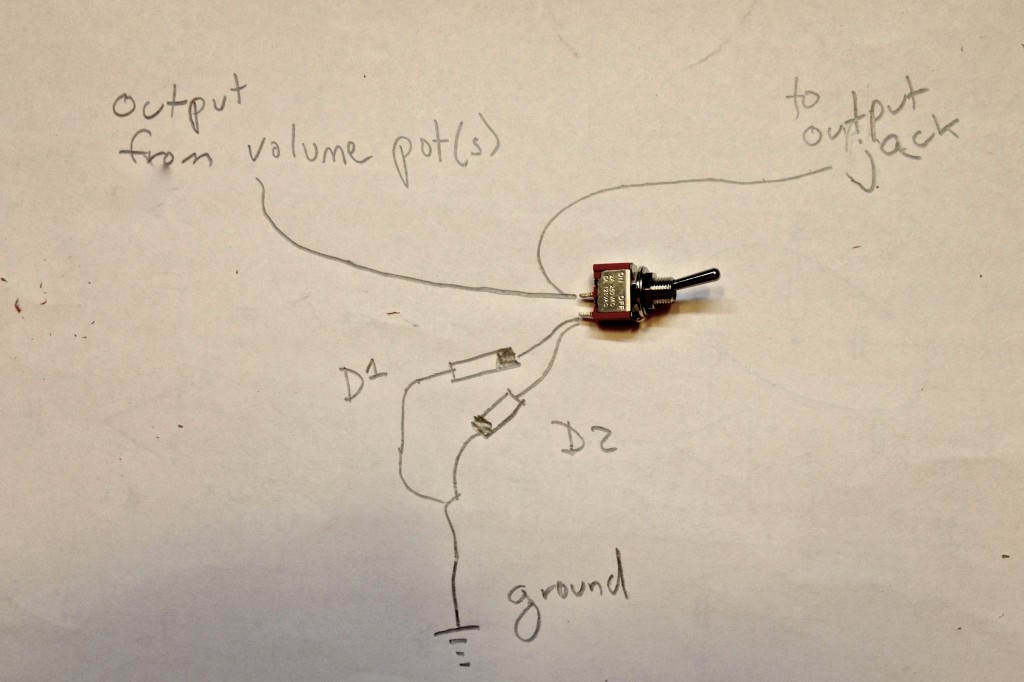
Use the low-voltage Schottky diodes specified in the article. Be sure they're oriented in opposite directions — the cathode (banded end) of one diode connects to ground, as does the anode (non-banded end) of the other.
I like the Black Ice package — it’s a snap to install, and I even bought a second one to try in my P-Bass. But you can definitely get a similar effect using a pair of low-voltage Schottky diodes like these or these. I have no idea which exact diodes the Black Ice uses, but the two types I mentioned will get you very close. (FYI, I tried a dozen or so diode types, and none sounded nearly as good as the two I linked to.)
Conclusions: Interesting, inexpensive, and possibly useful. Worth a try! 









You know, just the other day I was wondering if something like this would work. Clearly your blog has made a tinkerer out of me…
Wow that seems like a pretty cool idea!!! What should I change to make a floor pedal version of it? Do you know any on line store that I can get the items for cheap in Europe? Definitely waiting for more projects like this in the future. Thank you!!!
Lots of my European friend order from Germany’s Bonzai Music (https://www.banzaimusic.com/). But these aren’t specialized guitar parts — you can get everything you need from any electronics supplier.
Hmm — a pedal version? Well, it would be the simplest pedal in the world, with no battery (unless you insist on adding an LED). But I’m not sure you’d LIKE it — the volume drop is a genuine issue, and if you’re going to go all the way and build a distortion stompbox, why not make a diode-based distortion with proper volume and gain controls, like DIY Club Project #1? 🙂
I really want to make the #1 project but It needs more effort and time that I don’t really have right now.
The volume drop isn’t an issue for me as I’m not switching between clean and distortion often. So how can I make the pedal version? Could you please make a nice scheme as you made above? Thanks!!
Must agree…that’s a pretty cool one. It’s a shame the blending isn’t any better. Be sure to update us it you find a different pot value works better. Thanks for more great ideas!
Very cool! I’ve seen the Black Ice & wondered about putting it in, but I like your super low-cost solution… I might do this to the Batman Logo guitar!
I can’t think of a more fitting home for it! 🙂
Have you tried Ge diodes such as 1n34a? Might be a alternative to the Schottkys.
It may give you too much of a voltage drop. The diodes Joe is using have a turn on voltage of .75 and 1.0 turn-on volts whereas Ge types run around 0.2 volt drop it may vreate a very low level output. Standard silicon diodes typically turn on at about 0.6 volts. You might also want to try 2 or 3 or even 4 or more Ge diodes in series rather than a single diode to get a higher turn on voltage, you could also do a mismatch which should give you an asymmetric clipping 2 diodes in one direction vs 3 in the other. This might also work with LED is you could find one that fired with low enough voltage. This would probably be very cool with active high output pickups.
Hi Matt –
Usually Schottky diodes turn on at around 0.2V, and have a relatively low resistance once on. Ge diodes turn on around 0.3V, and the on-resistance is quite a bit higher. Standard Si diodes turn on about 0.7V. LEDs are all different beasts, and the turn-on voltage depends on the semiconductor material and the wavelength; the lowest turn-on voltage is about 1.6V and can go up to about 4V for some Violet/UV LEDs.
Anyway, with Ge diodes (as compared to Schottky), they would start clipping at around the same voltage or just a little higher (making them just a little louder). Also, they would have a higher on-resistance, making for more of soft-clipped sound. Just a thought.
-Jeff
Thanks guys — that is a TON of stuff I didn’t know. I’m definitely going to check out a Ge version once I dig myself out from this mountain of crap soon. 🙂
Yep I misread the specs and I mistook the maximum forward voltage drop for the firing voltage on the links provided in the original post. I’ve never used Shottky diodes much in audio, my only experience with them was in chemistry instrumentation. Ge diodes I have used all seemed to fire around .2 volts or a little more when I used them as clippers but that was when they were after an IC or in the feedback loop for the IC circuit. I always liked the Ge diodes best in those circuits. The Ge diodes I use are all from my stash that I purchased in the early to mid 70’s from small electronic suppliers that were going out of business. So my Ge diodes are definitely the old school glass types many of which are fairly leaky. In any case it always amazed me that the best sounding guitar circuits sort of break the rules of electronic engineering.
Back in the 1970s there were a couple of devices called Blue and Black Ice Cubes that plugged in the rear jacks in place of the reverb tank on Fender and other amps. It created a parallel distorted signal varied by the reverb control. They were basically diodes with a couple of resistors and capacitors that were also encased in plastic resin. Nils Lofgren used to use one on a Twin Reverb quite a bit back then to achieve his lead tone (according to his brother Tom who was in our dinner club).
I usually figure that any circuit or device encased in plastic or epoxy is an embarrassingly simple design that the makers worry everyone will build themselves [Dumble amps ?] :-).
I was curious about having this turned on and running through the buffer(to make up for the volume drop) then into either the distortion or the rangemaster.
Is this a good idea, or would it get all muddy sounding?
Well, the buffer wouldn’t change anything, but the booster/buffer from DIY club would.
But honestly, I think it’s probably best to take this effect as it is, volume drop and all. If you want loud distortion, well, see my reply to DohminSemper above.
I’ve actually built a few pedals using the Black Ice. The first one is based on the one that includes a switch to turn it on FULL. I used a 250push/pull pot & use a capasitor for humbuckers. It seeems louder then the single coil type.
Cool! I don’t suppose I could persuade you to sketch out and post a little schematic? 🙂
Stewart MacDonald Parts
1-Mega Pot for volume
1-250 push/pull
1-BlackIce
1-.20mf capacitor
Radioshack Parts
1-SPST Toggle Switch(279-0834
2-1/4 Mono Audio Jacks
Fry’s Electronics Parts
Push on-Push Off Standard Pushbutton (Parts No. 38-448)
Home Depo Part
1-Round PVC style used for electric wiring (Trim & modified for it’s out shell/Digitalcamo Duct Tape for outer appearance)
I basically used the same StewMac diagram, I added a 1 Meg Volume & kill switch.
Use a 3 way switch and you can toggle between 2 different diode combinations…
Ok – I know this is kind of counter to the original premise….but COULD we stick a battery in there?
Totally! No problem putting a battery in there. But pragmatically speaking, it’ll sort of be like putting a battery in a cantaloupe.
Hey
This is great, btw
If I put a signal booster on when the distorted sound was there? Would that mess with the distortion, or just make it louder?
Yeah, that would totally work. It’ll change the sound, in the sense that more level will be hitting your amp, and the tone will be more distorted than it would otherwise be. But it’ll retain the basic color.
HAHAHAHA 🙂
I have an original Black Ice – it’s a little black thing (with a serial number on it) with two rca male connections aligned to fit precisely into the reverb circuit of a Fender Princeton Reverb. It’s a little strange but its an ultra rarity that no one will own up to – but i suspect it was made by EHX. Actually I had three i gave two away to fender loving friends. it came in a box a bought in the 80’s along with 4 versions of Treble boost/Screaming Bird – i kept an original of that one too… very basic effects but they do the job pretty well. I’m amazed how some of the EHX effects have remained in my pedal chain – none which are newer than 1983.
You could also try changing out just ONE of the diodes, e.g. use a Schottky on one side and the Ge diode on the other. That way your distortion will be asymmetrical, giving more even harmonics. I won’t go so far as to say “tube” tone.
Now I did try putting a battery in a canteloupe, and WOW!
what about just using 1 diode or LED? and how would you describe the difference in sound between a led and a silicone diode? will just 1 led mean less signal loss?
Sorry, that just won’t work at all — you need to two diodes oriented in opposite direction to produce the effect. Also, while using different diodes is a cool way to customize the sound of a 9v-powered distortion pedal, only certain types of diodes work in this PASSIVE circuit. LEDs won’t work at all. There may be some other options that work here (maybe some of the electronics aces who read this site can help me here), but as far as I know, the effect you hear in my demo is pretty much the only option.
Can anyone expand on that?
Ok, you could use only 1 diode – but it would clip only half of the waveform. You would probably end up with a strong octave effect.
The choice of diode dramatically impact the amount of clipping available. The clipping happens when the diode goes from being “off” to “on”. While off, the diode lets the signal go through unaffected. However, once the input voltage reaches the diode’s threshold voltage, it turns on, and doesn’t allow the signal to get any bigger.
With active effects, you can boost the signal to allow diodes with higher threshold voltages to work. However, when using passive pickups, you need to have diodes with relatively low threshold voltages – otherwise they will never clip and never have any overdrive.
If you look at the comments above, I quoted some specifications on other diodes.
Always experiment!
Also, there is a new version of the “Black Ice” available from StweMac. It can be found here: https://www.stewmac.com/shop/Electronics,_pickups/Components:_Black_Ice_overdrive/Black_Ice.html?actn=100101&xst=3&xsr=17287 This new version has four available configurations. Check it out!
-Jeff
Today I added some clips over at my forum post about rectification https://tonefiend.com/tonefiend-forum/?mingleforumaction=viewtopic&t=85.0. A single diode will only result in half wave rectification and does not create an octave effect. It creates a strong second harmonic but it just sounds really distorted.
That seems like a great idea. But how the two diodes add distortion? Could you please explain how this works?
Also to make a pedal box that’s permanently turned on, what will I need? A metallic box, 2 mono jacks, cable and the diodes only?
Hi Nick — actually, I’d recommend taking a look at my first DIY stompbox project, even if you don’t want to actually build it, because it explains all the hardware and wiring necessary to build amy first DIY stompbox effect into an enclosure. The dual-diode distortion will totally work in stompbox form, and it’s a super-easy build. 🙂
Well, what I don’t understand is where is the “ground”. Do I have to solder a cable from one side of the peftboard to the other and call it “ground”? Is the negative side of a battery the groudn? Could you explain this please?
Here’s my suggestion for someone putting in a diode clipper on their guitar: Use an SPDT center-off switch and get two different distortion sounds.
1) Put two identical diodes back to back from ground to one terminal. This creates a “thin” distortion sound.
2) Put two diodes with different forward voltages (e.g. a silicon and a Schottky) back to back from ground to the other terminal. This creates a “thick” distortion sound. The output level will be lower still than the “thin” sound so you’ll need to compensate for that somehow.
You could run the guitar into a compressor or volume pedal to take care of the output level differences.
This arrangement will give you three sounds:
1) No distortion (center off)
2) Thin distortion
3) Thick distortion
I should stick to the forum, where I can edit my stupid remarks!
If you start with two low voltage diodes like Schottkys, and then unbalance it by replacing one with a silicon or germanium diode, the result will be louder. Whichever combination has the lower sum of forward voltages is the quietest.
LOL — hey Larry, I’m sorry I haven’t figured out how to add a revision feature to comments. But trust me, man — no one thinks you’re stupid. Your suggestions abou passive diode distortion are brilliant, I don’t think anyone anywhere has spelled it out that well, and I can’t tell you how much I appreciate you sharing your expertise here. 🙂
Hey, Joe.
Just wanted to drop a line to thank you for posting those diode “model numbers”. I added both to a tiny box I made so now I have an outboard pedal that I can select between the two types.
The silicon diodes actually have no perceivable (that I can tell) volume drop compared to the germanium ones.
Cheers for this post…it was very helpful.
Be well.
E.
Awesome! I’m delighted it worked out for you.
Hey, me again. Trying this one in a bass. Running into some problems. I’m trying to make a very weird series of mods to a bass with only a neck pickup. It’s a Dean Edge.
I have the volume pot in and working, and after that is a kill switch. That also works fine.
After the kill switch I planned to install a passive distortion circuit, followed by two capacitors each on their own toggle switch (sort of like on-off all-or-nothing tone controls). The switches would work the same as your PTB circuit, and I figured out that you can mount them onto mini SPDT switches from this link…
https://www.metalguitarist.org/forum/guitar-tech-electronics-diy/773-tight-control-simple-passive-bass-cut.html
First would be a 0.1uf capacitor to roll off obscene amounts of highs (my self-dubbed “overkill” mod), followed by a 10pv capacitor on the next switch to roll off an obscene amount of lows.
The point here is to try to get fuzzy synth-tones out of a bass using the various rolloffs, distortion, and kill switch. It’s an ambitious franken-project.
After the kill switch, I’m getting nothing. I have signal flow to the amp, but the distortion doesn’t work and neither do the tone capacitors.
I’ll post a rough sketch diagram. I’d love it if one of you could look it over and see if I’ve overlooked anything.
From what I can tell, there’s no ground connection to your tone circuits. They look like an R and C in parallel and then this is in series with your signal lead. If anything this will provide a treble boost, depending on the load resistance.
A low pass filter looks like:
Input signal —-RESISTOR—– output signal
|
|
CAPACITOR
|
|
GROUND
For a high pass filter, swap the location of R and C.
The kill and diode switches and connection do look correct to me.
What kind of pickups do you have?
What types of diodes are you using?
Gah! It took out my spaces. The capacitor and ground should be coming down from the wire between RESISTOR and output signal.
I looked at the “Switched” diagram on the link you supplied. I see now there is an “R” hanging off the end providing a load for the final treble boost at any rate.
What value components are you using?
It’s also possible that you cannot achieve your specific goal of combining two passive filters directly together because one affects the other. I don’t mean to say that it is impossible, simply that you would need to take the loading effects into account when choosing the component values, or add a buffer between them, which seems counter to your battery-less goal.
My suggestion for debugging would be to build/check one section at a time, using an alligator clip lead to avoid soldering.
I actually ended up deciding that the diagram in the link I gave was crap, and applied some recently attained knowledge of the basics to figure out how to get the two components to work that do currently work. For example, in the diagram with the switchable tightness control, there is nothing going to ground. I did it their way, drew my diagram above, then when nothing worked I posted it here. Then I started thinking about what was happening. A tone cap sends signal to ground, but i wasn’t sending mine to ground. So I dismantled and started over.
I went from the pickup to the volume pot lug 1 and ground, out from the volume pot on lug 2 to the center post of the spdt switch I was using for my kill. Tested it, and it worked. So then I thought about how a tone pot is basically just a shortcut to ground through a capacitor. I put a wire on lug 1 of the volume pot going to the center lug of the spdt switch I was using for the tone switch. I put the 0.1uf capacitor on lug 3, and sent the other end of the cap to ground.
When that worked, I then did a happy dance like a crazy man :cuckoo: who had way too much coffee :coffee:
But as stated in reply to Joe below, I’ve got some more reasearch to do to figure out why the diodes aren’t working and why the 10pf cap isn’t trimming off bass. So I’m back to the drawing board on how to wire those up.
Hi Brandon,
I woke up because the screen door was banging in the wind, then I got a leg cramp! I’ll get back to sleep in a bit (I hope). Meanwhile… it would help to start by having a specific goal in mind frequency wise. Also, I can tell you up front that using RC filters is not going to give you a “synth” like filter sound.
Pardon the upcoming math. It is simply how I think and my hope is that if I am unable to communicate, perhaps someone with better grounding in the real world can assist.
Anyway, the fundamental frequency of bass low E is 42 Hz (cycles per second). But, strings have higher harmonics that can be heard, for example, when you slap the string, or pick with a Fender heavy right near the bridge. Every octave that you go up doubles the frequency. So two octaves up is still only (42 x 2 x 2) = 168 Hz.
From what I gather about your sonic goal (a synth like sound), this tells me you want a fairly tight (small) bandwidth. So, start by choosing the NOTE on the bass that you want to be most prominent. Notes above this will roll off at (decrease) 6 dB per octave increase in frequency.
That’s what a typical one cap tone control sounds like cranked all the way down (though where that corner frequency is depends on your component values and pickups). I’m assuming that you want more high end than you would normally get when you have the tone control all the way down?
No, the synth sound comes from the combination of the capacitors and the distortion on my amp (a Line 6 Spider III’s insane channel…the 0.1uf cap through that really sounds like a square wave synth, I was quite surprised). So I’m aware that the cap alone won’t do the synth sound. Also, through a clean channel with some chorus and delay, volume swells with the 0.1uf cap in the chain sound like a synth too (I got this new product called a VKnob and it makes this process much more fine-tunable). Again, well aware that the synth tones will come in post, but the caps will help me shape it going in to get those tones in post.
I used the PTB wired double fat strat with volume swells to simulate a synth for an ambiance record on a meditation CD for a client who is working in my studio right now. It was really cool.
What I’m looking for is the 0.1uf cap to roll off the highs to an absurd level, then an equally absurd smaller cap to roll off the lows on a bass to help me thin it out when desired. The combination of those two filters with an onboard distortion, in theory, will let me shape the tones through the post processing to get even wackier tones, and the distortion circuit would act like a square wave reinforcement in theory (one reason I’m not worried about the volume drop, it’s likely to already be going into a very distorted signal, so the volume drop won’t be much of a concern).
Add to that the ability to get staccato voicings using the kill switch, and the volume swells using the volume pot to simulate pad swells when desired, and this seems like a very cool approach to writing some industrial metal tunes.
So that’s what I’m going for, if that helps to clarify.
Hi again Brandon, I looked at your link and see you have some sort of recording studio? Or you’re really good at Photoshop 8^). Anyway I would recommend trying to design your equalizer frequencies though experimentation with equipment you already have prior to buying components and soldering them together.
In this case, if you have a graphic equalizer, I’d run the bass (possibly through a distortion pedal) into the EQ and then turn down bands on the high and low ends (don’t boost anything in the middle) and see if you can get to the sound you are after.
If you can, then you could use the band frequencies at the edge of the center zone which isn’t being cut and use these for the corner frequencies of your bandpass filter.
Keep in mind this will just be an approximation of what you would achieve with an RC bandpass filter, but it would help you determine whether it’s even worth the effort. The main thing to understand about a passive RC bandpass vs. a synth type filter is that the RC is not “resonant” and won’t give you that real accentuated peak at the center frequency.
I do own a studio, but not the one I’m pictured in on my web site. 😉 that said, all I’m looking for is something that will work as a switchable low cut filter for the bass that I can wire in with the switchable high cut filter I already have, as well as a working diode distortion. The rest of the synthy tones I come up with in post, I just need to know how to get the low cut and diode distortion to work in my circuit.
The ptb wiring mentioned on this site worked well on two guitars I’ve wired. I just can’t seem to get it to work on an spdt switching configuration instead of a potentiometer.
furthermore, I don’t necessarily have a specific sound in my head I’m trying to go for, it’s more of a “hey, what would happen if I did this?” kinda frankenstein project.
https://youtu.be/AiHvrrB8Q5k – a quick youtube vid shot on an iPhone 5C of me sloppily playing one handed bass lines through the insane channel of the amp, with the 0.1uf capacitor switched on…not set up to be synthy here, more of a bass lead sound. It has some tremolo on the channel, and a mild delay, but mostly it’s about how much sustain you get from that channel of the amp with the neck pickup of an instrument through the 0.1uf capacitor. It flattens it out, and the intense distortion compresses it and makes the notes able to go on forever (almost ebow like). I spend more time tweaking that, add in the fuzzy diode distortion, I’ve probably got a filthy square wave on my hands (I’m a fan of filth) that would not sound like a bass. Add the ability to cut some of the lows at the flick of a switch, a good long delay time, and some rhythmic kill switch timing, you’ve got a really interesting bass sound that doesn’t sound much like a bass.
OK I think I have figured out the main problem. If you want the first filter to roll off a lot of highs, it needs to be configured as a low-pass or bass boost. Check the image supplied for basic circuits for low pass, high-pass, and bass and treble boost. I am happy to explain how these work or help you figure out how to select component values, if you like.
This article goes on at great length about what I think you are trying to accomplish. https://www.electronics-tutorials.ws/filter/filter_4.html
I’m stupid, and my little smily friend is with me… :stupid:
You’ll have to forgive my ignorance of how to read a schematic, but it’s greek to me. I could sit there and google what each symbol means, but my time is a little limited at the moment. Learning to read those is on my todo list though, as I’m diving quite deeply into this tinkering hobby/rabbit hole…
In other words, ANY information you are willing to freely give me to help me figure out what I need will be appreciated and not fall on deaf ears…or eyes…or whatever the internets equivalent is.
I’m gonna go check out the link you sent right now. Thanks a lot for the help.
The squiggly thing is a resistor. The thing that looks possibly like a hi hat is a capacitor.
GOTCHA! Thanks!
Thanks for stepping up, Shizmab! You answered better than I could have.
I’m watching this project with interest! And I hope you’re not taken aback by the way the passive diode distortion (AKA Black Ice) induces a volume drop. We’re so accustomed to distortion adding volume that it’s a bit unnerving when it has the opposite effect. I imagine you can TOTALLY get great sounds from this setup, but I hope there are no unpleasant surprises.
I too have been thinking about all-or-nothing, switch-based tone controls — like a dumbed-down version of the Stellartone Tone Styler. I think could work great for many players, whether they realize it or not. I can easily imagine getting by with three settings: wide-open (bypassing the tone caps), some small cap (for just taking a bit of edge), and a cap between .022uF and .047uF for a dark, rolled-back tone suitable for EBow.
Keep us posted about this one! Interesting project—good luck! 🙂
Quoth Joe: “I can easily imagine getting by with three settings: wide-open (bypassing the tone caps), some small cap (for just taking a bit of edge), and a cap between .022uF and .047uF for a dark, rolled-back tone suitable for EBow.”
That’s a pretty interesting idea. I think that one reason the Stellartone offers six, ten, or eleven settings is not so much that each one of these settings will be useful, but simply that the resonant peak (and rolloff) frequency is set by a combination of the cap (which Stellartone supplies) and the pickup’s inductance (which they don’t).
So “how it sounds” depends a lot on your pickups. For any given guitar you’d want to choose the cap values experimentally (by ear, that is) before committing to solder. Since putting pickups in parallel and series changes the resulting inductance quite a bit, different pickup settings would also result in different peaks. It’s not at all like running your guitar through a fixed equalizer.
Been a busy few days, during which I neglected to check back here. But I tried it, and only half of it worked. I have a 0.1uf capacitor on a toggle where the tone control was, and a kill switch. For the life of me, I CANNOT get the diode distortion to work :cuss: (indicating that I need to do more research into how diodes make distortion and whether or not I actually did buy the right kind from Micro Center or if I need to go shopping again…and don’t ask what I bought, the package got lost and I have no idea…Hi, I’m a noob! Nice to meet you!), and the 10pv capacitor did nothing. I’m going to assume it’s a flaw in my diagram, as I did the PTB on my Squier double fat strat and on an Epiphone SG with success. But, as stated…NOOB!
That said, I’d given up and decided to go with the ones that worked…til just now when I saw that you’re interested in this mod. :oogle: was quite surprised and got excited to finish the original vision! So I’ll keep it going til I get it to work. Don’t expect extremely quick results, my kids have autism and the only really safe time to break out a soldering iron is during school hours…
Shizmab Abaye, I haven’t yet read through your replies, but am very interested in what you have to say to see if there is anything in there that will help me accomplish what I want to here. Thanks a ton for your time trying to help me with this.
Joe, the all or nothing approach you mentioned in this post is what inspired this monster. I’d already done the ptb, and pushing for more extreme cap values in both directions I was in love with the results. When I saw this, and then looked at my bass (a Dean Edge, nothing special), it all kinda clicked. The distortion drop isn’t going to be a huge thing for me, as most of my playing is for studio purposes anyway :thumbup:
I’m including a picture of the bass, alongside the components I bought, for anyone interested in what I’m working with. I’ve already got a couple of sound samples of the current working order of the bass on my band’s instagram (look up @projectdivide – little video clips are in there).
I’ll get back to researching to see what it’ll take to get this to work, and post the results here. Thanks guys.
Hi Brandon, (kinda hard to figure out which message to respond to, but oh well)…
Would you be able to post an updated drawing of your existing circuit showing the component values, and/or resistor color codes? Then I’ll have a better idea of what’s really going on.
Thanks!
Here’s the drawing…and you’re right, confusing all over. Let’s just keep it all on this one then?
This is the drawing after I sealed it up a few days ago, as I haven’t had time since seeing your responses to try anything new yet. The only resister in here as of right now is the volume pot, and I’m sending the 0.1uf capacitor to ground (which wasn’t part of the drawing on the original link I posted, which is one reason it didn’t work.
Would like to know how to add another tone toggle to this that would roll off lows (like the PTB circuitry) and how to add the diode distortion. Could not get either of those to work.
OK, here’s my back of the napkin suggestion.
Place the cap in question BETWEEN the hot lead from the pickup to the lug of the pot where it currently connects. So the pickup hot lead won’t be connected directly to the pot any more.
The cap values below are calculated, but mostly aren’t easily available values. Use the closest available value and for sure, dial it in by ear. I started at 84 Hz which is one octave up from low E and went up by octaves from there.
If your volume pot is 250k:
84 Hz, C = 7.6 nF. (7600 nf, 0.0076 uF)
168 Hz, C = 3.8 nF (3800 pF, 0.0038 uF)
336 Hz, C = 1.9 nF (1900 pF, 0.0019 uF)
If your volume pot is 500k:
84 Hz, C = 3.8 nF (3800 pF, 0.0038 uF)
168 Hz, C = 1.9 nF (1900 pF, 0.0019 uF)
336 Hz, C = 0.95 nF (oh heck 1.0 nF) (1000 pF or 0.001 uF)
Anyway as you can see, each time the rolloff frequency doubles (goes up one octave) the cap value is cut in half.
To bypass it, put a switch across the cap.
If you get any popping when switching in or out, put a 10 Meg resistor across the cap.
If this doesn’t work I will demand a refund on my college degree! :what: :oogle: :cuss: :shake:
By putting the cap before the pot, how would I get a switchable cap? I’m not understanding? I want it to be not hardwired in, but toggle switchable.
Thanks for the info on the frequencies of specific caps. That will help in picking a different cap. It could be the cap I was using was just too small for the job.
FYI, it’s a 500K audio taper pot.
Put the switch across the cap (shorting it out when turned on).
Well I’ve contacted my alma mater for a refund. My calculations neglected to include the effect of the 0.1 uF cap. Without the 0.1 uF cap switched in, the frequencies will be accurate. With it switched in, the high pass frequency will shift much higher and the output will be pretty heavily attenuated.
There is a way around this, but it would involve putting resistors in (such as the RC bandpass I gave you the link for).
Sorry for leading you astray.
Ok, so I’m headed back to the electronics store to see if I can get the right diode (I’m betting I got the wrong kind). Will report back if it works. Meanwhile, discovered the Blower Switch mod, and am adding that to a guitar this morning! Going to try to pick back up the bass experiment tomorrow after looking into my diagrams again. Will post results if I can find the time as I plan to.
You said Stellartone I am interested? BTW should be getting the 335 build back soon (screams for a varitone) it needed fretwork sent it to the master luthier.
Una gran mentira, esos diodos sólo harán una cosa, "nada". cosa bien distinta es el black ice del vídeo que para nada tiene que ver con el diagrama que tú has puesto
Wrong, htis crap works fine: just choose the correct diodes. Sicone diodes works great
Andrea Coletta :
Can you prove by a video?
The videos I've seen are about the black-ice.
Desvan Hendrix: there's no need to prove anything: i've just clipped two leds with a resistor and two schotty diodes as well, and these things make a sort of fuzzy and dirty distortion. Go to an electronic store, spend 1 euro and try yourself…
so if a resitencia if possible so that it will some power but the diodes themselves is impossible. Greetings!
Regards !
Hey Joe, had great success with this using an SPST with Germanium diodes. Many thanks for that! I’m looking to add another to my SSS Strat now. I’m just wondering (apologies for the n00b question), would it be possible to add an LED to the SAME circuit just to warn me that it’s still on? I’m easily distracted, and I don’t want to accidentally send the cats into cardiac arrest. Also, what amount of ohm should the resistor be on the + of the LED (if it does indeed work)? Here’s my thoughts:
Thanks, Cygnus! Glad it worked. But sadly, you need to add a battery to make the LED illuminate.
Dang… I thought that would be the case. Oh well, thanks for the quick response! I’m thinking this time around I’m gonna make a custom jack plate and add the switch on it, like the Stratoblaster design. Hell, might add a Tele bridge and go for the ‘Lowell George’ look (minus the dungarees).
Sorry to bug you again, Joe. I tried the Black Ice wiring with a pot (from their PDF instructions) and Schottky diodes. I can’t notice any changes though. I’ve mocked up a quick schematic for it to work like your SPST switch. Just wondering if you reckon it’ll work?
If not I’ll just get a latching SPST button and cover it with a tone knob (it’s on another Strat, just want to keep the ‘original appearance’).
Dudo que funcione, y, si es así, ¿por qué no subes un vídeo con esos diodos y no con el blackice?
Andrea Coletta I did what you mention Pepe Kaos and does not work. What kind of resitencia use?
hey joe,
the “black ice’ control for amps if memory serves was two rca plugs, with a 47k or 470k resistor (can’t remember which) soldered to the two tip connections. that’s IT. what it does is use your reverb as an overdrive, complete with a fair amount of transformer saturation. kinda like blending a tube overdrive in parallel with your signal.
real easy and kinda neat. will work in almost any tube amp that has a reverb transformer.
hope that helps clarify
peace!
pink
Hey Jimi — how’s it going?
Wow, I never even heard of that mod. Do you have links to any audio examples? Thanks for sharing!
i tried and dont work for me, nothing happens 🙁
This project still working, man ??
Actually, I transplanted it into a bass. 🙂
Hey all I have a question on this. I have an acoustic guitar I recently refinished and put a piezo and preamp into. Would i connect the diodes to the preamp output and then connect them to a pot that connects to the output jack? I’d really like to be able to have an acoustic guitar with some grit in it 🙂
I don’t think that’s likely to work with a piezo, Jack, though you might get interesting results if you had a magnetic soundhole pickup. On the other hand, why not just plug in to a drive/distortion pedal? It’s not a popular technique, but I happen to LOVE the sound of amped acoustic. https://tonefiend.com/effects/amped-up-acoustic/
Actually a pair of back to back Schottky diodes clips at around 400 to 500mV peak to peak. As long as the pre-amp you use can manage greater than this signal level (it is likely it will) you will get some clipping distortion.
You may want to fit a resistor in series with the diodes (maybe 1K, although the pre-amp may already have an output isolation resistor of anything between 470 ohms and 10K to stop instability when loaded by instrument cable capacitance) and take the output between signal ground and the junction of the two diodes and the resistor. It is probably going to sound a bit scratchy unless you roll off the treble.
Thanks for the quick reply guys. Now, I see in the diagram joe drew an on on switch, well I’d much prefer a knob instead, not a switch guy.. Would I simply take the ground and signal out from the circuit and solder it to a pot and that to a jack? It doesnt have a ground, not that I can see, but the cable that leads to the jack has a red, black and white(?) wire.
I’m ready to cut the wires and find out via guess and check but figured I could see if you guys could help
If Terry and I ever say conflicting things, always believe Terry. 🙂
And while I’m at it, I’m wiring up a guitar to have a knob to cut treble, and another to cut bass. I’m following this schematic with 500k pots and .104 uf caps. The bass cut isn’t working, is that a problem in execution or is this model flawed?
Spent hours checking my connections
the large charge cap has been great on the treble cut. I can get a really murky, underwater tone from it, and I’m looking for the bass knob to allow drastic cuts as well
Hey Joe what’s the diagram for wiring this on a pot? I’ve spent hours trying to get it to work and I’m not sure if it’s my lack of soldering skills or bad model
Hi Jack,
If you look at Joe’s original post on the PTB you will see that the values of both he pots and the capacitors for bass and treble are quite different. The bass pot needs to be a high value and the capacitor quite small. Joe used a 1M pot and an 0.0022uf for the bass.
Without the cap, the bass pot at maximum value needs to be large enough to attenuate much of the signal. The capacitor allows the signal to bypass the pot, but because of its relatively small value only the highs get past, while the lows are still blocked. To start with just try making the bass cap 10 times smaller in value.
One-tenth the value is a good starting point. I just did a short Premier Guitar column on this idea (posting in about four weeks) where I pointed out that the .002uF cap is one-twentieth the value of a typical .047uF tone cap — or, like Terry says, one-tenth the value of an equally common .022uF. There’s no perfect number — it’s a matter of taste. But a .002uF and a 500k pot work great for me. (Yup, a 1M pot is fine too.) For more bass cut at the maximum-cut position, step down to a .001uF. For less maximum cut, try a .003uF or .004uF.
Hey all, I’ve been busy with school, but I never got this to work, I’m attaching a sketch I made of my wiring, am I doing something wrong? I just want to play some nice low-fi metal on it already :/
I’ve seen people use resistors in addition to the cap on the high pass knob, should I do the same?
I didn’t trace it all out, but there’s nothing on the middle lug of your high pass pot, which is almost certainly a mistake.
Hello there,
I don’t know if the comments on this old post are still checked, but I was thinking about a passive distortion circuit in my new guitar wiring.
Would it be a good idea (and even possible ?) to have a single 2-way switch (I’m thinking about the rythm switch on my Jazzmaster) which both activates the diodes circuit and puts the pickups in series, which if I’m not mistaken increases the output of the guitar ? This looks like a way to get less volume drop with the diodes, but maybe I’m wholly mistaken !
Thanks for reading !
All diode distortion, active or passive, limits the signal swing to that of the forward voltage drop of the diodes used, holding volume to, or below, that fixed level. That is why guitarists often speak of distortion pedals offering more or less ‘compression’.
The forward voltage drop varies a little for different models of diode within the same technology, but very roughly speaking you can say something like; Schottky diodes Vf = 0.2volts, Germanium diodes Vf = 0.3 and Silicon diodes Vf = 0.6volts.
So for a pair of back-to-back Schottky diodes the signal is clipped to 0.4volts peak to peak, for Germanium to 0.6volts and for Silicon to 1.2volts. This is why only Schottky diodes are used in built-in-to-the-guitar passive distortion circuits since the maximum output from passive guitar pickups is only just enough to produce usable clipping. If you use Germanium or Silicon diodes you likely won’t hear any distortion at all.
This also to large degree why the different types of diode produce different sounds when inserted into the same active distortion pedal circuit. If the gain of the diode driving circuit is adjusted to produce the same degree of clipping then the different diode types all start to ‘sound’ similar. Most (all?) distortion pedals that provide switching for different diode types do not include any gain normalization to drive each diode type to the same degree of clipping. Or any gain compensation after the diodes to normalize signal level.
Once driven into clipping, Schottky diodes produce a smaller signal and therefore sound quieter than Germanium and then Silicon. Driving diode pairs with a larger signal simply makes the distortion sustain for longer, it does not make the signal out of the diodes any louder.
Thanks for the detailed answer!
I had to re-read some parts, but I think I get it.
Since I’m increasing the output of my guitar with a series mod (I don’t know by how much), is there a kind of passive circuit that would clip this louder signal to an output that would produce some usable clipping, and getting it in the ballpark of a ‘normal’ guitar output ?
Sorry if this is vague, I have already some difficulty wrangling these concepts in French, and this isn’t easy to write about in English.
But thanks for this thought-provoking answer !
Well Flürk, diodes are relatively cheap, although it might take a bit of hunting around to get samples of all three types – Schottky, Germanium and Silicon in small signal format (diodes designed for higher current may have more forward resistance and voltage drop, forward voltage for Schottky diodes in particular seems to vary a lot by model). Ebay might be your friend in this case.
Anyway assuming you can get hold of some sample diodes, why not experiment? Lift your pick guard and just hang the bits on a piece of perfboard onto your guitar with croc clips.
With high output pickups in series you might get a result you like with Germanium or even Silicon. I suppose also if you wan to stay with a passive circuit inside the guitar you might try a small audio transformer. The type you used to be able to get for small transformer coupled transistor amplifiers, to boost the signal level. Although most small audio transformers of that type will probably load the pickups somewhat and reduce treble (perhaps desirable in a distortion circuit).
Thanks for the compliment Joe 😉
I didn’t see this further answer thanks a lot Terry ! I will try to get ahold of some variety of diodes and experiment, and do some reading about small audio transformers 🙂
And thanks again Joe for the articles and video, this blog has proven priceless in the last few years of experimenting with guitar-related weirdness !
Per usual, Terry has jumped in with a better response thannI might have managed. I think the dual switching you propose SHOULD be doable with the right multi-pole switch, but it would involve some pickup selector wiring wizardry that I’m a little to groggy to contemplate. On the other hand, if you like the sound of series-arrayed pickups (I usually don’t, but a lot of players far better than I disagree), you might prefer two separate switches so you have the option of series WITHOUT the distortion. (That is, use a push/pull pot to activate the diodes, and wire your selector so that series is one of the options.) But Terry confirms with facts what I’d have said based on a vague hunch: You’d get different tones from the diodes with more output (plus the basic tonal difference relative to parallel), but it wouldn’t mean an increase in distortion volume.
Built it as a stomp box and added a circuit for an LED to indicate the effect is engaged.
I’m looking to do this with a couple Schottky diodes on a PJ bass setup with 2 vols and 1 tone. I have two little SPST switches because I like the idea of dropping it in and out rather than gradually rolling them in.
I’m pretty new to understanding electronic circuits, but I have done many pickup mods by way of Seymour Duncan diagrams. I am proficient in the work, but not theory (huh, just like my playing…) so I’m a little confused about how Joe’s original rough sketch with the SPST switch will work. I feel like when you flip it to engage the diodes, you’d just lose signal…
Any help in understanding this is greatly appreciated.
Well, just answered my own question, I didn’t realize the single pole lug on the switch was constant and when you flip the switch you just add the other throw….
Is there a reason why you would add a diode returning from ground to live? Ive tried this whilst messing about with these cicuits and it seems to sound better just using a single diode. The return one seems to just make your signal sound a bit farty and loses its clarity
Great question! I never tried that — I just copied the original formula. I’m going to try that if I ever clear out the crap currently piled up in my bench. 🙂
Hey joe i have a strat with 3 single coil pickups and i cant seem to find a wiring diagram to get the diodes in place so if you have any tips or photos please let me know and what im trying to do is instead of adding another ill just use the middle one for the diodes.
*instead of adding another knob ill just use one 1 of the 3 thats already there
Hi all!
Try as I might I just can’t get any change in sound, volume, distortion, et cetera when trying to do this with my precision bass ANY pointers..?
-Denny
Hi Denny! As coincidence would have it, I too am currently in the UK. 🙂
Might you be able to post a good quality, well lighted photo of your work so far? Maybe I (or more likely, one of my friends with superior tech knowledge) can do some remote diagnosis?
Thanks!
Hope you’re getting to play in the UK (I’m meeting folks in Vegas)
Basically I have bought a whole load of shcottky diodes, over here (including the two recommended in your main text) and orientated many of them in the way described yet there doesn’t seem to be any change in volume or distortion when I crocodile clip them in to audition them
no tone
Basically I have a two single coil pickup bass that I put together with one volume control but no tone control- instead it has a four way selector that chooses each of the pickups individually and has the other two options to provide either parallel or series connection
-Denny
PS:
( basically I’be connected the two diodes to ground via every one of the 3 lugs of the volume pot but nothing so far…)
wired up a “new” black ice type that has 6 wires and three options depending on shorting the various wires…
using an old sewing machine pedal as a floor stop switch that’s spring loaded; while up the black ice off and when depressed the circuit s engaged. at the side of the floor pedal installed a switch for the two options I liked.
mores or less an on off switch… to be used for quick distorted line and back to clean… seams to work ok but I do prefer stomp boxes… more of a fun project rather than something that I would use giving but still quite cool
How did the distortion work in the pbass and did you make a video? Thanks!
Fetaurwrevy
Hi Joe,
I’m curious if it’s Okay to twist the lugs of the Schottky diodes together or if they have to be seperated. Do you have a kOhm value of the finished Schottky-module, so I can check if mine is alright. Currently I’m not able to test it because the guitars electronic is not finished yet.
Thanks!
Hi Joe,
I’m just curious, what if I use this diode bridge rectifier single phase besides 2-4 diode GE/schottky or BlackIce?
I’m not sure! Did you try it?
Hola amigos, hice algunas pruebas y creo que utilizare una switch spdt, tambien usare en el mismo spdt pero del lado opuesto una resistencia a tierra para que no se note la caida de volumen, tengo que encontrar el valor indicado, por lo que estuve probando creo que solo tendré que subir un poco el volumen del amplificador, o tambien me gustaría probar con un potenciometro que tenga encendido on/off para desconectar la tierra cuando decida usar la guitarra sin cambios
¡Gracías por la info en español, Oscar!