

Lately I’ve been obsessed with mounting boosters inside my electric guitars.
Why bother? Especially when you can just get a clean-boost stompbox and use it on all your guitars? Because:
- a) certain guitars just seem to sound best with a particular boost circuit;
b) you can “play” the booster by riding the gain setting, and;
c) why leave well enough alone when there’s an exciting opportunity to screw things up?
Two examples: a squeaky-clean boost inside a lipstick tube Strat (which I previously wrote about here), and a dirty little germanium overdrive inside an old Les Paul (a guitar I previously wrote about here).
Listen to the results!
We recently built a simple clean boost circuit in tonefiend DIY Club, and I mounted one inside a Gretsch baritone guitar (you can hear the results toward then end of this video I posted a few weeks ago.).
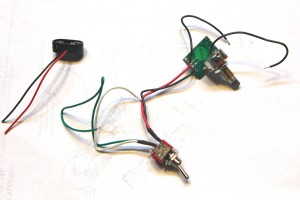
This time around, I used a pre-made booster circuit, a little-known Seymour Duncan gizmo called the Firestorm, which has appeared as an onboard booster in some Jackson guitars. It’s the same circuit found in Duncan’s Pickup Booster pedal, minus the resonance switch. It’s a great-sounding circuit that strikes a nice balance between brightness and fatness. I had a hunch it would sound perfect in the lipstick-tube Strat, preserving the cool high-end content, but adding the extra oomph that, to my ear, is necessary to make the lipstick tubes really sing.
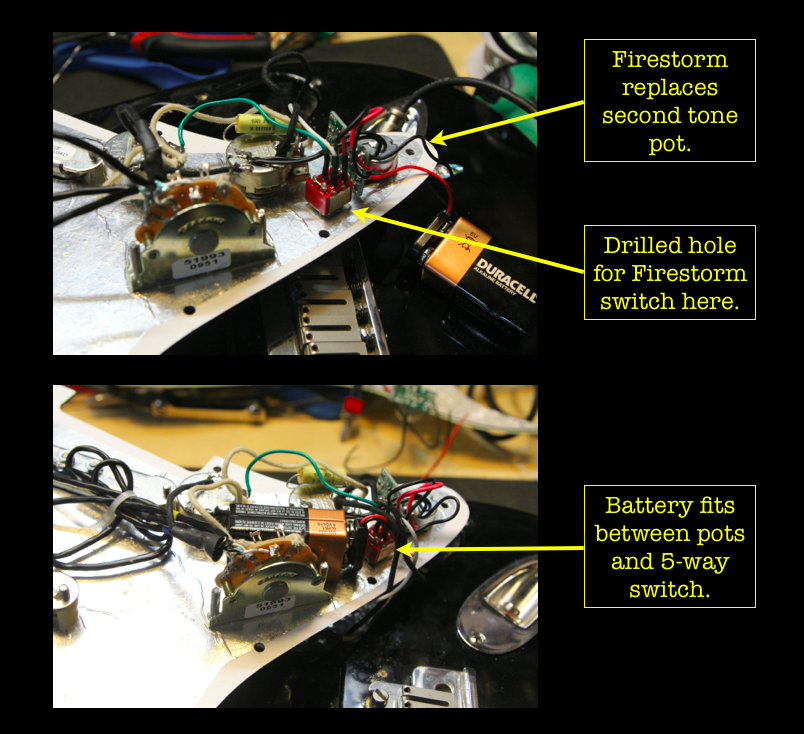
In the Gretsch installation, the booster didn’t include a gain control — I simple connected it to a push/pull pot, and set the level with the guitar’s volume pot. But the Firestorm includes its own dedicated gain control, plus an activation switch. I could have desoldered the device and installed it as before. Instead, I rewired the Strat for single volume/single tone (come on — does anybody really use both tone knobs on a Strat?) and replaced one of the tone pots with the Firestorm.
Take a tip from someone who learned the hard way: Verify that you have room inside the guitar for the components and a 9v battery before embarking on a project like this. Luckily, you can tuck the battery between the 5-way switch and the pots on a standard Strat.
The soldering was easy. The only tricky bit was drilling a hole for the switch. You can’t remove a misplaced pickguard hole! If you screw up — well, that’s another great thing about stickers.
Dang, I love the results! The booster highlights the pickup’s treble sparkle, and there’s enough gain on tap to get yourself in serious trouble. I think it’s the liveliest, most expressive lipstick-tube guitar I’ve ever played.
The Les Paul was an entirely different project. Unlike the lipstick tube Strat, ears didn’t tell me that its pickups needed a boost to sound their best — these Seth Lovers sound pretty awesome just as is.
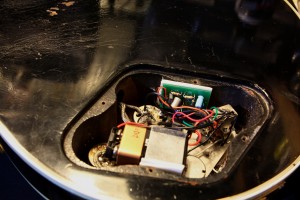
But since I pretty much can’t pick up a Les Paul without longing for a Rangemaster-style germanium boost, I resolved to always have one of those dirty-yet-dynamic overdrives within reach. I used the same method as with the Gretsch baritone: I replaced a tone pot with a push/pull, and placed the booster last in the circuit before the output jack. Next time, though, I think I’ll nix a tone pot add a dedicated gain control. (Come on — does anybody really use both tone knobs on a Paul?) 
Is the time, money and effort justified, when you can get many of the same sounds via stompbox? I’d say yes if you a) like to manipulate gain controls while you play, and b) are confident you’ve found the perfect booster for a particular guitar. Anyway, I’m having a blast with these amped-up axes!
So — has anyone else ventured down this slippery slope picturesque highway?


Leave a Reply