
Weird, isn’t it? You can explain the rules of thumb for ordering your guitar effects in about ten seconds, but you can still get stumped after years of experimentation.
You probably know the conventional effect-order advice, which goes something like this (in order of appearance):
- Distortion effects (fuzzes, distortion, overdrives)
- Modulation effects (phasers, flangers, vibratos, tremolos)
- Delay effects (digital or analog delays)
- Reverbs (analog or digital)
And that’s good advice, as far is it goes. But you don’t have to dig very deep before encountering alternatives, exceptions, and arrangements that make no sense whatsoever, but still sound great.
How, for example, do you deal with the following?
- Dynamic effects (compressors, envelope modifiers, etc.). They usually go first — though a compressor sometimes sounds best at the end of the signal chain, mimicking a mixing desk signal flow, adding mass and smoothing your overall sound. (Though best is probably first if you want to shape the envelope of your tone with, for example, minimized note attack and increased sustain).
- Pitch effects (Whammy pedals, octave pedals, etc.). They usually go first — though sometimes they track better after compressors.
- Filter effects (wahs, auto-wahs, envelope filters, etc.). Before distortion, they subtly alter your tone. After distortion, they radically alter it. Wah before fuzz is great for a throaty, Hendrix-style sound, but wah after fuzz can create an edgy, super-resonant squawk that’ll slice through concrete.
- Noise gates. Conventional wisdom says to put ’em last — but they often sound best at the front of your effect chain. They may not silence your signal as completely that way, but they often feel better, with delays and reverbs decaying more organically. (Try it yourself and see!)
And then there are the endless exceptions: You might, for example, place tremolo and vibrato pedals after reverb to mimic, say, Fender blackface or Magnatone combo amps, which modulate the reverb sound rather than reverberate the modulated sound.
Another example: Boosters often work best at the front of your effect chain, but sometimes placing one last in line provides a consistent solo-level volume boost, regardless of which pedals are engaged. (I’ve been doing this a lot lately for live performance pedalboard setups.)
And all those über-cool retro effects add more wrinkles. Vintage-style Fuzz Faces, for example, sound thin and nasty when preceded by a buffer — and there are buffers in many mass-produced stompboxes, especially the Japanese ones, so brace for disappointment if you situate a Fuzz Face after a Tube Screamer.
Here’s a case study, from my friend Linda B., of all-female sex Pistols cover band fame. She asked for a recommended effect order, and I said, no problem.
But it was a big problem!
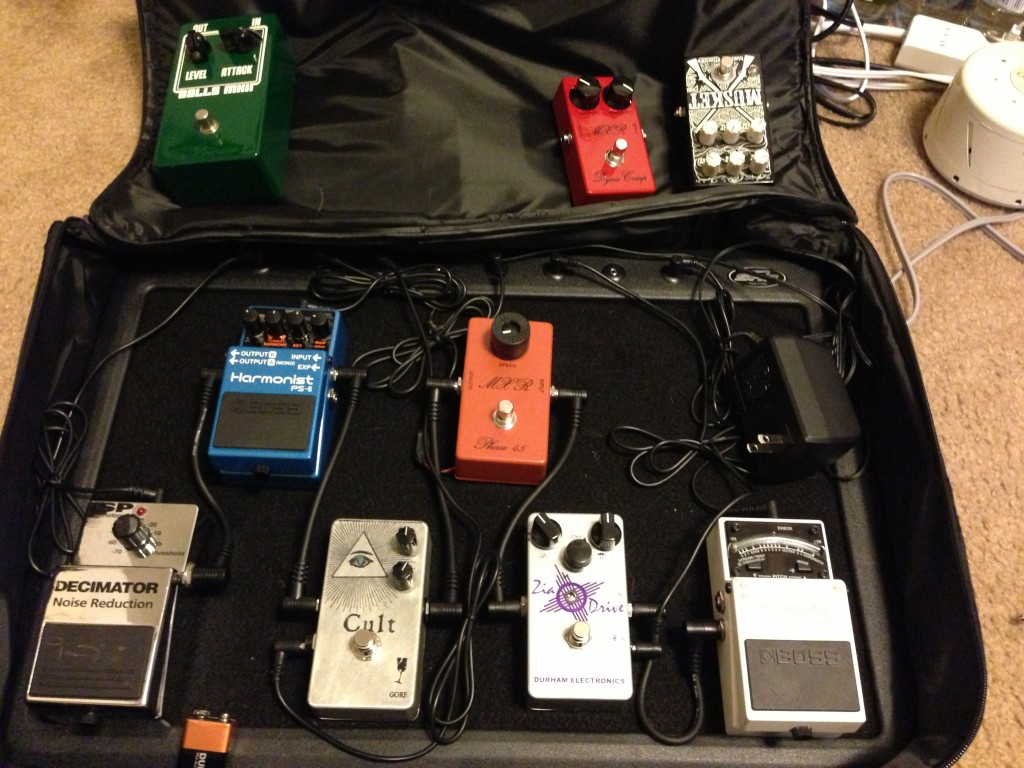
What to make of that? Linda says the MKII clone sounds like crap after most other pedals, so I think she’s going to put it on a separate effect loop with no other pedals. (Remember, original MKII users in the ’60s would have used it alone, or maybe with one or two other boxes.) I know from experience that Rangemaster-style boosters, like the Cult and this site’s Fiendmaster project, usually sound better before clean boost rather than after, though I have no idea why. It rapidly starts sounding like one of those logic puzzles involving boats, grain, and hungry animals.
So my advice for Linda is basically, try every option and use whatever sounds the least crappy. And that’s my advice for you too.
Also, you might be astonished by some of the things that shouldn’t work at all, but occasionally do, like distortion after reverb. Some players have deployed counter-intuitive effect chains to great effect (the Radiohead guys spring to mind). And if you’re working in the digital realm, the sky’s the limit. For better or worse, the vast majority of my digital patches mimic traditional analog signal paths, but that may be more about my lack of imagination. Auditioning crazy effect sequences in software such a Logic, Guitar Rig, and AmpliTube is definitely a great way to brainstorm offbeat ideas. But don’t be surprised if your kooky creations don’t translate back to the analog world. After all, many of the above-mentioned kinks (like The Great Fuzz Face Crap-Out) have to do with impedance issues not encountered in the digital realm.
Anyway, I’d love it if you shared some of your hard-one effect-order techniques — especially ones that deviate from the norm. Got any great-sounding secret recipes? Terrible combinations to be avoided at all costs? Stuff that sounds horrible, but still kind of cool? Please share your signal-chain pain!


Leave a Reply