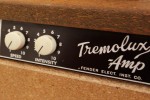
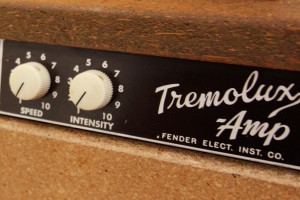
You see a lot of chatter online about the differences between the tremolo circuit Fender used in its early-’60s “brownface” amps and the trem circuit that replaced it in the mid-decade “blackface” models. (Just Google “brownface blackface tremolo” to see what I mean.) The prevailing sentiment seems to be that the brownface version is the ultimate Fender trem—or so you’d conclude, judging by all the boutique amps and pedals offering the brownface version of the effect.
The way I’ve always heard it explained, the brownfaces created the effect by splitting the input signal, running one half through a high-pass filter and the other through a low-pass, and then recombining and modulating the two signals. Fender dubbed this circuit “harmonic vibrato.” Blackfaces, on the other hand, use a photocell and an oscillating lamp to create the effect, known as optical, or “opto” trem. Meanwhile, some small amps of the era, notably the Champs, continued to employ the tube-biasing trem found on some pre-brownface amps.
UPDATE, 09.02.11: As astute reader WB points out, the Tremolux demoed here is NOT an example of the “harmonic vibrato” circuit, but an even rarer Fender freak, an output-bias trem circuit:
The Super Reverb has optical tremolo, the Champ has preamp tube bias trem, and the Tremolux has output bias term. The “Harmonic Vibrato” is very different and sounds somewhere in between tremolo, a phaser, and a Univibe – this clip has a pretty good demo of a slow-ish setting : https://youtu.be/Rnva4acvQsw
Brownface twins, Showman, Bandmaster, Concert, Vibrasonic, Super and Pro amps had it, but Tremoluxes didn’t. From what I’ve been told, it’s a fairly complicated circuit that uses two and a half to three tubes for the tremolo alone. (there are different versions of it to complicate matters further!)
I’m not a tech btw, don’t know a volt from a watt, I’m just a Bo Diddley obsessed geek who loves all things tremolo and vibrato, haha!
Check out that link — wow, it really does sound different. Then thing is, I’m not sure I like it all that much, though I’d want to play with the intensity control to see what it sounds like at lower settings. There’s something a little seasick about the pitch modulation—and this is coming from a dude (me) who owns four Magnatone amps!
So what do you guys think?
Adding to the confusion is the fact that Fender always called the trem circuit “vibrato.” Technically, vibrato refers to a pitch-change effect, while tremolo refers to a change in volume, so most Fender vibrato circuits are actually tremolos. Magnatone amps are famed for their true vibrato effect, a lovely little wobble with definite changes in pitch. Supposedly, brownface trems have a bit of this true vibrato quality as well.
I say “supposedly,” even though I’ve used vintage Fenders of all types. They all sound fab to me. When I play, I just think, “Mmm, yummy Fender term,” rather than, “Hmm . . . I think I detect a slight variance in pitch in addition to the usual amplitude modulation.”
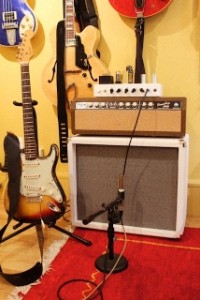
But since I happened to have specimens of all three types here in my studio right now, I recorded a quick comparison. For the brownface sound, I used an original ’62 Tremolux. The bias sound is a kit-built clone of a bias-trem Vibro-Champ. And for opto-trem, I used a silverface Super Reverb—not quite a blackface, but I’ve played it side-by-side with blackface Supers I’ve owned, and the effect is identical.
To level the sonic playing field, I recorded a guitar phrase into Logic Pro, and then used a ReAmp to pump it through the three amps. I recorded all the examples with the same mic—a Royer R-121—and connected each of the amps to the same speaker cabinet with a single 12” Celestion Alnico Blue.
Feeling brave enough for a blind-listening test? Then meet our lovely contestants! (Answers below. The honor system is in effect.)
Tremolo A
Tremolo B
Tremolo C
Careful about drawing too many conclusions from this. Vintage amps vary a lot from specimen to specimen. But to my ear, these are pretty good representatives of each type.
So which do you like best? I’m more drawn to Trem A and Trem C than to Trem B. They both have the dreamy, “lose yourself in it” quality I love in tremolo. Trem B seems a bit more two-dimensional, though hey, I’d still be happy to use that sound anytime. But I can’t say I’m hearing a lot of phase-shifting or true vibrato from any of the amps. Well, I can make myself hear those things if I instruct myself to, but really, the results just strike me as three nice tremolos in varying grades of juiciness. And the juiciest for me is Trem C, my fave.
Who’s who? Trem A is the Vibro-Champ with bias trem. Trem B is the Super Reverb with Opto Trem. And Trem C is the Tremolux with “harmonic vibrato.” So I guess I agree with the notion that there really is something magical about brownface trem!
So what are some of your favorite ways to wiggle?


Leave a Reply