It’s hard to discuss the Beatles without summoning their shadow: the Stones. Since posting last week about Randy Bachman solving the mystery of the “Hard Day’s Night” chord, I can’t stop thinking about another 1960s conundrum: Who played the solo on “Sympathy for the Devil?”
There’s one key reason why so many listeners suspect that it wasn’t Keith Richards: It simply doesn’t sound like anything else he ever recorded, and certainly nothing like his solos on the many live versions of the song.
A couple of years ago a wrote a short piece on the solo for a “100 greatest guitar solos” anthology. Sadly, the project remains unpublished for legal reasons — a pity, since it boasted contributions from many great guitar-centric music writers. But I’m rather relieved my piece never appeared, since I argued that Keith did in fact play the solo. Now I suspect the opposite. Here’s what I wrote:
June, 1968. France was in turmoil. US troops were reeling from the Tet offensive. MLK was two months in the grave, and RFK was still lying in state. And the Rolling Stones were in London’s Olympic studios, struggling to complete “Sympathy for the Devil,” the greatest track on Beggar’s Banquet, perhaps their greatest album.
The notion that this song features Keith Richards’ finest solo should be beyond dispute. But few tunes have accrued as much extramusical mythology as “Sympathy.” Rumors abound: Some believe Jimmy Page played the solo. (He does in fact appear on some early Stones sides.). No, insist rival conspiracy theorists—it’s Roy Buchanan. (The Stones briefly courted Buchanan as a replacement for drug-sodden Brian Jones, who contributed only tepidly to Beggar’s Banquet.) And let’s not get into the silliness the Stones inspired by flirting with satanic imagery, a situation exacerbated the following year by Jones’s drowning death and the group’s disastrous Altamont concert. (Besides drawing on headlines of the day—literally—Mick Jagger’s “Sympathy” lyrics were inspired by Mikhail Bulgakov’s Stalin-era comic novel, The Master and Margarita, whose Professor Woland is the sort of Satan who’d at least brighten your cocktail party before laying your soul to waste.)
The Stones’ own accounts of the “Sympathy” sessions are jumbled and contradictory. Even the fact that Jean-Luc effin’ Godard filmed the proceedings does little to dispel the murk. In fact, the resulting film, Sympathy for the Devil (AKA One on One) is a triumph of murk, alternating Stones footage with polemical theatrics—and inevitably cutting away from the studio at precisely the wrong moment.
Even in strictly musical terms, it’s easy to see why the solo has inspired so much bunk speculation. For starters, it sounds like nothing Richards recorded before or since. (Keith rarely plays extroverted solos, preferring to pilot the groove via subtle rhythmic punctuation.) And there are few precedents, from Keith or anyone else, for the “Sympathy” solo’s infamously corrosive timbre. It’s not so much nails on a chalkboard as a nail bomb demolishing a chalkboard factory. Ironically, it’s a tone that countless guitarists have taken pains to avoid. If a journeyman player deployed such tweeter-shredding treble at a bar gig, he’d clear the house and have his beer coupons revoked. There’s nastiness of every sort on Beggar’s Banquet, but nothing nastier than Keith’s caustic assault. It’s one of the angriest solos ever recorded.
Richards had plenty to be angry about, and not just a world in chaos. The Stones’ previous release was the poorly received Their Satanic Majesties Request. (The Beatles’ Sgt. Pepper may have been a razor-sharp response to the Beach Boys’ wigged-out Pet Sounds, but Satanic Majesties was a loose and rambling reply to Pepper.) Part of the problem with Majesties, the Stones’ deepest foray into psychedelia, was that Jagger, Richards, and Jones had been forced to record it while shuttling between studio, court, and jail as they battled drug charges. When it came time to record Beggar’s Banquet, the band adopted a tougher, more blues-infused approach. The lyrics were tougher too—while the Beatles sang of love and mystery tours, the Stones grappled with violence, class conflict, and 15-year-old groupies.
Yet there was still some Satanic Majesties-style experimentation. (Example: Keith jettisoned conventional recording wisdom by tracking “Street Fighting Man” through a cheapo cassette recorder’s preamp.) Footage of the “Sympathy” sessions reveals a laborious evolution from limp acoustic ballad to apocalyptic masterpiece. Much of the struggle had to do with creating the right rhythm-section arrangement. The song commenced as as a leaden pseudo-samba with churchy organ chords, but blossomed into a fiery Afro-jam thanks to the conga work of Ghanaian percussionist Kwashi “Rocky Dijon” Dzidzornu. Richards played a Fender Precision bass on the basic tracks, with Stones bassist Bill Wyman relegated to rattling an axatse (a West African shaker).
Richards recorded his solo as an overdub, and it sounds like one. Dry and painfully present, it doesn’t “sit with the track,” as good little overdubs are supposed to do, but springs from it like a cobra exiting a basket. The brittle tone makes many suspect Richards plays a Fender Telecaster on its bridge pickup, but he’s most likely using a three-pickup ’57 Les Paul Custom. The Custom is generally viewed as a warm-sounding instrument, but it can be bright in some circumstances—such as playing it through a treble-boost pedal, as Richards almost certainly does here. (Richards was an early stompbox devotee, having immortalized the raspy buzz of the Maestro Fuzz-Tone on “Satisfaction” in 1965.) By the late ’60s, pretty much the entire Brit guitar pantheon was using treble-boosters such as the Dallas Rangemaster, which is probably the device heard on “Sympathy.” Unlike latter-day distortion pedals that boost frequencies across the tonal spectrum, treble-boosters attack tone from the top down, introducing a massive gain increase that emphasizes highs as it pummels a guitar amp’s preamp tubes into overdriven submission. In this case, the victim amp is probably one of two Voxes visible in the studio footage: a classic AC-30 or a newfangled solid-state Supreme. Producer Jimmy Miller and engineer Glyn Johns may have tweaked the tone further at the mixing board.
The guitar tone isn’t the only shocker—Richards’ spasmodic phrasing is equally jarring. His opening lick erupts like projectile vomit. He compounds the offense by playing it again. Many of the solo’s phrases unfold like that—a few coarse syllables, repeated, repeated, and then gradually extended, like some bitter soul refining the perfect put-down beneath his breath.
The solo resumes after the song’s final chorus, as Richards regurgitates variations of his earlier licks. Between phrases he marks time with percussive glissandos that sound for all the world like a smoker expectorating phlegm. (Sorry to keep grossing you out, but if you’re going to pollute your soul with devil music, don’t expect politesse or taste.)
Richards’ note choices and articulations allude to such Chicago-based blues players as Freddie King and Buddy Guy, but the crude, asymmetrical phrasing is breathtakingly original. Elsewhere on Beggar’s Banquet, Jagger and Richards pillage the blues. (They recorded Robert Wilkins’ 1929 classic “That’s No Way To Get Along,” renamed it “Prodigal Son,” and claimed authorship, at least until their plagiarism was exposed.) But on “Sympathy,” Richards stands as a bona-fide blues original.
So did Keith create his most stunning and singular solo by tapping the source of eternal wickedness? Or did he just happen to dial up an exceptionally wicked tone on his stompbox one night? I’m going with the second theory. But if the Stones were unconvincing antichrists, they made damn good antibeatles.
What changed my mind? Listening to isolated tracks from the Stones’ “Gimme Shelter,” which have been leaked online in recent years.
audio clipWhen I wrote the original article, I listened, read, analyzed, read, and listened some more. I came to an “Occam’s Razor” conclusion: The notion that somehow, Keith tapped into a unique energy at a unique time seemed a likelier explanation than any of the alternatives.
But when I heard Keith’s “Shelter” parts soloed, I had an instant gut reaction: It’s not the same hands that played “Sympathy.”
“Shelter” sounds cut from the same cloth as everything else Keith’s recorded over the last half-century. “Sympathy” is . . . something else. The phrasing, the fingering, intonation, and vibrato just don’t match.
Two things I should add: I have absolutely no inside knowledge about what transpired at that epic 1968 session. This is strictly about subjective listening. Furthermore, were we to learn definitively that Keith did not play the “Sympathy” solo, it wouldn’t tarnish my fandom in the slightest. Most of the great ’60s bands — or at least their producers — had no qualms about bringing in pinch hitters if it meant a better track. (McGuinn was the only Byrd permitted to play on the band’s first disc, and think of all the great, uncredited musicians who enlivened the Beatles’ albums.)
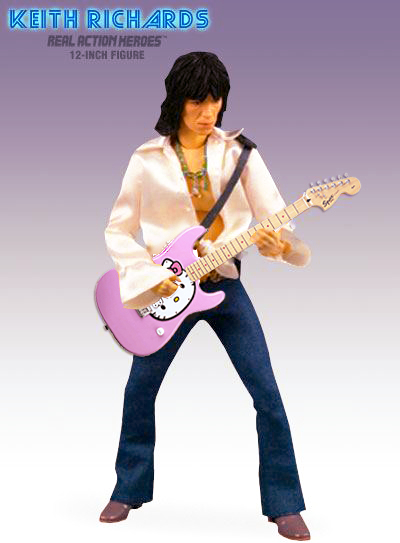
When I was in London on tour with Tracy Chapman a couple of years ago, I kept running into Keith and his bodyguard in the stairways and elevators of the Knightsbridge hotel where we were staying. He looked . . . sort of magnificent: bright-eyed and dashing in a craggy, eccentric- country-squire sort of way. Naturally, I was way too chicken to say anything, even though friends who’ve met him all say he’s charming, and I had a decent opening line. (“Hey — we’ve both played with Waits!”) I guess Keith will always be a superhuman action figure to me, no matter who played certain solos. 
If you force me to guess who the “Sympathy” soloist is, I’m going to have to go with Page. Ask in six months, and I may have a different answer.
So what do you think?


Leave a Reply