
What’s your favorite guitar mod? The kind that changes how you play. One you’ve become so accustomed to that you wince when you pick up an axe that lacks it?
I’ll choose pickup wiring mods as a starting point: During the year that Seymour Duncan sponsored tonefiend.com, I devoted many posts to the under-appreciated wiring schemes I found in the company’s wiring diagram database. Some faves:
- “Vintage” Les Paul wiring
- “Broadcaster blend” Tele wiring
- “Nashville-style” Tele wiring in both Teles and Strats
…and of course, the suicidal soldering mission known as the Pagey Project.
I’ve still got the “advanced” version of the Pagey wiring in my nothing-special beater Les Paul, and I like it so much, I want to fix up the guitar so it feels as nice as it sounds.
But of all the wiring experiments I tried, my absolute favorite is one that doesn’t appear in the Duncan archives: the so-called “PTB” tone control (for “passive treble and bass”). It’s a cliché to call a neglected idea “ahead of its time,” but in this case, it happens to be true. Being able to roll off lows as well as highs is unbelievably useful when sculpting sounds. It makes me want to run into the nearest Bain Capital Guitar Center, grab players by the collar, and shout, “You need to know about this!” (But I probably won’t, ’cause G.C. customers aren’t accustomed to receiving that sort of personal attention, and I wouldn’t want to freak them out.)
Allow me to repost last year’s video, demonstrating the circuit in action:
Over a year later, I remain totally addicted to this circuit, and I recommend it to anyone who doesn’t require a guitar with independent volume controls per pickup. (Everyone, basically.) It seems especially relevant for drop-tuned and 7-string metal players who realize you must sometimes cut a little bass to keep the lowest register tight and articulate. And the circuit is a godsend when used with bass-heavy fuzz pedals (such as vintage-style Fuzz Faces). In fact, I’ve even been building the circuit into the front end of certain loud fuzz pedals for use with guitars lacking this magnificent mod.
But I remembered something interesting this week when I opened up the Hamer 20th Anniversary guitar used in the video:
I cheated! I didn’t have the requisite “C-type” reverse-log 1M pot needed for the bass control, so I substituted a “B-type” linear 500K pot, the same part used for standard Les Paul tone controls. You don’t need to know much about electronics to suspect that changing the part alters the range and response of the control. But as you can hear, it still performs well.
This time, I replaced the B500K with a C1M. For years, reverse-log pots were practically unobtainable, though that’s no longer true thanks to vendors such as Mammoth. But as you can see in my incriminating control cavity pic, I had to use a small format, 16mm pot rather than a proper 24mm one, and the shaft is barely long enough to attach securely. (I’m not even sure if you can get a 24mm reverse-log 1M pot — anyone?) I would have made a new video, but the fact is, it doesn’t sound terrible different — it’s more of a feel thing.
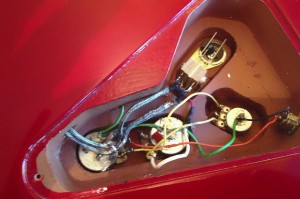
With the proper reverse-log pot, the bass frequencies taper off more gradually as you roll back the pot. With the B500K, the action is more jerky and less musical. But since I happen to be somewhat jerky and unmusical, I may well go back to the substitute value as heard in the video above. The point is, don’t let the hard-to-find part derail you. This mod works great with a common B500K pot.
The schematic — originally provided by reader JH — and my wiring diagram appear here. One important detail: If you wire a guitar exactly as I’ve diagramed, the bass pot will siphon off bass as you rotate it clockwise, with maximum bass in the full counter-clockwise position. (The treble control, as usual, transmits maximum treble in the fully clockwise position.) If you’d like to have maximum bass with the pot fully clockwise, swap the connections between the outermost lugs of the bass pot. Actually, you can do that anytime a pot’s motion is the opposite of what you want — just swap the connection between lug 1 and lug 3.
Anyway, that’s my favorite guitar mod, the one I can’t believe isn’t more widely known and used. So how about you? What’s your favorite mod? It doesn’t have to wiring — it can be hardware, setup, whatever. Just hurry up and post it to comments before I run screaming through Guitar Center.


Leave a Reply