Stay One Step Ahead with the Best Payment Methods for Online Casino Bonuses
When it comes to online gambling, finding the best MuchBetter casino sites can make all the difference in your gaming experience. MuchBetter is an innovative payment solution that allows players to make fast and secure transactions. With its seamless integration and user-friendly interface, this e-wallet has gained popularity among online casino enthusiasts. Whether you are a seasoned player or new to online gambling, choosing a MuchBetter casino can provide you with a convenient and enjoyable gaming experience.
One of the top MuchBetter casino sites is https://csiss.org/deposit-methods/muchbetter/. This online casino has embraced MuchBetter as a preferred payment method, ensuring that players can easily deposit and withdraw funds. CSISS offers a wide selection of casino games, including slots, table games, and live dealer options. With its user-friendly website and mobile app, players can enjoy their favorite casino games on the go. The casino also boasts a generous welcome bonus and regular promotions, ensuring that players have ample opportunities to boost their bankroll.
Another excellent MuchBetter casino option is csiss. Known for its extensive game selection, this online casino caters to players of all preferences. From classic slots to progressive jackpots and live casino games, there is something for everyone at CSISS. The site also features a sleek and modern design that allows for easy navigation, making it a pleasure to explore the wide range of games. With its integration of MuchBetter as a payment option, players can enjoy swift and secure transactions, ensuring that their gaming experience is hassle-free.
In conclusion, selecting the best MuchBetter casino sites can greatly enhance your online gambling experience. Not only does MuchBetter provide a convenient and secure payment solution, but it also allows for seamless integration with top online casinos like csiss.org. With its extensive game selection, user-friendly interface, and generous promotions, [CSISS] is an excellent choice for players looking for a top-notch gaming experience. So, why not give MuchBetter a try and enjoy the benefits it brings to your casino gaming?
When it comes to online gambling in Austria, one of the most important factors to consider is the withdrawal process. Players want to ensure that they can access their winnings quickly and conveniently. That`s why the best online casino instant withdrawal in Austria is in high demand among avid gamblers. One platform that stands out in this regard is https://online-casino-osterreich.org/sofort/. With its seamless and efficient withdrawal system, players can enjoy their winnings instantly.
One of the key reasons why this online casino is considered the best for instant withdrawals is its partnership with reputable payment providers. They offer a wide range of options, including popular e-wallets such as Skrill and Neteller, as well as traditional bank transfers. This means that players can choose the method that suits them best and receive their funds without any unnecessary delays. Additionally, the casino`s user-friendly interface and intuitive navigation contribute to a smooth withdrawal process.
Moreover, this platform also prioritizes security and fairness. It holds a valid gambling license, ensuring that players` transactions and personal information are protected. Furthermore, it provides a wide selection of high-quality games from renowned software providers, guaranteeing a fair gaming experience. Whether you prefer slots, table games, or live dealer options, this online casino has something to cater to every player`s taste.
In conclusion, if you`re looking for the best online casino with instant withdrawal options in Austria, online-casino-osterreichis the ideal choice. Its partnership with reputable payment providers, commitment to security and fairness, and extensive game selection make it a top-notch platform for any passionate gambler. Experience a seamless and convenient withdrawal process today by visiting their website.
When it comes to online casinos, one of the most important aspects for players is the availability of secure and convenient payment methods. This is where ecoPayz casinos online truly shine. As one of the best providers in the industry, ecoPayz ensures that players can enjoy a seamless and hassle-free gaming experience while keeping their financial information safe. With its user-friendly interface and widespread acceptance, ecoPayz is a preferred choice among online casino enthusiasts.
One of the top ecoPayz casinos online is https://online-casino-schweiz.org/ecopayz/. This casino not only offers a wide range of exciting games and lucrative bonuses but also provides the option to use ecoPayz for deposits and withdrawals. With just a few clicks, players can easily transfer funds, ensuring a smooth and efficient gaming experience. Additionally, this casino prioritizes customer security, utilizing advanced encryption technology to protect sensitive financial details.
Another reputable ecoPayz casino is [Your Anchor Text]. With its sleek and modern design, this casino attracts players from all over the world. Thanks to its collaboration with ecoPayz, players can enjoy quick deposits and withdrawals without any additional fees. Moreover, the casino offers a generous welcome bonus and ongoing promotions to enhance the overall gaming experience. With its extensive collection of games and seamless integration with ecoPayz, this casino is a top choice for online gamblers.
In conclusion, ecoPayz casinos online are excellent options for players looking for a secure and convenient payment method. With widespread acceptance and a commitment to user safety, ecoPayz ensures that players can enjoy their favorite casino games without any worries. By choosing top ecoPayz casinos like [Your Anchor Text], players can enjoy a seamless gaming experience while benefiting from quick and hassle-free financial transactions.
After last week’s loudness experiments, and with the sonic carnage of NAMM just days away, I figured it was a good opportunity to dial down the decibels and share an interesting guitar/string combination I’ve been enjoying for a few months.
At $34 bucks a pop in the U.S., they’re blisteringly expensive, but they have a sound I’ve never encountered elsewhere. The result is the closest thing to a nylon-string sound I’ve heard from an ordinarily steel-stringed guitar.
I’ve had the same set on this guitar since May — they’re certainly long-lasting! Now I’m going to experiment with a few other options, but I wanted to document these before swapping them out.
Have a listen:
These strings fascinate me. They convert the guitar into what sounds like a hybrid nylon/steel-string instrument. They permit classical techniques such as rest-strokes, but when you bend them, they feel more like steel strings. The gauges are bizarre: .013 through .039. I’ve never played anything like them.
With these strings, my Martin is quieter than most classical guitars — more like the volume of Renaissance lute (an instrument I played a lot in my teens, though I haven’t owned one in many years). For me, this pairing has the same sort of sweet intimacy. This happens to be the one guitar I keep in my house — everything else is down in the studio. It’s quite literally a parlor instrument, and I’ve loved having a soft, quiet guitar to noodle on. It’s sometimes frustrating, though, how quickly these strings “overload” — the notes in the demo that snap and sizzle aren’t intentional — I’m just playing a little too hard.
I still consider this is a cool alternative classical sound, but after months of playing, I tend to think this combination would best suit a fingerstyle player who uses a lot of bending, smearing, and slapping. I bet Joseph Spence and Bert Jansch would have sounded great on these, as would Ry.
I may return to these extraordinary strings. Actually, in a perfect world, I’d have two lovely old Martins, one to strung conventionally, and the other strung with rope-cores. And since we’re talking “perfect world,” what the hell? Two pre-War Martins for everybody! No, make that three!
I just tried an interesting tone comparison, one I’ve never seen attempted. It concerns the search for loud amp sounds at low volumes.
Have any of you ever experimented with speaker attenuators — the passive load boxes that reside between your amp output and speaker input, which let you crank the amp while maintaining a low level from the speaker?
I’ve worked with one model before, a borrowed THD Hot Plate, and thought it performed well. I decided to purchase my own attenuator after several Premier Guitar reviews of large amps. As a small amp fan (not to mention an aging player with fragile ears), I wanted to minimize the aural assault of evaluating loud-ass amps.
But first, I wanted to determine whether it’s legit to evaluate amps at attenuated levels. Does attenuation inevitably alter the tone? And if so, can you compensate for via recording software?
Online opinions about attenuators range from “works like a charm!” to “totally killed my tone!” So I picked up a Swart Night Light and started recording and measuring. (I didn’t compare rival products. I just went with the Swart for its reasonable price, solid online reviews, and dual outputs for driving two cabs. I didn’t A/B it with a Hot Plate, though the results seem roughly similar.)
I direct-recorded a brief guitar phrase using my black Les Paul with Bigsby and PAFs, and then ran it through a ReAmp to my early ’60s Tremoverb, a 35-watt Fender with two 6L6 power tubes. I dimed the volume and left the EQ flat. Tt was insanely loud in my small studio. After recording that, I tracked the same clip again using the attenuator at each of its three settings. The lowest attenuation setting reduced the sound from insanely loud to very loud. Medium attenuation reduced to somewhat loud. Strong attenuation produced a sound quiet enough to speak over. I recorded the results through Royer R-121 ribbon mic. I added a touch of plate reverb, but no compression or EQ. (Though I did normalize the files so they played back at similar levels.) In other words, you hear the same clip four times through a head whose settings never vary.
So did the tone change? Have a listen:
Do you hear what I hear?
IMHO, none of the clips sound particularly great. (Most amps, including this one, don’t sound their best at 10.) But the unattenuated loud sound has some qualities the others examples lack. The attenuated clips have a little less low-mid impact, and the higher-register single notes that sound a bit thin and prickly even on the original sound even thinner and pricklier post-attenuation.
Why, since the amp settings don’t change, and the performance are identical? Mics can respond differently at different sound pressure levels, and the relatively restrained speaker movement alters the result as well. Conclusion: the timbres of the attenuated signals are fairly faithful to the original, but there are slight spectral differences and a bit less body/fatness, especially on single notes.
Aha! Now we know why no one has developed a cancer cure! It’s because young James Page took that skiffle thing a little too seriously.
Yep — it’s Jimmy Page at 13 in 1957. (He turned 70 this week.) Imagine how different the world would be had he followed his stated goal of becoming a cancer researcher. We’d probably have eliminated cancer 30 years ago, but our music would be a lot crappier.
As much as I love Pagey’s playing, I’ve long felt his greatest influence was as a producer. He defined what rock sounds like, largely via his unprecedented innovations in exploiting and manipulating reverberant spaces. Zep sounds like modern rock. Nothing before does.
Condescending BBC presenter: “What are you going to do when you leave school? Take up skiffle?”
Many years ago I was kicking that notion around with my friend Andrew Goodwin, the brilliant British media studies scholar. He expanded our ramblings into a journal paper, and gave me an entirely undeserved co-author credit. To this day, it’s my only academic publication. Andrew went on to create a Led Zeppelin course at the University of San Francisco. He was working on a Zep book when he died in a freak apartment fire a few month ago. I assume he was aware of this clip, though I’m not certain. He definitely would have loved it! I miss him.
What’s your favorite Pagey moment? I think mine is from one of those leaked studio outtakes, an excerpt from “Heartbreaker.” You hear the amp close-miked and claustrophobic-sounding. Then you hear it miked from a distance, spooky and reverberant. Then you hear both sounds together. Voilà — modern rock guitar.
My fave Pagey solo is — hehe — “Sympathy for the Devil.” Yeah — I still think he played that one.
Earlier this year I got to do a couple of shows with Marianne Faithfull, who prompted the song in the first place when she gave Mick a copy of Bulgalkov’s brilliant novel The Master and Margarita. We were talking about the song, so I figured it was my moment to finally solve the mystery.
“So who played the solo?” I asked.
She rolled her eyes and sighed. “I just knew you were going to ask me something idiotic like that.”
But not everyone is a resolution cynic. Check out the comments section below last year’s NYE post, and you’ll find a dozen entires from Josh Starmer, who pledged a year ago today to record an entire album, finishing one song per month.
Yup — he did it! You can read about his journey here.
Speaking of journeys: I emailed Josh to congratulate him, and he wrote back from frickin’ Cambodia on the day he was touring Angkor Wat.
Heck of a year, Josh!
I solicited words of wisdom. Josh’s reply:
For every one part challenging, it was 10 parts rewarding. Before I started, I’d never written a song before. I’d recorded little instrumental tunes, but nothing with words. I was pretty intimidated by lyrics early on, so I did what any awkward person would in such a circumstance, I sang about the weather. I then sent the song out to my closest friends and, over the months, their praise and complements kept me going, and their honest criticisms made me better. I’ll have an album out by mid-February.
Each month started out with one or two weeks of doubt and freak out. It didn’t matter how good an idea I had about what I wanted to record, it always seemed impossible. But, like everything, it was just a matter of starting, pressing record, and then putting the song together, piece by piece. The second two weeks of each month were always filled with immense pride as I watch the song materialize out of nothing. An idea in my head made real, and in many cases, better.
Along the way I developed a systematic method for singing in tune (which, sadly, is a different skill from playing any other instrument in tune), and I’m going to write about that as soon as I can. There’s a lot of bad advice out there on the internet, and I think what I came up with works really well.
Oh, and perhaps the most important thing – I can’t say enough about how cool it’s been to take an seemingly impossible task and just chip away at it each month in a disciplined way. I’ve found myself encouraging everyone I meet to do a similar thing – be it sewing a quilt, or writing short stories, etc…
How cool is that?
Anyone up for the “Starmer Challenge” in 2014? Or are you goals more modest? Or more grandiose? Please — confide your hopes and dreams for 2014 so that one year from today we can all join together to laugh at your failure toast your amazing accomplishments!
So what are my 2014 resolutions? Easy — same as 2013! :satansmoking:
Somewhere far, far away, all NYE resolutions come true.
It’s a holiday miracle! The 30-minute Bigsby tremolo installation.
Sometimes it pays to write for a guitar magazine!
My old pal and Premier Guitar colleague Andy Ellis hipped me to the Vibramate, an adapter that allows you to install a Bigsby tremolo on many types of guitars with no drilling or other permanent modifications to your instrument.
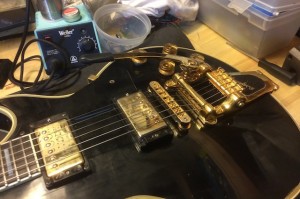
A Bigsby and Vibramate were a centerpiece of a cool makeover project the magazine concocted, transforming a beat-up ’70s Epiphone in a bitchin’ Bigsby-bedecked bombshell. Inspired, I decided to give myself the shakes for Xmas. I bought a Bigsby B7 and corresponding Vibramate kit and popped them onto my long-suffering Les Paul. Check it out:
Yup, this is the much abused ’82 Les Paul that I’ve used in many tonefiend experiments, especially the OCD-approved Pagey Project. What a journey this guitar has been on! Never a big Les Paul fan, I picked up the cheapest old one I could find because I needed it as a reference for the sound design work I was doing for Apple. Trust me — it was a thoroughly unremarkable instrument. But then I started playing with pickups … and alternate wirings … and replacement hardware … and after several years of hacking, I have an instrument I love.
Pity about the gold hardware though — I should have switched to chrome early on. It’s the downside, I suppose, of incremental makeovers. By the time I got to the Bigsby, I had to cough up extra cabbage for the vulgar finish. (My wife recoiled when she saw the Bigsby box on the counter: “Eww — what’s this gold thing?”)
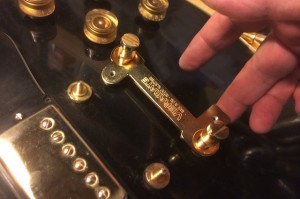
The Vibramate bracket screws into the existing tailpiece bushings.
I’m no Bigsby expert. I’ve never owned a Bigsby-fitted guitar (though I’ve had a couple of long-term loan). It’s odd, because I like how they perform, look, and feel, and “bling cringe” aside, I love it on this guitar. It definitely changes the tone — though in spectacularly unscientific fashion, I replaced the previous roundwound strings with flatwounds while doing the installation, and it’s tricky to sort out which changes are exclusively related to that hardware, and which to the strings. The guitar feels brighter and more resonant. (I’m reminded of Ry Cooder’s dictum: The more springs you add to a guitar, the livelier the acoustic response.) The treble response is WAY different — I needed to lower the treble sides of the pickups to offset the face-slapping response of the high E string.
I’ve bored everyone to tears with my incessant testimonials to the glory of great flatwound strings. This guitar has never worn flats — I’ve kept it in roundwounds for writing product reviews, and for sessions where I specifically need a roundwound sound. But I’m loving the way they sound and feel here, so I guess I’ll have to select another Gibson-flavored guitar as a dedicated roundwound instrument.
The installation was a breeze. The quality of materials is superb. I also added Vibramate’s String Spoiler, a clever little bracket that clips onto the tiny nubbins that usually secure strings to a Bigsby. The Spoiler makes string changes way easier. I’m deeply impressed by the Vibramate products — even in frickin’ gold.
Oh — the demo tune is the late John Barry’s wonderful Midnight Cowboy theme. Berry wasn’t a guitarist, but he contributed so much to the guitar vocabulary through his scores, especially for the early James Bond films. I was privileged to interview Barry for Guitar Player back in the ’90s. What a cool and brilliant musician!

Just in time for the single-coil holiday season: my comparison review of 16 humbucker-sized P-90 pickups is live at Premier Guitar. This heartwarming holiday fun-fest has it all: Mouth-watering adjectives. Freshly baked audio clips. Irate manufacturers. Don’t miss it!
This was a fun, if challenging project. Comparison pickup reviews are such cans of worms! Not only are they sadistically labor-intensive, but the differences between one pickup and the next are easily overshadowed by other variables in the tone chain.
After much thought about how to create meaningful comparisons, we came up with an intriguing process: I tested all the pickups in the same guitar, with identical setups, and ReAmped them through the same combo amps with identical recording settings. If this were an amp or pedal review, I would have used the same performances throughout, but of course, each example had to be played anew with each pickup, so I spent much time matching performances to guard against misleading variations in touch and intensity. It’s not a perfect solution, but better than most, and in the end quite revealing.
And what did it reveal, exactly? You’ll find out at the link. Beyond that, I can report that:
All the products sounded pretty good.
They sounded more similar than you might expect.
I’m gonna find me a guitar to house a set of my favorites — though I’m not sure which ones are my faves! Really, they’re close enough that, say, the tone of a particular body wood alone would be enough to sway the decision. It’s not so much a case of “better or worse” as “brighter or darker” and “louder or quieter.”
As mentioned in the article, there’s no “gold standard” of P-90 tone — or rather, every P-90 lover has his or her own standard. Gibson’s ’50s original are notoriously inconsistent in their output, even their magnet type. Plus, the mere fact that you’re winding coils around a narrow, tall humbucker bobbin rather than a wide, low P-90 one has sonic implications. So I tend to think of this entire pickup category as either “single-coils that are ballsier than Fender single-coils,” or, in the case of hum-canceling models, “humbuckers with brighter highs and clearer mids.” (Or as my ol’ pal Steve Blucher from DiMarzio calls them, “humbuckers that hum.”)
Funny thing: I love P-90s, but don’t own any guitars fitted with them. Not yet. :satansmoking:
So talk to me about P-90s! Your faves? Beloved P-90 guitars? Fave P-90 players and performances?
I’m thrilled to bits about a show I’m playing Thursday eve in San Francisco featuring two guitarists of impeccable skill and taste, plus me.
Teja Gerken and I are co-hosting a monthly solo guitar night at El Rio, my groovy neighborhood dive.Our guest is the amazing Eric Skye who, among other things, plays gorgeous solo guitar versions of classic Miles Davis tunes. If you happen to be in cold, cold San Francisco this week, stop by and say hi!
I’ve been doing the digital looping thing with Mental 99 for a few years now, and man, trying to work out solo arrangements with live-looped MIDI drums has been seriously humbling. You know all those jokes we love about how drummers speed up, slow down, drool, and generally disappoint? I can do all those things and everything else a drummer does, except occasionally play a competent groove. Some of the problems have to do with MIDI tracking in general, and some are simply general suckage. Man, it sure makes me appreciate my brilliant musical partner Dawn Richardson, who never speeds up and drools only rarely.
But those who can’t, teach. So I whipped up a little tutorial on playing drums with MIDI guitar. The first half covers the moves, and the second half features a live improv based on my fave afrobeat pattern. (Tony Allen is my rhythm god.) It also includes some of the hybird synth/guitar sounds I’ve been exploring, like double single-not lines an octave lower, mixing trashy guitar and trashy organ, and of course, space pigeons. (I stole the organ line from my pal Robin Balliger.)
In other news: I’ve been speaking to the ultra-knowledgable Rob Hull from Tube Depot about creating a minimalist DIY amp kit inspired by our conversations here. Lots more details to come. Tube Depot has a track record of making real nice amp kits, and Rob’s documentation/build instruction are the best in the biz. I reviewed their cool tweed Champ clone kit here.
It’s that time of year when we stop practicing, turn off the soldering irons, and pretend to relate to spend precious time with our loved ones. I’m off to Santa Fe for a visit with my wife’s family (it’s okay — they’re mostly musicians), and I’m especially looking forward to hanging out with my super-cool nephews. So please pardon this zero-effort post.
Reflexive snark aside, I’d like to thank all of you who have contributed your time, effort, musicality, and ingenuity to tonefiend since the last time I posted a poorly Photoshopped turkey image. If it weren’t for you, this site would be nothing more than a bunch of self-important pontification, instead of what it is: a bunch of self-important pontification leavened by your wit and wisdom.
Thanks, too, to you lurkers — I know you’re there! Truth be told, I’m a habitual lurker who rarely contributes to his favorite blogs, so I get where you’re coming from and invite you to lurk to your hearts’ content. (Though if you ever do feel like introducing yourself, I promise you a friendly welcome.)
I’ve got lots of interesting stuff coming up after the holiday. Your responses and suggestions to the Let’s Design a DIY Amp post have helped focus that notion, and I’m speaking with some smart people about creating a project/kit. I’ll also be reporting on some of the new digital gizmos and soundware I’ve been exploring in preparation for a performance at Strung Out!, a monthly San Francisco solo guitar event I’m launching with friend/acoustic virtuoso Teja Gerken.
And frankly, I’m glad to be powering down the soldering iron for a few days, because I just completed all the tech work for a massive pickup review I’m preparing for Premier Guitar, which includes recordings of eight rival humbucker-sized P-90 pickup sets, all tested in the same guitar/signal chain. The results are fascinating, and I managed to perform a couple of dozen pickup changes with only one second-degree burn and two small puncture wounds. (Yep — you heard it here first: The next big thing in humbuckers is hum!) I’ll link to the story when it goes live in a few weeks.
I’m thankful for having so many of you to thank. Have a lovely holiday, everyone!
Let’s not just talk about one-knob gear — let’s design some! Any interest in conspiring to create a minimalist DIY amp?
Frankly, the intensity of the reaction to my recent One Knob Manifesto startled me. I had a general sense there was a growing interest in minimalist gear, but I was no idea the sentiment was so intense. (Though I’d hesitate to draw too many conclusions based on a focus group of the obsessive geeks who hang out here.)
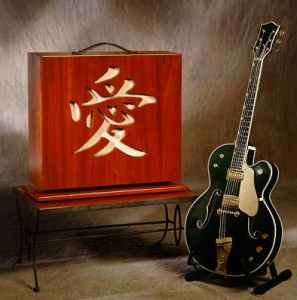
Now, don’t get your hopes up — we probably won’t create anything QUITE this awesome.
The limited edition Love amp fascinates me. Not its ornate furnishings, but the minimal controls: no tone stack, not even a volume control. It’s pretty much exactly what I was talking about when I expressed an interest in an amp with nothing but an on/off switch. That desire became even more focused last week when I reviewed a fabulous amp from a new Colorado Springs company called Toneville. (I’ll link to the Premier Guitar review when it goes live in a couple of weeks.) The Toneville Beale Street model I reviewed features a full compliment of blackface-style controls, but the tone controls are voiced so that the tone stack can largely be removed from the circuit, and there’s also a pot to remove the negative feedback loop for a more tactile/primitive response. As with some other ultra-high-end amps I’ve written about recently (like the Little Walter 50/22 covered here), the tone controls sound great wide-open, and it matters surprisingly little where you set the volume — you just drive it hard enough to warm things up, and then shape the tone from the guitar. With a nicely voiced and biased amp, you need far fewer controls than you might think. And the more crap you omit, more livelier the reponse and the more immediate the tone
The no-controls Mill Hill Love amp.
So why don’t we collectively create something in this vein? A simple but great-sounding tube amp with nothing but an on/off switch? I’ve never designed anything such thing and have little relevant expertise beyond the knowledge that, unlike 9v stompboxes, AC-powered amps can kill you. But I’ve built enough kit amps to know that a one-knob head can be easy, potentially inexpensive (though you could invest in ultra-premium tranformers, vintage tubes, NOS parts, and so on), and it should sound stunning. If we come up with a plan, we can source the parts, create step-by-step instructions, and probably get a vendor to put together a kit for us. (I’m thinking out loud here, so bear with me.)
I’m not firm on many details other than these:
head-only design (at least initially)
low-wattage for home/studio use — something you can crank without self-evicting
should sound big and bad-ass (not a cheap, practice-amp sensibility)
Any interest, folks? And more important, any ideas? And more important, any ideas? What would make this fun, useful, and bitchin’?
My pal Josh Hecht is making a documentary on Howlin’ Wolf. Josh, a noted engineer and audio instructor who came of age hanging out in Chicago blues clubs in the ’60s and ’70s, has corralled great interviews with the likes of Sam Phillips, Jimmy Page, and the late Hubert Sumlin, Wolf’s longtime guitarist. He also speaks with younger Wolf fanatics such as Dan Auerbach and Kirk Hammett. This work-in-progress will be cool indeed.
(Don’t be surprised that Kirk is a Wolf worshipper. He’s an extremely well-rounded listener, a lifelong guitar student, and an exceptionally cool and smart dude. Long after he became a star, he studied music a San Francisco State University, where Josh was one of his instructors. Josh shot cool footage of Kirk in his practice room, playing “Smokestack Lightning” on a funky old Epiphone — a Coronet, I think.)
Josh dropped me a note yesterday, telling me he was going over to Kirk’s to shoot additional interview footage, and asking whether I had ideas for further questions. Here’s what sprang to mind:
Many of the interviewees point out the things that rock drew from from Wolf: the riff-based composition, the power and aggression, the distortion. But it’s also interesting to consider the ways later players veered from Wolf’s path, and ponder what was left behind.
1. Take groove: Wolf’s rhythms are powerful but rubbery. The beat wobbles and floats like surfboard. The note placement floats relative to the beat, like a skateboard atop the surfboard. Today’s players are more like slot cars speeding along a pre-carved groove. We’re metronomic and predictable in comparison, even when not performing to click. Bands play together in tight lockstep, favoring even note values and motoric rhythms. Where did the looseness go?
2. Or take distortion: We’ve been in an overdrive arms race for decades, using fuzz pedals, heavier amps, aggressive signal processing. But doesn’t the relatively light distortion of Wolf’s guitarists permit tonal nuance, dynamic range, note-per-note color we can’t equal? So many of our tones are always on 10, squeezed to maximum density like toothpaste. What did we surrender to get there?
3. Or phrasing: Consider, say, Sumlin’s solo on “Shake for Me,” full of oddball phrases of uneven length. Today’s players tend to lock into a single type of vibrato. In “Shake,” there aren’t even two notes with identical vibrato. He smears in and out of notes in ways no one seems to do these days. It’s like we’re punching out notes on an assembly line, while Sumlin is carving each one individually from wood.
What happened? How might it have gone differently? Might any of those aesthetics return?
I have no idea whether Josh will use my questions, and if so, what response they may elicit. But what do you think?
Some inspiration:
Sumlin’s solo above isn’t quite as awesome as on the studio version, which may be my fave solo ever. (God knows, I’ve stolen from it often enough.) But still.