Stay One Step Ahead with the Best Payment Methods for Online Casino Bonuses

When it comes to online gambling, finding the best MuchBetter casino sites can make all the difference in your gaming experience. MuchBetter is an innovative payment solution that allows players to make fast and secure transactions. With its seamless integration and user-friendly interface, this e-wallet has gained popularity among online casino enthusiasts. Whether you are a seasoned player or new to online gambling, choosing a MuchBetter casino can provide you with a convenient and enjoyable gaming experience.

One of the top MuchBetter casino sites is https://csiss.org/deposit-methods/muchbetter/. This online casino has embraced MuchBetter as a preferred payment method, ensuring that players can easily deposit and withdraw funds. CSISS offers a wide selection of casino games, including slots, table games, and live dealer options. With its user-friendly website and mobile app, players can enjoy their favorite casino games on the go. The casino also boasts a generous welcome bonus and regular promotions, ensuring that players have ample opportunities to boost their bankroll.

Another excellent MuchBetter casino option is csiss. Known for its extensive game selection, this online casino caters to players of all preferences. From classic slots to progressive jackpots and live casino games, there is something for everyone at CSISS. The site also features a sleek and modern design that allows for easy navigation, making it a pleasure to explore the wide range of games. With its integration of MuchBetter as a payment option, players can enjoy swift and secure transactions, ensuring that their gaming experience is hassle-free.

In conclusion, selecting the best MuchBetter casino sites can greatly enhance your online gambling experience. Not only does MuchBetter provide a convenient and secure payment solution, but it also allows for seamless integration with top online casinos like csiss.org. With its extensive game selection, user-friendly interface, and generous promotions, [CSISS] is an excellent choice for players looking for a top-notch gaming experience. So, why not give MuchBetter a try and enjoy the benefits it brings to your casino gaming?

When it comes to online gambling in Austria, one of the most important factors to consider is the withdrawal process. Players want to ensure that they can access their winnings quickly and conveniently. That`s why the best online casino instant withdrawal in Austria is in high demand among avid gamblers. One platform that stands out in this regard is https://online-casino-osterreich.org/sofort/. With its seamless and efficient withdrawal system, players can enjoy their winnings instantly.

One of the key reasons why this online casino is considered the best for instant withdrawals is its partnership with reputable payment providers. They offer a wide range of options, including popular e-wallets such as Skrill and Neteller, as well as traditional bank transfers. This means that players can choose the method that suits them best and receive their funds without any unnecessary delays. Additionally, the casino`s user-friendly interface and intuitive navigation contribute to a smooth withdrawal process.

Moreover, this platform also prioritizes security and fairness. It holds a valid gambling license, ensuring that players` transactions and personal information are protected. Furthermore, it provides a wide selection of high-quality games from renowned software providers, guaranteeing a fair gaming experience. Whether you prefer slots, table games, or live dealer options, this online casino has something to cater to every player`s taste.

In conclusion, if you`re looking for the best online casino with instant withdrawal options in Austria, online-casino-osterreichis the ideal choice. Its partnership with reputable payment providers, commitment to security and fairness, and extensive game selection make it a top-notch platform for any passionate gambler. Experience a seamless and convenient withdrawal process today by visiting their website.

When it comes to online casinos, one of the most important aspects for players is the availability of secure and convenient payment methods. This is where ecoPayz casinos online truly shine. As one of the best providers in the industry, ecoPayz ensures that players can enjoy a seamless and hassle-free gaming experience while keeping their financial information safe. With its user-friendly interface and widespread acceptance, ecoPayz is a preferred choice among online casino enthusiasts.

One of the top ecoPayz casinos online is https://online-casino-schweiz.org/ecopayz/. This casino not only offers a wide range of exciting games and lucrative bonuses but also provides the option to use ecoPayz for deposits and withdrawals. With just a few clicks, players can easily transfer funds, ensuring a smooth and efficient gaming experience. Additionally, this casino prioritizes customer security, utilizing advanced encryption technology to protect sensitive financial details.

Another reputable ecoPayz casino is [Your Anchor Text]. With its sleek and modern design, this casino attracts players from all over the world. Thanks to its collaboration with ecoPayz, players can enjoy quick deposits and withdrawals without any additional fees. Moreover, the casino offers a generous welcome bonus and ongoing promotions to enhance the overall gaming experience. With its extensive collection of games and seamless integration with ecoPayz, this casino is a top choice for online gamblers.

In conclusion, ecoPayz casinos online are excellent options for players looking for a secure and convenient payment method. With widespread acceptance and a commitment to user safety, ecoPayz ensures that players can enjoy their favorite casino games without any worries. By choosing top ecoPayz casinos like [Your Anchor Text], players can enjoy a seamless gaming experience while benefiting from quick and hassle-free financial transactions.

The Jon Herington Interview

Soloist, Sideman & Steely Dan’s Guitarist of Choice

One unexpected pleasure of my recent Marianne Faithful mini-tour was getting to hear guitarist Jon Herington at the Kate Wolf Music Festival.

Jon Herington with his Gibson ES-336. [Photo: Tony Kukulich.]

Jon Herington with his Gibson ES-336. [Photo: Tony Kukulich.]

Since 1999, Herington has been best known to audiences as Steely Dan’s touring and recording guitarist. He also performs with The Dukes of September Rhythm Review, an all-star band featuring Donald Fagen, Michael McDonald, and Boz Scaggs. And when he’s home in New York, he sings and plays with his trio, the Jon Herington Band, whose material blend bluesy raunch with sly, jazz-informed harmonies in a way that Steely Dan fans are likely to love. (Their latest release is Time on My Hands.) He’s also worked with many other jazz and pop luminaries (partial discography here).

Angel-voiced Madeleine Peyroux was onstage when out van pulled up at the festival. She was performing a set of intimate chamber jazz, complete with strings and a whisper-quiet rhythm section. We couldn’t see the band, but man, could we hear them! When the guitarist took flight with a ravishingly lyrical slide solo — in standard tuning, no less — my bandmate Rob Burger and I turned to each other. “Who is that?” I mouthed. More lovely guitar work wafted from the stage: a fluent bop solo. Sublimely understated rhythm guitar work straight out of a 1940s session. “Seriously,” I muttered. “Who is that?”

It was Jon, of course. As he left the stage, I plied him with as many questions as the quick set change permitted. How did he get those tones? How did he wring such a great slide sound from that Gibson ES-336 using conventional tuning and a standard setup? I was also curious about the demands of the Steely Dan gig, and not merely the challenge of performing a vast catalog of complex guitar parts for the notoriously demanding duo of Walter Becker and Donald Fagen. How, I wondered, would a player approach those oh-so-varied riffs and solos? How would a guitarist honor those beloved solos without making them sound canned?

I didn’t have time to ask half those questions. But Jon, a charming, articulate fellow, agreed to an email interrogation upon his return home, even though he’s busy with Steely Dan rehearsals in advance of the band’s summer tour.

MORE→

Well, THAT Was Quite a Week!

8x Marianne

Wow, what a week!

On Thursday I met Marianne Faithfull for the first time at rehearsal, and then played two shows with her this weekend. It was intense. It was musically challenging. It was amazing.

Ten facts about Marianne Faithfull:

  • She’s written countless great songs, including the Stones’ “Sister Morphine.” Her songwriting collaborators have included Nick Cave, Polly Harvey, Jon Brion, Angelo Badalimenti, Beck, Roger Waters, Dave Stewart, Damon Albarn, Jarvis Cocker, and many others.
  • Many great songs were written about her: The Stones’ “Let’s Spend the Night Together” and “You Can’t Always Get What You Want.” The Beatles’ “And Your Bird Can Sing.” “Carrie Anne” by the Hollies.
  • Many great songs were written for her, including “As Tears Go By,” which she recorded before the Stones, and “Strange Weather” written for her by Tom Waits.
  • She portrayed God on the TV series Absolutely Fabulous.
  • She portrayed the devil in the stage production of Tom Waits’ The Black Rider.
  • She is hereditary Austrian nobility, the Baroness Sacher-Masoch. Her great uncle was Leopold Sacher-Masoch, author of the perv novel Venus in Furs and the man whose name inspired the word “masochism.”
  • In the early ’70s she was a junkie who lived homeless on the streets of London’s Soho district for two years.
  • She appears as one of the hangers-on in the seminal Bob Dylan documentary, D.A. Pennebaker’s Don’t Look Back.
  • She’s written two riveting memories: 1990’s Faithfull: A Biography (with David Dalton) and 2008’s Memories, Dreams, and Reflections.
  • She has collaborated with an astonishing list of great guitarists. Jimmy Page played on her earliest sessions. The week before last, she performed in Vienna, Paris and London with Bill Frisell, who’s worked with her for almost 30 years. Her other guitarists have included Keith and Ronnie from the Stones, Marc Ribot, Ry Cooder, Barry Reynolds, Chris Spedding, and Polly Harvey. So no pressure there.

Marianne  is one of my musical heroes — and would be even if she’d done nothing more than record 1979’s Broken English, for my money one of the bravest albums of all time. She is cool, gracious, witty, generous, and generally brilliant. What an experience!

Preparing for the shows presented a number of technical hurdles (beyond the usual difficulties of having to learn much music in little time). We performed as a trio, with just me and my old pal Robbie Burger on piano. I made a number of technical discoveries, both in terms of playing and gear. I’ll share some of them with you in upcoming posts. 🙂

I love my hometown.

I love my hometown.

All this unfolded against the delirious backdrop of San Francisco Pride Week, with the entire city exulting in the US Supreme Court ruling that nullified California’s homophobic Proposition 8. I strive to keep this blog apolitical, but I must speak out here, since the issue of marriage equality affects my family, friends, co-workers, bandmates, teachers, and mentors. My eyes teared up when I saw the pics of anti-Prop 8 plaintiffs Sandy Steir and Kris Perry getting hitched in the beautiful SF City Hall rotunda, where my wife and I exchanged vows 20 years ago.

Like I said: a hell of week. :beer:

Fuzz Detective Appendix 1.0

D’oh! I omitted a circuit from the Fuzz Detective video. It’s the germanium version of the Shin-Ei Companion Fuzz FY-2. So here’s a brief Fuzz Detective Appendix.

The silicon version of the FY-2 is a cult item, a nasty little thing best known for its appearance on Jesus and Mary Chain’s Psychocandy album. The germanium version (which I didn’t even know existed until reader Bear pointed it out!) is a very different beast. Most notably, it lacks the silicon version’s signature midrange scoop, delivering a thicker, fatter sound.

As noted in the video, I replaced the stock B50K gain pot with a B5K. (The overall range of tones is pretty much the same, but this way, all the variations aren’t crammed into 10% of the knob’s range.) Construction details and testing procedures are the same as they were for the 12 Fuzz Detective pedals.

MORE→

Fuzz Detective:
The Case of the 12 Germanium Fuzzes

As threatened, the Fuzz Detective video:

WHAT: Twelve germanium fuzz circuits compared and analyzed. These represent the sounds of almost every fuzz pedal introduced between 1962 and 1968.

WHY: A tool to help players identify the circuits most relevant to their musical needs. This isn’t about particular brands of pedals, but the circuits they employ. If you hear something you like, you can either do as I did and build a clone from the schematic, or buy one based on that particular design. (The relative merits of rival clones is another story.) Of course, if you’re rich and you desire an ancient pedal that probably doesn’t sound as good as a new clone, you can always purchase a vintage original. 😉

HOW: I tried to establish a “level playing field” by removing as many sonic variables as possible. I used the same signal chain, the same guitars, the same musical material, etc. (Tech details below.)

WHO:

  1. Maestro FZ-1 Fuzz Tone
  2. Sola Tone Bender Mk 1
  3. Hornby-Skewes Zonk Machine
  4. Sola Tone Bender “Mk 1.5” (similar to Vox Tone Benders)
  5. Dallas-Arbiter Fuzz Face
  6. WEM Pep Box Rush
  7. Sola Tone Bender Mk II (same as Marshall Supafuzz)
  8. Mosrite Fuzzrite (germanium version)
  9. Orpheum Fuzz (germanium version)
  10. Selmer Buzz Tone
  11. Sola Tone Bender Mk III (same as Park Fuzz Sound, Carlsbro Fuzz)
  12. Baldwin-Burns Buzzaround.

WHEN: Like, now, man!

MORE→

Fuzz Detective: The Plot Thickens!

Man, I’m glad I announced my intentions about this project! Thanks to your links and suggestions, the “Fuzz Detective” project has grown vastly more ambitious. I need a few more days to make my test recordings are assemble the results, but I believe this will be the most complete and “scientific” audio comparison of 1960s fuzz circuits yet attempted. I’m posting this update to share my current plans — and solicit last-minute suggestions for improving them. —Joe
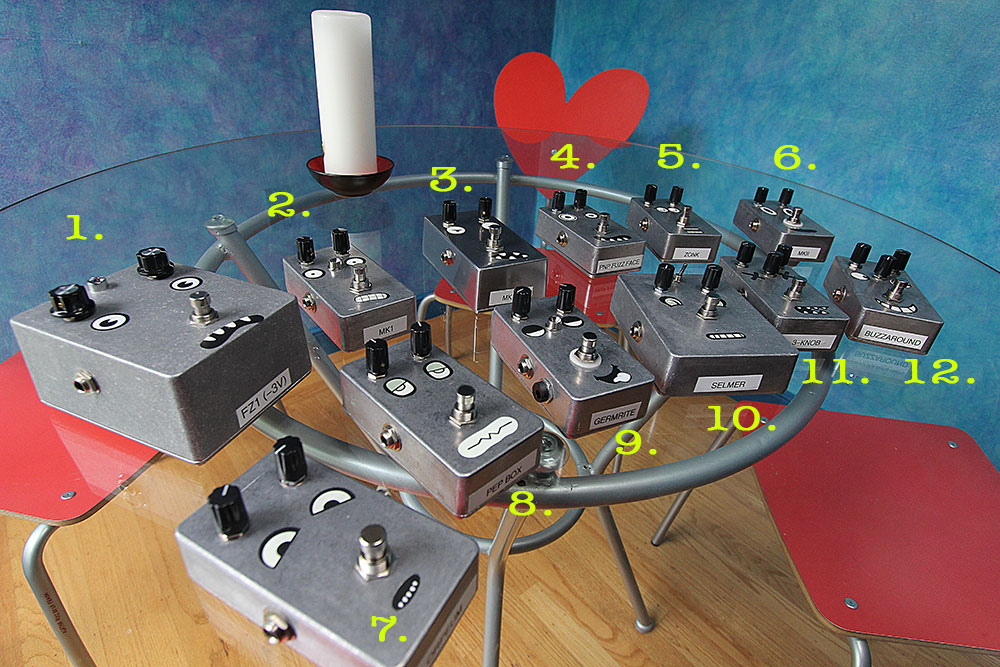
Wanker's Dozen: twelve Germanium fuzz pedals compete on a level playing field.

Wanker’s dozen: twelve germanium fuzz pedals will finally compete on a level playing field.

I’ve been a busy little solder monkey! Dig my new pedals:

1. Maestro Fuzz Tone FZ-1 clone
2. Sola Tone Bender “Mk I” clone
3. Sola Tone Bender “Mk 1.5” clone (near-twins: Vox Distortion Booster, Italian Vox Tone Benders)
4. Dallas-Arbiter Fuzz Face clone (very similar to Tone Bender Mk 1.5)
5. Hornby-Skewes Zonk Machine clone (near-twin: Tone Bender Mk 1)
6. Sola Tone Bender “Mk II” clone (near-twin: Marshall Supafuzz)
7. Orpheum Fuzz clone
8. WEM Pep Box Rush clone
9. Mosrite Fuzzrite clone (germanium version)
10. Selmer Buzz-Tone clone
11. Sola Tone Bender Mk III (“3-knob”) clone
12. Baldwin-Burns Buzzaround clone

About the Fuzz Detective project:

I’m attempting to create a comprehensive comparative sound library of germanium-transistor fuzz pedal circuits.

There’s no shortage of audio clips and demo videos featuring the great stompboxes of the ’60s and their modern clones. Yet it’s difficult to make qualitative comparisons between circuits because there are so many other variables at play. Who performed the examples? Using what gear? Were the examples recorded in a pro studio or on a mobile phone? Are the pedals ’60s originals or modern clones? What’s the condition of the transistors? And so on.

This isn’t about, say, deciding who makes the best Fuzz Face clone. The focus is the circuits themselves. The Fuzz Detective project aims to “level the playing field” by removing as many variables as possible.

MORE→

Next Week on Fuzz Detective!

UPDATE: Based on cool info supplied by YOU, dear readers, I’m expanding the scope of this piece. I’m furiously wiring up clones of some very rare models, and I can promise many cool and interesting surprises. Thanks, guys! :beer:

Okay, now that we’ve all gotten that silly “reading” stuff out of our systems with Book Week, it’s time to get back to the real focus of this blog: nasty, filthy fuzz pedals.

Last time we were on the subject, we looked at the original version of Dallas-Arbiter Fuzz Face, and included Mitchell “super-freq” Hudson’s beautiful DIY instructions.

Those posts generated many interesting comments — plus some misinformation on my part. For example, I said that the original Fuzz Face circuit is a close cousin to the Tone Bender Mk I, which would mean, for example, that known Mk 1 user Mick Ronson was essentially using a Fuzz Face between his Les Paul and his Marshall. But subsequent listening and reading makes me believe I was wrong. So I figured it was time to play fuzz detective and sort the facts from the other stuff.

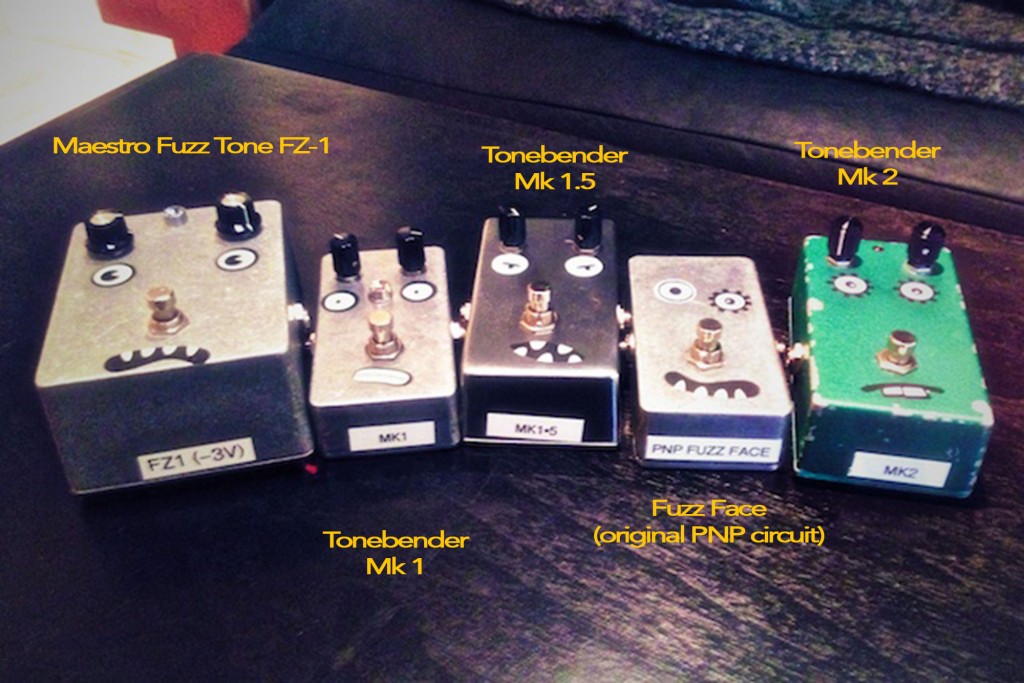
First, I made clones of all the early commercial fuzzes. I’ll be posting a compare-and-contrast video in the coming days. (The audio forensics will be quite incriminating.) Here’s the lineup:

The usual suspects. (Incriminating audio/video evidence to be posted soon!)

I’ve also re-read the experts, and man, even my most trusted sources contradict each other right and left, especially when it comes to those darn Tone Benders. While I have absolutely no inside dope on what actually transpired, I think David from D*A*M Stompboxes offers the most convincing Tone Bender chronology, which you can read here.

Anyway, here’s my best guess about how the early fuzz years unfolded:

MORE→

Tonefiend Book Week 2013: Epilogue

Monday: Theory and Technique
Tuesday: Gear
Wednesday: Repairs and DIY
Thursday: Biography
Friday: Fiction

Thanks to all my smart and cool readers who contributed to the first (maybe annual?) Tonefiend Book Week! I loved chatting about some old favorite books, and getting exposed to so many cool new ones.

An encyclopedia of rad.

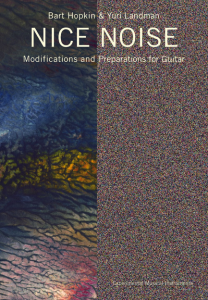
An encyclopedia of rad mods.

I have just two quick additions: the first concerns an exciting new acquaintance, and the other a sad departure.

In comments to Tuesday’s post on DIY and repair books, reader smgear mentioned Nice Noise, a book on prepared guitar by Bart Hopkin and Yuri Landman. I immediately ordered a copy, and received it the other day. I’m blown away. It’s a small-format book, a mere 72 pages, but it is a veritable encyclopedia of alternate guitar treatments.

Hopkin (he edited the journal Experimental Musical Instruments and wrote the fabulous alternate instrument books Gravikords, Whirlies & Pyrophones and Orbitones, Spoon Harps & Bellowphones) and Landman (he builds mutant guitars for Sonic Youth, Liars, Melt Banana, and other artists) discuss pretty much every avant-garde guitar mod I’ve ever heard of, and many besides. It’s not just a catalog — it’s a detailed how-to, meant to be consumed alongside the pair’s online audio library of musical examples. I’m sure you’ll be reading about it more here, because I’m definitely going inflict some of these rad alterations on some unwitting guitars.

One of the finest rock-and-roll novels.

A great rock-and-roll novel.

An a sadder note, the death of Scotland’s Iain Banks this weekend reminded me of a book that should have been inclued in Friday’s installment on musical fiction. Both funny and moving, his 1987 novel, Espedair Street, is simply one of the finest rock-and-roll novels ever. Its protagonist is a fabulously successful rock star (think Floyd or Fleetwood Mac in their prime) who must process his own past while grappling with the prospect of suicide.

Readers in the UK, where Banks is hugely popular, may be surprised to learn he’s strictly a cult figure in the States. While Espedair Street is his only work to focus on the music world, he wrote many fine novels marked by wry humor and vast empathy. (The Crow Road and Whit are two other favorites of mine.) He also wrote scads of science fiction under the name Iain M. Banks. Banks, 57, had only recently learned he was dying of cancer. In April he composed a final communique to his readers, writing:

I’ve asked my partner Adele if she will do me the honour of becoming my widow (sorry – but we find ghoulish humour helps). By the time this goes out we’ll be married and on a short honeymoon. We intend to spend however much quality time I have left seeing friends and relations and visiting places that have meant a lot to us.

Tonefiend Book Week 2013
Friday: Musical Fiction

Monday: Theory and Technique
Tuesday: Gear
Wednesday: Repairs and DIY
Thursday: Biography
Friday: Fiction

Tonefiend Book Week is simple: I discuss a few titles I’ve found particularly enlightening, useful, or entertaining, and then you jump in and do the same. I’ve organized the days of this week by subject matter. Today’s topic: musical fiction.

In comments to yesterday’s installment on musical autobiographies, several folks mentioned the Real Frank Zappa Book. Which reminds me of a quote often (and apparently incorrectly) attributed to Frank: “Writing about music is like dancing about architecture.”

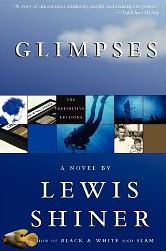
Glimpses

A music fan rescues ’60s rock via time travel. (Not as dorky as I’m making it sound!)

The line probably originated in reference to music journalism, but it applies just as well to fiction about music. Countless novelists and screenwriters are ardent music lovers. Yet there aren’t many novels or films that capture the act of music creation — what’s it’s like to be a musician.

The problem isn’t a lack of passion for music. Leo Tolstoy, Thomas Mann, and Victor Hugo were knowledgable listeners who channeled the emotions they perceived in great music into equally great prose. But even among literary titans, depictions of the music-making process tend to be as bogus as that clichéd Hollywood montage: Composer paces room. Furiously crumbles aborted manuscript page. Howls at moon. And then — Eureka! — a Masterpiece is born. [CUT TO END OF CONCERT, STANDING OVATION.]

Writers seem to do better depicting the worlds that surround music. For example, Jennifer Egan’s 2011 novel A Visit from the Goon Squad includes scenes set in the old San Francisco punk scene, and she nails the vibe. Many fine younger writers — Egan, Dave Eggers, Jonathan Lethem — are obvious rock geeks who skillfully evoke the experience of music consumption. There are also memorable depictions of fandom, notably Nick Hornby’s 1996 novel High Fidelity. But few books attempt to provide glimpses into the musicianly mind. (Actually, I haven’t yet read Lethem’s You Don’t Love Me Yet, which is set in the indie rock scene. Have any of you? I sure love his Motherless Brooklyn and Fortress of Solitude.)

At worst, smart writers sound stupid when attempting to write knowingly of music creation. I dig most Salman Rushdie I’ve read, but man, his 2000 “rock” novel, The Ground Beneath Her Feet is a stinker. Rushdie attempts an alternate rock history via his signature South Asian magic realism, and the result isn’t fantastical — it’s bunk. Sorry, partying with members of U2 doesn’t automatically afford vast insight into the musicianly mind. Or at least that’s been my experience. 😉

MORE→

Tonefiend Book Week 2013
Thursday: Musical Biographies

Monday: Theory and Technique
Tuesday: Gear
Wednesday: Repairs and DIY
Thursday: Biography
Friday: Fiction

Tonefiend Book Week is simple: I discuss a few titles I’ve found particularly enlightening, useful, or entertaining, and then you jump in and do the same. I’ve organized the days of this week by subject matter. Today’s topics are musical biographies and autobiographies.

Classic rock fans have been rewarded with many cool autobiographies in recent years: Keith Richards’ Life, Patti Smith’s Just Kids, Bob Dylan’s Chronicles, Neil Young’s Waging Heavy Peace, and Pete Townshend’s Who Am I: A Memoir, to name a few. I’ve read Richards and Smith, and I plan to read the others. Any thoughts about those and similar titles?

And then there are the great jazz autobiographies, such as Miles Davis’s Miles and Duke Ellington’s Music is My Mistress. Despite their alleged omissions and inaccuracies, both are epic accounts of epic lives dedicated to epic music. (So which is better: a lively, lying-through-the-teeth autobiography, or a dry but truthful biography?)

But my favorite musical autobiography is Hector Berlioz’s Mémoires, first issued in 1865.

Screen Shot 2013-06-05 at 2.36.11 PM

Hector Berlioz: total punk!

This, admittedly, isn’t a book for all musicians, or even most musicians. It concerns the explosive classical music scene of 19th-century Europe. If that topic holds no interest, the Mémoires probably won’t either.

But consider: Berlioz (1803-1869) is, along with Debussy, France’s greatest composer. He was a founder of Romanticism, and the first composer to fuse literature and instrumental music on a grand scale. He helped create the modern concept of orchestration and wrote the first orchestration manual. And of all the great composers, Berlioz is hands-down the best writer. He is arrogant, irreverent, sarcastic, and blisteringly funny. If you enjoy, say, the acidic humor of Mark Twain’s essays, you’ll dig Berlioz’s voice.

And like Twain, Berlioz played guitar. (More on that in a bit.)

The Mémoires drip attitude from page 1:

Needless to say, I was brought up in the Catholic faith. This charming religion (so attractive since it gave up burning people) was for seven whole years the joy of my life, and although we have long since fallen out, I have always kept the most tender memories of it.

Berlioz's music was often less than subtle. Here's how one cartoonist depicted it.

Berlioz’s music was often less than subtle. Here’s one contemporary caricature.

…and it never lets up. We meet the era’s greatest composers and performers and learn what it was like to be a professional musician in an era before recorded music. Concerts were longer. Audiences were more passionate. Wars were waged in the music journals. If you think going on tour today is demanding, imagine it in an era of unpaved roads and horse-drawn carriages.

MORE→

Tonefiend Book Week 2013
Wednesday: Repair and DIY

Monday: Theory and Technique
Tuesday: Gear
Wednesday: Repairs and DIY
Thursday: Biography
Friday: Fiction

Tonefiend Book Week is simple: I discuss a few titles I’ve found particularly enlightening, useful, or entertaining, and then you jump in and do the same. I’ve organized the days of this week by subject matter. Today’s topics are repair and DIY.

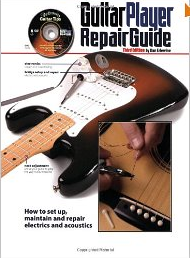
I'm indispensable.

I’m indispensable.

Sorry in advance if my faves in this category are a bit predictable!

For any repair topic, I turn to the redoubtable Dan Erlewine. Dan knows his stuff like no one else, plus he’s a terrific writer, with a rare talent for explanation and a charming sense of humor.

Dan has serviced the instruments of countless great players. (I’d insert a list, but it might wear out my comma key.) Better yet, he makes comprehensive notes and measurements. You learn much about, say, Albert King, just by studying Dan’s numbers.

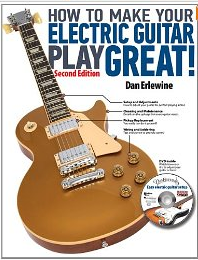
Now, I’m the furthest thing from a guitar tech. (Just ask San Francisco’s brilliant Gary Brawer, who regularly rescues my guitars from clumsy abuse and ill-considered DIY attempts.) But for players who simply need help with basic setup, maintenance, and modification tasks, Erlewine’s books — The Guitar Player Repair Guide and How to Make Your Electric Guitar Play Great — are godsends. Get ’em both. You won’t be sorry. (The digital versions live on my iPad for workbench reference.)

"Me too!"

I’m indispensable too!

I never had the pleasure of editing Dan’s columns when I worked at Guitar Player — Jas Obrecht jealously guarded that privilege. But the entire staff would laugh itself silly over Dan’s April Fools columns, like the one where he explained how to install a Floyd Rose tremolo on a pre-War Martin. (If I recall correctly, the process involved filling the body with cement.) Another year, he suggested using kitchen objects as lutherie tools. The photos included a kitchen table used as a clamp for a glue job on some über-valuable axe. (Touch of genius: The pic showed the poor guitar being crushed by a weighty trestle table, where Dan’s kids sat enjoying large bowls of breakfast cereal.) That one prompted a very famous guitar maker to write a shrill letter to the editor. (“It’s highly irresponsible for Mr. Erlewine to recommend using a heavy kitchen table as a clamp. Proper clamps don’t even cost that much!”) The luthier followed this with a frantic phone call, explaining that someone had alerted him to the joke, and begging us not to run the letter. We didn’t. (Dagnabbit!)

MORE→