Monday: Theory and Technique
Tuesday: Gear
Wednesday: Repairs and DIY
Thursday: Biography
Friday: Fiction
Tonefiend Book Week is simple: I discuss a few titles I’ve found particularly enlightening, useful, or entertaining, and then you jump in and do the same. I’ve organized the days of this week by subject matter. Today’s topic: musical fiction.
In comments to yesterday’s installment on musical autobiographies, several folks mentioned the Real Frank Zappa Book. Which reminds me of a quote often (and apparently incorrectly) attributed to Frank: “Writing about music is like dancing about architecture.”
The line probably originated in reference to music journalism, but it applies just as well to fiction about music. Countless novelists and screenwriters are ardent music lovers. Yet there aren’t many novels or films that capture the act of music creation — what’s it’s like to be a musician.
The problem isn’t a lack of passion for music. Leo Tolstoy, Thomas Mann, and Victor Hugo were knowledgable listeners who channeled the emotions they perceived in great music into equally great prose. But even among literary titans, depictions of the music-making process tend to be as bogus as that clichéd Hollywood montage: Composer paces room. Furiously crumbles aborted manuscript page. Howls at moon. And then — Eureka! — a Masterpiece is born. [CUT TO END OF CONCERT, STANDING OVATION.]
Writers seem to do better depicting the worlds that surround music. For example, Jennifer Egan’s 2011 novel A Visit from the Goon Squad includes scenes set in the old San Francisco punk scene, and she nails the vibe. Many fine younger writers — Egan, Dave Eggers, Jonathan Lethem — are obvious rock geeks who skillfully evoke the experience of music consumption. There are also memorable depictions of fandom, notably Nick Hornby’s 1996 novel High Fidelity. But few books attempt to provide glimpses into the musicianly mind. (Actually, I haven’t yet read Lethem’s You Don’t Love Me Yet, which is set in the indie rock scene. Have any of you? I sure love his Motherless Brooklyn and Fortress of Solitude.)
At worst, smart writers sound stupid when attempting to write knowingly of music creation. I dig most Salman Rushdie I’ve read, but man, his 2000 “rock” novel, The Ground Beneath Her Feet is a stinker. Rushdie attempts an alternate rock history via his signature South Asian magic realism, and the result isn’t fantastical — it’s bunk. Sorry, partying with members of U2 doesn’t automatically afford vast insight into the musicianly mind. Or at least that’s been my experience. 😉
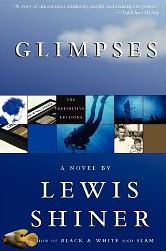
One entertaining music-geek novel is Lewis Shiner’s 1993 Glimpses, long out of print, but recently reissued by Subterranean. The premise: Ray Shackleford, a depressed stereo repairman and ’60s rock fan, starts to experience altered-state hallucinations in which he returns to the ’60s and rescues the era’s great lost music: Let It Be, minus the Phil Spector cheese. The Doors’ “Celebration of the Lizard.” Jimi’s follow-up to Electric Ladyland.
It’s not nearly as silly as it sounds. Granted, the info that inspired the novel is 20 years out of date, and several of the “lost” recordings Shiner invokes have been reconstructed and released, generally to anti-climactic effect. But man, I love the 1967 Beach Boys sequence, in which Ray watches the Smile album derail as Brian Wilson’s fragile psyche collides with the aggression (passive and otherwise) of his family/bandmates. Here’s Ray describing the moment when Brian introduces the band to the trippy new songs he wrote with Van Dyke Parks:
Once we were settled Brian started the tape. First it was “Do Ya Dig Worms” with the chant “Rock, rock, roll, Plymouth Rock roll over.” It went from that into the bicycle rider theme, then a weird kind of Hawaiian chant, punctuated with kettle drums. I started to to feel like I did in the studio when I listened to “George Fell into His French Horn,” only worse. The album seemed totally crazy. There was no way it would work. I looked at Mike Love. His face was completely rigid, expressionless.
Brian put on “Cabinessence” which, at least, had a more obvious melody. Not that it mattered. I already knew what was about to happen. Mike took a ballpoint pen out of his shirt pocket and made notes on a napkin. By halfway through “Surf’s Up” he was shaking his head. Brian saw it and jumped up and shut off the tape.
We all took off our headphones.
“Mike?” Brian said. “Is something wrong?”
Mike took a second or two to get cranked up, then he let fly. “What is this shit? It’s crazy. Why can’t you write songs like you used to?”
Brain said, “Cars and girls and surfing.”
“What’s wrong with that? It’s what people want to hear. You don’t need other people to write lyrics for you than nobody can understand.” I saw Van Dyke flinch; Mike acted like he wasn’t there. “You’re going to blow it, Brian. Stick to the old stuff. Don’t fuck with the formula.”
“I like those lyrics,” Brian said. He said it with a hesitant defiance, like he expected Mike to jump over the table and hit him for it. […]
Mike looked down at his napkin. “‘Crow cries uncover the cornfield?’ Those are the lyrics you like? What the hell is ‘crow cries uncover the cornfield’ supposed to mean?”
He looked up at Brian, who didn’t answer him, and then back at the napkin. “‘Colonnaded ruins domino.’ You want to tell me what you love about that line?”
“Columnated,” Van Dyke said.
He finally looked at Van Dyke. “‘Columnated?’ What the hell kind of word is ‘columnated’? Would you care to explain this song to me?”
“I have no excuse, sir,” Van Dyke said.
“Just tell me what the hell the song is supposed to be about.”
“I don’t know what the songs are about. They’re about whatever you feel when you listen to them.” Over by the tape machine Brian nodded.
“What I feel is a headache. How am I supposed to sing lyrics nobody understands? This is gibberish, and it’s going to destroy the group.”
Ray, hoping to prod Brian into completing the disc, violates a cardinal rule of time-travel fiction and describes the bleak dystopia that is 1993, starting with the destruction of Brian’s beloved hangout, the pier at Santa Monica’s Pacific Ocean Park:
Brian drove the XKE over the hills into the San Fernando Valley….The moon was out, and a few of the brighter stars.
“They’ll close POP inside two years,” I told Brian.[…]They won’t have the money to knock it down. Winos and junkies will move in. There’ll be a fire. The place turns into a public eyesore. It’s 1974 before they ever tear it down.”
“Why are you telling me this?”
“They don’t make records anymore. Everything is either cassettes, or these new things called compact discs, or CDs.[…] In 1989 Capital will finally release the entire Beach Boys catalog on CD. They’re making a really big deal out of Pet Sounds, your masterpiece. Because after that the Beach Boys went to shit. There’s some okay albums and the occasional good song, mostly a lot of aimless crap. No more masterpieces. Not ever. Because you decided to go with your family instead of your music and you knew it was wrong, and knowing it was wrong made you crazy and you couldn’t work at all anymore.
“In 1989 there’s a kind of sexually contagious cancer called AIDS. That was the last straw for free love. All the rest of the stuff that seemed like a good idea in the sixties, like feeding the world and loving your brothers and sisters, has gone out the window because it costs too much money. We got out of Vietnam but we still have wars because they’re good for the economy. Money is all anyone cares about. There’s a revolution happening in Eastern Europe, not over idealism, but because people think it will get them cars and TV sets and the good life. For twenty years kids have been listening to this music they call heavy metal, this real ponderous stuff with lots of distorted guitars and posturing and black leather and lyrics about death.”
Brian pulled over to the curb. I didn’t look at him. I was on a roll. “There’s a hole in the ozone layer that lets in ultraviolet radiation. You can’t lie in the sun unprotected anymore without getting skin cancer. Oil tankers are spilling oil all over the world’s beaches anyway, and nobody stops them because we don’t want to give up our cars. Which create so much pollution that the carbon dioxide in the air is holding in heat, turning the whole planet into a greenhouse. The polar ice caps are starting to melt—”
“Stop it,” Brian said.
I finally looked at him. He was crying now, not some put-on, spoiled child act, really crying, in complete silence, tears running down his face.
“Why are you doing this to me? What do you want from me?”
“The album, Brian. I want you to make the goddamned album.”
On the classical music front, I’ll cite two contemporary writers with remarkable musical insight. Both authors are Brits.
First, Ian McEwan, who seems to sneak clever words about music into most of his novels — especially in 1999’s Booker Prize-winning Amsterdam, with its cruel, if not sadistic, portrait of fictional composer Clive Linley’s creative constipation. The art and business of composing and performing are depicted with depressing accuracy.
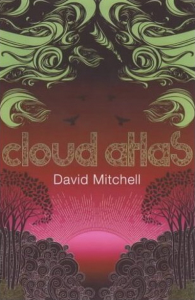
And there’s some fabulous music fiction in the “Letters from Zedelghem” sections from David Mitchell’s 2004 novel Cloud Atlas, my fave literary work of the young century. (Regarding last year’s Cloud Atlas film, a controversial box office flop: I loved it! But do yourself a favor and don’t watch it before you’ve read the novel, or you’ll be as lost as most viewers.)
The novel’s first half consists of six seemingly disconnected stories, each set later in time, from the 19th century through a post-apocalyptic future. The second half works backward through the tales, making connections and threading themes before concluding where and when it all started. Sheer genius.
The two long “Zedelghem” chapters are set in the 1930s. They consist of letters from Robert Frobisher — deadbeat, rapacious bisexual, and musical genius. After getting run out of England on a rail, he insinuates himself into the Belgian household of geriatric expat Vyvyan Ayrs (who is kinda-sorta based on real-life Frederick Delius).
(The movie alters the setting from Belgium to Edinburgh, though of course, everything is more more fun when it happens in Bruges. It also nixes the love-interest character of Ayrs’ daughter Eva, portraying Frobisher as predominantly gay, rather than as an equal-opportunity horn dog.)
Anyway, the scenes in which the two composers talk shop and talk shit are astonishingly well informed. It truly feels like you’re hanging out with a pair of brilliant but bitchy early-20th-century musicians. Consider this passage, where Frobisher, angling for a musical assistant gig, auditions for the sour, decrepit Ayrs:
Hearing Hendricks wheel his master this way, I stopped my snooping and faced the doorway. Ayres ignored my “I do hope you’ve recovered, Mr. Ayrs” and had his valet leave him facing the garden window. “Well?” he asked after we’d been alone half a minute. “Go on. Impress me.” Asked what he wanted to hear. “I must select the program too? Well, have you mastered ‘Three Blind Mice’?”
So I sat at the Bösendorfer and played the syphilitic crank “Three Blind Mice,” after the fashion of a mordant Prokofiev. Ayrs did not comment. Continued in a subtler vein with Chopin’s Nocturne in F Major. He interrupted with a whine, “Trying to slip my petticoats off my ankles, Frobisher?” Played VA.’s own Digressions on a Theme of Lodovico Roncalli, but before the first two bars were out, he’d uttered a six-birch expletive, banged on the floor with his cane, and said “Self-gratification makes you go blind, didn’t they teach you that at Caius?” Ignored him and finished the piece note perfect. For a finale of fireworks, gambled on Scarlatti’s 212th in A major, a bête noire of arpeggios and acrobatics. Came unstuck once or twice, but I wasn’t being auditioned as a concert soloist. After I’d finished, VA. kept swinging his head to the rhythm of the disappeared sonata; or maybe he was conducting the blurring, swaying poplars. “Execrable, Frobisher, get out of my house this instant!” would have aggrieved but not much surprised me. Instead, he admitted, “You may have the makings of a musician. It’s a nice day. Amble over the the lake and see the ducks. I need, oh, a little time to decide whether I can find a use for your gifts.”
Left without a word. The old goat wants me, it seems, but only if I’m pathetic with gratitude. If my pocketbook had allowed me to go, I’d have hired a cab back to Bruges and renounced the whole errant idea. He called after me, “Some advice, Frobisher, gratis. Scarlatti was a harpsichordist, not a pianist. Don’t drench him in color so, and don’t use the pedal to sustain notes you can’t sustain with the fingers.” I called back that I needed, oh, a little time to to decide whether I could find a use for Ayrs’…gift.
Damn. And does that attitude remind you of anyone else we know?
So can you guys think of any fiction — and what the heck, let’s include screenplays as well as novels — in which the writer truly captures what it feels like to make — to live — music?
Bonus question: Which writers boast the most musical prose? A quality to their words that feels and flows like music? James Joyce and Vladimir Nabokov are at the top of my list. And frickin’ Nabokov was writing in his second language! How ironic that Nabakov’s prose is so musical, yet in his autobiography, Speak, Memory, he confides his true feelings about music:
Music, I regret to say, affects me merely as an arbitrary succession of more or less irritating sounds….The concert piano and all wind instruments bore me in smaller doses and flay me in larger ones.
Okay — your turn!


Leave a Reply