As if this year wasn’t sucky enough: I tripped on the sidewalk ands fractured my left wrist. I’ll be fine in a few weeks, but I had to put a hold on a couple of projects in progress.
But there are a few things you can play when your forearm is in a cast. Dobro, for example. Or EBow. Or both at once.
Hi folks! I created this video during my initial COVID quarantine, but I cleverly forgot to post it here at tonefiend.com.
When COVID struck, I was in Mexico City, working on a MTV Unplugged special with one of my all-time favorite bands. (I can’t share the details yet.) But the project was postponed when the scope of the disaster became clear, and I rushed home. I quarantined in the studio for two weeks and recorded this.
For decades Claudio Monteverdi has always been one of my three favorite composers, along with Claude Debussy and Duke Ellington. He’s one of the most fascinating figures in music history. It’s an exaggeration to say that he invented opera, but only a slight one. Over the course of his long career, opera transformed from an avant-garde experiment among court intellectuals to a grand popular entertainment. He also composed many books of madrigals and some of the most gorgeous liturgical music ever created. He pushed the period’s musical limits on all fronts: dissonance, drama, instrumentation, structure, and psychological depth. Do yourself a favor and read up on this radical visionary!
This piece, Zefiro Torna, was originally a vocal piece, based on a poem celebrating the return of spring. (This video includes a lovely traditional performance, with a scrolling view of the score.)
When the piece was published in 1623, there wasn’t much to celebrate. Europe was decimated after the ravages of the insane international power grab known as the 30 Years War. Venice, the composer’s adopted home, had lost a third of its population to the plagues that accompanied the incessant violence. Yet it’s exceedingly upbeat music, celebrating the seasons rebirth — until toward the end, when the mood turns dismal as the poet/narrator mourns that he alone is miserable, tortured by unrequited love.
For my video I performed the vocal lines mostly on overdubbed Veillette Gryphon. It’s a small 12-string tuned an a minor 7th above standard. (That is, when I finger the piece in its original key of G, it comes out in F.) Most of the other instruments perform the continuo — that is, the bass line and chords, as indicated in ubiquitous Baroque-era shorthand.
As I write now, many months later, COVID rages worse than ever. In the intervening time I’ve returned again and again to medieval, Renaissance, and early Baroque music from times of plague. There’s something soothing about beauty born of cataclysm. It’s a tribute to the better angels of our artist nature at a time when good angels are scarce.
P.S.: That postponed Mexican project returned to life last month. It’s a fun story that I’ll share soon.
This guitar blog has been around since 2011. The site remains active, and I reply to almost all comments. But I’ve posted here less frequently as my focus has shifted from text to video.
Please visit my YouTube channel. And if you find anything worth your time, please subscribe. There too I reply to most comments. And you can always contact me via my personal page, joegore.com.
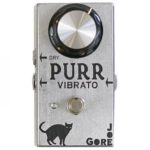
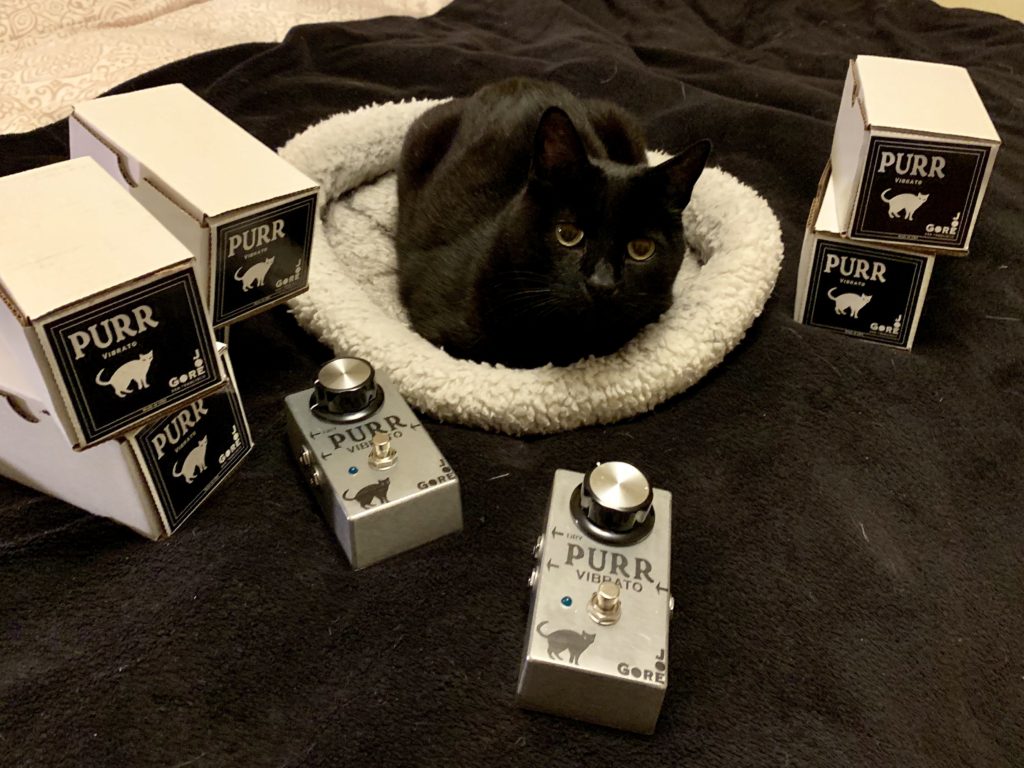
About frickin’ time! I announced this new Vibrato pedal at NAMM 2018. Now it’s time for NAMM 2019, and Purr is finally available and in stock at Vintage King.
Why so long? As soon as we finalized the prototype and designed the new circuit board, a crucial part suddenly became unavailable. ARGH!
It took forever to track down an acceptable substitute. But we finally did, and I’m thrilled with the results. I hope other guitarists dig it too.
Hey, if you’re going to NAMM 2019 in Anaheim next week, please stop by and say hi. Especially since since I’ll be sharing a booth with my my friend James Trussart, creator of some of the loveliest guitars ever conceived. We’ll be in Hall D at Booth 3942.
It’s too early to say whether guitarist will dig the Purr pedal. But at least someone I know is excited about the new release!
This 65-minute performance features 17 of the songs I’ve been performing live over the last couple of years. In concert, though, I use a single instrument. But here I get to play most of my favorite guitars.
I’ve posted each of these songs individually over the last few weeks, but this is the first time I’ve shared them as a single video.
Song List
1. Heroes (00:20)
2. Thunderbeast Park (05:28)
3. Just Like Heaven (09:09)
4. Shake It Off 11/8 (13:14)
5. God Only Knows (18:14)
6. Monospace (21:12)
7. Lujon (24:39)
8. Disco Plato (28:15)
9. Pumped Up Kicks (32:00)
10. Pandemonic Waltz (36:44)
11. Love Will Tear (38:16)
12. Midnight Cowboy (42:57)
13. In Like Flint (46:13)
14. Space Shrine (48:45)
15. Rhiannon (52:34)
16. Luxardo (56:55)
17. Ladies and Gentlemen We Are Floating In Space (01:00:58)
For the last day of Loopocalypse, here’s a cover of Spiritualized exquisite “Ladies and Gentlemen We Are Floating in Space.” I often close my show with this tune.
In first heard this song in while asleep on one of those coffin beds on a tour bus. I was listening with headphones, and awoke during the tunes final seconds, with earlier passages still in my head. As it it weren’t already sufficiently dreamlike and spacy.
Spiritualized’s original studio masterpiece flirts with the melody of Willie Nelson’s “I Can’t Help Falling in Love With You,” though it never quite crosses the copyright line. In concert, however, the backing choir breaks into the tune near the end, (as heard here at 08:00) and it’s magnificent. What a masterpiece!
The guitar is my DIY Kitschcaster, with Warmoth parts, TV Jones Filter’Tron pickups, and some very weird electronics. More details here and here.
Inspired by the most sublime thing you can drop into a cocktail. Or maybe that and the cocktail.
The guitar is a random collection of Fender Strat parts with Duncan lipstick tube pickups. They sound a zillion times better than modern Danelectro pickups. (Plus I boycott Dano on principle because their parent company is a major supporter of homophobic far-right legislation.)
I’m not trying to play in an authentic Nigerian style, obviously. But I lived for this stuff when I was in my early ’20s. Back then there was a thriving expat African musician community in Oakland, and I was privileged to be mentored by monster players who’d played with the greats, or who were the greats.
The first good band I ever played in was with Orlando Julius, a highlife star who’d come to the States with Hugh Masekela. (At the time, he performed under the name O.J. Ekemode, and everyone called him O.J.)
At the time, I’d just dropped out of a classical music composition PhD program, where I’d focused exclusively on abstract and complex music that no one liked. It was a revelation not only to play in a great dance band, but to play a single one- or two-bar pattern without (intentional) variation for 30 or 40 minutes at a time.
Even though it’s been a long time since I’ve played somewhat authentic African pop, the style influences me every time I pick up the guitar. I’m eternally grateful to have learned from such masters. Ever since that experience, I’ve maintained an exceedingly afrocentric view regarding the history of American popular music.
The last time I swapped email with O.J. he was living back in his hometown of Lagos, Nigeria, and doing well. He still performs in African and Europe.
The guitar, a loaner from singer Greer Sinclair, is a 21st-century Tele Deluxe reissue, retrofitted with a Bigsby and Lollar Wide Range pickups. More info.
This is a companion piece to yesterday’s version of John Barry’s Midnight Cowboy theme. It’s the main title from Jerry Goldsmith’s score for In Like Flint, a kitschy Bond parody that predated Austin Powers by decades. I was too young to see the film as a kid, but a radio ad featuring this theme blew my impressionable mind. I seriously believe the theme’s #4s and b2s triggered my lifelong love of dark chromaticism.
I’ve covered this once or twice before, though the sounds are quite different here.
The guitar is an unremarkable 1982 Les Paul Custom — the cheapest real Paul I could find when I needed one for an Apple sound design project. It’s even stamped “SECOND” on the back of the headstock. But the only original parts are the neck and body. The pickups are unpotted Duncan Seth Lover PDFs, and the guitar houses the most ridiculously over-the-top wiring scheme I’ve ever attempted.