Categories
Acoustic

Taylor 150e: An Affordable 12-String Acoustic

I needed a 12-string acoustic in a hurry for a session, so I picked up a new Taylor 150e for under $700. It wasn’t a review model or anything — I just ordered one online, sight unseen and sound unheard.

This model has been generating much buzz as an affordable yet good-sounding 12-string. It’s savvy positioning on Taylor’s part: I suspect there are many players who, like me, would love to have a nice 12-string, but aren’t about to spend $2,000+ for that occasional color. Anyway, I’m duly impressed. Have a listen!

I’ve got it strung with a super-heavy set from Pearse, and it’s a bit too macho for me. I dig the volume and harmonic richness, but it’s a beast to maneuver, at least for complex fingerstyle stuff. Either I’ll restring with something lighter, or consider testosterone supplements.

I haven’t owned a 12-string acoustic since I was 13. My first decent acoustic guitar was a late-’60s Fender Villager 12-string purchased for under $200. I loved it, but unfortunately, the shop that worked on it removed the tone bar, an essential brace. Uh oh — after a couple of weeks, I opened the case to find that the guitar had imploded on itself overnight. Instead I got a Yamaki 6-string, a crappy Yamaha knockoff. I’ve spent years in therapy working through the trauma.

The 150e is a Mexican-made instrument with a solid spruce top and a layered sapele body. I didn’t even realize till I received the guitar that it included onboard electronics. I almost never use that stuff, but before typing this, I went to plug it in. And guess what? It’s a surprisingly decent-sounding system that relies on an internal microphone. It doesn’t sound as good plugged in as it does in the video, but it’s totally acceptable for stage use. I didn’t expect it to sound half as good.

Anyone tried one of these? Any other acoustic 12-string recommendations, observations, or rants? What’s the coolest 12-string riff? And who’d win in a fight: Leo Kottke, Ralph Towner, or Leadbelly?

Categories
Acoustic guitar

Strange, Strange Strings

No longer ridiculously expensive — just REGULAR expensive.
No longer ridiculously expensive. Now they’re just very expensive.

I spent last week covering the Musikmesse musical instrument trade show in Frankfurt, Germany, for Premier Guitar. I had a blast, and Chris Kies and I posted details and pics of more than 70 new products. (Here’s the short list of our personal faves.) Kies shot lots of video, and will be posting more than 50 demo segments to the PG site in the coming weeks.

But Messe is hellishly loud, far noisier than NAMM. When I finally got home and picked up a guitar, it was an acoustic. I was trying something new, based on info I obtained from Mary Faith Rhoads-Lewis, CEO of Breezy Ridge, a company that distributes several brands for acoustic musicians, including John Pearse strings.

I’d previously geeked out here about about the strangest and most expensive guitar strings I’d ever tried: this “rope core” set from Austria’s Thomastik-Infeld. Reader/cool guy Al Milburn turned me on to them, and I wrote about them here. And I recently posted this video demonstrating how the transformed my old Martin 0-17 into a compelling steel/nylon hybrid with a unique and expressive voice.

Anyway, Ms. Rhoads-Lewis told me that the late John Pearse originally created this set for Thomastik, and that the John Pearse Folk Fingerpicking set [PJ116] is identical to what the Austrian company sells. Best part: You can get them in the States for under $20, as opposed to a walloping $35 for the Thomastiks. She also told me that their magic works in reverse: You can put this relatively low-tension set on a classical guitar for a very different sort of hybrid steel-string sound. (This, she said, is exactly what the great Brazilian player Bola Sete used to do.)

I popped a set on my old Yairi classical. The feel was — totally strange, and in precisely the opposite way as on the Martin. The tone was edgy and exciting, but the tension seemed a little too extreme. If just seemed a little too … high-strung, in every sense. Then I tried lowering the entire tuning a whole step, with the sixth dropped all the way to C.

And … oh, my. Check it out:

Summary: Holy cannoli, I love how this sounds. And there’s something psychologically satisfying about the transformation too. See, this guitar has always been a bit … tragic to me. I got it when I was 16. My classical guitar prof at UCLA said I needed a better instrument, and my every-supportive folks, bless ’em, helped me buy this Alvarez Yairi for around $700 (in 1970s dollars). It was a top-tier model for Alvarez, signed by luthier Kazuo Yairi, and boasting lovely Brazilian rosewood backs and sides. It was a huge upgrade for me, but as I got deeper into classical playing, its shortcomings emerged. Had I not shifted my studies to composition, I’d have needed to upgrade again. I envied the Igancio Fleta y Hijos models my two teachers played, but at around $3,000, they were beyond my budget, even with parental help. (Pity — their current value is approaching $50,000.) So I’ve used this instrument as a limited but decent-sounding model suitable for pop work, if not serious classical concertizing.

Categories
Acoustic guitar Pickups

A Lo-Fi Acoustic Guitar Pickup

Part acoustic, part electric—but 100% bitchin'.
Part acoustic, part electric—but 100% bitchin’.

This post is inspired by in interview I just did with Mississippi Allstars guitarist Luther Dickinson, a cool dude and a deep player. I’m digging the band’s new album, World Boogie is Coming. (And for better or worse, that praise comes from someone who hates almost all modern blues albums.) You can read the interview here.

Anyway, Luther was talking about how his entire style is a quest to create a loud, electric version of acoustic country blues. He mentioned how he was more drawn to the Mississippi blues players who went electric by slapping DeArmond pickups on their acoustics, as opposed to, say, Muddy Waters, who swapped his acoustic for a Telecaster. Luther also mentioned that DeArmonds are still his favorite way to amplify an acoustic guitar

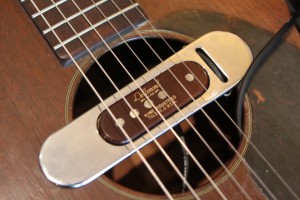
At some point it occurred to me that I’d never actually played an acoustic with a DeArmand. So I picked up a 1950s RHC-B and popped it into my old Martin 0-18. Have a listen:

I’m a longtime fan of magnetic pickups on acoustic guitars. I had a Sunrise in my Lowden for 15 years and loved it, but it croaked last year. I replaced it with one of those hybrid models that combine a mag pickup with an internal mic, and it works fine. But after a year or so, I don’t think I’ve ever used the mic sound. I just like the way the mag pickup sounds.

But is it still acoustic guitar? I’m not sure. I increasingly view amplified acoustic as a guitar category unto itself, residing somewhere between acoustic and archtop.

And the DeArmond? Between its noisiness and reticent highs, it’s probably not the best choice for every occasion. It’s also a bigger pain to install and remove than modern mag pickups. But I dig how it sound in the video, and I’m definitely keeping it!

So what’s you experience with amplifying your acoustic guitars?

Categories
Amps Effects guitar Music

Tonefiend Book Week 2013
Tuesday: Guitar Gear

Monday: Theory and Technique
Tuesday: Gear
Wednesday: Repairs and DIY
Thursday: Biography
Friday: Fiction

This week we’re talking about our favorite guitar/music books. The plan is simple: I discuss a few titles I’ve found particularly enlightening, useful, or entertaining, and then you jump in and do the same. I’ve organized the days of this week by subject matter. Today’s topic is guitar gear.

Guitar gear books seem to fall into three categories:

  1. Pornographic. Lavish publications featuring beautiful photos of rare instruments, often focusing on a single manufacturer or collector.
  2. Encyclopedic. Thick reference books covering wide swaths of guitar history.
  3. Pragmatic. Books that explain the inner workings of guitar technology, with an emphasis on how to turn this info to your musical advantage.

Even if I weren’t a jaded former guitar mag editor, I doubt I’d have much interest in coffee-table guitar porn books (and the occasional guitar porn magazine). Or at least, no more interest than I’d have in photos of, say, beautiful watches, speedboats, or nutcrackers. I’m not a guitar collector.

Not on <i>my</i> coffee table, you don't!
Not on my coffee table, you don’t!

Hey — stop laughing! Yeah, I own more than 20 guitars. (The exact number depends on whether I count guitars I’ve loaned out indefinitely and ones I’ve borrowed indefinitely.) I appreciate my instruments greatly, and I am very aware of how fortunate I am to have access to so many musical tools. But in the end, they are just tools to me, with little significance beyond their musical applications.

I realize this is a pretty weird attitude for a guitar dude, and one reason why I was probably never a perfect fit as a guitar mag editor. (I must be missing some crucial male gene, because I’m equally blasé about cars and sports. With rare exceptions.)

The classic reference book.

Reference books are a different story, especially the books of George Gruhn and Walter Carter, and those of Tom Wheeler. Sure, some of their weightier works have guitar porn aspects, but always paired with vast historical knowledge and the expertise of longtime industry insiders. Gruhn and Carter may know more about American guitars than anyone. But I always gravitate to Tom Wheeler’s books, and not just because he’s a longtime friend and mentor. Tom is a fine writer, an impeccable researcher (he’s been a journalism prof for the last 20 years), and he still conveys a teenager’s passion for the instrument. Tom is my hero.

(Bonus question: Has Wikipedia rendered the guitar reference book obsolete?)

But these days, the gear books that excite me most are the technically slanted, nuts-and-bolts titles. It’s one thing to ogle pretty instruments, and another to explain how they work, why they sound the way they do, and what that all means for the music we make today. And that’s why I love the books of Dave Hunter.

Categories
Acoustic guitar

Acoustic Strings Search: Update

Holy crap! Now THAT'S a guitar string!
Holy crap! Now THAT’S a guitar string!

Man, it pays to curate a blog frequented by smart people!

I wrote last week about my experiment with silk-and-steel strings.

It’s the latest chapter in my ongoing search for the right acoustic strings. Most available options simply sound far too harsh and bright to my ears, especially for fingerstyle playing on the small-bodied guitars I favor. Even though the Martin silk-and-steels I used were dramatically quieter than most bronze strings, I dug their warmth and strong fundamentals — and the absence of the hyped sizzle of bronze.

Several of you responded in comments with string suggestions, including several types I barely knew existed. Despite some rather shocking expenditures for these high-end, imported strings, I found much to love. Now I’m rich in tone, if nothing else.

Since I’m hot on the trail of a cool new fuzz circuit, I haven’t yet had time to record demos (and besides, I’d rather wait till the strings wear in a bit). But I’d like to share details about several products that impressed me.

Categories
Acoustic guitar

Silk and Steel Strings Revisited

Silk and steel — bad-ass, or strictly for wusses?
Silk and steel — bad-ass, or strictly for wusses?.

It’s been a long, long time since I’ve tried silk and steel strings.

I’ve always thought of them as a transitional set for students migrating from nylon to steel strings. At least that’s how my mom used to explain them to me back when she was giving me my first lessons. Like many players, I viewed them more as a remedy for tender fingertips than a sound you’d actively seek out.

But over time, almost everything I thought I knew about strings turned out to be wrong. So I figured I’d give silk-and-steels a fresh listen.

This thread over at the Acoustic Guitar Forum seems like a fair summary of common attitudes about these strings. Opinions seems divided between players who simply find silk-and-steel strings too soft and quiet to be of much use, and those who enjoy them for fingerstyle playing, especially on small-bodied guitars.

I’ve been frustrated finding the right strings for the old Martin acoustic I picked up last year. I had a violent reaction against coated bronze strings, which I wrote about here. But I was kind of digging the way Martin Marquis 80/20s bronze strings sounded on the instrument, as heard in this video. Sometimes, though, the tone is just too harsh and clacky, so I wanted to try something lighter and softer.

I slapped down this quick duet performance of “Drewrie’s Accordes,” an anonymous lute duet found in The Jane Pickering Lute Book, a manuscript anthology of late 16th-century lute pieces. (This would have been played on gut strings in its day, and is usually performed on nylon-string classical guitar or lute today. My steel treble strings are definitely not historically correct, though some wire-stringed fretted instruments such as the cittern did exist in the Renaissance.)

Observations after the video.

Compared to all-metal strings, the silk-and-steels are definitely quieter, with less treble bite. I like their soft, malleable feel for intricate fingerstyle playing like this. They offer relatively smooth transitions between unwound and wound strings. They exhibit less clacky string and fingernail noise. Playing aggressively with a pick definitely “overloads” them, and would no doubt destroy the windings in short order. Even when playing exclusively fingerstyle, you get the sense that the bass strings aren’t long for this world. But I enjoy their sweet, quasi-classical tone, which to my ear does indeed split the difference between nylon and all-metal strings.

Still, I’m not sure I want to commit to having these on the guitar all the time. (I wish the guitar had a switch to toggle between a bronze and silk-and-steel sound!) Also, these are lighter than I usually play (the treble is .0115, and I pretty much never go below .012). But the relaxed tension does seem to suit this particular guitar.

How about you guys? Any experience with these soft-spoken strings? Do you think they sound cool, or are they merely a salve for sore fingers? And has anyone tried John Pearse silk-and-bronze strings? (That’s probably the next stop on this particular string quest.)

P.S.: This is also a pretty good example of how I apply lute techniques to steel-string playing, as I mentioned here. For most of the fast bits, I pick alternately using my right-hand thumb and index finger. A proper classical player would be more likely to alternate index- and middle-finger. Also, my right thumb sometimes drifts “behind” my right-hand fingers (that is, closer to the bridge). Classical players rarely position their picking thumbs closer to the bridge relative to the fingers. It’s not conscious on my part — it just what my hand does when I’m trying to brighten the bass notes and darken the trebles.

Categories
Acoustic Music

An Alternate-Tuning Capo

Spider Capo

UPDATE, 03.07.13: I should have mentioned a point that several readers noted in comments: The capo only alters the tuning of open strings. Which means that while you can play many harmonies normally available only in dropped tunings, any notes above the capo appear at their usual frets. For example, all barre chords are played exactly as in standard tuning.

After all the digital guitar stuff I’ve been writing about lately, I really wanted to spend an afternoon without plugging in any frickin’ USB cables. So I finally got around to experimenting with the SpiderCapo I picked up last year on a whim.

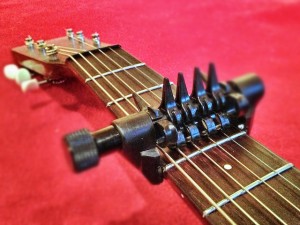
The SpiderCapo his six independently adjustable clamps, each of which can either stop the string or let it ring freely. That means you can dial in most dropped tunings without actually detuning any strings — instead, you transpose the entire voicing up. It’s a lot of fun to play, and seems like it could be a cool composing tool if you’re the sort of musician who gets inspired by unfamiliar tunings. Plus, it looks kind of wicked when you fret the unstopped strings behind the capo.

Here’s a little video I made, noodling around in a few tunings I particularly liked:

Anyone else tried one of these? Or any other “tricky” alternate-tuning capo? How about those gadgets that (unlike the SpiderCapo) can stop strings at differing frets?

Categories
Acoustic Amps Bass Digital DIY Effects Gigs guitar Music Pickups Recording Technique

Who Dares Predict Our Fretboard Future?

“We are all interested in the future, for that is where you and I are going to spend the rest of our lives.” — Criswell, Plan 9 from Outer Space

UPDATE: Wow, I can’t believe all the cool stuff folks have been posting to comments. I find myself feeling quite inspired about the future of instrument — when I’m not laughing so hard I spit coffee all over my laptop. Thanks for all great ideas. Keep ’em coming! 🙂 :thumbup:

Prophecy is for suckers. Who’s stupid enough to go on record with bold prognostications about the future of music and music-making, given the near-certainty that the words will reappear someday to bite you on the ass?

Well, me. And, I hope, you.

So I invite my fellow foolhardy loudmouths to join me in sharing their half-assed guesses wise and well-informed predictions about our brave new fretboard future.

The author of the most compelling prediction wins one of my hand-built stompboxes. So does the author of the one that makes me laugh hardest.

Post your predictions to comments. I’ll go first. 🙂

Categories
Acoustic guitar

A High-Tech Plastic Guitar —
from Half a Century Ago

Plastic guitars are not a new idea!

In comments to a recent post on 3D-printed guitars, we were discussing the pros, cons, and general aesthetics of instruments molded from plastic. But this isn’t exactly a new idea.

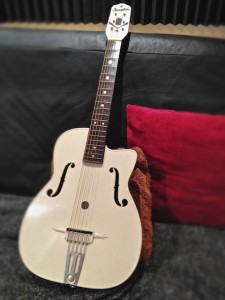
Back in the 1950s, luthier Mario Maccaferri conceived a line of plastic guitars and ukuleles. (This was many years after Maccaferri designed the D-hole Selmer guitars that will forever be associated with the Gypsy jazz of Django Reinhardt.) These plastic guitars were never very popular, and they’re not particularly valuable today.

I bought the one pictured here a few years ago at one of the music shops in London’s Denmark Street (I forget which one). I paid a couple of hundred bucks, and felt like a chump.

But I’ve grown attached to this guitar. It’s lovely to look at, and it plays great. The neck is substantial yet comfy, and it intonates well throughout its range. The tone isn’t warm, complex, or rich. But the Maccaferri has a cool, lo-fi character this sits well in a mix. I also like using it to double conventional acoustic guitars — the sharp, percussive tone adds a rough, aggressive edge.

Have a listen:

Categories
Acoustic

Acoustic Strings: Bronze vs. Nickel

Like Talos the Giant from Jason & the Argonauts, most modern acoustic strings are made from bronze. Like him, they can be cruel and inflexible.

UPDATE: I’ve updated the audio examples to include 80/20 bronze strings, as detailed in this newer post.

Can I share my steel-string psychodrama?

I’m lucky enough to own many electric guitars, but I’ve played one steel-string acoustic almost exclusively for many years — a small-bodied Lowden with a tone that a very famous manufacturer of acoustic pickups once described as “like a f%^$ing cannon!” Its sizzling-bright treble and modest low-end make it a great recording instrument. (Engineers often boost highs and roll off lows when processing acoustic guitar, but this model is practically “pre-EQ’ed.”)

But it’s not an easy guitar to play. It seems to amplify string noise, flubbed notes, and all other playing imperfections. “This is a ‘tough love’ guitar,” muttered one singer/songwriter friend.

So when I bought a second steel-string recently, I wanted something warmer, softer, and more flattering, and I found it in a pretty old small-bodied Martin. The day I bought it, I restrung it with treble strings to record my recent Nashville high-strung demo, then popped on a set of the phosphor-bronze strings I’ve been using for years on the Lowden.

And I was seriously bummed out by the tone, as I lamented over at the forum.

The problem was, my sweet, soft antique suddenly sounded a hell of a lot like the Lowden, with blistering treble and cruel string noise. And I realized in a flash that a lot of the qualities I’d attributed to the Lowden were, in fact, a result of the modern, coated phosphor bronze string I’d been using. So I ordered some alternatives and made a few test recordings to demonstrate how dramatic the differences are.

Have a listen: