Plato credited the invention of disco to his mentor, Socrates. However, most modern historians and classics scholars believe the style originated with an earlier, unknown Athenian proto-philosopher.
The guitar is a Steelcaster built by my pal James Trussart. If you’re not familiar with his breathtaking work, stop now and visit his site. (If you’re going to NAMM 2019 in Anaheim, you can meet us both at the same time, since we’ll be sharing a booth.)
It was a longer and harder process than I’d ever imagined, but the first of my four new pedals is finally released and in stock now at Vintage King.
Here’s my product demo:
And here’s a just-posted “First Look” video from John Bohlinger at Premier Guitar:
Man, it’s always such a trip when you tinker with an effect and play it in isolation for years, and then hear it being played by someone else. But I couldn’t be luckier: The first person who ever played one beside me was the stupefyingly talented Blake Mills. (He dug it, and he got the very first production model). And now, another performance by another of my favorite players. Pinch me!
There’s lots more info about Porkolator on the Joe Gore Pedals product page. As I explain, this is a highly mutated version of a circuit that was pretty bizarre to begin with: the Interfax Harmonic Percolator. There is so much bad info about the original pedal floating around. Everyone seems use a couple of phrases over and over: “tube-like” and “even-order harmonics.” Wrong and wrong! Everyone’s just copying something (incorrect) they read somewhere else.
A few years ago, I did a story on the Harmonic Percolator and its boutique DIY spinoffs. Even if you don’t especially dig the pedal, it’s an interesting study in how an effect gets tweaked and modernized. Here’s the accompanying video.
At the end I demonstrate an early version or Porkolator, though it’s changed so much that you can’t really compare. I gave this original to famous drummer and not-as-famous guitar player Matt Chamberlin during a film score session. Like many of my hand-built prototypes, it promptly broke. Fortunately, the new ones are built by the talented professional at Cusack Music. I just designed the damn things.
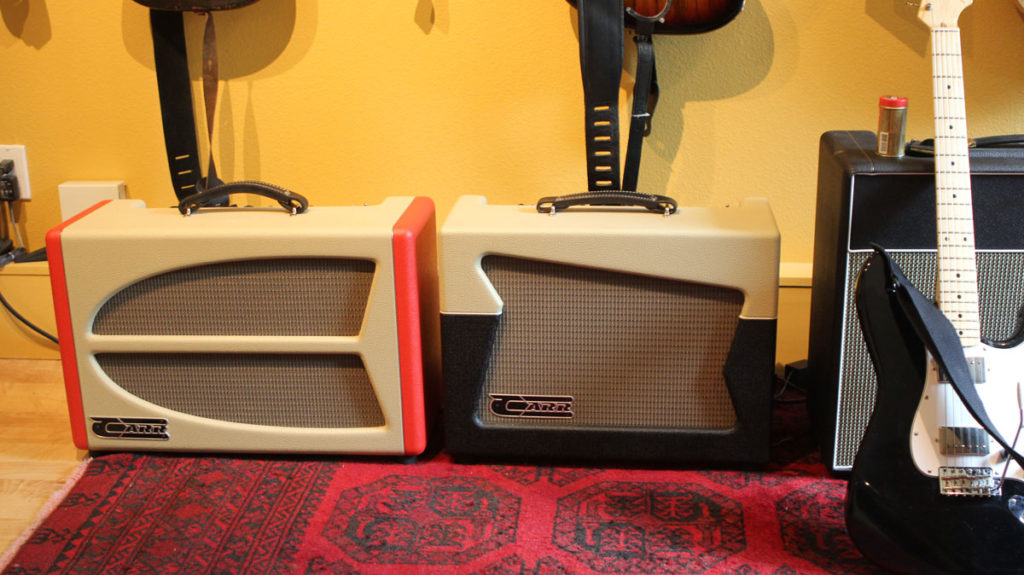
I’ve been using my Carr Skylark amp incessantly for the last 18 months or so. I’d originally reviewed it for Premier Guitar magazine, and then I bought one for myself. I dig the fact that, while Skylark is inspired by 1960s Fender amps, builder Steve Carr made numerous departures from the Fullerton template. To my ear Skylark sounds better than my ’60s originals. That’s especially true of its re-voiced tone stack, where the ranges are smaller and subtler than on vintage Fenders, with more of a Matchless-style “no bad settings” sensibility.
For better or worse, history repeated itself earlier this year when I reviewed Carr’s Lincoln in PG. Lincoln is to Vox what Carr is to Fender — not a clone, but vintage-inspired model with its own character and unique twists. Its dual EL-84 architecture makes it a cousin of the AC-15. But I think of it more as a “fantasia on a theme by Vox.” It’s captures the Vox qualities I dig, minus the ones that can make dealing with vintage Voxes a major drag.
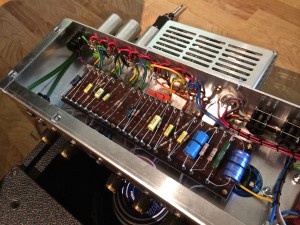
Skylark features true point-to-point wiring, with no circuit or turret board. (Lincoln, however, uses bits of circuit board for non-audio functions such as channel-switching.)
If you’ve listened to many of my videos and demo clips from the last year or so, you’ve heard these amps, so I figured I’d focus on them. For tech details, see the reviews. This video is more about how the amps inspire me musically.
From their flawless cabinetry to their ravishing tones, these amps are simply stunning. Cheap, they ain’t, but I felt like I was (RATIONALIZATION ALERT!) investing in musical art. Or maybe I’m making up for not buying a Trainwreck amp back in the ’90s when they were affordable.
I especially love how these Carr amps sound with my flatwound-strung guitars, and I used them on most of the demos for my pedals because they’re so very flattering. Ironically, I thought I’d given up buying new amps, because I was having so much fun building from kits. But trust me — both these instruments sound way better than any of my kit amps. Have a listen!
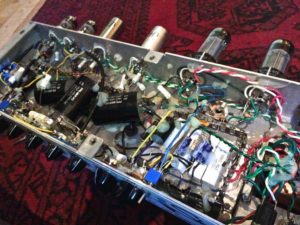
How come my DIY amps never look this pretty inside?
A couple of weeks ago I posted here about a Premier Guitar project in which I built two Marshall 18-watt clone kits. Meanwhile, the magazine received a review model of Marshall’s latest iteration of the 18-watt, a high-end, hand-wired version that sells for $2,700. My new review is online at PG, if you’re curious to hear a proper Marshall as well as the clones.
My take: It’s a beautifully built, hand-wired amp that sounds as least as good as either clone. Unlike the kits with their single 12″ speakers, the Marshall has a pair of 10s, which I think I prefer in this circuit. At $2,700, though, it’s pretty darn expensive, even for a beautiful, hand-made instrument. But I’ll be sad when I send the review model back to Bletchley.
I had a blast building and testing two Marshall 18-watt kits for a Premier Guitar story — and I emerged with new respect for this cool 1965 design.
These mini-Marshalls were neglected in their day, but are now treasured. The oft-heard claim that they provide plexi tones at reasonable volumes is only partially true — these are open-backed combos powered by a Vox-like pair of EL-84s tubes. But while they have roughy the same horsepower as the era’s Fender Deluxe and Vox AC15, their tone is undeniably ’60s Marshall. In the studio, they sound far larger than their actual size. And out of the studio, they’re still pretty darn loud.
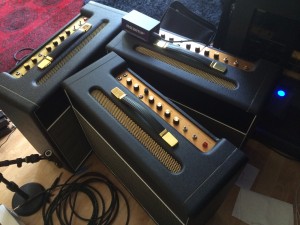
I’ve never seen three 18-watts in the same place before.
Even though the Mojotone and Tube Depot kits I built share the same schematic (and identical cabinets, both made by Mojotone), the build experiences and final results differed greatly.
And just when I thought I’d scaled the Everest of 18-watt ecstasy, I get a real Marshall 18-watt reissue for an upcoming Premier Guitar review. Stay tuned.
Are any of you guys 18-watt fans? Any observations to share?
Using the same “reasonably scientific” techniques deployed in my recent germanium fuzz survey, I’ve created a blind listening test that removes as many variables as possible from the equation.
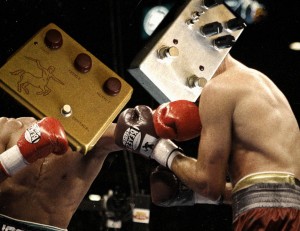
The video details the testing procedures. But basically, the A/B recordings are identical save for the use of one pedal or the other. The rival pedals are Klon Centaur #309 (the unit reviewed in Guitar Player back in the ’90s) and a new BYOC Overdrive 2, a DIY Tube Screamer clone kit with extra knobs and pots to provide the most popular boutique mods.
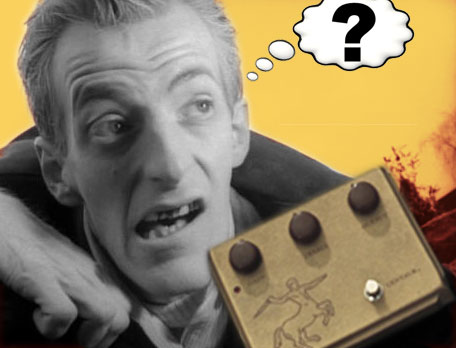
This Klon would fetch north of $2,000 on EBay. You can order the Overdrive 2 online for $95.
Now, these two pedals are NOT identical circuits. (The key differences are covered in the video.) But they share the same topology and sonic character. It’s not an apples and oranges comparison — more like two apples of distinct but related varieties.
For the video I dialed in five different sounds from across the Klon’s range, and then tried to duplicate them with the BYOC Screamer clone. You’ll hear the same material ten times, like so:
Example 1: medium gain, medium tone
Pedal A =
Pedal B =
Example 2: high gain, medium tone
Pedal A =
Pedal B =
Example 3: low gain, medium tone
Pedal A =
Pedal B =
Example 4: medium gain, bright tone
Pedal A =
Pedal B =
Example 5: medium gain, dark tone
Pedal A =
Pedal B =
To compete, just fill in the blanks and copy your answers into the comments thread below.
The pedals might not appear in the same order for each pair of audio clips. Other than that, there are no sneaky tricks. (For example, you really do hear two different pedals for every example.)
The first three contestants to submit perfect scores before Tuesday, July 23rd, 2013, will each win fabulous prizes one of my hand-built stompboxes. On that date I’ll post the answers and announce the winners here, assuming there are some. You can still test your ears after that by watching this video and not peeking at the answers — but sorry, no more prizes.
Only one entry per person. Anyone caught circumventing this rule via multiple identities may be subject to global ridicule.
I’ll hold off on any sonic observations till I post the correct answers next week.
Good luck, and may the best ears win some gnarly stompbox.
D’oh! I omitted a circuit from the Fuzz Detective video. It’s the germanium version of the Shin-Ei Companion Fuzz FY-2. So here’s a brief Fuzz Detective Appendix.
The silicon version of the FY-2 is a cult item, a nasty little thing best known for its appearance on Jesus and Mary Chain’s Psychocandy album. The germanium version (which I didn’t even know existed until reader Bear pointed it out!) is a very different beast. Most notably, it lacks the silicon version’s signature midrange scoop, delivering a thicker, fatter sound.
As noted in the video, I replaced the stock B50K gain pot with a B5K. (The overall range of tones is pretty much the same, but this way, all the variations aren’t crammed into 10% of the knob’s range.) Construction details and testing procedures are the same as they were for the 12 Fuzz Detective pedals. (more…)
WHAT: Twelve germanium fuzz circuits compared and analyzed. These represent the sounds of almost every fuzz pedal introduced between 1962 and 1968.
WHY: A tool to help players identify the circuits most relevant to their musical needs. This isn’t about particular brands of pedals, but the circuits they employ. If you hear something you like, you can either do as I did and build a clone from the schematic, or buy one based on that particular design. (The relative merits of rival clones is another story.) Of course, if you’re rich and you desire an ancient pedal that probably doesn’t sound as good as a new clone, you can always purchase a vintage original. 😉
HOW: I tried to establish a “level playing field” by removing as many sonic variables as possible. I used the same signal chain, the same guitars, the same musical material, etc. (Tech details below.)
WHO:
Maestro FZ-1 Fuzz Tone
Sola Tone Bender Mk 1
Hornby-Skewes Zonk Machine
Sola Tone Bender “Mk 1.5” (similar to Vox Tone Benders)
Dallas-Arbiter Fuzz Face
WEM Pep Box Rush
Sola Tone Bender Mk II (same as Marshall Supafuzz)
Mosrite Fuzzrite (germanium version)
Orpheum Fuzz (germanium version)
Selmer Buzz Tone
Sola Tone Bender Mk III (same as Park Fuzz Sound, Carlsbro Fuzz)
UPDATE:Based on cool info supplied by YOU, dear readers, I’m expanding the scope of this piece. I’m furiously wiring up clones of some very rare models, and I can promise many cool and interesting surprises. Thanks, guys! :beer:
Okay, now that we’ve all gotten that silly “reading” stuff out of our systems with Book Week, it’s time to get back to the real focus of this blog: nasty, filthy fuzz pedals.
Those posts generated many interesting comments — plus some misinformation on my part. For example, I said that the original Fuzz Face circuit is a close cousin to the Tone Bender Mk I, which would mean, for example, that known Mk 1 user Mick Ronson was essentially using a Fuzz Face between his Les Paul and his Marshall. But subsequent listening and reading makes me believe I was wrong. So I figured it was time to play fuzz detective and sort the facts from the other stuff.
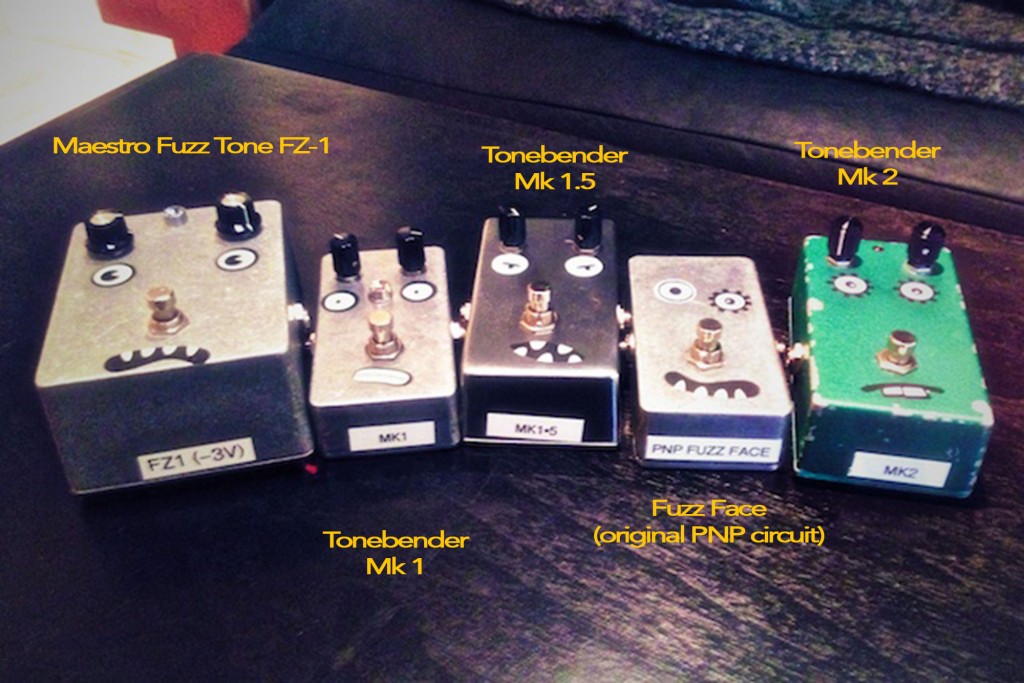
First, I made clones of all the early commercial fuzzes. I’ll be posting a compare-and-contrast video in the coming days. (The audio forensics will be quite incriminating.) Here’s the lineup:
The usual suspects. (Incriminating audio/video evidence to be posted soon!)
I’ve also re-read the experts, and man, even my most trusted sources contradict each other right and left, especially when it comes to those darn Tone Benders. While I have absolutely no inside dope on what actually transpired, I think David from D*A*M Stompboxes offers the most convincing Tone Bender chronology, which you can read here.
Anyway, here’s my best guess about how the early fuzz years unfolded: (more…)