Categories
DIY Effects guitar Pickups

Ultimate Lipstick-Tube Guitar (with experimental tone control & onboard overdrive)

Okay, it’s not the ultimate lipstick-tube guitar for everybody, but it probably is for me. It’s my third lipstick-tube pickup experiment — and definitely my favorite.

You may have heard some of these parts before: I used the neck for all my Mongrel Strat projects, and the Strat-sized Seymour Duncan pickups appeared in my previous lipstick-tube experiments. (I love Duncan’s lipstick-tubes. To my ear, they sound way better than the ones in new-school Danelectros.) The new body is Warmoth’s Hybrid Tele model, in purple with butterfly stickers. It’s très macho. (Better not use if for gigs in Indiana and Arkansas.)

My previous lipstick tube experiments used a MIM Strat body, but I wanted something a little more distinctive, and with a built-in battery compartment (because nothing is a bigger pain than changing batteries in a traditional Strat control cavity). Also, I like how the design evokes both Strat and Tele, since the guitar has three-Strat sized pickups and a whammy, but is wired more like a Tele.

About that wiring: The 3-way pickup selector chooses neck, bridge or both pickups, like on a Tele. Meanwhile, a SPDT switch toggles the middle pickup on and off regardless of the pickup selector, so you get six settings: neck, bridge, neck + bridge, neck + middle, bridge + middle, and all at once. It’s a pragmatic variation on “Nashville Tele” wiring with a switch rather than a pot. That means you can’t dial in varying amounts of middle pickup—it’s all or nothing. But on the plus side, I can jump instantly to an out-of-phase sound from any pickup-selector setting, and it freed up space for the other weird crap I put in this guitar. (Yo, electrical engineers: Don’t bother telling me that combined-pickup settings aren’t really out-of-phase True, they’re not out-of-phase electronically, but they are acoustically, and the distinctive “hollow” sound of combined settings is precisely the result of phase cancellation from two pickups at different positions.)

The weirdest detail is what I call a “cap-fade” tone control. It’s an idea I speculated about back in January, and to which many of you contributed cool perspectives. I pretty much followed the scheme in the original diagram:
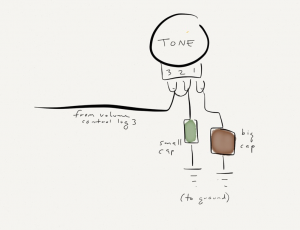
cap-fade tone control

The idea again: Instead of sending varying amounts of signal to ground via a tone cap, the pot here fades between a small-value cap (which defines the minimum cut when the control is engaged) and a larger one (defining the frequency of the maximum cut). In other words, instead of sending varying amounts of signal to ground, this circuit always sends everything above the cutoff frequency to ground, with the pot determining the frequency.

Categories
Effects

Lookit — My New Pedals!

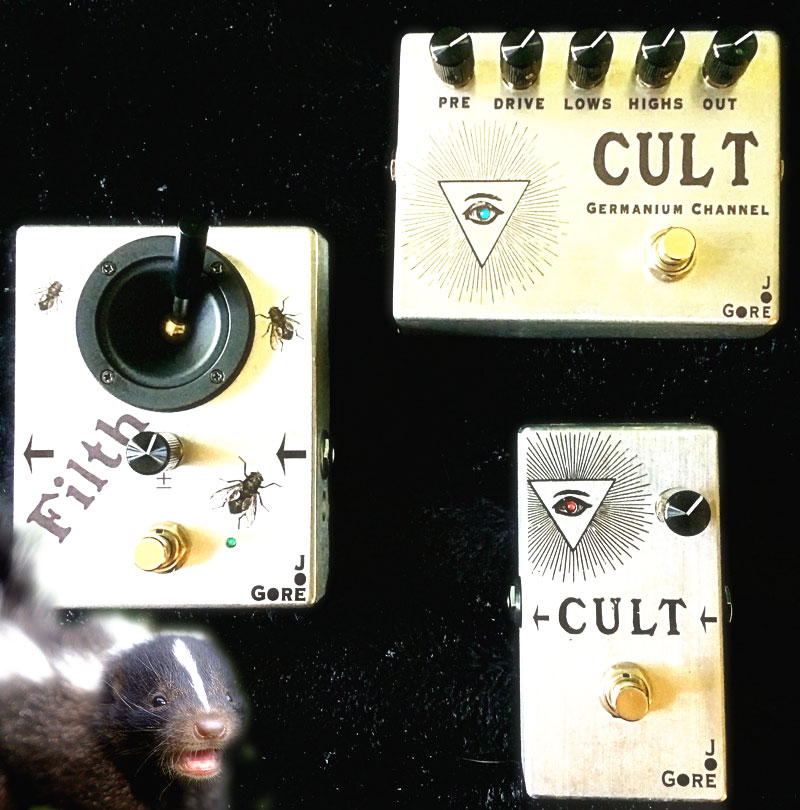
Awesome! I just received production prototypes for my next three stompbox releases, in the wake of last month’s launch of my Duh Remedial Fuzz. I’m still making minor tweaks, but these should be available in just a few weeks. Whee!

New-Pedals_skunk
Filth is a freaky joystick fuzz. Cult is my oddball take on Rangemaster-style single-transistor overdrive. It’s my absolute favorite distortion device, and the same one heard in many of my videos and gear reviews. The Cult Germanium Channel supplements this simple but deadly circuit with extra controls and an active EQ stage.
(Baby skunk sold separately.)


Filth. I love whack-job fuzz boxes like the Z. Vex Fuzz Factory and the countless “sick fuzz” pedals it’s inspired over the last two decades. But here my goal was to create one with a higher percentage of “likely to use” settings — I wanted to make it easier to find the good stuff. Topologically, the circuit’s nothing tricky — basically a Fuzz Face descendent coupled with an extra JFET boost stage (though it doesn’t sound remotely like any Fuzz Face you’ve ever heard). The main innovation is the x/y control, which jiggers the transistor biasing, producing a broad array of timbres. It’s not a conventional tone control, though it’s arranged so that it’s easy to summon smooth, chubby tones or angry, brittle ones.

There was a lot of interest in this a couple of years ago when Fuzz Box Girl posted a demo (apparently no longer online) of one of my handmade ones. She focused on the pedal’s maximum-gain, My Bloody Valentine side, which was fine — Filth can definitely make your amp melt like a Salvador Dali timepiece. But now it’s easier to dial in crisp, lower-gain tones.

I’m making two Filth versions: the joystick model [pictured], and one with three conventional knobs. They sound identical — only the interfaces differ. The three-knob is good if you want to mark an exact setting for use onstage, while the joystick is more fun when concocting new sounds. (I don’t know the exact pricing yet, but the joystick model will cost more, because that’s an expensive part!)

I’m far from the first builder to create a joystick stompbox, but you usually encounter them on crazy noisemaker effects, or deployed as conventional EQ controls. I’m not aware of another pedal where it regulates the fuzz’s fundamental timbre this way. But then, I don’t get out as much as I should.

Cult. If you’ve seen my videos or heard my audio demos, you’ve probably heard Cult. I’ve built it into several guitars (while others have a built-in Duh fuzz). It’s a one-germanium-transisor boost descended from the Dallas Rangemaster of the 1960s, though the apple has rolled far from the tree: All part values differ, the EQ profile is modernized, and the gain control works in an unconventional way. But like a Rangemaster, it boasts spectacular dynamic response and electrifying tones that crackle with presence.

To my (admittedly odd) ear, no other distortion sounds as bitchin’ as a single-transistor boost between a good guitar and a great amp. The weird thing is, while most players know the countless ’60s rock tracks produced with such primitive boosters, many  have never tried this sort of circuit. I love faithful Rangemaster clones, and I love many of the variations I’ve explored over the last five years. But Cult is my very favorite recipe.

Cult Germanium Channel. This one pairs the Cult circuit with relatively modern active EQ/boost stage, with proper tone controls that don’t suck tone. The added circuitry sacrifices a touch of Cult’s explosive presence, but it provides a greater range of tones. There’s also more gain on tap, so it’s better for those high-testosterone rawk tones that I’m far too much of an prissy, effete San Franciscan to use myself.

Thanks a Lott. As mentioned, these are manufactured by Cusack Music in Michigan, under the expert eye of engineer Tony Lott. Cusack builds pedals for numerous  boutique brands you know, many of whom prefer to keep the fact a secret. But I’m proud of the relationship, because Tony and his team improve everything I submit. (More about the collaborative process below. It’s fascinating stuff, assuming you’re a geek — which I do assume, since you’re here.)

Categories
guitar Music

A REAL Cult Band

I just watched an amazing documentary on Netflix: The Source Family, the story the early-’70s cult led by James “Father Yod” Baker. Baker’s Sunset Strip restaurant, the Source, was a fixture of my LA youth — a popular hang for both hippies and music-industry types. (You’ve probably seen it as the backdrop for the breakup scene in Woody Allen’s Annie Hall.)

source
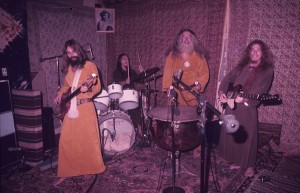
The hell with cowbell! We need more tympani!
James “Father Yod” Baker (with mallets towards none) fronting Ya Ho Wa 13.

One of Baker’s less eccentric notions was to blow a fortune on music gear and a pro studio, where his self-styled “band,” Ya Ho Wa 13, reportedly recorded 65 albums’ worth of improvised music, much of which has been reissued in recent years. Prolific, chaotic, and fueled by a philosophy comprehensible only to its creator, the body of work is a bit reminiscent of Sun Ra’s, minus the talent.

Perhaps the best thing you can say about Baker is that he was no Manson. I don’t know that anyone died on his watch other than Baker himself (in an idiotic stunt I’ll refrain from sharing so as not to spoil the film’s stupefying denouement, though you can devour the details here if you like).

But he was a serial psycho-sexual abuser who acquired 14 very young wives while liberating hundreds of starry-eyed acolytes from their worldly possessions and cruising LA in a white Rolls Royce. Among the film’s most remarkable scenes are Ya Ho Wa 13’s recruiting concerts held at well-to-do West Side high schools and colleges, including my alma mater. Just … wow.

(Buttloads more audio/video here.)

To its credit, though, the film isn’t moralistic in the slightest — directors Maria Demopoulos and Jodi Wille tell the story via the words of its witnesses, supplemented by film and photos of the cult’s own Isis Aquarian, Baker’s anointed archivist. (They report — you gawp in astonishment.) Many surviving members appear onscreen, as do such rock admirers as Billy Corgan and Don Bolles of the Germs.

The film is a companion to Isis Aquarian’s 2007 book (co-written with fellow Source family member Electricity Aquarian), The Source: The Untold Story of Father Yod, Ya Ho Wa 13, and the Source Family. The book includes a CD of Ya Ho Wa 13’s music. I haven’t read it — but will now!

August 8, 1969: Connie McCormack, Shep Shepheard, Nancy Bacar and cult leader Ken Kerman arrested.
Fictional mugshots of our fictional band’s fictional 1969 arrest, along with their fictional cult leader.

I knew the general outlines of the Source story, but not the hundreds of bizarre details that make it so compelling. Elise Malmberg and I drew from it a decade ago while creating Clubbo Records, our “music fiction” project. We concocted the Fold, a fictional hippie cult band, using bits pilfered from various spiritual scams of the era, including the Source and the equally fascinating Process Church. (A fictionalized Process Church also figures in Last Days, a darn good horror novel by Adam Nevill, though not quite as awesome as Nevill’s The Ritual, with its Scandinavian black metal underpinnings. It’s as scary/funny as actual black metal.)

Naturally, our fake story isn’t one-tenth as interesting as the shit that actually happened. But it did produce “Into the Fold,” one of our best bits of counterfeit music, featuring the brilliant Chuck Prophet singing the Morrison-esque role of Gary “Shep” Shepheard, who fronted the Fold’s rock band under the direction of cult leader Maestro Ludgang. (Elise wrote the song, and I played the music, except the drums, which are by Patrick Campbell. Other friends served as photo models.)

Meanwhile, I’ve been working on a new piece that has some sounds and phrases I like, but has steadfastly refused to take shape. I tried recording it the other night, but every soloistic element I added sounded stupid. When live-looping, I’m so self-conscious about excessive repetition that I use every trick I can muster to vary the sound and move things  along. This time, though — under the spiritual influence of The Source Family, perhaps? — I just let the loops roll, visualized my ego dissolving into a pool of pearlescent light, and dug on the trance. Man.

It’s called “Unfolded,” after the Fold, of course.

But please, folks — if I start calling myself Maestro Ludgang Aquarian, do me a favor and stage an intervention.

steven_seagal_guitar
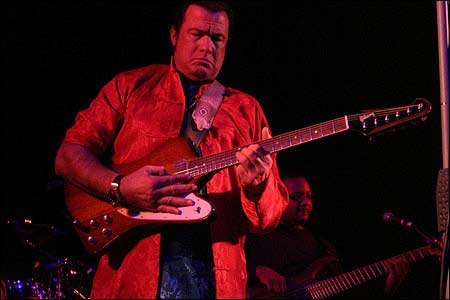
Actor Steven Seagal, who belongs to the homophobic (yet oddly homoerotic) Vladamir Putin cult, plays a reverse Firebird like the one that Ya Ho Wa 13 used. Coincidence?

UPDATE [06.16.14]: Okay, this is too great: I just shared this post with my pal/fellow Premier Guitar editor Charlie Saufely, who told me he played for a Ya Ho Wa 13 tribute band that performed in front of original band members when this film premiered at San Francisco’s Roxy Theater. Afterwards he got to jam with Djin, the guitarist. “It was a thrill,” Charlie says. “He was way more into skronking than blues jamming. We kinda went off on a Thurston-and-Lee, hail of sonic scree barrage. He had the Firebird … it was surreal. He reached over at one point and started scraping my strings with his fingernails. That was pretty sweet!”