I should have been out buying nice presents for you all. Instead I sat around inhaling solder fumes. When the smoke cleared (mostly, anyway) I’d tested ten unusual Strat pickups in the same poor guitar.
Verdicts? I dig them all, and not just ’cause I’m too polite/chicken to say otherwise.
I love the Lollar Gold Foils so much I’m assembling a new parts guitar to surround them. I’m going to keep the Fralin Big Singles in the demo Strat, at least till the next Mongrel Strat Project. I’m going to try putting the mini-humbuckers in a “parts” Tele at some point. I originally reviewed the Lollar P-90 set for Premier Guitar (where I evaluated them the “right” way: in a Gibson guitar), so they go back to manufacturer, though I’d sure like to own a set someday. Meanwhile, the Allparts set isn’t in the same league as its high-end competitors, but at a mere $30 per pickup, it costs about 1/4 the price of its expensive rivals. You could definitely do a lot of lo-fi damage with a pair of these surprisingly solid-sounding pickups!
As threatened, here’s a closer look at Strat with PAF humbuckers used for my recent “God Only Knows” cover. Most parts are from the long-suffering guitar used for all the Mongrel Strat Project experiments. And this one is especially mongrel-ific, with its blend of vintage Fender and Gibson.
Obviously, Gibson pickups is a Strat is far from a new idea. But usually, that arranged marriage is designed to spawn macho, high-gain solos minus the characteristic shrillness of vintage Strat bridge pickups. While many players I love have used humbucker-equipped Strats, I’ve always loathed playing them myself. But what, I wondered, if you didn’t use a hot humbucker, but an über-vintage PAF?
Like many players my age and younger, I was astonished when I first encountered a vintage-voiced humbucker. It was nothing like the dark, over-overdriven tones I associated with the word humbucker. A good PAF is sparkly, resonant, and perfectly capable of gloriously bright and clean tones. Here I used a Seymour Duncan Joe Bonamassa signature set, the same one heard in a more Gibson-like context here.
The results are … compelling. As expected, notes have far more mass than on a conventional Strat, and the bass response is vastly increased. There’s no shortage of top-end either, though the big lows can overwhelm the highs at times. So while I’m pretty much always obsessed with bass-cut controls (especially the high-pass section of the PTB circuit I’ve written about approximately 37 zillion times), it’s especially invaluable in this case. Since lows disproportionately drive distortion, even modest bass cuts clean up the tone and make highs speak more clearly.
I’ve also incorporated the dual-capacitor treble control I wrote about here. It creates a Vari-Tone/ToneStyler effect in a simplified way: Instead of using a clunky rotary switch to choose from a large set of treble-trimming capacitors, it fades between a large cap and a small cap, yielding the same resonant effect as the more complex options. I’ve incorporated this circuit in several guitars now, and it’s still working for me. It’s especially nice here, when paired with a Steinberger JackPot potentiometer, which lets you bypass the entire tone circuit for absolute maximum volume and brightness. I chose the small cap based on the minimum amount I’d ever want to remove from the signal, and the larger one based on the maximum cut I’d use.
I would have included a photo of the project in progress, but I didn’t because I’m embarrassed about how awful it looks inside. I needed to route out the pickup cavities to accommodate these larger pickups. But instead of taking it to a professional, or getting a proper router and learning how to use it, I chipped away with the tiny routing bit on an inexpensive Dremel tool. Do yourself a favor, kids, and don’t follow my lazy-ass example.
But hey, what’s a Strat pickguard for if not to conceal your shoddy workmanship? The guitar looks okay in the end, and I’m digging its sounds, even though it was far harder to get accustomed to than I’d anticipated. I had to recalibrate my right-hand dynamics to prevent treble notes from screeching. I was almost ready to chalk this up as a failed experiment, but after a few days of noodling around, I started to get the hang of it and enjoy the results. I think I’ll keep it this way for a while — or at least until the next Mongrel Strat concept wafts up from the bowels of Hell. 🙂
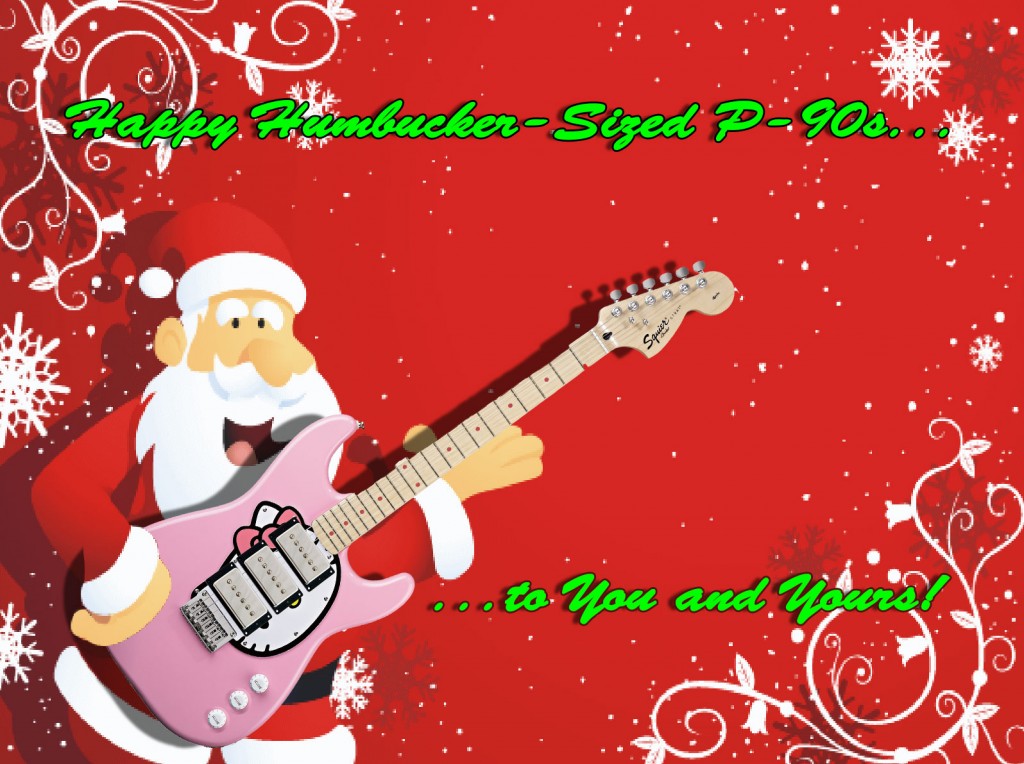
Just in time for the single-coil holiday season: my comparison review of 16 humbucker-sized P-90 pickups is live at Premier Guitar. This heartwarming holiday fun-fest has it all: Mouth-watering adjectives. Freshly baked audio clips. Irate manufacturers. Don’t miss it!
This was a fun, if challenging project. Comparison pickup reviews are such cans of worms! Not only are they sadistically labor-intensive, but the differences between one pickup and the next are easily overshadowed by other variables in the tone chain.
After much thought about how to create meaningful comparisons, we came up with an intriguing process: I tested all the pickups in the same guitar, with identical setups, and ReAmped them through the same combo amps with identical recording settings. If this were an amp or pedal review, I would have used the same performances throughout, but of course, each example had to be played anew with each pickup, so I spent much time matching performances to guard against misleading variations in touch and intensity. It’s not a perfect solution, but better than most, and in the end quite revealing.
And what did it reveal, exactly? You’ll find out at the link. Beyond that, I can report that:
All the products sounded pretty good.
They sounded more similar than you might expect.
I’m gonna find me a guitar to house a set of my favorites — though I’m not sure which ones are my faves! Really, they’re close enough that, say, the tone of a particular body wood alone would be enough to sway the decision. It’s not so much a case of “better or worse” as “brighter or darker” and “louder or quieter.”
As mentioned in the article, there’s no “gold standard” of P-90 tone — or rather, every P-90 lover has his or her own standard. Gibson’s ’50s original are notoriously inconsistent in their output, even their magnet type. Plus, the mere fact that you’re winding coils around a narrow, tall humbucker bobbin rather than a wide, low P-90 one has sonic implications. So I tend to think of this entire pickup category as either “single-coils that are ballsier than Fender single-coils,” or, in the case of hum-canceling models, “humbuckers with brighter highs and clearer mids.” (Or as my ol’ pal Steve Blucher from DiMarzio calls them, “humbuckers that hum.”)
Funny thing: I love P-90s, but don’t own any guitars fitted with them. Not yet. :satansmoking:
So talk to me about P-90s! Your faves? Beloved P-90 guitars? Fave P-90 players and performances?
Last winter I tried an odd experiment: a website where players were encouraged to post their best tone secrets — the kinds of tricks and techniques that are almost too good to share. But in order to get, you had to give: The site was password-protected, and the password was only sent to those who contributed secrets.
Musicians responded, no doubt encouraged by the cool prizes awarded to the top secrets, as judged by user ratings. I also asked some cool musician friends to contribute the first round of secrets, yielding tips from the likes of composer/virtuoso Lyle Workman, metallurgist-turned jazzbo Alex Skolnick, original Chili Peppers guitarist Jack Sherman, boy genius Blake Mills, and other great players.
Once the contest ended, traffic slowed, but the site has slowly but surely grown. And now, as an experiment, I’ve removed the password protection. Now anyone can visit the Secret Room, AKA tonesecret.com, even if they haven’t coughed up a secret. So please do!
It’s a fascinating document. Naturally, the quality of secrets varies, as does the level of expertise needed to make the most of them. I exerted a light editorial hand — only silly or flat-out-wrong tips were vetoed, and I didn’t do much in the way of spelling and grammar repair. Sometimes the contents are a little repetitious — but trust me, there is much wisdom and originality throughout.
I hope you find something helpful — and I hope you’re moved to contribute some secrets yourself using the site’s submission form. And who knows? There may be more tawdry bribes fabulous prizes lurking around the corner…
Like this royalty-free clip-art illustration, the Alternative 8 manages to be both aggressive and round.
I was talking to some of the Seymour Duncan dudes the other day about pickups models deserving greater public awareness. One of the first names on everyone’s lips was the Alternative 8, a a high-output humbucker that uses a powerful alnico VIII magnet in lieu of the alnico II or alnico V magnets that fuel the vast majority of non-ceramic pickups.
I was intrigued, so I popped one into the bridge position of my Hamer 20th Anniversary. Yow.
If you’ve been following this blog, you’ve probably noticed that I tend to gravitate toward lower-output, vintage-flavored pickups, generating gain from the amp or a number of sketchy homemade distortion boxes. The Alternative 8, with its blistering DC resistance of 17.68k, is definitely a departure for me, but I found myself captivated by its deft balance of aggression and definition.
Have a listen and see what you think. Post-mortem after the video.
I’ve said it so many times, I feel like the parrot of pickups, but here goes again: These days the weakest links on inexpensive Asian and Mexican guitars are invariably the pickups. Upgrading them often yields a princely axe at a pauperly price.
A perfect example is the Ibanez Art Star archtop I just upgraded for my friend Dusty. These aren’t especially sought-after models — they seem to sell used here in the States for for between $400 and $500.
The guitar looked cool and played well, but the pickups were murky and undistinguished. I replaced them with a pair of Duncan ’59s, and man — a merely decent guitar suddenly became very good.
Dusty’s not really a jazz player — more a cool indie-rock-pop guy — so I figured he’d like the option of a brighter, single-coil sound. I requested the ’59 model with four-connector cable (plus chrome covers to maintain the retro look), and used push/pull pots from StewMac for humbucker/single-coil switching. That was also my rationale for choosing “vintage-style” wiring, which keeps the tone relatively bright, even when rolling back the tone pots. Dusty also wanted to keep the guitar’s flatwound string as a departure from his usual roundwounds, which was all the more reason to keep the tone as bright as possible.
Just one disclaimer before you view the demo: Dusty is left-handed, and I am not. I foolishly bravely recorded the performance playing the guitar upside-down without restringing. So you’re going to have to imagine how it would sound played confidently and comfortably! (It was an interesting experience, to say the least, one I wrote about it here.)
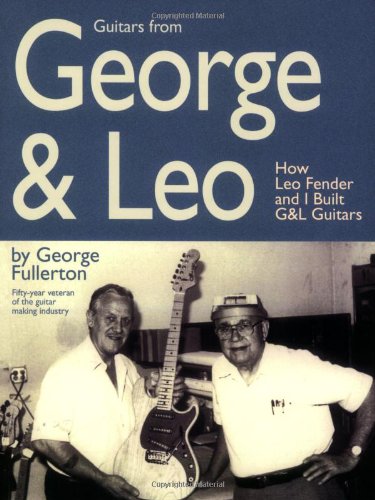
After the frantic soldering fest that was The Pagey Project, I figured it might be time for a nice, simple DIY wiring project. At the suggestion of tonefiend reader JH, I played with variations on the 2-band tone control that appeared in some G&L guitars. And I am over the moon with the results!
This circuit, sometimes called “PTB” (for “passive treble and bass”) combines a standard treble-bleed tone knob with a bass-cut control. The latter has a huge effect on the way distortion pedals and amps respond to the pickups, especially with humbuckers. Cutting some bass makes the pickups sound cleaner, airier, and more dynamic (i.e., less compressed). To my ear, the bass pot is not so much a tone control as a clarity knob.
Hi folks — I’m experimenting with a switch to the SoundCloud audio player. I’ve been eyeing it for a long time, but until now it’s been entirely Flash-based, which meant you couldn’t access SoundCloud clips from mobile devices. But they’ve just introduced HTML5 support, so I’m ready to make the plunge.
The clip is an accompaniment to the post below about using unspotted Seth Lover pickups with the expanded Phase 2 version of the Jimmy Page wiring scheme.
One of the coolest things about SoundCloud (beside the nifty waveform view) is the fact that it supports notes. Just click on the little icons beneath the waveform to read a description of which pickup settings are being heard at a particular point. Sweet.
Work for you? Computer? Phone? Tablet? Any comments or questions? (Thanks in advance for for your unpaid beta testing!)
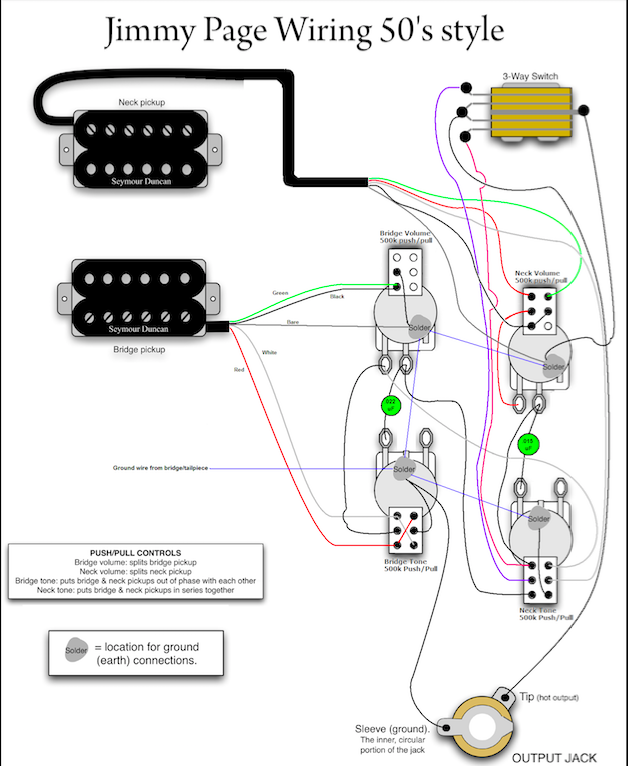
Man, preparing the Pagey project has been a real eye-opener! Expect some surprising results! (Hint: There’s much of interest, even for players who have zero desire to sound like Page.)
I’ll be posting the first video and tech walk-through after the weekend, but in the meantime, I wanted to update you on the game plan, which, frankly, only became clear once I started soldering.
If you haven’t downloaded the relevant schematics, you can snag them here. (Reader Jeff pointed out pointed out a difference between the two versions of the four-push/pull wiring. I have no idea which version page used, but I went with the version from Scott Miller’s Guitar Player magazine article because it offers a bit more control — and this project is all about control!)
We’re going to tackle the project in two phases. First, we’ll look at the original Pagey wiring, using four push-pull pots and period-accurate pickups (I went with Duncan ’59s with four-connector cable). I’ve wired up my ’82 Les Paul in exactly this fashion, and it’s pretty dang cool. Yes, it’s a complicated job, but not as tough as anticipated. Amazingly (for me) it turned out great on the first attempt. (more…)
In the previous installment of our ongoing mongrel strat series, I experimented with a version of Gibson’s oddball Vari-Tone circuit. I said it was too fussy and complex, and that I wanted to experiment with a simplified version.
So naturally, I built a “parts” Strat with a Vari-Tone twice as complicated as the original — a configuration I’ve dubbed the “Obsessive/Compulsive Tone Control.” I also deployed some of my favorite quirks and wiring tricks from previous strat experiments, plus a few new hardware discoveries. Result: a weird-ass guitar that only a geek could love a cool, one-of-a-kind instrument.