No, I had not. And they’re soooo good. All three are from YouTube user MotorGoblin. I don’t know anything about him, beyond the fact that he’s clever, funny, and very musical.
Anyone have any similar techniques to share? (I’ve been meaning to do a post on my “plastic tube Leslie”…)
For the first Fishman TriplePlay demo I posted last month, I featured pretty, naturalistic acoustic sounds. This time around I went for something a little less polite.
I’ve been having a blast — albeit a humbling blast — trying to play real-time drum parts from the guitar. I still suck if it’s much more complicated than what I play here, but I can imagine learning to do it well. It’s also fun using the guitar to access the big keyboard sound libraries I’ve built over the years. Perhaps most exciting of all are the hybrid guitar/synth/sample sounds I’m starting to develop. (There aren’t any in this demo — the sounds are either samples or processed guitar, though I blur the lines with guitar-ish samples and guitars processed to sound like machinery. Next time, though, I’ll try to showcase some of those unholy hybrids.)
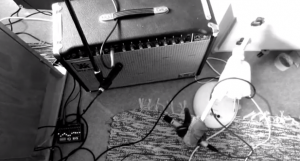
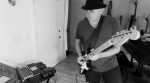
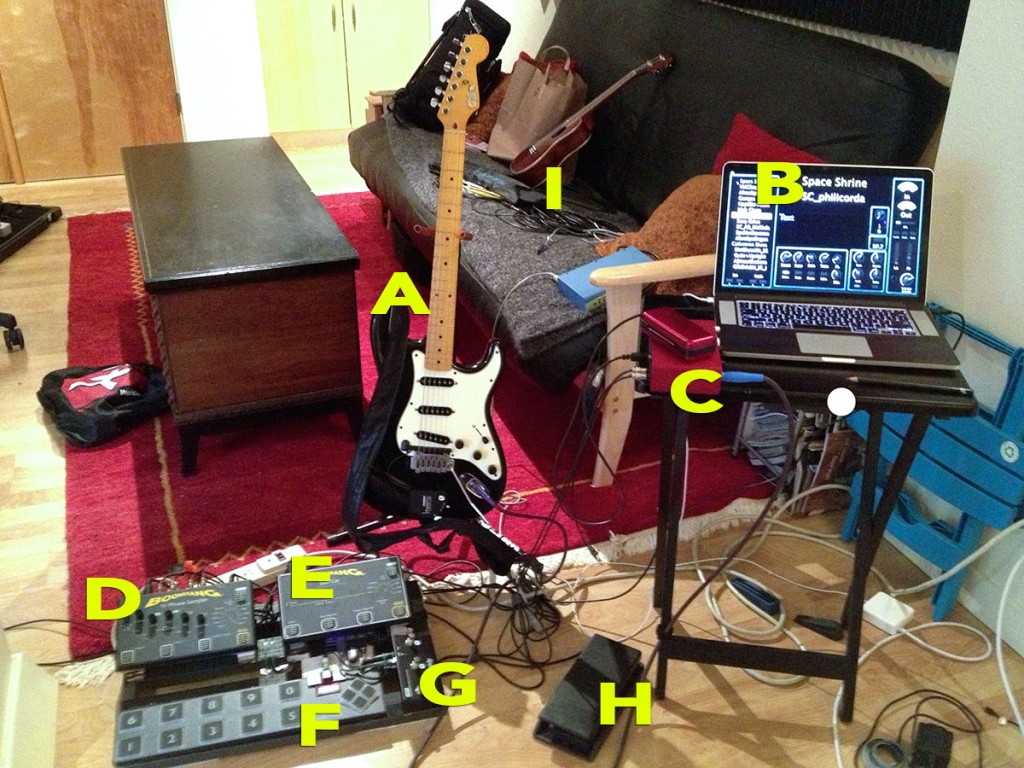
Here’s how the setup looks from my perspective. (I’m not trying to be secretive about what’s on the floor — it’s just hard to fit into the frame, even with a wide-angle lens.)
Joe’s looping/MIDI rig.
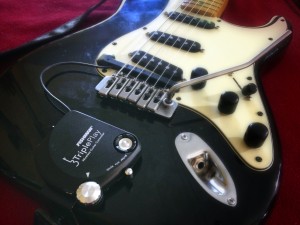
Homemade strat with Fishman controller/pickup. MIDI transmitted wirelessly.
MacBook Pro running Apple’s MainStage software. I use a ridiculous number of plug-ins and some ridiculously huge sample libraries. My main sampler is NI Kontakt.
Focusrite Scarlett interface. All the prosumer interfaces sound pretty decent to me these days, though I like the fact that this one isn’t made out of cheapo plastic.
Boomerang III looper. I love its ergonomics and smooth looping points. I screw up my loop points constantly, but I have fewer disasters with the Boomerang than with anything else I’ve tried.
Boomerang Sidecar. Basically just extra buttons for the Boomerang so you can access more features without reprogramming it or performing awkward foot moves.
Keith McMillen SoftStep MIDI controller. Powerful, rugged, feather-light, and not too expensive.
Logidy UMI3. A nice, rugged, and inexpensive USB MIDI controller — just to have a few extra switches.
Generic controller pedal. Its role varies from patch to patch. It might be a mod wheel, a pan pot, a fader, a filter cutoff control, etc.
Piles of crap. These magically materialize every time I start messing with this stuff.
Just to be clear — these sounds are from my collection, and are not included with TriplePlay. Also, I used TriplePlay in “simple mode” for this video — in other words, I’m not using the dedicated TriplePlay application, but simply using TriplePlay as a generic MIDI controller to trigger sounds loaded into MainStage.
BTW, I’m about to head out for Musik Messe in Frankfurt, Germany, where I’ll be demoing this contraption. Oddly, I’ve never been to this vast musical instruments show, which has been described as a much larger NAMM show with more sausage, beer, and accordions. I’ll be sure to tell you about any cool stuff I see!
DISCLOSURE: Fishman, Apple, and Keith McMillen are among my clients, but no one paid me to make or post this video.
But I wouldn’t use them on, you know, one of my normal guitars.
But then I recorded that Bartók piece, using the above-mentioned Guid and Bass VI alongside two standard-tuned guitars with roundwounds. The piece has a lot of counterpoint — all these motifs bouncing between the instruments. And the more I listened, the more I realized that I liked the tone of the two flatwound guitars far more than that of the two roundwound guitars.
And then I bottomed out. I put flats on four more guitars. It wasn’t just musically risky — it was economically catastrophic! And that’s what brought me here tonight.
Funny thing about flatwounds: Everytime I pick up a guitar with flats, I react negatively to the dullness of the wound strings. Where’s the shimmer? Where’s the zing?
But the more I listen, the more I get sucked in. Parts layer over each other more readily. Chords speak more clearly. Fuzz and distortion yield sweeter overtones. It’s easier to get a consistent sound from melodies spanning wound and unwound strings. And the feel? Smooth, sleek and sensual.
Sigh. Maybe I’ll try and kick the habit again tomorrow.
For the last few months I’ve been working with Fishman on the documentation for TriplePlay, their long-awaited wireless MIDI guitar system, which will finally ship this quarter. I had a blast demoing TriplePlay at MacWorld a few weeks ago, and I’m looking forward to doing so again at Musikmesse in Frankfurt in April.
But at times, it’s been frustrating. I power up TriplePlay to study some feature, get all excited, and then have to turn it off and write about it instead of going off and playing it for six hours. This little demo was my first real chance to just fool around with the thing. Thoughts and details after the video.
Bartók: Smarter than math-rock — and way more violent.
My Bowie fandom is second to none. Yet I’ve always felt a vague sense of disappointment that the Spiders from Mars didn’t really sound much like spiders from Mars.
On the other hand, the fourth movement from Béla Bartók‘s Fourth String Quartet really does sound like Martian spiders — assuming the critters in question had been force-fed a diet of chord clusters, mathematics, Hungarian folk music, and some of the most astonishing counterpoint this side of J.S. Bach.
And dig it: This white-hot blast of dissonant modernism was composed in 1928!
And how does this string quartet music sound on guitars? Awesome, IMHO — largely because the movement is played entirely pizzicato (plucked, not bowed). Very few modifications were needed to adopt it for four electric guitars.
“We are all interested in the future, for that is where you and I are going to spend the rest of our lives.” — Criswell, Plan 9 from Outer Space
UPDATE:Wow, I can’t believe all the cool stuff folks have been posting to comments. I find myself feeling quite inspired about the future of instrument — when I’m not laughing so hard I spit coffee all over my laptop. Thanks for all great ideas. Keep ’em coming! 🙂 :thumbup:
Prophecy is for suckers. Who’s stupid enough to go on record with bold prognostications about the future of music and music-making, given the near-certainty that the words will reappear someday to bite you on the ass?
Well, me. And, I hope, you.
So I invite my fellow foolhardy loudmouths to join me in sharing their half-assed guesses wise and well-informed predictions about our brave new fretboard future.
The author of the most compelling prediction wins one of my hand-built stompboxes. So does the author of the one that makes me laugh hardest.
Post your predictions to comments. I’ll go first. 🙂
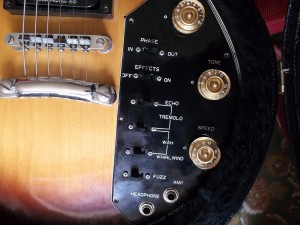
First, he got his hands on a Kay Effector — a psychotronic Korean axe with built-in effects. Then he got it working. Then he recorded a bitchin’ demo. It’s required reading/listening for deviant guitarists.
The recent experience making a DIY Class A Champ reignites for me the eternal debate between the merits of Class A and Class A/B amps. (I link once more to Dave Hunter’s excellent short article on the topic, since he explains the distinction so much better than I can.)
Like most American players of a certain age, I grew up without access to great Class A amps. (I’m going to take the lazy way out here, and lump Voxes and their kin into the Class A category, despite the distinctions that Dave H. explains so well.) My initial exposure to various ’90s Vox reissues and other “Voxoids” of the era was enough to spark my interest. (And is “spark” the perfect verb for great Class A amps, or what?) But it wasn’t till I encountered Matchless amps and real vintage Voxes that I totally got it.
But still, I go back and forth constantly. And whenever I switch between categories, I think, “Ah! There’s what I was missing,” though I tend not to miss it when I’m playing an amp of the opposite type. So at least I’m usually happy.
Overall I’ve probably favored Vox-type amps over Fender- and Marshall-flavored ones, though I’m the sort of player who’s rarely interested in macho rock and metal distortion. (If that weren’t so, I’d be an A/B purist!) But having said that, my fave amp these days is the decidedly A/B brownface Tremolux I use in the lion’s share of my videos. So put me down as perennially undecided.
How about you? Do you pledge your allegiance to the explosive harmonic energy of Class A or the focused impact of Class A/B? And has anyone explored switchable schemes, as found on some Mesas and modded Marshalls?
When you make DIY stompboxes powered by 9-volt batteries, your biggest fear is a solder burn (or dropping your drill on your iPad, but that’s another story). DIY amps are different: AC voltage can kill you, so a klutz like me approaches amp builds with caution.
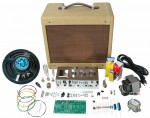
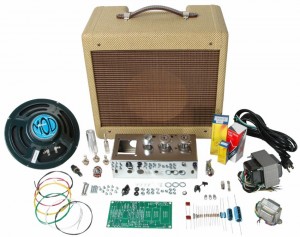
Which brings me to one of the great things about Tube Depot’s Tweed Champ Vacuum Tube Amp Kit: the fantastic assembly manual. Other great things include the price ($499, roughly half the price of a non-kit Champ clone of comparable quality). The design (which follows the original circuit, but substitutes an intelligently designed circuit board layout for the original turret board). And most of all, the tone.
I’ve got lots more to say about the kit, the fun I had building it, the lore of the 5-watt ’58 Champ, and the pros and cons of Class A amps (the Champ is the only Fender classic that merits the classification). But first, have a listen! (more…)
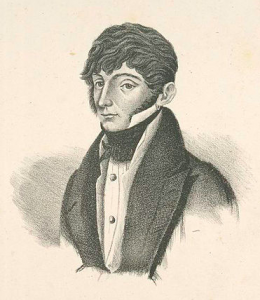
I’m 200 years old, but I can still kick your ass, punk!
UPDATE: I’m proud to announce that my fingerstyle video lesson based on the 200-year-old etudes of Mauro Giuliani has been selected to appear in the debut issue of Pure Guitar, a new digital guitar mag whose editorial staff includes my two music journo mentors : Tom Wheeler and Jas Obrecht. Also on board: jazz ace Wayne Goins, session superhero Tim Pierce, Nashville’s leading guitar tech, Joe Glaser, and other preeminent axe experts.
You’ll find my article here — but frankly, I recommend starting at the homepage of issue #1 and reading all the way through!
Congrats, guys, on the new mag. I’m psyched to be part of it. :beer: