Categories
Music

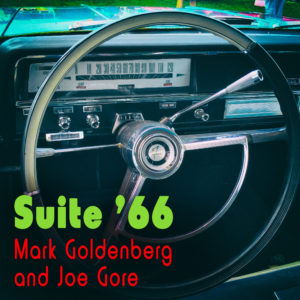
Suite ’66: Free EP by Goldenberg & Gore!

suite-66-cover

A free EP from we to thee!

Guitar genius Mark Goldenberg and I recently recorded Suite ’66, a set of improvised duets on four tunes from 1966, in honor of the 50th Anniversary of one of the greatest years in pop music.

We teased this “release” a few months ago with this rehearsal video. The EP features a more developed version of the same tune, plus three others.

Even if you’re not familiar with Mark’s name, you’ve probably heard his playing. Mark has been a leading LA sideman and session player for decades. He’s worked with Jackson Browne, Linda Ronstadt, Bonnie Raiit, Waylon Jennings, Chris Isaak, Willie Nelson, Hugh Laurie, Natalie Imbruglia, and most impressively, William Shatner.

Less well known is Mark’s beautiful solo style, which resides at the intersection of rock, classical, and jazz. I was instantly smitten when I first heard Mark play in person at one of Teja Gerken‘s solo guitar events a couple of years ago. Mark’s musicianship flabbergasted me, plus we bonded over the fact that we shared the same teacher, the late Ted Greene. (Though I studied with Ted when I was a teen, so much of his wisdom went over my head. Mark, however, worked with Ted after becoming one of LA’s most respected players, so he absorbed Ted’s insights on a far deeper level.)

Listening to Mark play is sheer musical ecstasy, whether or not I happen to be picking along with him. He’s been one of my greatest musical inspirations of the last few years. (Translation: I’ve ripped him off more times than I can count.)

Listen and download via SoundCloud:

Tech notes: We recorded and mixed this in my basement studio. I’m on the left channel throughout, and Mark’s on the right. (There are no overdubs.) My instruments are a Gretsch Spectra Sonic electric baritone guitar (kindly loaned by Xander Soren), a Veillette Avant Gryphon octave 12-string, and a Taylor 150e 12-string. Mark plays two magnificent guitars: his Kenny Hill classical and a Collings 001MH steel-string.

IMPORTANT: This non-commercial recording is shared as a gift between us and our friends. It may not be reused for any purposes, especially commercial ones. We’re simply inviting you to listen in on our jam session.
Categories
Music

Tribute to Mancini: “Lujon” for Solo Guitar and Looper

I was polishing up my solo solo version of this lesser-known Mancini tune, and I was reminded once again of the late composer’s genius. Sure, we all know he was a great tunesmith and brilliant orchestrator. But the deeper you dig into his compositions, the more remarkable things you uncover.

Even though Mancini worked exclusively in pop idioms, I rank Hank as one of the 20th century’s greatest composers. Everything he composed seems to have some remarkable and unlikely compositional twist, even the best-known tunes we take for granted. Consider the slippery chromaticism and crunchy minor-3rd modulations of the Pink Panther theme. Or the familiar “Baby Elephant Walk” melody — if you take a step back, you realize how bizarre it is, rocketing up as an arpeggio before leaping down to a dissonant note. It’s also easy to forget how shocking the Peter Gunn theme was, with those violent dissonant accents, not to mention its unprecedented fusion of brainy Stan Kenton harmonies and greasy guitar rock. (Jobim is the only parallel I can draw in terms of writing wildly original chromatic themes that somehow become universally beloved pop melodies.)

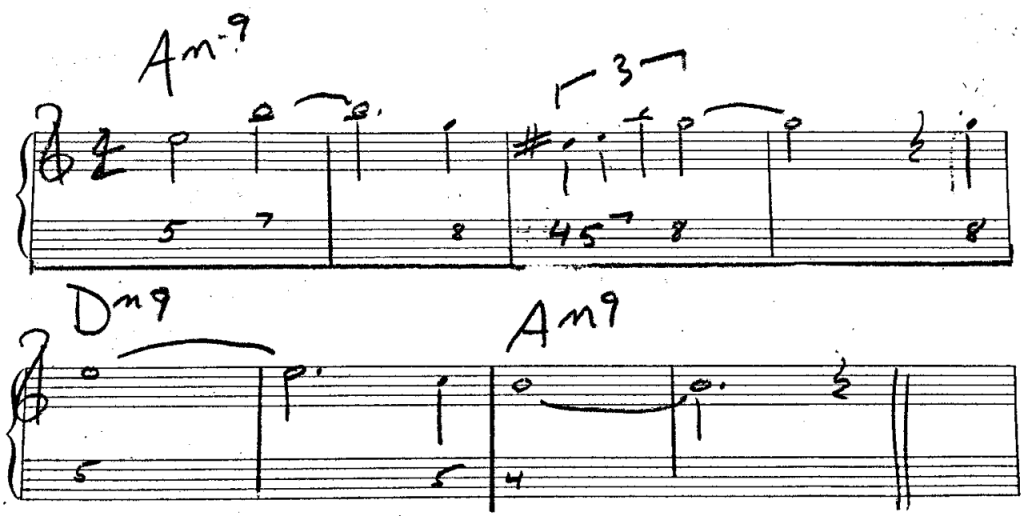
This song is Mancini’s take on the exotica style created by the likes of Martin Denny and Les Baxter. (Mancini was far too tasteful to include exotica’s signature big-call effects, but I lack such restraint.) But check out the cool melody and the way is straddles the underlying harmonies:

Lujon music

We’re in A minor, but no A notes appear in the main melody. Instead, the tune lingers on the 9th, emphasizing B over the Am7 chord and E over the Dm7. Eventually an A does appear — but not till the downbeat of the B second, by which point we’ve embarked on a long, twisted trail of chromatic modulation.

My Mancini obsession goes way back. In the ’90s, I was privileged to play in Oranj Symphonette, a jazz group lead by cellist Mat Brubeck (yeah, Dave’s son) that also included peerless keyboardist Robbie Burger, mad multi-instrumentalist Ralph Carney, and drum titan Scott Amendola (later replaced by the equally awesome Pat Campbell). Sadly, our two Rykodisc albums are out of print, but there’s buttloads of our stuff on YouTube.

Damn, I miss that band. Reunion, anyone?

Categories
Gigs

I’m Performing Solo. Yikes.

joe_solo
Seriously, dude — where’s my band?

Anyone have much experience playing solo instrumental guitar gigs?

Even though I’ve been playing since the Pleistocene, I’ve only performed solo once since I was a teenaged classical guitarist. But I’ll be making the stumble leap this Wednesday, Sept. 11th, when I perform north of San Francisco at the Sleeping Lady Cafe in Fairfax. I’ll be a guest at Teja Gerken’s monthly fingerstyle guitar showcase, performing alternating tunes with Teja and Mark Goldenberg. (Gig details here.)

Both Teja and Mark are gifted players and composers — check out the evidence here and here. I believe they’ll be playing acoustically, while I’ll be dragging up my whole frickin’ looping/synth rig. Because what could provide better counterpoint to an evening of refined and intelligent fretwork than a goddamned electronic racket?

Oh — that one solo gig? It too was a multiplayer solo guitar night featuring some astonishing players: Will Bernard, Jim Campilongo, and Buckethead. Will, Jim, and Brian were as amazing as you’d expect. Meanwhile I put everyone to sleep by performing the entire Bach A Minor Lute Suite on steel-string acoustic. (I’m sure the audience was duly impressed by my formidable memorization skills as they nodded off.)

I’m not repeating that mistake! This time it’ll be fuzz and feedback, with a double side order of ring modulation!  :pity:

So got any survival tips for performing solo? Any good jokes for during the inevitable laptop crash and reboot?

If all else fails, I can borrow a trick that the late, lamented Danny Gatton once shared with me in an interview: A lifelong tinker, Gatton built a stompbox designed to blow the power in any club. If he didn’t like how the gig was going, he’d click it on, plunging the venue into darkness and calling it a night. (Or so he claimed.) Hmm — maybe that’ll be the next tonefiend DIY project….