Categories
DIY Effects guitar

Museum of Lost Effects:
Interfax Harmonic Percolator

Few guitar pedals can rival the cult cachet of the Harmonic Percolator, a singularly ugly distortion stompbox produced in minuscule numbers in the early ’70s by Interfax, a small company based in Milwaukee, Wisconsin. And guess what? They sound ugly too, though they’re ugly in a cool and useful way.
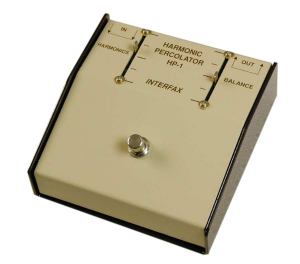
They don't get much rarer — or uglier.
They don’t get much rarer — or uglier. (This is a cosmetically faithful reproduction from Theremaniacs.)

I’ve been wanting to write about these for years, but was hindered by the fact that I don’t have access to one. No one does! Well, except the pedal’s best-known user, producer/guitarist Steve Albini. (Steve has posted several popular YouTube videos in which he sings the praises of the original and evaluates it against modern clones.)

But I revisited the idea recently when Christian Magee, who runs Tube Depot, sent me a couple of old 2N404A transistors from a stash he recently acquired. This rare PNP germanium transistor appeared in the original, along with an NPN 2N3565 (also rare, but not as ridiculously rare as the 2N404A). Yes—this pedal uses both a positive-ground germanium transistor and a negative-ground silicon transistor in the same circuit. (Another Fuzz Face/Tone Bender clone, this ain’t!)

I whipped up several variants:

    • a clone using the original parts


    • a near-clone using more readily available alternatives


    • a Harmonic Jerkulator, an all-silicon/no-diodes variation created by DIY stompbox titan Tim Escobedo


    • an experimental version with extra controls

Survey the wreckage:

Post-mortem after the jump.

Categories
Effects guitar

Museum of Lost Effects:
The Systech Harmonic Energizer

IMG_5847
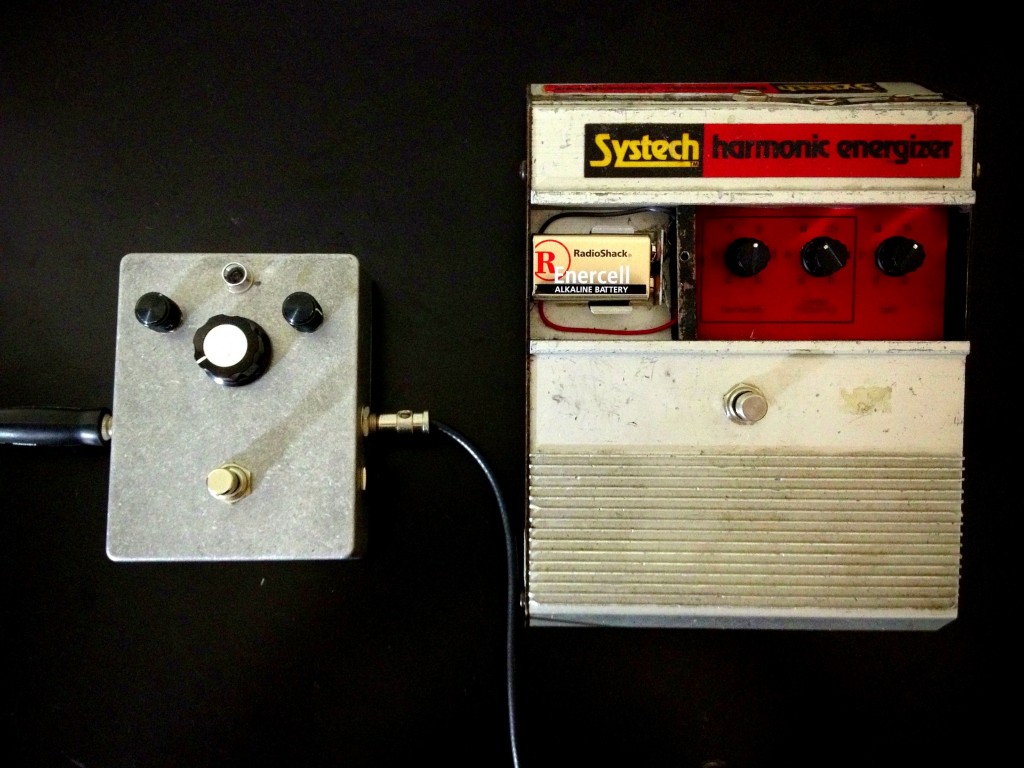
A homely clone cowers in the shadow of a ramshackle original.

Okay, here’s an old weirdo I’ve been meaning to write about for ages. The Systech Harmonic Energizer is an ultra-rare filter/distortion effect from the ’70s that takes the fuzz-wah formula in some interesting directions. Its signature is edgy, ultra-resonant filter sounds. You’re most likely to have heard it generating Frank Zappa’s nasal midrange squawk, but it does lots of other abrasive tricks too. I used this one on Tom Waits’s “All Stripped Down,” and on “Jets” by Action Plus.

The S.H.E. doesn’t do pretty. Most of its sounds are so strongly flavored, they’re hard to use as a primary tones. But it’s great for things like clanky percussive accents, or walloping low-frequency assaults.

But let’s talk later. First the video:

Categories
Effects guitar

Museum of Lost Effects:
Maestro Rhythm ’N Sound for Guitar

Well, I’m not sure it’s fair to call it a “museum” when there’s only one exhibit so far. But it’s a really, really good one…

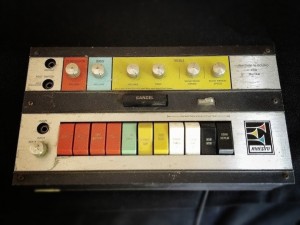
I bought this Maestro Rhythm ’N Sound for Guitar for a pittance back in the ’90s. It’s a primitive multi-effect unit from 1968, with a cool octave-down bass tone, auto-wah, and two fixed filters. It’s got fuzztone (though mine has always been broken), and a weird, choppy tremolo reminiscent of the Vox Repeat Percussion effect. (Mine worked fine — until I broke it yesterday while trying and failing to fix the fuzz. Kill me now.)

But the marquee feature of this hand-soldered contraption is the option of triggering four wonderfully cheesy analog percussion sounds. Bongo? Cymbal? Tambourine? Clave? At your command!

Does it sound as weird as it sounds? No — weirder!

You can’t assign specific specific notes to specific sounds — any input triggers the percussion, so the clicks and clanks tend to work best shadowing every note in a phrase, adding a weird edge. (I used them like that on Oranj Symphonette’s “Charade,” Erica Garcia’s “Yo No Tengo La Culpa,” and PJ Harvey’s “Maniac.”)

But then it occurred to me you could more ambitious things with the percussion sounds via looping. Which is exactly what I do in this short, fuzz-free video.

Check it out — and then let’s talk about this Museum of Lost Effects thing!