Categories
Digital guitar Music Technique

Less-Boring Looping (“Pumped-Up Kicks” Cover)

For a while I’ve been playing this loop-based cover of Foster the People’s “Pumped-Up Kicks” at solo gigs and with my duo band, Mental 99. At risk of sounding like a pompous dick, I’ve annotated the performance, highlighting techniques I’ve found useful for making loop-based performances livelier and less predictable.

I’ve covered some of this ground before, particularly in this Premier Guitar looping-technique article. But here I call out the techniques mid-performance, and I’ve included a few new ones. I hope you find some of them useful.

Likewise, I’ve already written about my live looping rig, but it’s changed a bit since then, and I’ve recently integrated a Universal Audio Apollo Twin interface (plus the stellar plug-ins it allows me to run). An updated overview:
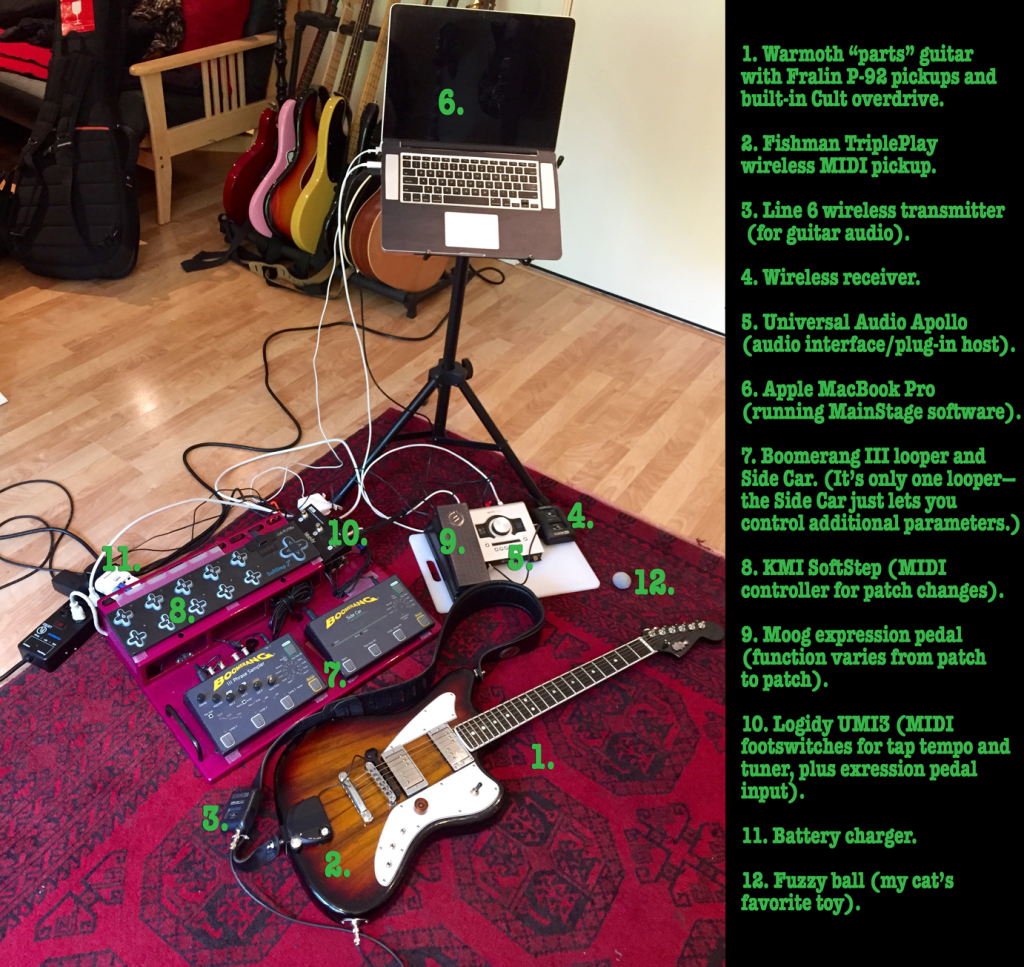
Pedalboard-Diagram

The arrangement perform nicely, and I dig the individual components. But I dislike the system’s Rube Goldberg complexity—it’s a royal pain to set up and schlep. I’m always looking for ways to simply. (Other than, you know, just plugging the guitar into a frickin’ amp.) I’m open to suggestions for streamlining!
Black Mac
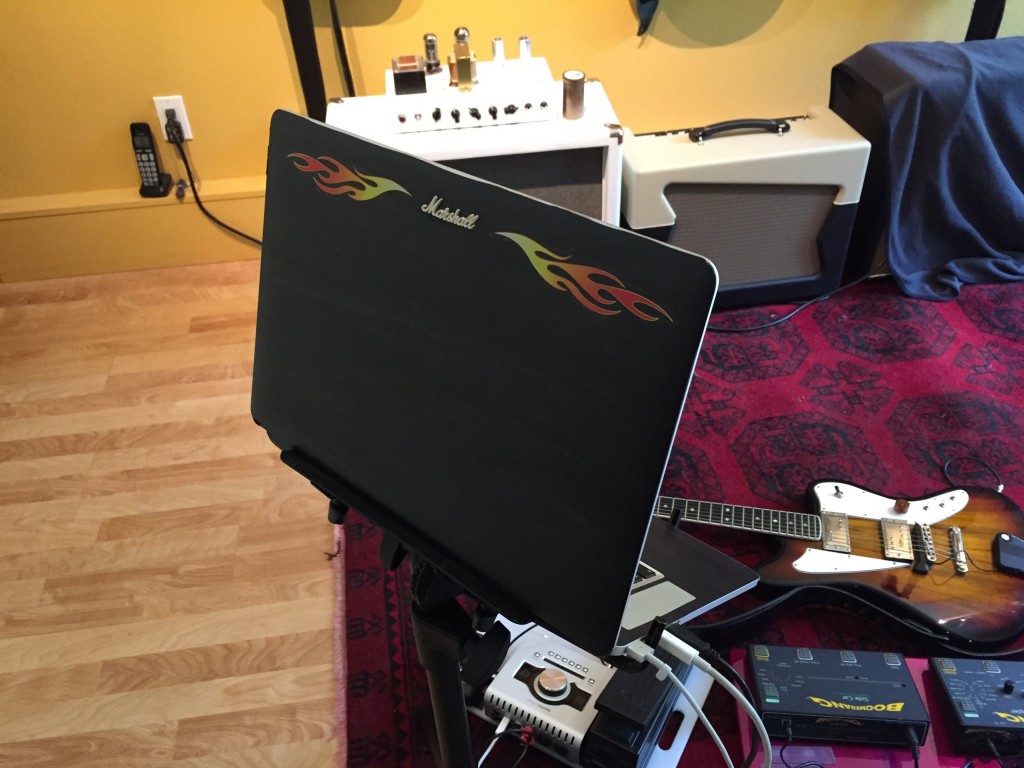
I love Apple products, but I hate having Macs onstage (mainly ’cause they’re so much better looking than me). Covering it in black wrap makes it less obtrusive. The Marshall logo is from one of those “toy” stacks (which, of course, can be far more than toys in the studio).
Categories
Digital Recording

My New Fave Mobile Interface

Apollo-Twin_WEB-Award

Premier Guitar has posted my review of Universal Audio’s Apollo Twin interface. Short version: I love the thing.

A rackmount Apollo interface has been the core of my studio for two years, replacing both a Pro Tools HD rig and a complicated Apogee setup. I adore Apollo’s great-sounding preamps, lucid interface, and innovative software, which, among other things, lets you track through simulated preamps on your way into your DAW. Also, UA’s analog modeling is second to none. (You hear their reverbs and tape simulations on most of the stuff I’ve recorded for this site.)

The intensity of my Apollo love is rivaled only by my scorn for the crappy mobile interfaces I’ve previously used with my live laptop rig. The problem isn’t audio quality — even the cheapest ones can sound surprisingly decent — so much as lousy ergonomics and flimsy construction. I’ve burned through half a dozen interfaces in the last few years. They just aren’t built to last onstage. Or anywhere else.

That’s why I’m so stoked to have the small-format Apollo on my digital pedalboard. It’s built well. The UI is brilliant. There are no horrid breakout cable octopi. It has the same preamps and processors as the rackmount Apollo. And I have access to my favorite UA plug-ins, including the juicy EMT plate reverb simulations, the stellar tape echo models, and a suite of low-latency virtual preamps. It’s pricy for a mobile interface: $700 for the single-processor model and $900 for the dual-processor model. But I’d spent far more than that on self-destructing junk that I wound up giving away or recycling.

Anyone else tried Apollo in its various formats? Or any other cool converters? Your observations, please?