Categories
DIY Effects guitar

It’s Raining Germanium!

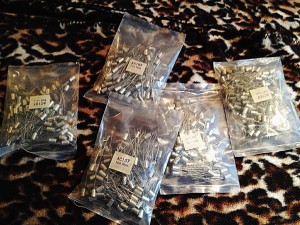
I just bought 500 germanium transistors. Yes, as a matter of fact, I am insane. Why do you ask?
I just bought 500 germanium transistors.
(Yes, as a matter of fact, I am insane. Why do you ask?)

UPDATE: My Dunlop Fuzz Face Mini review is live at Premier Guitar. Audio clips included!

How and when did it get so frickin’ easy to procure great-sounding germanium transistors?

I’ve been building stompboxes for four years or so. I used to consume article after article detailing the sheer horror of dealing with germanium. Sure, those old-school transistors sound great, I’d read, and they’re necessary for vintage distortion circuits. But they’re unstable. They’re expensive. They’re hard to find. You have to sort through dozens to find the few good ones. And once you do, you must spend countless hours matching and biasing them for optimal sound.

I believed everything I read — until I finally admitted to myself that I seldom encountered any of those problems.

(If you don’t know much about germanium transistors and why they’re cool, here’s my manifesto.)

I used to buy germanium transistors from Small Bear and other parts sites, and was always happy with the results, even though I had to pay eight or ten bucks per transistor. (Small Bear even does the matching for you, offering sets of transistors suitable for various vintage fuzz circuits.) However, it was a little tough finding NPN (negative-ground) germanium transistors. In fact, Small Bear once rejected my order of a dozen or so NPNs because they were so scarce. (To his credit, Small Bear’s Steve Daniels explained that he restricted sales so that everyone who wanted to build a couple of great DIY fuzzes would have the opportunity.)

The workaround is to build pesky positive-ground pedals, or jigger with the schematic in order to use PNP (positive-ground) transistors in negative-ground circuits. (This site’s Fiendmaster project is an example of the latter workaround.)

Then some odd things happened:

Categories
DIY Effects guitar

The “Super-Fiend” DIY Fuzz Face!

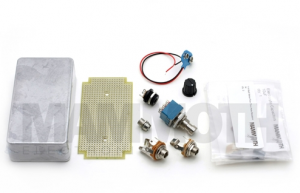
You can purchase a kit, or source your own parts.

UPDATE [06.16.2013]: Build instructions updated to v02.

The Fuzz Face has inspired countless spinoffs since Ivor Arbiter unveiled the device in 1966. Some introduced meaningful improvements. Many didn’t.

The goal of this project, created by my friend Mitchell “Super-Freq” Hudson, is to create a pedal very similar to the original. It’s a great way to explore one of the iconic sounds of ’60s rock (and lots of ’60s-influenced rock).

The instructions are available here. [19MB PDF.]

You can order a kit from Mammoth for $45. (Disclosure: Neither tonefiend nor super-freq has any financial stake in these kits. I simply asked the Mammoth guys to create one for your parts-sourcing convenience. All necessary parts are readily available from other vendors.)

But before you attempt the project, please be aware of some of its quirks. (And if you’re curious, you can read about how I customized the pedal I used in my video demo.)

Categories
DIY Effects guitar

Fuzz Face:
The Daiquiri of Distortion Pedals?

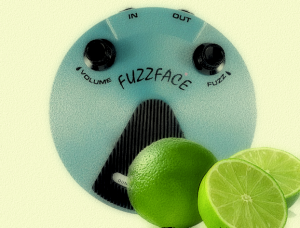
fuzzlimeMost sentient guitarists love Hendrix, but not everyone is equally fond of his signature distortion pedal.

So what’s your take on the Fuzz Face?

I used to hate them — but only because my sole exposure to them was via the crappy reissues of the ’70s, ’80s, and ’90s. They sounded so brittle and harsh! Not till this century did I encounter the pedal in its original incarnation.

What a difference!

Vintage-style Fuzz Faces produce tones that are warm, rich, and unbelievably dynamic. It was like the first time I tasted a vintage-style daiquiri. Like the Fuzz Face, the classic daiquiri is a delicate concoction made from a few simple yet complexly interactive ingredients — nothing like those nasty blended drinks that taste like Slurpees spiked with Everclear.

Here’s everything I love about vintage Fuzz Faces, compressed into 60 seconds:

My DIY version is based on inventor Ivor Arbiter’s original 1966 schematic. That’s also the basis for a new DIY project created by my stompbox-buildin’ pal Mitchell Hudson, who runs the cool DIY site Super-Freq. We’ll both be posting it on our sites in the next few days. You can source the parts on your own, or order a kit for less than $50 — not as cheap as some of our other DIY projects, thanks to its two relatively pricy germanium transistors.

Most lore about “mojo” stompbox parts is utter nonsense, but there is something harmonically unique about the germanium transistors used in ’60s fuzz pedals, including original Fuzz Faces. (See my “Germanium Mystique” post/rant for more info.) You don’t need germanium for a good fuzz sound — there are many great tones available via silicon transistors, integrated circuits, and digital modeling. But one problem with those god-awful Fuzz Face reissues was that they often simply substituted high-gain silicon transistors for germanium ones without modifying anything else in the circuit. The result was more gain, but at the cost of harsh, excessively bright tones and inferior dynamic response.

In the last decade or so, builders have wised up. Numerous manufacturers offer authentic ’60s-style replicas. Meanwhile, the DIY community has created countless variations, many of which use post-germanium parts to great effect. These days it’s pretty easy to find a Fuzz Face that doesn’t suck.

I’ve build many Fuzz Face variants, but until Mitchell created his Fuzz Face project, I’d never done a strict original, with positive-ground wiring, PNP transistors, and few latter-day “refinements.” (Don’t sweat it if those terms mean nothing to you — they’re all explained within the project.)

Anyway, that’s the circuit you hear in the video above. It’s not a fuzz for all seasons — it doesn’t have a ton of gain, and its loose, spongy distortion is unsuitable for metal and modern hard rock. But I love its warm, non-macho timbre and phenomenal dynamic response. It’s simple, classic, and delicious, much like this.