Inspired by the most sublime thing you can drop into a cocktail. Or maybe that and the cocktail.
The guitar is a random collection of Fender Strat parts with Duncan lipstick tube pickups. They sound a zillion times better than modern Danelectro pickups. (Plus I boycott Dano on principle because their parent company is a major supporter of homophobic far-right legislation.)
On the occasion of a daunting round-number birthday, I’ve just completed Loopocalypse, a concert-length video of my live looping show. I’ll be posting a song per day, each featuring a different guitar, from now till Thanksgiving/birthday. Here’s Day 1 of 17, a tribute to that dearest of the dearly departed, David Bowie. I’ve been playing this for years, and it just gets sadder and sadder. Tomorrow I’ll share something appropriately angst-ridden for the US election day. (Here’s a remembrance of my brief Bowie encounters, written the day after he died.)
Here’s an explanation of my live looping rig. The guitar is an all-original 1963 Strat that I’ve owned since 1980. For many years it was my only good guitar.
I’ve been following the story of Fishman Fluence pickups and their radical pickup design for a few years. From the beginning, I’ve thought Fluence pickups sounded great in the hands of some other guitarist, but this is the first chance I’ve had to experiment with my own set.
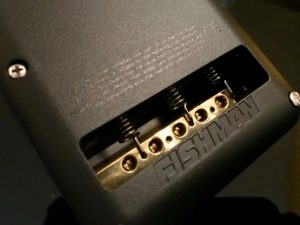
Most of the tech details are in the video. But in brief: These are active pickups with magnets, but no wire coils. Instead, the “coils” are printed on thin pieces of circuit board glued together like plywood. This design removes all noise and hum — chances are these are the quietest single-coil-sounding you’ll find. (Fishman also makes humbuckers and Tele pickups.) They can run on 9-volt batteries or (this is the other interesting part) a separately sold battery pack that replaces the trem cavity back plate. (There are other battery configurations for other guitars.) Another marquee feature: Each Fluence set includes a push/pull pot to switch between vintage voicing and a hotter “modern” sound.
This technology originated at an aerospace company. Someone there realized that their printed coils might work on musical instruments, and they contacted a leading pickup manufacture, who passed on the idea. Next it went to Larry Fishman, who was all over it from the get-go. He refined the idea and came up with lots of clever engineering to make it work in guitars. [DISCLAIMER: I have been paid in the past as a freelance contributor to Fishman products, but no one paid me to post this.]
To my ear these sound perfectly authentic, though the fact that they’re active is problematic for me personally. (That’s because I use so many retro stompboxes that don’t play well with the active pickups, which are buffered. The same goes for most of the pedals I sell.)
Killer, indeed!
While installing this in my much-abused MIM Strat, I also added a heavyweight bridge, trem block, and claw from Killer Guitar Components. I’m not kidding when I say “heavyweight” — it’s a formidable piece of metal, beautifully tooled. It feels like a major improvement on the standard design, and I think it sounds great as well (though it’s hard to be definitive about that without side-by-side comparisons). My favorite feature is the way the string inserts are chamfered — strings pop in correctly every time, which. as any Strat player can tell you, it not always the case. Killer, indeed!
You know what sucks about attending NAMM as a manufacturer rather than a gear writer? I was epoxied to my booth all day, and I barely saw anything other than my guitar pedals. But on one rare break, I got to hang out with Jannis Anastasakis and his crew from JAM Pedals of Athens, Greece. (I highlighted some of their beautiful work in my pathetically skimpy “NAMM report.”)
Happily, there’s more to celebrate here than great visuals. JAM builds lovely versions of many classic analog effects. Their sounds and production quality are stellar, and JAM often adds modern updates such as realtime expression control, extra knobs, and internal trim pots for customizing tones. It’s quality stuff, used by many a guitar star.
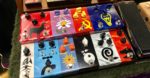
And guess what? Jannis loaned me one of his magnificent Custom Shop analog pedalboards. Γαμώτο!
Sadly, I must now pack up and return this pretty pedalboard. But I’ll be getting my own JAM Delay Llama Supreme, an expanded version of the analog delay heard here, with tap tempo, a cool modulation section, and the almighty infinite-hold switch. (I reviewed it for Premier Guitar a few months ago.)
In the meantime, this experience makes me want to try my own DIY pedalboards. Not as an item for sale — just as a way to group related effects in a single enclosure for stage use. Gears are spinning ….
As threatened, here’s a closer look at Strat with PAF humbuckers used for my recent “God Only Knows” cover. Most parts are from the long-suffering guitar used for all the Mongrel Strat Project experiments. And this one is especially mongrel-ific, with its blend of vintage Fender and Gibson.
Obviously, Gibson pickups is a Strat is far from a new idea. But usually, that arranged marriage is designed to spawn macho, high-gain solos minus the characteristic shrillness of vintage Strat bridge pickups. While many players I love have used humbucker-equipped Strats, I’ve always loathed playing them myself. But what, I wondered, if you didn’t use a hot humbucker, but an über-vintage PAF?
Like many players my age and younger, I was astonished when I first encountered a vintage-voiced humbucker. It was nothing like the dark, over-overdriven tones I associated with the word humbucker. A good PAF is sparkly, resonant, and perfectly capable of gloriously bright and clean tones. Here I used a Seymour Duncan Joe Bonamassa signature set, the same one heard in a more Gibson-like context here.
The results are … compelling. As expected, notes have far more mass than on a conventional Strat, and the bass response is vastly increased. There’s no shortage of top-end either, though the big lows can overwhelm the highs at times. So while I’m pretty much always obsessed with bass-cut controls (especially the high-pass section of the PTB circuit I’ve written about approximately 37 zillion times), it’s especially invaluable in this case. Since lows disproportionately drive distortion, even modest bass cuts clean up the tone and make highs speak more clearly.
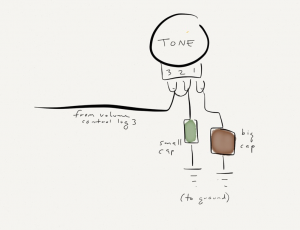
I’ve also incorporated the dual-capacitor treble control I wrote about here. It creates a Vari-Tone/ToneStyler effect in a simplified way: Instead of using a clunky rotary switch to choose from a large set of treble-trimming capacitors, it fades between a large cap and a small cap, yielding the same resonant effect as the more complex options. I’ve incorporated this circuit in several guitars now, and it’s still working for me. It’s especially nice here, when paired with a Steinberger JackPot potentiometer, which lets you bypass the entire tone circuit for absolute maximum volume and brightness. I chose the small cap based on the minimum amount I’d ever want to remove from the signal, and the larger one based on the maximum cut I’d use.
I would have included a photo of the project in progress, but I didn’t because I’m embarrassed about how awful it looks inside. I needed to route out the pickup cavities to accommodate these larger pickups. But instead of taking it to a professional, or getting a proper router and learning how to use it, I chipped away with the tiny routing bit on an inexpensive Dremel tool. Do yourself a favor, kids, and don’t follow my lazy-ass example.
But hey, what’s a Strat pickguard for if not to conceal your shoddy workmanship? The guitar looks okay in the end, and I’m digging its sounds, even though it was far harder to get accustomed to than I’d anticipated. I had to recalibrate my right-hand dynamics to prevent treble notes from screeching. I was almost ready to chalk this up as a failed experiment, but after a few days of noodling around, I started to get the hang of it and enjoy the results. I think I’ll keep it this way for a while — or at least until the next Mongrel Strat concept wafts up from the bowels of Hell. 🙂
It probably wins my vote for prettiest pop-rock song of all time, and it’s a far-from-controversial opinion. “God Only Knows” and all the other great tracks from the Beach Boys’ incomparable Pet Sounds album are 50 years old. (The album was released on May 26th, 1966.)
I owe a big thanks to my pal Mark Goldenberg who inspired me to really learn the entire tune. Mark performs an exquisite solo version, far more lyrical and poetic than my relatively motoric reading. He and I are also preparing a duo version for an album project in the works.
I say “really learn” because you don’t appreciate the number of perverse composition tricks in the tune until you study it bar by bar. Example: the jarring leap into the bridge after the second verse. Or the way that chromatically snaking bridge seems to usher in a return to the chorus, but it’s only a three-bar tease (and in the “wrong” key at that) before a exquisite harmonic pirouette into the final verse. Or the fact that many, if not most, chords in the song don’t feature their root note in the bass. (Especially that verse! The voice leading simply makes no sense on paper, but it’s perfection in practice.) And while countless musicians have praised the outro’s beautiful choral polyphony, I haven’t got much to add, except to say that it’s frickin’ hard trying to cover all those parts! (I didn’t succeed — I only played as many as I could cram into my left hand.)
And oh, the guitar: It’s the latest installment in the ongoing Mongrel Strat Project.I’ve been hacking away at the same sad parts for years. Literally hacking, in this case: I had to route out the pickup cavity to accommodate a pair of über-retro PAFs (a Duncan Joe Bonamassa signature set). Yeah, a Strat with humbuckers isn’t a new idea. But the pickups used are almost always high-gain models designed for macho soloing. I wanted to try something low-gain and unpotted for relatively bright, resonant sounds not quite so far removed from traditional Strat tones. I’m finishing up a video about the project, and I’ll post it in the next few days.
Anyway: Happy birthday, beautiful. You wear your age well.:)
Okay, it’s not the ultimate lipstick-tube guitar for everybody, but it probably is for me. It’s my third lipstick-tube pickup experiment — and definitely my favorite.
You may have heard some of these parts before: I used the neck for all my Mongrel Strat projects, and the Strat-sized Seymour Duncan pickups appeared in my previous lipstick-tube experiments. (I love Duncan’s lipstick-tubes. To my ear, they sound way better than the ones in new-school Danelectros.) The new body is Warmoth’s Hybrid Tele model, in purple with butterfly stickers. It’s très macho. (Better not use if for gigs in Indiana and Arkansas.)
My previous lipstick tube experiments used a MIM Strat body, but I wanted something a little more distinctive, and with a built-in battery compartment (because nothing is a bigger pain than changing batteries in a traditional Strat control cavity). Also, I like how the design evokes both Strat and Tele, since the guitar has three-Strat sized pickups and a whammy, but is wired more like a Tele.
About that wiring: The 3-way pickup selector chooses neck, bridge or both pickups, like on a Tele. Meanwhile, a SPDT switch toggles the middle pickup on and off regardless of the pickup selector, so you get six settings: neck, bridge, neck + bridge, neck + middle, bridge + middle, and all at once. It’s a pragmatic variation on “Nashville Tele” wiring with a switch rather than a pot. That means you can’t dial in varying amounts of middle pickup—it’s all or nothing. But on the plus side, I can jump instantly to an out-of-phase sound from any pickup-selector setting, and it freed up space for the other weird crap I put in this guitar. (Yo, electrical engineers: Don’t bother telling me that combined-pickup settings aren’t really out-of-phase True, they’re not out-of-phase electronically, but they are acoustically, and the distinctive “hollow” sound of combined settings is precisely the result of phase cancellation from two pickups at different positions.)
The weirdest detail is what I call a “cap-fade” tone control. It’s an idea I speculated about back in January, and to which many of you contributed cool perspectives. I pretty much followed the scheme in the original diagram:
The idea again: Instead of sending varying amounts of signal to ground via a tone cap, the pot here fades between a small-value cap (which defines the minimum cut when the control is engaged) and a larger one (defining the frequency of the maximum cut). In other words, instead of sending varying amounts of signal to ground, this circuit always sends everything above the cutoff frequency to ground, with the pot determining the frequency. (more…)
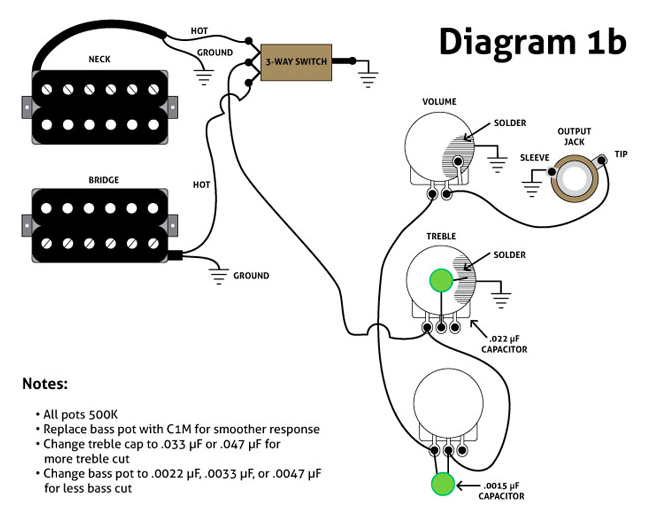
Premier Guitar just posted my new article on three favorite electric guitar wiring mods. The concepts won’t be new to anyone who hangs out here — I’ve pretty much flogged them all to death! But the new article includes the step-by-step walkthroughs that I never got around to creating for this site, and PG art director Meghan Molumby created beautifully clear tech diagrams like this one:
The descriptions and instructions in the new story are clearer and more detailed than my original posts here, plus I’ve refined some details, so I suggest working from the new PG versions.
My three choices:
Yup, the ol’ PTB tone control, the coolest mod I know, at least for players who love distortion. The new version of the project uses the 500K pots you probably already have in your guitar rather than the more eccentric G&L values.
I also revisited the Strat version of the “Nashville-style” Tele wiring popularized by Brent Mason and other Music City cats. It performs brilliantly in a Strat, and IMHO its benefits (vastly more blended-pickup options plus a musical and intuitive control layout) for outweigh the costs (loss of the middle-pickup-alone setting, cost of a 3-way switch). Not to launch a protracted Strat-vs.-Tele battle, but I love the whole notion of “Tele-fying” a Strat via wiring, control layout, and pickup choice.
In the article’s comments thread, several savvy readers also mention Strat wiring systems that provide the sounds of the Nashville mod without sacrificing any others. They’re right — but the more I mess with this stuff, the more I value simplified operation. I’m less concerned with having all options than with having the coolest ones, ergonomically organized. Still, there are many ways you can go here.
Finally, I’m once more beating the dead Varitone horse exploring variations on Gibson’s Varitone concept, updated for modern players. I added a new twist in the PG story: deploying these ideas via toggle switches, rather than a big, clunky rotary switch.
It was fun when PG editor Shawn Hammond asked me to choose my favorite mods. It was easy to decide though — these are the three I keep coming back to, and all three deliver dramatic results, unlike many better-known mods.
So which electric guitar mods would be on your short list? Wiring, hardware, whatever. How do you make your guitars cooler?
WHAT: Twelve germanium fuzz circuits compared and analyzed. These represent the sounds of almost every fuzz pedal introduced between 1962 and 1968.
WHY: A tool to help players identify the circuits most relevant to their musical needs. This isn’t about particular brands of pedals, but the circuits they employ. If you hear something you like, you can either do as I did and build a clone from the schematic, or buy one based on that particular design. (The relative merits of rival clones is another story.) Of course, if you’re rich and you desire an ancient pedal that probably doesn’t sound as good as a new clone, you can always purchase a vintage original. 😉
HOW: I tried to establish a “level playing field” by removing as many sonic variables as possible. I used the same signal chain, the same guitars, the same musical material, etc. (Tech details below.)
WHO:
Maestro FZ-1 Fuzz Tone
Sola Tone Bender Mk 1
Hornby-Skewes Zonk Machine
Sola Tone Bender “Mk 1.5” (similar to Vox Tone Benders)
Dallas-Arbiter Fuzz Face
WEM Pep Box Rush
Sola Tone Bender Mk II (same as Marshall Supafuzz)
Mosrite Fuzzrite (germanium version)
Orpheum Fuzz (germanium version)
Selmer Buzz Tone
Sola Tone Bender Mk III (same as Park Fuzz Sound, Carlsbro Fuzz)
Most sentient guitarists love Hendrix, but not everyone is equally fond of his signature distortion pedal.
So what’s your take on the Fuzz Face?
I used to hate them — but only because my sole exposure to them was via the crappy reissues of the ’70s, ’80s, and ’90s. They sounded so brittle and harsh! Not till this century did I encounter the pedal in its original incarnation.
What a difference!
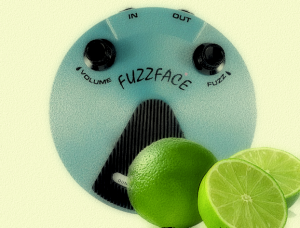
Vintage-style Fuzz Faces produce tones that are warm, rich, and unbelievably dynamic. It was like the first time I tasted a vintage-style daiquiri. Like the Fuzz Face, the classic daiquiri is a delicate concoction made from a few simple yet complexly interactive ingredients — nothing like those nasty blended drinks that taste like Slurpees spiked with Everclear.
Here’s everything I love about vintage Fuzz Faces, compressed into 60 seconds:
My DIY version is based on inventor Ivor Arbiter’s original 1966 schematic. That’s also the basis for a new DIY project created by my stompbox-buildin’ pal Mitchell Hudson, who runs the cool DIY site Super-Freq. We’ll both be posting it on our sites in the next few days. You can source the parts on your own, or order a kit for less than $50 — not as cheap as some of our other DIY projects, thanks to its two relatively pricy germanium transistors.
Most lore about “mojo” stompbox parts is utter nonsense, but there is something harmonically unique about the germanium transistors used in ’60s fuzz pedals, including original Fuzz Faces. (See my “Germanium Mystique” post/rant for more info.) You don’t need germanium for a good fuzz sound — there are many great tones available via silicon transistors, integrated circuits, and digital modeling. But one problem with those god-awful Fuzz Face reissues was that they often simply substituted high-gain silicon transistors for germanium ones without modifying anything else in the circuit. The result was more gain, but at the cost of harsh, excessively bright tones and inferior dynamic response.
In the last decade or so, builders have wised up. Numerous manufacturers offer authentic ’60s-style replicas. Meanwhile, the DIY community has created countless variations, many of which use post-germanium parts to great effect. These days it’s pretty easy to find a Fuzz Face that doesn’t suck.
I’ve build many Fuzz Face variants, but until Mitchell created his Fuzz Face project, I’d never done a strict original, with positive-ground wiring, PNP transistors, and few latter-day “refinements.” (Don’t sweat it if those terms mean nothing to you — they’re all explained within the project.)
Anyway, that’s the circuit you hear in the video above. It’s not a fuzz for all seasons — it doesn’t have a ton of gain, and its loose, spongy distortion is unsuitable for metal and modern hard rock. But I love its warm, non-macho timbre and phenomenal dynamic response. It’s simple, classic, and delicious, much like this.
 Most sentient guitarists love Hendrix, but not everyone is equally fond of his signature distortion pedal.