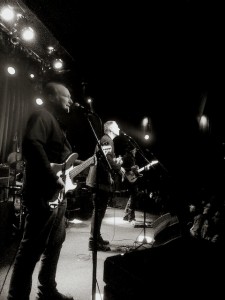
Oh man — I got to open for Television last night in San Francisco, accompanying storyteller Dennis Driscoll. These days the band includes original members Tom Verlaine, Billy Ficca, and Fred Smith, plus Jimmy Rip filling in quite capably for original guitarist Richard Lloyd. They’ve been doing shows where they play their debut album, Marquee Moon, in its entirety (though they mixed and matched songs last night).
Television recorded other cool records, including a lovely 1992 reunion album. But Marquee Moon is one of those instances in which an artist’s aesthetic is etched in stone from the beginning. The two-guitar interplay … the abstract, almost architectural arrangements … the contrasts between stiff and loose time … Verlaine’s free-floating rhythm and quavering 16th-note-triple vibrato—all were present from the get-go 36 frickin’ years ago.
I couldn’t help comparing Television’s artistic arc to that of their contemporaries, Talking Heads. Sure, the latter’s debut, Talking Heads ’77, is a classic, but had the band stopped recording after its release, we’d have only a vague inkling of what the group would become. More than once Jerry Harrison has told me that today’s bands rarely have the luxury of defining themselves over the course of several albums as Talking Heads did, slowly finding their audience and refining their sound. Today’s music business demands spectacular success from the start. A latter-day Talking Heads (if you can imagine such a thing) wouldn’t have the luxury of recording three albums before releasing a bona-fide hit like Remain in Light.
Most great musicians evolve over time—imagine how we’d regard the Beatles, the Stones, Springsteen, Prince, or Dylan if they’d thrown in the towel after one album. That, I think, seems intuitive to most of us. The talent is there—it simply needs time to reach its apogee.
But artists who seem to materialize fully formed mystify and fascinate me. I’m not just talking about Mozart syndrome, prodigies who display phenomenal talent while very young. Mozart grew artistically throughout his brief life. His juvenile works barely hint at the later masterpieces.
On the other hand, consider Charlie Christian, whose style was fully realized from his first recordings with Benny Goodman in 1939, soon after the guitarist’s 23rd birthday. At his initial audition/gig, this kid from Oklahoma was mocked by the Goodman band hipsters for his hick cowboy clothes—until he blew them off the bandstand with 20 consecutive choruses of “Rose Room.” It was the most radical guitar sound the musicians had ever heard. From his first sessions to his last a mere two-and-half years later, Christian’s style never evolved. It was perfect from Day 1.
Dig it! (Charlie’s solo starts at 1:10.)
Another fascinating case: I’ve always had a soft spot for Cheap Trick, though I don’t know their music exhaustively. Like many listeners, I relate more to the relatively raw live versions of their hits on the Budokan album than to the tepid studio originals. The Budokan version of “I Want You to Want Me” has so much more power and passion than the slow, limp, overdub-laden version on In Color. But it wasn’t till 1996’s Sex, America, Cheap Trick compilation that I encountered the original demo of “I Want You to Want Me.” And holy crap—it’s simply one of the most perfect rock and roll tracks ever.
Wow. No overdubs. Monster groove. Fabulous lead vocal. A perfect distillation of Elvis, Chuck Berry, and the Beatles. With all due respect to this long-running and hard-working band, I don’t believe they ever again nailed it quite like this.
Since I’m already probably picking fights, I may as well blurt out that I view the first Doors album and Are You Experienced? in a similar light. Not that Strange Days and Electric Ladyland aren’t great—just that both Hendrix and the Doors entered the public consciousness with their artistry fully formed, and that they never recorded anything that wasn’t implicit in those initial recordings.
Why do some artists just seem to come out of the chute fully mature, while others need time to realize their potential? And which ones would you include on a “Getting It Right the First Time” list?