Categories
Digital guitar

Fishman TriplePlay Demo:
Now with More Nasty!

For the first Fishman TriplePlay demo I posted last month, I featured pretty, naturalistic acoustic sounds. This time around I went for something a little less polite.

I’ve been having a blast — albeit a humbling blast — trying to play real-time drum parts from the guitar. I still suck if it’s much more complicated than what I play here, but I can imagine learning to do it well. It’s also fun using the guitar to access the big keyboard sound libraries I’ve built over the years. Perhaps most exciting of all are the hybrid guitar/synth/sample sounds I’m starting to develop. (There aren’t any in this demo — the sounds are either samples or processed guitar, though I blur the lines with guitar-ish samples and guitars processed to sound like machinery. Next time, though, I’ll try to showcase some of those unholy hybrids.)

Here’s how the setup looks from my perspective. (I’m not trying to be secretive about what’s on the floor — it’s just hard to fit into the frame, even with a wide-angle lens.)
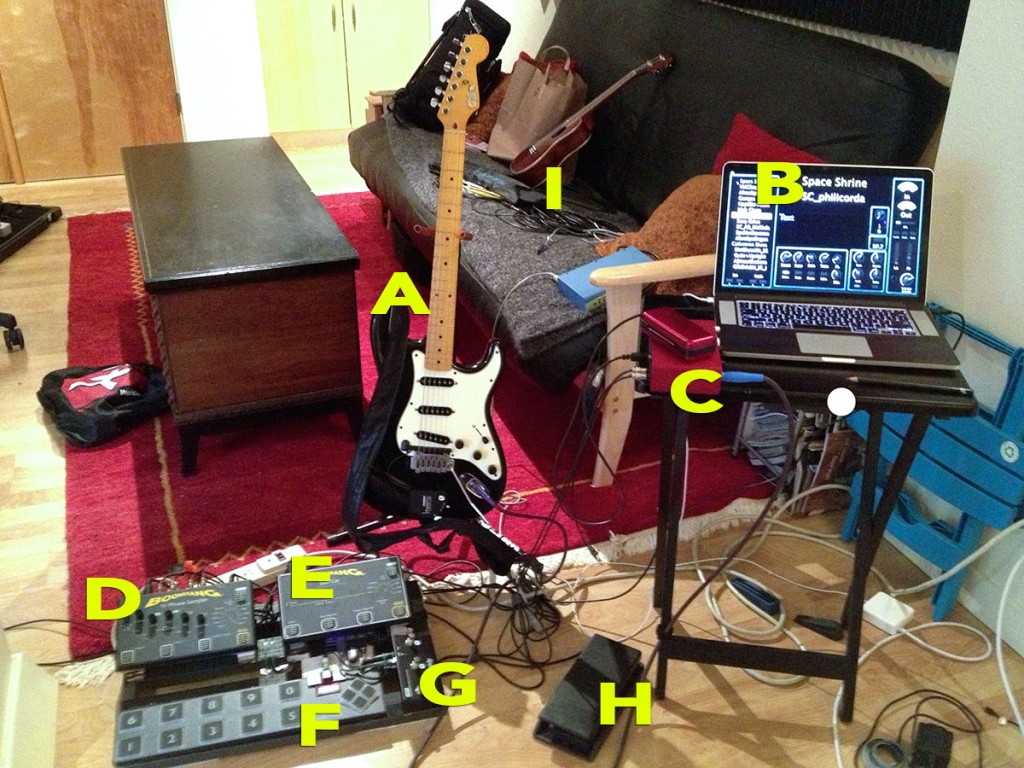
Joe's looping/MIDI rig.
Joe’s looping/MIDI rig.
  1. Homemade strat with Fishman controller/pickup. MIDI transmitted wirelessly.
  2. MacBook Pro running Apple’s MainStage software. I use a ridiculous number of plug-ins and some ridiculously huge sample libraries. My main sampler is NI Kontakt.
  3. Focusrite Scarlett interface. All the prosumer interfaces sound pretty decent to me these days, though I like the fact that this one isn’t made out of cheapo plastic.
  4. Boomerang III looper. I love its ergonomics and smooth looping points. I screw up my loop points constantly, but I have fewer disasters with the Boomerang than with anything else I’ve tried.
  5. Boomerang Sidecar. Basically just extra buttons for the Boomerang so you can access more features without reprogramming it or performing awkward foot moves.
  6. Keith McMillen SoftStep MIDI controller. Powerful, rugged, feather-light, and not too expensive.
  7. Logidy UMI3. A nice, rugged, and inexpensive USB MIDI controller — just to have a few extra switches.
  8. Generic controller pedal. Its role varies from patch to patch. It might be a mod wheel, a pan pot, a fader, a filter cutoff control, etc.
  9. Piles of crap. These magically materialize every time I start messing with this stuff.

Just to be clear — these sounds are from my collection, and are not included with TriplePlay. Also, I used TriplePlay in “simple mode” for this video — in other words, I’m not using the dedicated TriplePlay application, but simply using TriplePlay as a generic MIDI controller to trigger sounds loaded into MainStage.

BTW, I’m about to head out for Musik Messe in Frankfurt, Germany, where I’ll be demoing this contraption. Oddly, I’ve never been to this vast musical instruments show, which has been described as a much larger NAMM show with more sausage, beer, and accordions. I’ll be sure to tell you about any cool stuff I see!

DISCLOSURE: Fishman, Apple, and Keith McMillen are among my clients, but no one paid me to make or post this video.
Categories
guitar

My Flatwound Addiction

flatwound
So smooth. So sexy.
So frickin’ expensive!

Hi. I’m Joe, and I’m a flatwound addict.

It took me a long time admit it. “What wrong with a little recrational flatwound use?” I used to ask. “I can quit anytime I want.”

Sure, I’d sometimes put flatwound strings on my Guild archtop. And sometimes on a bass. And yeah, I did that post about how flatwounds are the key to nailing that ’60s electric 12-string sound. And that other post on how flatwounds brought my reissue Fender Bass VI to life. And yeah, I may have happened to blurt out that I like using flatwounds on a MIDI guitar.

But I wouldn’t use them on, you know, one of my normal guitars.

But then I recorded that Bartók piece, using the above-mentioned Guid and Bass VI alongside two standard-tuned guitars with roundwounds. The piece has a lot of counterpoint — all these motifs bouncing between the instruments. And the more I listened, the more I realized that I liked the tone of the two flatwound guitars far more than that of the two roundwound guitars.

And then I bottomed out. I put flats on four more guitars. It wasn’t just musically risky — it was economically catastrophic! And that’s what brought me here tonight.

Funny thing about flatwounds: Everytime I pick up a guitar with flats, I react negatively to the dullness of the wound strings. Where’s the shimmer? Where’s the zing?

But the more I listen, the more I get sucked in. Parts layer over each other more readily. Chords speak more clearly. Fuzz and distortion yield sweeter overtones. It’s easier to get a consistent sound from melodies spanning wound and unwound strings. And the feel? Smooth, sleek and sensual.

Sigh. Maybe I’ll try and kick the habit again tomorrow.

Categories
Acoustic Music

An Alternate-Tuning Capo

Spider Capo

UPDATE, 03.07.13: I should have mentioned a point that several readers noted in comments: The capo only alters the tuning of open strings. Which means that while you can play many harmonies normally available only in dropped tunings, any notes above the capo appear at their usual frets. For example, all barre chords are played exactly as in standard tuning.

After all the digital guitar stuff I’ve been writing about lately, I really wanted to spend an afternoon without plugging in any frickin’ USB cables. So I finally got around to experimenting with the SpiderCapo I picked up last year on a whim.

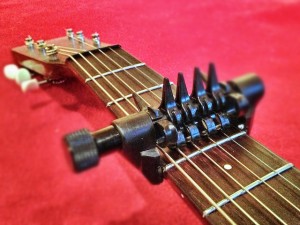
The SpiderCapo his six independently adjustable clamps, each of which can either stop the string or let it ring freely. That means you can dial in most dropped tunings without actually detuning any strings — instead, you transpose the entire voicing up. It’s a lot of fun to play, and seems like it could be a cool composing tool if you’re the sort of musician who gets inspired by unfamiliar tunings. Plus, it looks kind of wicked when you fret the unstopped strings behind the capo.

Here’s a little video I made, noodling around in a few tunings I particularly liked:

Anyone else tried one of these? Or any other “tricky” alternate-tuning capo? How about those gadgets that (unlike the SpiderCapo) can stop strings at differing frets?

Categories
Digital guitar Pickups Recording

Demo: Fishman TriplePlay Wireless MIDI Guitar System

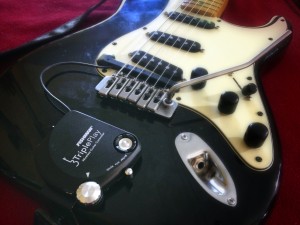
I've installed TriplePlay on this homemade strat.
I’ve installed TriplePlay on the homemade strat.

For the last few months I’ve been working with Fishman on the documentation for TriplePlay, their long-awaited wireless MIDI guitar system, which will finally ship this quarter. I had a blast demoing TriplePlay at MacWorld a few weeks ago, and I’m looking forward to doing so again at Musikmesse in Frankfurt in April.

But at times, it’s been frustrating. I power up TriplePlay to study some feature, get all excited, and then have to turn it off and write about it instead of going off and playing it for six hours. This little demo was my first real chance to just fool around with the thing. Thoughts and details after the video.

Categories
guitar Music

Meet the REAL Spiders from Mars!
Bartók on Electric Guitar

Bartók: Smarter than math-rock — and way more violent.

My Bowie fandom is second to none. Yet I’ve always felt a vague sense of disappointment that the Spiders from Mars didn’t really sound much like spiders from Mars.

On the other hand, the fourth movement from Béla Bartók‘s Fourth String Quartet really does sound like Martian spiders — assuming the critters in question had been force-fed a diet of chord clusters, mathematics, Hungarian folk music, and some of the most astonishing counterpoint this side of J.S. Bach.

And dig it: This white-hot blast of dissonant modernism was composed in 1928!

And how does this string quartet music sound on guitars? Awesome, IMHO — largely because the movement is played entirely pizzicato (plucked, not bowed). Very few modifications were needed to adopt it for four electric guitars.

Categories
Effects guitar

Museum of Lost Effects:
The Systech Harmonic Energizer

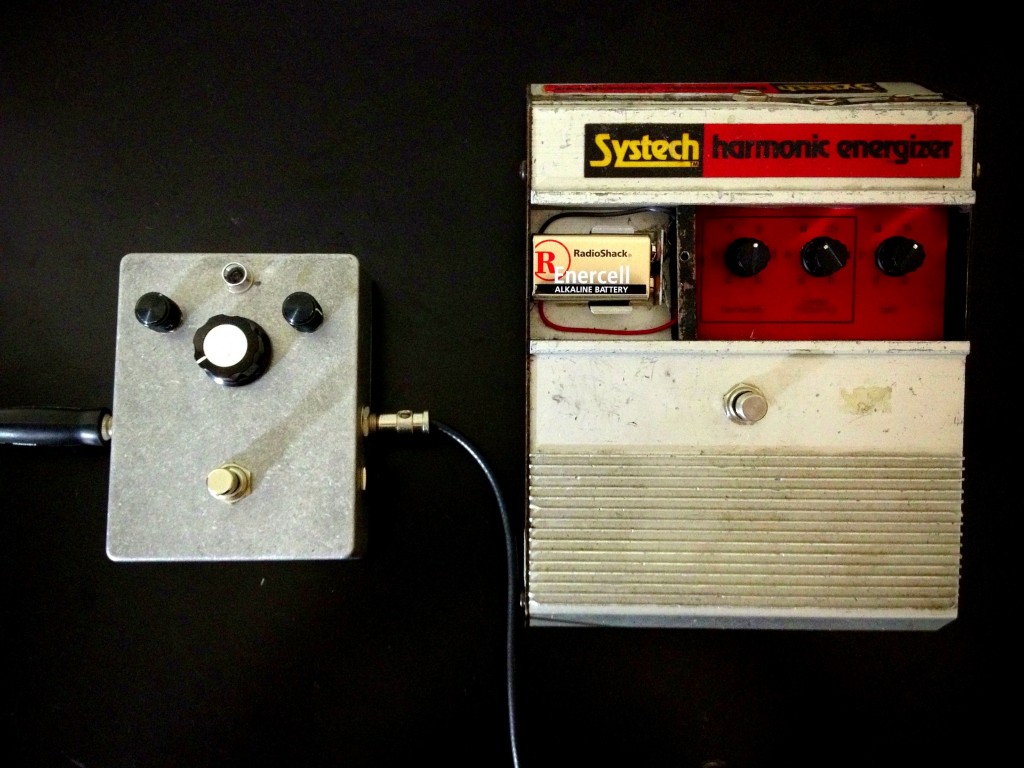
IMG_5847
A homely clone cowers in the shadow of a ramshackle original.

Okay, here’s an old weirdo I’ve been meaning to write about for ages. The Systech Harmonic Energizer is an ultra-rare filter/distortion effect from the ’70s that takes the fuzz-wah formula in some interesting directions. Its signature is edgy, ultra-resonant filter sounds. You’re most likely to have heard it generating Frank Zappa’s nasal midrange squawk, but it does lots of other abrasive tricks too. I used this one on Tom Waits’s “All Stripped Down,” and on “Jets” by Action Plus.

The S.H.E. doesn’t do pretty. Most of its sounds are so strongly flavored, they’re hard to use as a primary tones. But it’s great for things like clanky percussive accents, or walloping low-frequency assaults.

But let’s talk later. First the video:

Categories
Effects guitar

Museum of Lost Effects:
Maestro Rhythm ’N Sound for Guitar

Well, I’m not sure it’s fair to call it a “museum” when there’s only one exhibit so far. But it’s a really, really good one…

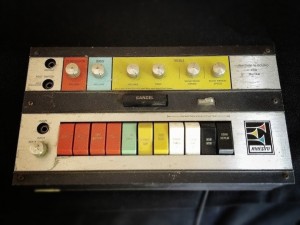
I bought this Maestro Rhythm ’N Sound for Guitar for a pittance back in the ’90s. It’s a primitive multi-effect unit from 1968, with a cool octave-down bass tone, auto-wah, and two fixed filters. It’s got fuzztone (though mine has always been broken), and a weird, choppy tremolo reminiscent of the Vox Repeat Percussion effect. (Mine worked fine — until I broke it yesterday while trying and failing to fix the fuzz. Kill me now.)

But the marquee feature of this hand-soldered contraption is the option of triggering four wonderfully cheesy analog percussion sounds. Bongo? Cymbal? Tambourine? Clave? At your command!

Does it sound as weird as it sounds? No — weirder!

You can’t assign specific specific notes to specific sounds — any input triggers the percussion, so the clicks and clanks tend to work best shadowing every note in a phrase, adding a weird edge. (I used them like that on Oranj Symphonette’s “Charade,” Erica Garcia’s “Yo No Tengo La Culpa,” and PJ Harvey’s “Maniac.”)

But then it occurred to me you could more ambitious things with the percussion sounds via looping. Which is exactly what I do in this short, fuzz-free video.

Check it out — and then let’s talk about this Museum of Lost Effects thing!

Categories
guitar

A Very Vintage Strat

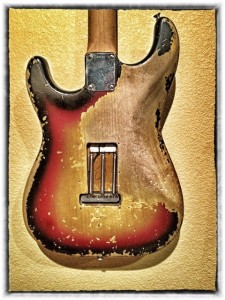
The ’80s were tough on guitars.

Last weekend I went to a memorial service for a music pal I hadn’t seen since the ’80s. Judging by the pictures I saw and the stories I heard, Brett remained the gentle, generous music lover I’d remembered till he died in his sleep a few weeks ago.

I ran into lots of old music friends and bandmates, and we alternately smiled and winced as our old photos and concert videos flashed on the big screen. Were we really that skinny? Did we actually wear that stuff without being coerced at gunpoint?

Like we tend to do at such moments, I left brimming with resolutions: Appreciate life. Cherish friends. Remember that music is a joy as well as a job. And do something nice for my sad old Strat, the guitar in all those old photos and videos.

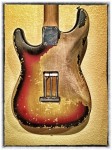
See, back then I only had one guitar — an all-original ’63 Strat I’d picked up in 1980, when pre-CBS Fenders were still perched on the precipice between collectible and affordable. (I paid $450, a staggering investment for me at the time.) It remained my only serious guitar for a decade. It was in near-perfect condition when I bought it, and it was a battered ruin by decade’s end. (The ’80s were a tough time for guitars, what with all those studded belts.) I was a young player with a bad attitude and little concern for collectibility, as opposed to the middle-aged player with a bad attitude and little concern for collectibility that I am today.

I’ll some thoughts about Strats then and now. But first, have a listen: