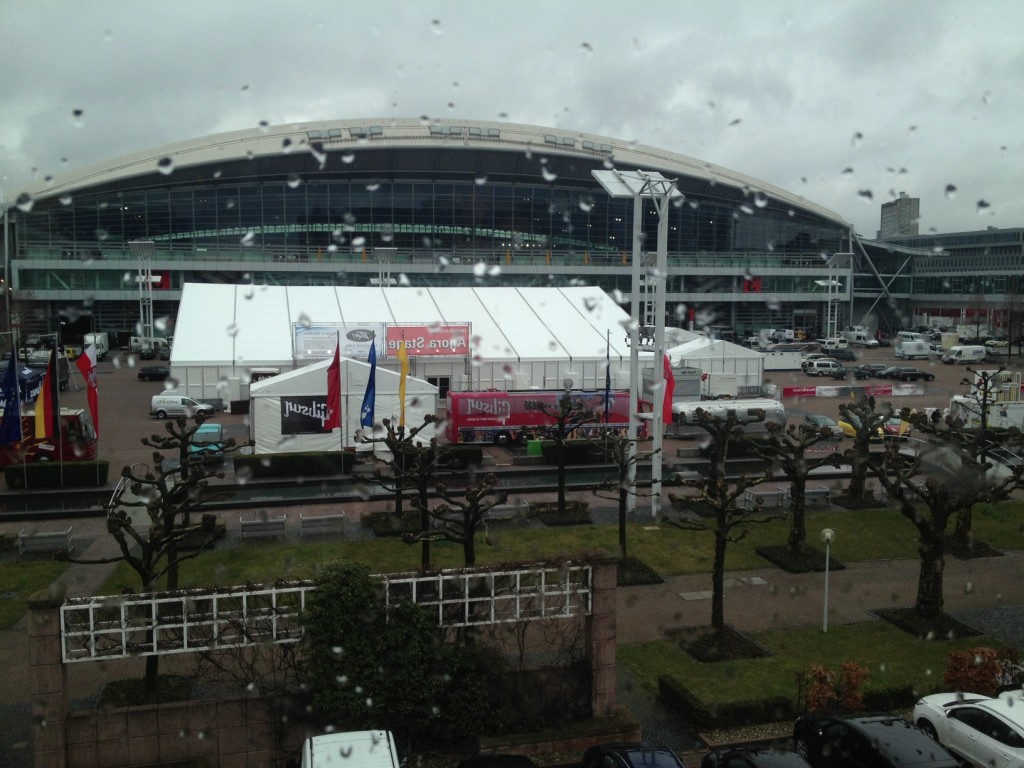
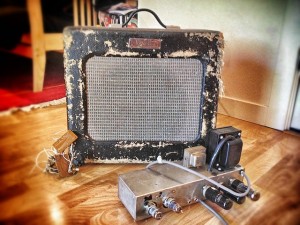
Howdy from Frankfurt, where I arrived this afternoon to attend Musikmesse. United Airlines was its usual scuzzy self, though a nice flight attendant found a place for me to stow my guitar. And my pedalboard seems to have arrived in fine shape, even though I had to checked it in its soft but reassuringly padded Mono case.
I’m here as a demo artist for Fishman’s TriplePlay, but I should have some downtime to poke around and look for cool stuff. I’ll keep you posted!
This event is gigantic — more than twice the size of NAMM. And even on a setup day like today, you can tell how loud it’s going to be, especially since they don’t enforce volume restrictions is stringently as they do in Anaheim. (I’m told it’s like Saturday afternoon at Guitar Center, squared.) And my demo area just opposite the big, loud Gibson stage. It’ll be an adventure! 🙂
Any of you guys ever been? Got any advice to share?
UPDATE:My apologies if this page failed to load properly before. After a much screaming and crying some careful troubleshooting, it seems to be working correctly now.
I put together a little slideshow of some of the interesting things I saw last week at the 2013 NAMM show in Anaheim.
I covered some of the coolest new digital gear in this post. This time, the focus is analog guitars, amps, and effects. Plus: an ultra-rare sighting of a true California celebrity!
Oh wait — that was last month. Now it’s January. NAMM time!
I’ll be there for the duration, partly to hang out with my Pure Guitar pals, and partly to meet with Fishman about the upcoming TriplePlay release. But mostly to gawp at the weird shit admire the musical instrument industry’s latest offerings. :oogle:
I’ll be posting my findings here, and also doing a little write-up for my friends at Create Digital Music, one of my fave musician sites.
Actually, I have this perverse fantasy of spending an entire show in Hall E: the Anaheim Convention Center’s low-rent basement/dungeon, a dark, inhospitable region where Fender and Gibson fear to tread. That’s where the industry leaders of tomorrow rub elbows with mad scientists and perennial laughingstocks (AKA “my peeps”).
Any of you guys going? And if not, anything special you’re curious about?
Last week I dared all incautious chumps you to prognosticate about our guitaristic future. I knew the resulting comments thread would be fun, but I didn’t expect it to be that fun!
And also oddly uplifting. Future predictions just seem to skew in an optimistic direction, perhaps because you have to start by assuming that we have a future. So for every funny post suggesting that the most stupid and obnoxious aspects of today’s musical culture will get even more stupid and obnoxious, there’s a complementary positive perspective. In the future, these upbeat dreamers argue, we wil be better…stronger…faster. Of course we’ll have the technology! Better still, we’ll develop common sense.
Granted, some of the predictions are destined to be as disappointing as a 1948 issue of Popular Mechanics, with its broken promises of personal helicopters and monkey butlers domestic robots. But would it be preferable never to have dreamt of having you own jetpack? I think not!
Here’s a fine, optimistic example from Thecoslar, writing about “Lego” Pedals and Amps:
Standardized wiring “harnesses” and interchangeable components will allow companies to produce amp cabinets and pedal cases that consumers will purchase, in addition to compartmentalized circuits. The consumers will “design” their own pedals and amps by mixing and matching that various parts. Combine an optical compressor and a germanium boost. An octave up and a chorus. And that’s just pedals. Imagine what could be done by mixing and matching tone stacks, reverb and delay, or pre amp circuits in amps? Built in analog effects your amp, just by plugging in the components. Everyone and anyone will be able to piece together their own custom circuit, no solder, no muss, no fuss.
Yeah, that would be frickin’ awesome. Of course, we happen to live in a world with at least four common types of USB connectors, no standardized guitar wiring harnesses, and where millions of consumers sigh as they fork over yet more cash for the latest proprietary i-connector. But we can dream can’t we?
Hell yeah, we can! I hope you’re enjoying the conversation as much as I am.
(The fun’s not over, BTW — keep posting your predictions.)
“We are all interested in the future, for that is where you and I are going to spend the rest of our lives.” — Criswell, Plan 9 from Outer Space
UPDATE:Wow, I can’t believe all the cool stuff folks have been posting to comments. I find myself feeling quite inspired about the future of instrument — when I’m not laughing so hard I spit coffee all over my laptop. Thanks for all great ideas. Keep ’em coming! 🙂 :thumbup:
Prophecy is for suckers. Who’s stupid enough to go on record with bold prognostications about the future of music and music-making, given the near-certainty that the words will reappear someday to bite you on the ass?
Well, me. And, I hope, you.
So I invite my fellow foolhardy loudmouths to join me in sharing their half-assed guesses wise and well-informed predictions about our brave new fretboard future.
The author of the most compelling prediction wins one of my hand-built stompboxes. So does the author of the one that makes me laugh hardest.
Post your predictions to comments. I’ll go first. 🙂
The recent experience making a DIY Class A Champ reignites for me the eternal debate between the merits of Class A and Class A/B amps. (I link once more to Dave Hunter’s excellent short article on the topic, since he explains the distinction so much better than I can.)
Like most American players of a certain age, I grew up without access to great Class A amps. (I’m going to take the lazy way out here, and lump Voxes and their kin into the Class A category, despite the distinctions that Dave H. explains so well.) My initial exposure to various ’90s Vox reissues and other “Voxoids” of the era was enough to spark my interest. (And is “spark” the perfect verb for great Class A amps, or what?) But it wasn’t till I encountered Matchless amps and real vintage Voxes that I totally got it.
But still, I go back and forth constantly. And whenever I switch between categories, I think, “Ah! There’s what I was missing,” though I tend not to miss it when I’m playing an amp of the opposite type. So at least I’m usually happy.
Overall I’ve probably favored Vox-type amps over Fender- and Marshall-flavored ones, though I’m the sort of player who’s rarely interested in macho rock and metal distortion. (If that weren’t so, I’d be an A/B purist!) But having said that, my fave amp these days is the decidedly A/B brownface Tremolux I use in the lion’s share of my videos. So put me down as perennially undecided.
How about you? Do you pledge your allegiance to the explosive harmonic energy of Class A or the focused impact of Class A/B? And has anyone explored switchable schemes, as found on some Mesas and modded Marshalls?
When you make DIY stompboxes powered by 9-volt batteries, your biggest fear is a solder burn (or dropping your drill on your iPad, but that’s another story). DIY amps are different: AC voltage can kill you, so a klutz like me approaches amp builds with caution.
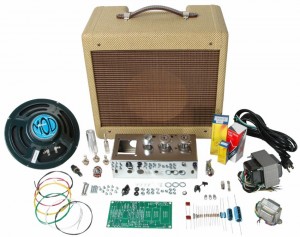
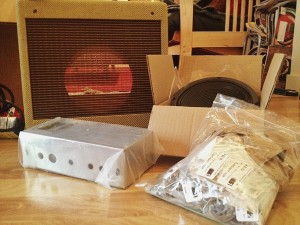
Which brings me to one of the great things about Tube Depot’s Tweed Champ Vacuum Tube Amp Kit: the fantastic assembly manual. Other great things include the price ($499, roughly half the price of a non-kit Champ clone of comparable quality). The design (which follows the original circuit, but substitutes an intelligently designed circuit board layout for the original turret board). And most of all, the tone.
I’ve got lots more to say about the kit, the fun I had building it, the lore of the 5-watt ’58 Champ, and the pros and cons of Class A amps (the Champ is the only Fender classic that merits the classification). But first, have a listen! (more…)
You can probably get cool tones from any old crap with a tube in it, such as this ’60s PA amp.
There were lots of interesting replies to last week’s post on small amps. Thanks for all the tips about some of today’s best tiny terrors!
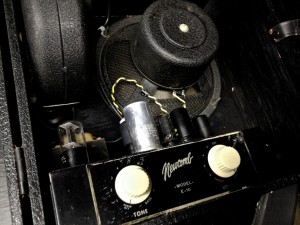
The discussion reminded me of a cool old amp that’s been gathering dust in my garage — and also of a notion of mine I call the “any old crap” theory. The idea is simple: Any funky old amp, including P.A. models never intended for guitar, usually has some compelling sounds in it. Plus, those old Newcomb, Masco, and Tapco amps are among the few remaining affordable vintage amps.
Case in point: This early-’60s Newcomb P.A. amp I picked up a few years ago at my local cool guitar shop. Actually, my pal/hero Tchad Blake spotted it and bought it for a hundred bucks or so. He was here in San Francisco working on Tracy Chapman’s Where You Live album. When we finished the project, he decided he had too much gear to schlep back to the UK, so I took it off his hands. I used it on Tom Waits’s Orphans album, and then promptly forgot about it till last week. So I fired it up and made a little video demo with an old cheap guitar that didn’t cost much more than amp: (more…)
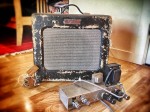
I’ve got a Tweed Champ kit, and I’m not afraid to use it. Or at least not VERY afraid.
Why do they make amps so damn loud?
It’s not just a cranky question from a guitarist who’s drawing depressingly close to the “Get off my lawn!” years. I ask sincerely: Why?
Big amps make total sense — but only if a) it’s 1969, b) you’re playing venues with Jurassic sound reinforcement, and c) you’re a guitarist in danger of being drowned out by Keith Moon or John Bonham.
Okay, end of harangue — I’ll have time for that when I’m chasing kids off my lawn (after I move to the suburbs and GET a lawn). But as I get psyched up to build this review model of Tube Depot’s Tweed Champ kit in the coming days, I figured I’d ask what folks are using these days to get cool amp tones in their bedrooms and basements. Not dedicated practice amps, necessarily, but great-sounding stuff that happens to be ultra-low-wattage? Name your petite-amp poison!
Anyway, I’m stoked about this kit. I’ve already completed a few amp clones from Ceriatone. They were fun to build and sounded great. But I can tell right off the bat that this Tube Depot kit has at least one major advantage over its Malaysian cousins: This one comes with a fabulous 40-page instruction manual. (Most clone vendors simply link you to a schematic.) Having created a few step-by-step instruction manuals myself, I can testify how much painstaking work these entail. Hats off to Tube Depot’s Rob Hull for doing it right!
Details and build report to follow. But now, let’s talk tiny-amp tone!
Thank heaven I became a guitar geek shortly before my 12th birthday. If I hadn’t, I probably would have requested a minibike for my bar mitzvah present a year later, instead of my first electric guitar. And today I’d be an over-the-hill biker instead of an over-the-hill guitarist.
My schoolteacher mom had a colleague whose son worked at Fender in Fullterton, California, not far from where I grew up. (Sadly, I’ve forgotten his name). Shortly before my big day, we visited his mobile home (let’s face it: the musical instrument industry has never been lucrative) to audition some decidedly post-CBS guitars he was selling. I opted for a black Jazzmaster, though I was tempted by the paisley Tele. It was my sole electric throughout high school, though I sold it at exactly the wrong time: five minutes before new-wave guitarists such as Tom Verlaine and Elvis Costello made it cool again. (Though I shouldn’t complain, since I managed to procure my pre-CBS Strat around that time.)
The Fender guy didn’t have extra amps on hand, but I slavered over the oversized amps in the early-’70s Fender catalog.Which sleek silver combo would greet me on the big day?
To my horror, I received an ancient, teensy-weensy combo amp, an ugly thing spray-painted black. I was mature enough not to express anything other than delight, but my heart ached. I wanted an amp as big and loud as my dreams, not this sad relic. They told me I was a man when I turned 13 — but I didn’t feel like one without the Dual Showman of my dreams.
My disappointing amp was a tweed 1952 Deluxe — which makes it sound like this story will have a happy ending. Sadly, no. (more…)