
Month: January 2012

  • Introducing the Secret Room

    Introducing the Secret Room

    UPDATE: Wow! I’m overwhelmed by the initial response. Hundreds of cool tips! Please bear with me as I process them and send out the access info. I could automate the process, but I want this to be more than just a bunch of random posts, and I want to weed out the silly stuff. —Joe

    Do you have a secret? I want it!

    No, not your credit card number, or the truth about what you were really doing on the night of September 23rd. Just a cool tip about anything that makes you play better or sound better. The kind of hard-won musical wisdom that’s almost too good to share.

    And in exchange for surrendering a precious secret, you get access to the best secrets of many other players, including some whose names you know.

    Just contribute a cool tone secret, and you’ll get access to this password-protected site. While there, you’ll be able to comment on the secrets and add ratings. Just to keep things lively, the authors of the highest-rated secrets will win cool gear prizes. In fact, whoever creates the highest-rated post between now and March 1st will receive a Godin Natural Summit CT, a lovely and versatile carved-top solidbody electric guitar that sells for $1,000. The authors of the second and third most popular posts win a their choice of Seymour Duncan pickup sets. (Custom Shop sets excluded.)

    The site is already looking pretty cool — but it will be cooler if you contribute! Learn more (and submit a secret) here.

  • The Bass That Shouldn’t Be

    The Bass That Shouldn’t Be

    Don’t you love when someone revisits a weird idea from the past — and makes it even weirder?

    I got a new bass last week, right before I left for the NAMM show. I finally had a chance to try it out yesterday. I think I’m in love. View the incriminating evidence in this brief video: (more…)

  • NAMM-O-Rama!

    NAMM-O-Rama!

    Amazing things at NAMM, #1,287: Bootsy Collins's right hand.

    Just got back from a couple of days at the 2012 NAMM convention in Anaheim. And I’m glad to be writing about it rather than talking about it, because I have no voice left from screaming over several days of unbelievably loud ambient noise. How ironic that we evaluate the musical instrument industry’s new creations in one of the earth’s most acoustically abysmal environments.

    Still, I had a blast. I saw tons of cool new things that will appear on this blog as they become available. I got to see lots of old pals and hobnob with great musicians, brilliant builders, visionary designers, and amusing crackpots. Fun was had.

    I didn’t prepare anything like a comprehensive report. For an overview of all the product announcements and press releases, just go here. This is just a short video documenting the misbehavior of my friends and colleagues some cool stuff I saw. (more…)

  • Oh — There’s Another NAMM Show?

    Oh — There’s Another NAMM Show?

    It has been brought to my attention that there is, in fact, another event this weekend called a NAMM show. I’ll be there Friday and Saturday with Seymour Duncan. If you’re at the show, please stop by. And tomorrow — Thursday — I’m playing a show at Taix in LA’s cool Echo Park neighborhood with my band, Mental 99. Please come by and say hi! (And for those who live in or near my fair city of San Francisco, we’re also playing tonight at the super-cool Madrone Art Bar.)

    I’ll try to post pics of the cool stuff I see in Nam at NAMM!

  • The Nam Show

    The Nam Show

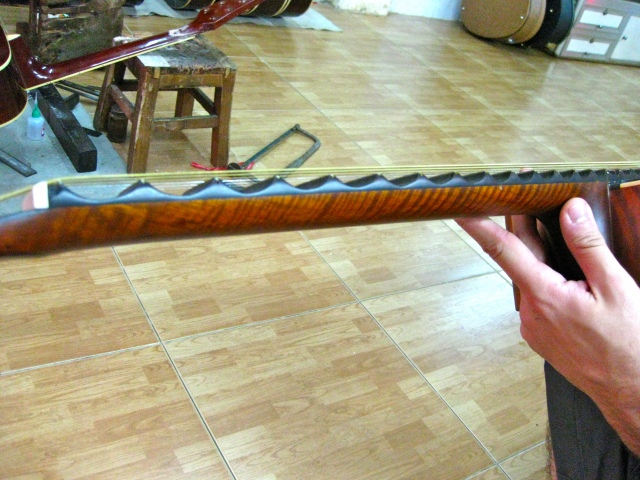
    This is not a Swedish guitar. (Photo by Candace Burnham.)

    Everyone’s talking about the upcoming Nam show, so I figured I should post something relevant. I’ve never been to Southeast Asia, though everyone I know who has loves the place. And I’ve been floored by the beauty and originality of those Vietnamese electric guitarists who scallop their fretboards not because they love Yngwie, but to replicate the wild swoops and expressive quavering of their indigenous folk instruments. Put it all through a cheap solid-state amp and vulgar digital reverb, and it’s…perfection.

    I’m no expert on the style, so I turned to Scott Collins, who’s posted here a few times. He’s a dauntingly knowledgable player and teacher who runs an interesting site called Guitarchitecture. The centerpiece is a comprehensive guitar method he’s created that applies visual metaphors to the process of mastering the fretboard.

    Anyway, Scott hastens to point out that he’s no expert on Vietnamese guitar either, yet he’s created a beautiful little piece on the topic. He visited Viet Nam with an eager ear, a respectful attitude, and keen powers of observation. You won’t be bored. —Joe

    (more…)

  • A New Look at an Old Wiring Scheme(and another cheap guitar makeover!)

    A New Look at an Old Wiring Scheme
    (and another cheap guitar makeover!)

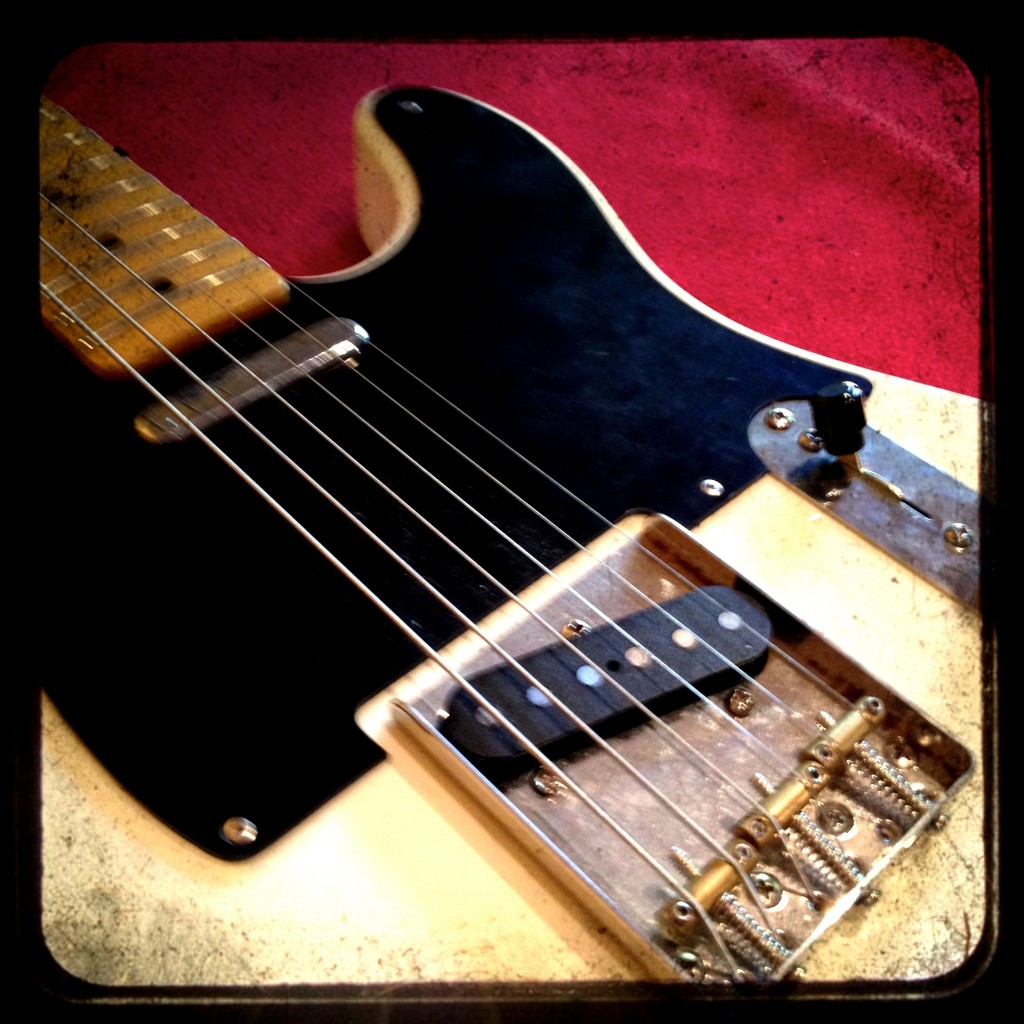
    An iPhone photo app makes this new Squier Tele look old. Duncan’s Vintage Broadcaster Set makes it SOUND old.

    Sometimes an antiquated idea can acquire new relevance.

    Example: The ancient Fender Broadcaster wiring scheme, in which the guitar has no tone control per se, but the second knob acts as a pickup-blend control. I wired up a guitar this old-fashioned way, with some very surprising results.

    My experiment had other motives: I wanted to check out Seymour Duncan’sVintage Broadcaster Set, which replicates those earliest Telecaster-family pickups. And once again, I wanted to see just how much of a sonic upgrade a simple pickup replacement could bestow on a humble guitar: in this case, a cheap, Chinese-made Squier Telecaster.

    Check out the results in the demo video.

    (more…)

  • Build the World’s Wickedest Overdrive(for less than $30)

    Build the World’s Wickedest Overdrive
    (for less than $30)

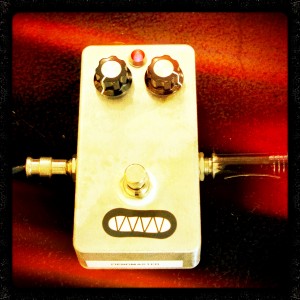
    "Who are you callin' ugly?"

    UPDATE: My thanks to reader William Badjek, who found in error on page 31 of the v01 project file, which would have prevented the tone control from working properly. (The schematics, however, were correct in v01.) If you’ve encountered that issue, please revisit that page of the v02 project file, now available at the link below. My apologies to anyone who got stuck on this!

    Hey, DIY victims fans!

    Here’s the project file for Tonefiend DIY Club Project #4: the Fiendmaster, a fab-sounding update of the Dallas Rangemaster, the circuit that put the punch in so much classic British rock. If your record collection includes a lot of albums from around 1970 featuring skinny guys with long hair and flared trousers, you need one of these!

    It sounds incredible. It’s a relatively easy build. And unlike strict clones, this version runs on a regular modern power supply like the rest of your pedals. It also includes a knob that fades between the original’s bright, snappy Brit blues sound, and the humungous sludgetone that spawned Sabbath. You can round up all the parts from the usual suppliers for less the 30 bucks, or just order a pre-assembled kit from Mammoth Electronics.

    View a brief demo video of the final product here. Learn more about the circuit’s significance here. And fill your cranium with everything you need to know about germanium here. Happy soldering!

  • ReAmps: Cooler and CHEAPER Than Ever!

    ReAmps: Cooler and CHEAPER Than Ever!

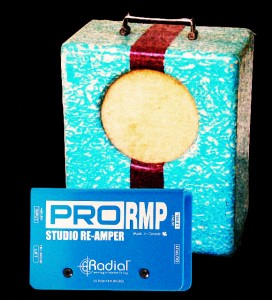
    The latest version of the ReAmp, the Radial PRO RMP Studio Re-Amper, lists for a recession-friendly US$115, which means you can probably snag one for under a C-note.

    Teisco amp not included. Pity.

    The device, created by engineer John Cuniberti (best known as Joe Satriani’s studio wiz), is a recording direct box in reverse: It lets you play recorded tracks through guitar stompboxes and amps by stepping the signal down from line level to instrument level. Applications include:

      • recording guitars direct or through amp simulators, and then choosing the perfect analog amp sound after other crucial tracks are in place
      • running non-guitar tracks through guitar effects and amps
      • making objective comparisons between amps, effects, and DIY project options by running identical signals through multiple pieces of gear.

    If you’ve been following this blog, you’ve heard a lot of ReAmp. I recommend them to all studio provocateurs — especially now that the price is right!

  • Meet the Fiendmaster!(A new Tonefiend DIY Club project)

    Meet the Fiendmaster!
    (A new Tonefiend DIY Club project)

    Technically speaking, original Dallas Rangemasters didn't have angel wings, though they probably should have. However, the musically illiterate treble staff IS historically accurate.

    The next Tonefiend DIY Club project is a cool update of the Dallas Rangemaster treble booster — for my money, the wickedest overdrive ever. I’ll post all the project files within the next week, but I’m introducing the project here so you can listen to the pedal, decide if you’re interested, and if so, start rounding up the parts.

    Like our first project, this is a single-transistor distortion device. But this one gets it glorious Brit-rock tones from a funky old germanium transistor.

    At the end of this post is a parts list, plus names of dealers who sell reliable germanium transistors. And once again, Mammoth Electronics is offering a pre-assembled kit with everything needed to build a ready-for-gigging Fiendmaster. [FYI, neither I nor Seymour Duncan have any financial stake in this item. I’ve simply asked Mammoth to put together a kit for your DIY shopping convenience.] You can order the kit here. If you don’t see it on the page yet, check back — it’ll be up soon.

    Check out this brief video to hear the wicked beast in action:

    (more…)

  • The Germanium Mystique

    The Germanium Mystique

    Germanium is actually a boring, silvery-gray color. Aren't you glad I added cheesy digital effects?

    “Germanium” is a magical word among guitar gearheads, right up there with “pre-CBS,” “true bypass,” “matched tubes,” “point-to-point wiring,” and “scatter-wound.” And like those other phrases, it owes its cachet to a mix of fact and fancy.

    Germanium was used extensively in electronic component production the 1950s and ’60s, but was abandoned in favor of silicon components, which boasted superior performance, consistency, and value. Today no one cares about rare and finicky germanium components except certain audio geeks — especially the ones who play guitars.

    In the stompbox realm, you’re liable to encounter two types of germanium components: germanium diodes, which lend distortion pedals a softer, smoother tone relative to silicon diodes or LEDs, and germanium transistors, which are typically used in clones of ’60s drive and fuzz pedals. Germanium components are usually available only from specialized distributors, who inevitably sell them for many times the cost of their silicon equivalents.

    Compared to silicon transistors, germaniums are . . . different.  (more…)