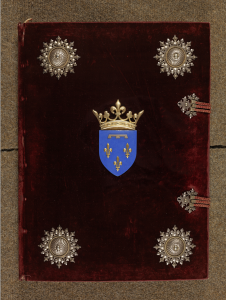
NOTE: I am a known perpetrator of musical hoaxes, but this isn’t one of them. This bizarre composition really is over 600 years old.
As Marsellus Wallace once quipped: “I’m’a get medieval on your ass.”
I’ve been obsessing again on a medieval composition that’s fascinated me since my geeky teens. It’s Fumeux fume par fumee, a bizarre artifact from a bizarre moment in music history: France in the final years of the 14th century.
(If you’re wondering why I was listening to medieval and Renaissance music when I was 17 instead of Zep and Floyd, and what the stuff brings to my guitar playing today, read on. But first, that freaky music!)
The world that produced Fumeux fume par fumee wasn’t your storybook Middle Ages. We’re talking Hundred Years War, Black Death, Papal Schism — and a radical musical style of head-spinning complexity and abstraction. It was dissonant music for dissonant times. The death rattle of the Dark Ages.
The 14th century had witnessed the rise of ars nova, a florid and intellectual style characterized by bold new approaches to counterpoint and musical structure. But by the 1380s or so, ars nova had mutated into ars subtilior, an even more abstract and experimental style.
“Ars nova” means “new art.” It was.
“Ars subtilior” means “more subtle art.” It wasn’t — unless by “subtle,” you mean “characterized by extreme dissonance and chaotic rhythms.” And Fumeux is a perfect embodiment of this radical style.
Here’s what I’m talking about:
WTF, right?
You probably don’t need me to specify why this music is so freaky, but I will anyway:
- It’s freakishly chromatic.
- It’s freakishly low-pitched.
- Its rhythms are freakishly complex.
- It may have been inspired by a freaky drug cult.
Fumeaux is one of a dozen Codex Chantilly compositions attributed to Solage, a composer about whom we know nothing. However, the song’s cryptic text may refer to an artsy-fartsy smoking club/cult. And in those pre-Columbian days, tobacco was unknown in Europe, so they would have been smoking either hash or opium.
A smoker smokes through smoke
A smoky speculation.
Is, between puffs, his thought:
A smoker smokes through smoke.
For smoking suits him very well
As long as he keeps his intention.
A smoker smokes through smoke
A smoky speculation.
And there are some who believe that reefer-puffin’ jazz cats and acid-baked hippies were the first to combine music and drugs!
Was Solage part of this crowd? Or was he lampooning them with ear-twisting sonorities? We don’t know — though we can probably assume he was a member of one of the avant-garde circles in Paris or Avignon. Here’s part of the original manuscript:
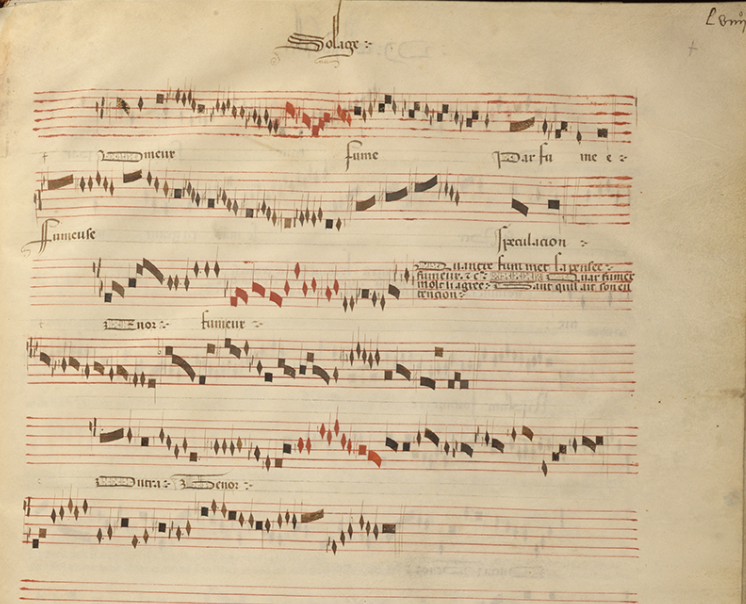
Nope, I’m not reading from that — I worked from a modern edition you can download here. But despite its six-line staff and multi-color note heads (the red ink indicates rhythmic variations), you can at least recognize this as an ancestor of modern notation. That’s less true of these Codex pages, which feature two pieces by a composer named Baude Cordier:
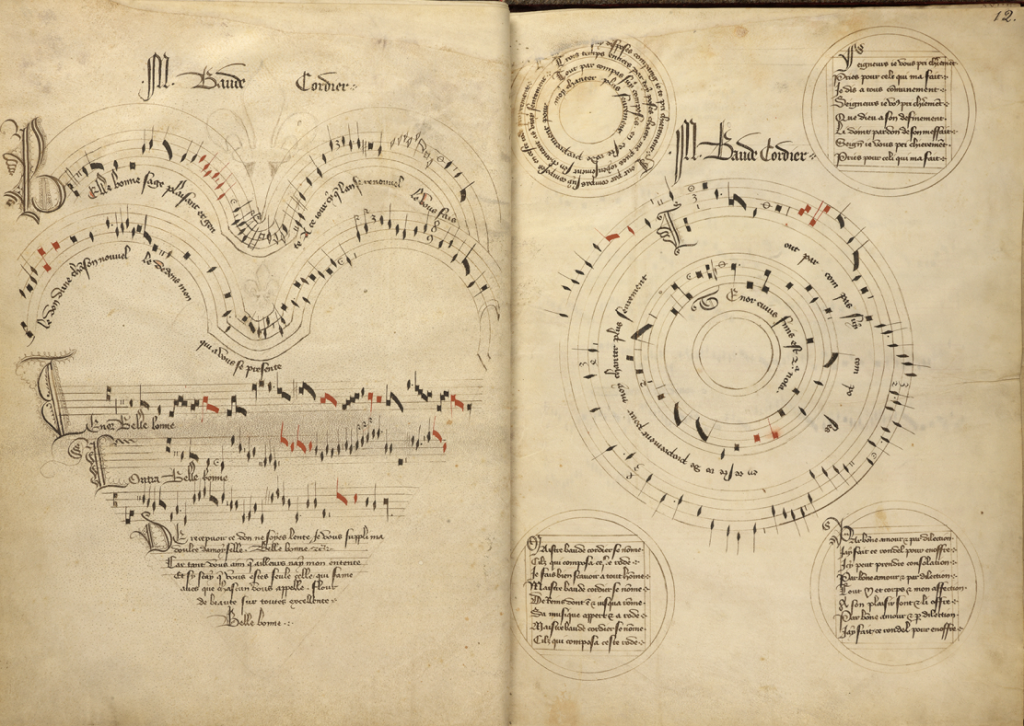
On the left is Belle, Bonne, Sage, a courtly love song notated in the form of a heart. (Or maybe it’s a pun of the composer’s name, which sounds like “couer,” the French word for “heart.”) On the right is an “endless canon,” a piece whose melodies echo and circle each other like a brainiac version of “Row, Row, Row Your Boat.” It’s called Tout par compas suy composés — “I was composed with a compass.”
Clever.
I originally tried recording this on acoustic guitar, but the three low-pitched parts sounded too muddy. It just worked better with pick-style baritone guitar. And while Solage probably never envisioned his music being played by a trio of Fender Bass VIs, the choice isn’t as ludicrous as you might think. Music of this era was almost never composed with specific instruments in mind — it was understood that the parts could be played by any available combination of voices and/or instruments. It wasn’t until the later Renaissance that composers began to create specialized parts for specific instruments, and the concept of orchestration was born. (Though orchestras as we think of them didn’t exist until the 18th century.)
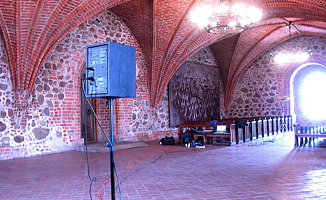
Oddly, the most historically authentic aspect of my recording may be its digital reverb. I ran the performance through an Altiverb impulse reponse reverb created in an actual 14th-century castle. (You can read more about the magic of impulse response reverbs here.)
I’ve marveled at this piece for decades, but never tried playing it till I tracked this yesterday. Getting “under the hood” with it only deepens my fascination.
How did I get turned on to it? At 17, I was convinced my destiny was to be a scholar of early music (the catch-all term for European art music before Bach). I studied the Renaissance lute in college. (When anyone asked my folks what their son was studying at UCLA, they’d reply: “Lute. He’s going to be a shepherd.”)
I switched to a composition major in grad school, and haven’t owned a lute in decades. But years later, when I decided to focus on fingerstyle electric guitar playing, I instinctively adopted something like a lutenist’s right-hand technique. It’s not terribly different from classical guitar technique, except that I almost never use a classical guitarist’s “rest strokes” (bringing a finger to rest on an adjacent string after plucking). Also, while a classical guitarist tends to play melodies with alternating index and middle fingers, I usually play them with alternating thumb and index finger, lute-style. (You can take the boy out of the Renaissance Faire, but you can’t…)
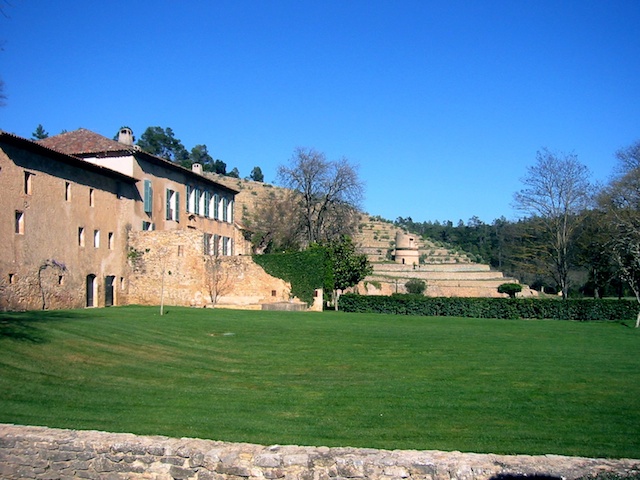
Funny epilogue: Ten years ago I was trying to record a Courtney Love album at a beautiful chateau in Southern France, the same studio where Floyd tracked The Wall. We weren’t far from Avignon, where this music may have originated. One night at dinner Courtney injected some casual comment about 14th-century compositional techniques. She may have gleaned it from Richard Hostatder’s Gödel, Escher, Bach. Or she may have just been fucking with me. (Reading up on you online so she can “casually” drop a mind-blowing comment into a conversation is very much Courtney’s style.) That led to a discussion of French poetry, and the studio manager recalled with admiration the way Robert Smith used to sit around that same table reciting symbolist poetry — in the original French, of course — while the Cure was recording Kiss Me Kiss Me Kiss Me. Occasionally rock stars are really smart.
The studio went under soon after, largely because Courtney neglected to pay her astronomical bills. Today the chateau, studio, and winery are the country estate of Brad Pitt and Angelina Jolie. I wonder if they ever discuss 14th-century counterpoint and the ars subtilior.
P.S.: If you’re curious about this remarkable juncture in history, check out Barbara Tuchman’s classic A Distant Mirror: The Calamitous 14th Century, a riveting history book suitable for general readers.


Leave a Reply