Not a turkey: Dave Wetherby's eye-catching Colorcaster
The contestants were formidable. The competition was fierce. But by the time yesterday’s deadline arrived, one mutant stood triumphant — so triumphant that we are spared the interminable silliness responsibility of a run-off round.
And the winner is Dave Wetherby’s kaleidoscopic Colorcaster. Congrats to Dave, who will receive as a prize a super-freq Uglyface, a fuzz pedal that only a mutant could love. Congrats, Dave!
At the moment, I’m particularly thankful that, despite being a jaded old musician, I can still encounter instruments that, um, take my breath away. And if you can view all the Mutant Beauty Pageant contestants without spewing your beverage all over your computer, you’re made of stern stuff indeed.
Exaggeration? You be the judge. Literally!
As specified in the “rules,” the submission deadline has arrived. Now it’s time to choose the most beautiful mutant. Just select your three favorites from the photo gallery below.
The end is nigh! But maybe not as nigh as originally planned…
Thanksgiving Day (that’s Nov. 24th to you non-U.S. residents) was the original deadline, but I’m going to extend it through the holiday weekend, till midnight, PST, on the 27th) for one simple reason: We want to HEAR some of these mutants!
C’mon — I know many of you are avid home recordists. Let’s have some audio to accompany the remarkable visuals! It doesn’t have to be a fancy production — just a little bit recorded into a phone will convey the true horror of these monstrosities express the unique musical qualities of each instrument.
Post your pics (and, I hope, audio) to the comments thread here. Meanwhile, I’ll be updating the astonishing photo gallery here.
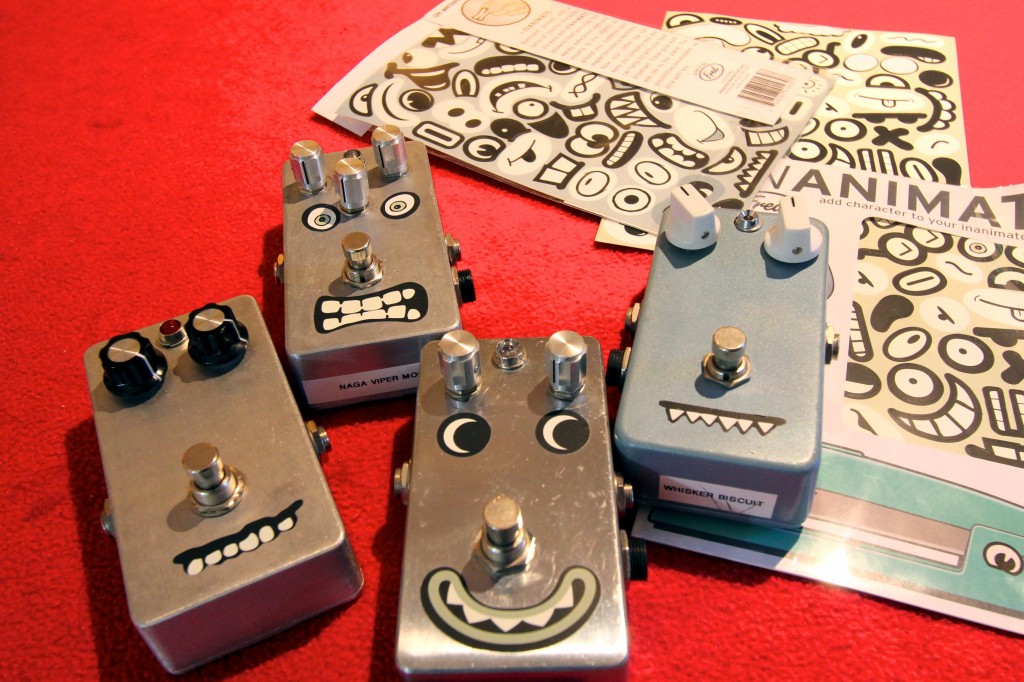
Helpless with paint, brushes, spray cans, decals and varnish? Take the lazy way out and use stickers. My favorites: the mouth, nose, and eye images in in World Wide Fred’s Inanimate pack.
Sure, the images will rub off eventually, but that’s the glory of stickers! Just use an adhesive remover like Goof Off and do it all again!
Digitally enhanced versions of the 1967 Patterson-Gimlin footage prove that Bigfoot used flatwounds.
Want to get a great ’60s-style Beatles/Byrds electric 12-string sound? Use flatwound strings. It’s almost guaranteed to up your jangle quotient.
This advice is admittedly counter-intuitive—why should relatively dull-sounding flatwounds improve a guitar’s treble response? My best explanation is that when the lower-octave strings emit fewer highs, there’s less phase cancellation against the higher-octave strings. The round wound sound is pretty in its way, but the flat wounds sound tighter and more defined, and are definitely easier to situate in a mix. The strings simply sound more in focus.
Don’t believe me? Hear for yourself.I’ve recorded the same lick with both types of strings—and you dang well better appreciate it! Do you have any idea what a pain it is to restring a 12-string twice within an hour?
(FYI, the guitar is a ’90s Japanese-made Fender Squier with Duncan pickups.)
One problem with this approach: Not many companies make flatwound 12-string sets, and they tend to be expensive. I’ve used both Pyramids and La Bellas with excellent results. The latter are far cheaper in the States.
And what’s the best amp? Bright Fender? Chiming Vox? Well, “Mr. Tambourine Man” was recorded direct into the board with no amp whatsoever, but tons of LA-2A compression.
Try this recipe: Plug straight into your warmest-sounding preamp. Boost the crap out of everything above 2kHz or so. Scoop a narrow band of low mids around 160Hz. Set the compression between 4:1 and 8:1, but with a slow-ish attack. A touch of plate-style reverb lubricates the proceedings.
On the other hand, maybe you want to liberate yourself from the conceptual prison on jingle-jangle 12-string. There’s no law that says you have to automatically start playing “Ticket to Ride” or “Turn Turn Turn” each time you heft one of these beasts. In that spirit, I offer a mismatched bouquet of alternative 12-string tones:
Well, um, the entires in our Mutant Beauty Contest are certainly . . . something. Click the MORE button to open the slideshow. New beauties added daily!
Post your images to comments via a photo-sharing site, or email them to me. I’ll add each new mutant to the slideshow so the entire Internet can laugh at your abysmal taste admire your collecting and building skills.
You can review the “rules” here. The prize is still TBD, but I guarantee it’ll be every bit as . . . something as the beauties displayed here.
Here’s a demo for our third DIY project: a combination clean boost and buffer.
The project files are here. For other tips, tricks, and resources, as well as all the info on our first two projects, visit the Tonefiend DIY Club page.
This is a super-useful guitar tool. You’ll learn about how to add more options to your effects via switching. You’ll also discover a) what a buffer is, and b) whether you need to care. (Answer: maybe.)
And this concludes the initial set of DIY Club Projects. Now that we’ve learned some workbench basics, the next few projects will involve poking around inside your guitars, where it’s possible to do some real damage. Until then, keep your soldering irons tinned and your smoke alarms armed!
I hereby announce the first Tonefiend Mutant Beauty Pageant.
I know many deadbeats with too much time on their hands musicians, and most of them have a thing for weird gear. I’m talking real freak-show stuff, the items that make anyone who walks into your music room shriek, “What the hell is that thing?”
Here’s the idea: You post your oddities, and the coolest/weirdest item wins. They can be anything music-related: guitars, basses, amps, effects, CDs or vinyl, music industry swag, some crazy DIY project—anything goes! The winner will receive—well, let’s just say something as weird and cool as the stuff being posted. (more…)
We all love tube amps. Yayy, tubes. Some of us love amp models. Yayy, models. And how about those cheap little solid-state amps?
[…crickets…]
Oh, come on! Am I really the only person who digs the barking attack and corrosive crunch of the subcompact tubeless combo? Will none step forward to sing the praises of those brave little badgers of the amp kingdom?
This nasty little fuzz bomb is fun to build and fun to play. Audition it here.
The project uses the same techniques introduced in Project #1, so if you survived that one, this should be smooth sailing. It’s also a great jumping-off point for custom designs, which you’ll get to explore in the course of the project. Bon Appétit!