
There’s a wealth of information online about the relative merits of “vintage” vs. “modern” wiring in Les Pauls. And after reading page after page on the topic, I was more confused than when I started. So here’s an attempt to pinpoint the sonic differences in a meaningful and relatively “scientific” fashion.
For those new to the debate, here are the basics: Nowadays tone pots in electric guitars usually connect to lug 3 of the volume pot, the same junction as the input from the pickup or pickup selector. Wired this way, the tone control siphons off highs before the volume control siphons off level. But in ’50s Les Pauls, the tone control often connects to lug 2, so treble is nixed after the volume pot does its thing. (I say “often,” because, as in so many other regards, vintage Gibson aren’t 100% consistent.) Here are some comparative schematics.
Most online sources manage to pinpoint the most basic difference: with vintage-style wiring, your tone retains more brightness as you lower the volume. But beyond that, there’s a buttload of b.s., including the frequent claim that vintage tone capacitors sound better or different from new ones. (They don’t.)
Anyway, I’ve made some comparative recording and measurements. After digesting all this geeky goodness, you’ll probably know whether ’50s wiring is an attractive option for you.
I made test recordings using the same ’80s Les Paul I victimized during the Pagey Project. The pickups are Seymour Duncan Seth Lovers, extremely accurate reproductions of vintage PAFs. I started with modern-style wiring, and made three sets of recording of the neck pickup:
- Playing the same phrase with the tone knob at 10, but with the volume decreasing from 10 to 6.6 to 3.3.
- Keeping the volume at 10, but lowering the tone from 10 to 6.6 to 3.3 to 0.
- Lowering the volume to 5, and then lowering the tone from 10 to 6.6 to 3.3 to 0.
Here’s what I found:
- As expected, with vintage-style wiring, you retain far more highs as you lower the volume knob, but there’s more to it than that: Modern also generated a pronounced low-mid bump. The brighter sound of vintage wiring has at least much to do with clearer low-mids as with stronger highs.
- With the volume control stationary, the “curve” of the tone control varies radically between the two wiring methods. With modern wiring, the tone rolls off much more quickly. To generalize, you need to lower a vintage-wired tone control about two-thirds of the way down to get a tone similar to a modern-wired tone control about one-third of the way down.
- You get about the same amount of treble loss with the tone control at 0 with both vintage and modern wiring — but modern wiring produces a stronger low-midrange bump, which probably makes the results seem darker.
- The tone-control properties described in #2 and #3 are similar whether the volume knob is all the way up or partially lowered.
Hear for yourself. For the test recordings, I recorded the Les Paul direct to disc via a Universal Audio Apollo interface. There’s no amp simulation or other EQ — you hear the harsh, unfiltered sound. (Plus some sketchy intonation, because I used garden-fresh strings for both recordings.) Without amps, tubes, and speakers (or virtual amps, tubes, and speakers) to filter highs, this is brightest sound you can get from a Paul, so take that into account when considering the results. Your amped tone will probably never be as bright as what you hear in this demo! Your results will also vary, depending to your pickups, amp, touch, and so forth. Contrasts will probably seem less extreme that they are here with the raw, direct sound. But you will almost certainly notice meaningful differences between the two wiring schemes.
Pretty dramatic, ain’t it?
Here are some readings I made using the Match EQ function in Apple’s Logic Pro. First I measured the sound of modern wiring with the volume at 10 and the tone at 6.6, and then measured vintage wiring at the same settings. Match EQ compares the two, and creates an EQ curve describing their differences. In other words, this is the EQ you’d have to apply to the modern sound to bring it in line with the vintage sound:
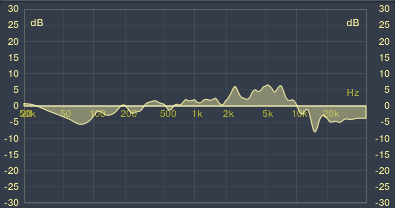
Now let’s flip the equation: Here’s the EQ you need to apply to the vintage wiring with the tone at 6.6 to make it as dark as modern wiring:

So which approach is better? It depends on your taste and gear, but allow me to offer a few recommendations:
- If you like your Les Pauls on the bright side, go vintage. (I love bright Pauls, so I’m sold already!)
- If you avoid using your volume control because of treble loss, go vintage. If you like exploiting the darker sound of a lowered volume knob, stick with modern.
- If you tend not to use your tone control much because you don’t like its dark, wooly-sounding effect, a switch to vintage might inspire you to use it more.
- If you’ve ever been tempted to replace a standard .047uF tone capacitor with something smaller for a more subtle treble roll-off (a .033uF or a .022uF, say), definitely try vintage! If you’ve ever contemplated a larger tone cap, go with modern.
This experiment also reinforces something I’ve learned over the course of our various experiments with Vari-Tones and other multi-capacitor tone controls, both homemade and commercial: Until recently, I failed to appreciate the extent to which standard passive tone controls not only filter out highs, but introduce resonant peaks surrounding the cutoff frequency. They don’t just cut highs — they emphasize mids. Even if you’re happy with standard controls (they’re standard for a reason, after all!), a little experimentation might uncover things uniquely suited to your style.
Has anyone else explored this territory? I’m especially eager to hear from anyone who’s applied this approach to any pickups other than a vintage-style PAF. Do tell!
Oh, one more thing: This is a super-easy soldering job. If you’re looking for a nice, n00b-friendly guitar mod, this one is a great choice!


Leave a Reply