
 Any baritone guitar fans in the house? Let’s talk LOW!
I’ve been obsessed with baritone and other low-tuned guitars for decades, but I’ve never really found a perfect method for setting up a lower-than-standard guitar, so I’m interested to hear about other players’ experiences.
My main issue is pretty straightforward: I can get great tones by simply lowering the pitch on a standard-scale guitar, but the intonation is a nightmare, especially on the fifth and sixth strings. And when I use a longer-scale instrument, I get huge bass tones and solid intonation, but the middle and upper registers feel too thin stiff and stiff — I have difficulty making them sing.
With standard-scale guitars, it seems to help if there’s a length of straight string-pull — like on a Telecaster — between the nut and the tuners. I used a standard Tele tuned down to BEADF#B (like standard tuning, but a fourth lower) on the Tom Waits albums I worked on in the ’90s. Fortunately, the sketchy intonation were a plus in that clangorous context. (His song “Goin’ Out West” is a pretty good example of a cool, but screamingly out of tune, guitar tone. It was played on an old Tele dropped down to B.)
Later I bought a crappy plywood Baldwin Virginian for $100 — also standard scale, but with a long, straight string-pull — and used it on many albums and tours. When I played with PJ Harvey, it was dropped to the “Gary Glitter” tuning she loved at the time. It’s the tuning from Glitter’s “Rock and Roll Part 2”: AAAAAA. That’s standard stringing, but with each string raised or lowered to the nearest A. I’d heard that song for many years, never realizing that the iconic riff is simply barred across all six strings. It sounds wicked, but only if you don’t mind an extremely wobbly intonation experience. That lowered first and sixth strings flap like sails in a hurricane. A lot of times I just used it as a noisemaker, as demonstrated in this Clinton-era clip:
What about the Danelectro six-string basses and Fender Bass VI? Love ’em! But to my ear, they’re best for single-note lines, like Robert Smith plays on all those great Cure singles, or like Glen Campbell’s epic solos to “Wichita Lineman” and “Galveston.” (Smith and Campbell both used the Bass VI.)

But often, I’m looking for something that feels and responds like a regular guitar, just lower. I want powerful, ringing low notes and a nice, warm sound throughout all its registers, and the long-scale solidbodies always sound dry and stiff once you get out of the bottom octave. I’ve used long-scale guitars when playing with Tracy Chapman (including a Yamaha Drop 6) when we’ve toured without a bass player. She has such a full, pretty acoustic tone that the inherent long-scale stiffness isn’t too obvious — I can get nice bass sounds and add some shading in the higher registers. But I’ve never loved the sound as the sole guitar.
Here’s a good example of what I mean, using an Gretsch Jet Baritone that a kindly friend gave me on long-term loan. (Thanks, Xander!) It’s a cool , 29.75″-scale guitar that looks and feels a lot more expensive than it is. But it’s got that characteristic thin, tight quality when played fingerstyle. I recently added the clean boost circuit we made in Tonefiend DIY Club, mounting it inside the guitar via a push/pull pot. (Don’t tell Xander I messed with his pretty guitar.) IMHO, it helps a lot. Have a listen:

But for the last year or so I’ve been using a new formula: a James Trussart Steelcaster — my favorite guitar — tuned CGCFAD (like dropped-D, but down a whole-step). I don’t know why it took me so long to try splitting the difference between B and E tunings, but it’s a pleasing compromise between the aforementioned approaches. The alto register really sings, and I can get massive lows, especially with a bit of digital assistance. I’ve been using that scheme exclusively in my new guitar/drum duo band, Mental 99, and recorded our first album using only that guitar and tuning — the first time I’ve ever done a project with a single instrument.
The audio clips here are a fair demo of how the instrument performs in varying registers. (Like all Mental 99 tracks, they were recorded live-to-drive by layering parts with a Boomerang III looper pedal.)
Has anyone else grappled with the stuff? Any advice?
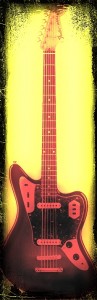
And has anyone tried one of those Fender Jaguar baritones, like the one pictured in the stylized photo at the top of this post? Looks like a Bass VI, minus some of the eccentricities. I’ve got a ’90s Japanese-made Bass VI, a lovely guitar that I’ve never been able to successfully use for anything other than deep, clean single-note lines.


Leave a Reply