After the frantic soldering fest that was The Pagey Project, I figured it might be time for a nice, simple DIY wiring project. At the suggestion of tonefiend reader JH, I played with variations on the 2-band tone control that appeared in some G&L guitars. And I am over the moon with the results!
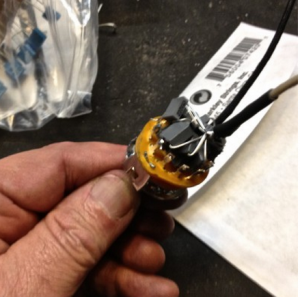
This circuit, sometimes called “PTB” (for “passive treble and bass”) combines a standard treble-bleed tone knob with a bass-cut control. The latter has a huge effect on the way distortion pedals and amps respond to the pickups, especially with humbuckers. Cutting some bass makes the pickups sound cleaner, airier, and more dynamic (i.e., less compressed). To my ear, the bass pot is not so much a tone control as a clarity knob.
Just how many colors can you coax from one guitar?
This post is about a guitar wiring scheme that only geeks and tweakers could love.
I think you’ll dig it.
In Phase 1 of this project, I recreated the original Page wiring scheme using an ’82 Paul, a pair of Duncan ’59 model pickups, and four push-pull pots. The result was a great-sounding, almost absurdly versatile guitar, though the sheer number of options was downright bewildering.
So naturally, the only way forward was to make the instrument even more bewildering by adding additional sonic options. This version offers all the sound of the Phase 1 model, and a buttload more. Several buttloads, actually — and I’m not talking about those skimpy metric buttloads!
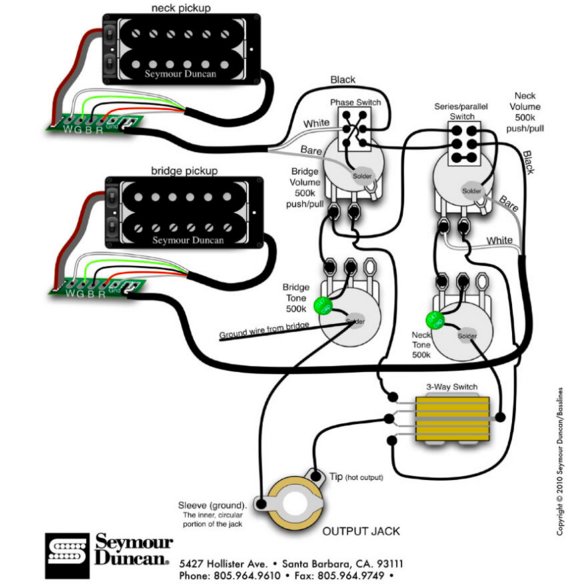
I gutted all the Phase 1 electronics. (Man, that hurt!) Next, using the same pickups, I added a pair of Duncan Triple Shot Mounting Rings. These provide four settings per pickup: humbucker, inner coil split, outer coil split, and both coils in parallel. (The Phase 1 plan offers only one split-coil setting per pickups. While you can configure the two pickups in parallel, you can’t do so with the individual coils in each pickup like you can here in Phase 2.) Here’s the wiring diagram I worked from, which for some reason is no longer posted on the Duncan site.
Since the Triple Shots add four new switches, the Phase 2 wiring requires only two push/pull pots. I wan’t about to let that real estate go unused! I installed a homemade germanium overdrive circuit (similar to the one we made in DIY Club) inside the guitar. My third push/pull pot activates it, and the fourth selects between two input caps, so I get a choice between a fat, Sabbath-style drive and a brighter, thinner Bluesbreakers-type tone.
“Just because it’s not broken doesn’t mean we can’t fix it.”
It’s been approximately 58 years since Leo Fender debuted the Stratocaster — and 57 years and 364 days since players started messing with it.
Strats just seem to invite modification. Sometimes it’s to address a perceived shortcoming: “The bridge pickup is too thin.” “Too much buzz.” “The trem won’t stay in tune.”
But sometimes it’s just a wild-eyed quest for something new and exciting.
Often this involves transplanting parts from other guitar models. Sometimes the strat simply rejects the new organs, but in the most successful cases, the implants expand the instrument’s capabilities in inspiring new ways. (To paraphrase The Six Million Dollar Man: “We can make it better…stronger…faster….”)
“The Mongrel Strat Project” is an ongoing series of strat-mod experiments ranging from simple pickup replacements to real mad scientist stuff. Some things we’ve covered so far:
• Mongrel Strat #1. Next, I tried a very different pickup recipe using three non-traditional strat pickups from Seymour Duncan: a Twang Banger (a bridge pickup that has a metal bottom plate like a tele bridge pickup for a huge, clanging tone), an APS-1 middle pickup (whose Alnico 2 magnets give it a slightly warmer, softer tone relative to a vintage Strat pickup with its Alnico 5 magnets), and a Danelectro-style Lipstick Tube in the neck.
Not what Leo han in mind: the Obsessive/Compulsive Tone Control.
• Mongrel Strat #2. After that, I combined the Twangbanger with a pair of more traditional vintage-style SSL-1 pickups, but I upped the weirdness factor by adding a Vari-Tone circuit — the quirky, multi-capacitor tone control found on such Gibson models as the ES-345. I unlocked some new sounds, but only you can say whether they were better left locked.
• Mongrel Strat #3. Then I tried combining the pickup choices, using a traditional-style SSL-1 in the middle with a Twangbanger at the bridge and a Lipstick tube at the neck. I also revisited the Vari-Tone idea via a monstrous 12-capacitor version. (Result: Many cool new sounds.) And since this installment involved constructing a new guitar, I tried out some new-fangled Strat replacement parts like Planet Waves locking/trimming tuners and the latest Wilkinson trem.
• Mongrel Strat #4. Yet another Twang Banger-fueled model, this time with an SSL-1 in the neck and an SSL-1 (RW/RP) in the middle. But this time around, I’ve used “Nashville-Style” Tele wiring, with the middle knob serving as a blend control. The down side: No access to the sound of the middle pickup alone. But oh, the upside! You get the outside pickups together, all three at once, and most important, the ability to adjust the blend in the “out of phase” combined-pickup settings. I love this Strat recipe! 🙂
• Mongrel Strat #5. I routed out the same poor generic Strat body used in previous experiments for the PAF Strat. (And now that I’ve mutilated the body with some exceedingly amateurish routing, you can expect more mongrel misfits.)
• Mongrel Strat #5. I routed out the same poor generic Strat body used in previous experiments for the PAF Strat. (And now that I’ve mutilated the body with some exceedingly amateurish routing, you can expect more mongrel misfits.)
• Mongrel Strat #6. After routing the Strat’s body for PAFs in project #5, I was free to try a new batch of larger-format pickups. You’ll gold foils, faux-single-coil humbuckers, mini-humbuckers, P-90s, staples, and more.
The series will continue! Feel free to offer suggestions — and share tales of your most memorable mongrel strat experiences.
In the previous installment of our ongoing mongrel strat series, I experimented with a version of Gibson’s oddball Vari-Tone circuit. I said it was too fussy and complex, and that I wanted to experiment with a simplified version.
So naturally, I built a “parts” Strat with a Vari-Tone twice as complicated as the original — a configuration I’ve dubbed the “Obsessive/Compulsive Tone Control.” I also deployed some of my favorite quirks and wiring tricks from previous strat experiments, plus a few new hardware discoveries. Result: a weird-ass guitar that only a geek could love a cool, one-of-a-kind instrument.
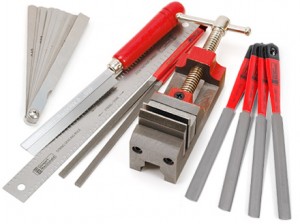
Better tools than I deserve: The Stew-Mac Essential Nut Making Tool Kit
Not something I’d recommend to everyone, but…
…as part of an ongoing series on mongrel/hybrid Strats, I’ve built a new Strat from parts to house all the cool little tricks and quirks I stumbled upon during the series. (Wait till you hear the “Obsessive/Compulsive Capacitance” tone control!) I’ll be doing a post on the guitar next week.
Anyway, lazy slob perfectionist that I am, I usually take my instruments to my local guitar tech/genius Gary Brawer for setup work, especially for carving and fine-tuning the all-important nut. But feeling brave, I ordered a few blanks from Stewart MacDonald and tried making a nut from scratch.
Numerous times, actually.
The first attempt was, of course, an unmitigated disaster. The second one was a little better — I’d call it a mitigated disaster.
Only a poor craftsmen blames his tools, so I blamed my tools. I sprung for Stew-Mac’s Essential Nut Making Tool Kit, with all the proper files, saws, feeler gauges, and a nifty little vise. And it actually did help — thanks to some great instructions from the ever-reliable Dan Erlewine, which you can find here. (Understand that my workbench skills are a joke. I’m the kind of guy who grabs a screwdriver to pound a nail rather than take 30 seconds to fetch the…whatever the hell you’re supposed to use.)
Anyway, I saved a fortune! My new nut cost less than ten bucks — plus $200 in tools and about $2,000 in labor.
Am I bitter? No way! I learned a ton, and the next time I need a nut, whether it’s made by me or someone competent, I’ll have a much better idea what to go for. I kept comparing it to making one’s own shoes — not something most of us are dumb enough to try, but man, you’d sure learn a few things about the contours of your feet!
I’m not posting a pic of my work because it looks really nasty, and Gary Brawer might see it and laugh at me. But ugly as it looks, my third home-cut nut actually feels and sounds great. (BTW, I tried working with both real bone and the simulated stuff from Tusq. Both materials have their staunch advocates, but I can’t claim to perceive all that much difference in tone or workability.)
Anyone else tried this at home? (I’m not talking to you, pro luthiers — I mean regular people!)