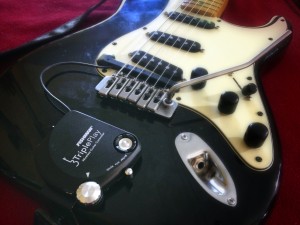
For the last few months I’ve been working with Fishman on the documentation for TriplePlay, their long-awaited wireless MIDI guitar system, which will finally ship this quarter. I had a blast demoing TriplePlay at MacWorld a few weeks ago, and I’m looking forward to doing so again at Musikmesse in Frankfurt in April.
But at times, it’s been frustrating. I power up TriplePlay to study some feature, get all excited, and then have to turn it off and write about it instead of going off and playing it for six hours. This little demo was my first real chance to just fool around with the thing. Thoughts and details after the video.
Hey, I’m totally guilty of fostering simplistic analog vs. digital arguments. After all, I launched this blog over a year ago with an Amps vs. Models listening contest. (The prizes have long since been claimed, but you can still take the test.) But maybe we should spend a little less time arguing about how faithfully that amp model mimics the sound of an amp from 1965, and a little more time exploring the cool and meaningful musical applications of post-analog tone production?
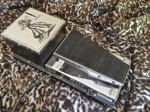
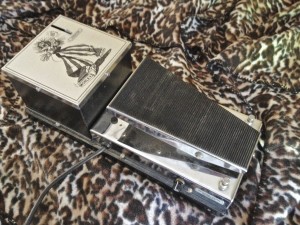
Two indisputable facts about Leslie rotating speaker cabinets: They sound awesome, and they’re approximately the size and weight of Rhode Island. Since the ’60s manufacturers have attempted to mimic the spinning-speaker effect in a more modest package. And one of the best mimics is the second exhibit in our Museum of Lost Effects.
The Morley Rotating Sound Wah is less well known than an earlier pseudo-Leslie, the Univox Uni-Vibe,forever associated with Hendrix. Like the Uni-Vibe, it a) tried to duplicate the Leslie, b) failed, but c) wound up creating a cool tone of its own. But while the Uni-Vibe milks its modulation from a series of optical sensors, the Morley relies on a rotating disc inside a can of electrostatic fluid. The result is a cool and complex modulation sound unlike any other (and one I’ve never been terribly successful at mimicking digitally).
This technology is descended from the “oil can” delays produced in the ’60s by the Los Angeles-based Tel-Ray company.In fact, Morley was a Tel-Ray spinoff — company founders Ray and Marv Lubow chose the name Morley for their line of guitar pedals based on the boast that this relatively compact modulation effect offered “more-lie,” as opposed to “less-lie.” (Note that I said “relatively” compact, since this beast is far and away the heaviest stompbox I’ve ever owned.)
The Morley Rotating Sound Wah is ugly, clunky, and klugey. If you drop it on your foot, you’ll never walk again. But I think it sounds incredibly cool.
No question about it: Amps are awesome, and guitarists will be plugging into them for a long time to come. But as threatened in this post from last week, I’ve been experimenting with direct- recorded guitar sounds. I’m not talking amp simulators, but the sound of electric guitar recorded straight into a mixing board with no attempt to replicate the tone of an amp. After all, some of the most iconic guitar riffs of all time — including Zep’s “Black Dog,” the Byrds “Mister Tambourine Man,” Chic’s “Le Freak,” and most ’60s Motown hits — were tracked not through amps, but through great old analog preamps, compressors, and mixing boards.
Not that I own any great old ’60s and ’70s analog recording gear. But I wanted to see how close I could get using modern preamps and compressors, plus plug-ins that simulate vintage gear.
And how close did I get? Um…kinda close, and I could have gotten closer if I had an attention span longer than five minutes dedicated sufficient time to the pursuit.
Hi folks — I’m experimenting with a switch to the SoundCloud audio player. I’ve been eyeing it for a long time, but until now it’s been entirely Flash-based, which meant you couldn’t access SoundCloud clips from mobile devices. But they’ve just introduced HTML5 support, so I’m ready to make the plunge.
The clip is an accompaniment to the post below about using unspotted Seth Lover pickups with the expanded Phase 2 version of the Jimmy Page wiring scheme.
One of the coolest things about SoundCloud (beside the nifty waveform view) is the fact that it supports notes. Just click on the little icons beneath the waveform to read a description of which pickup settings are being heard at a particular point. Sweet.
Work for you? Computer? Phone? Tablet? Any comments or questions? (Thanks in advance for for your unpaid beta testing!)