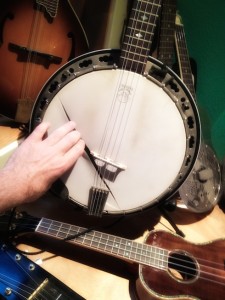
Weird but true: After my experience last week with simulated gut strings, I ordered a banjo set, figuring I’d restring my beautiful Deering with “nylgut” for an old-timey pre-bluegrass sound. But as soon as I tuned up, BANG! The head ripped in two.
I went upstairs and told my wife, “That’s weird — I’ve had that head on there for more than 20 years,” and she said, “That’s really weird — Earl Scruggs just died. Your banjo must be in mourning.”
Maybe. Or maybe Earl was just saying, “Don’t turn your back on bluegrass too fast, now, son.”
I’m not much of a player, though I’ve used the instrument a lot on Tom Waits records. I bring the Deering to sessions, but he always says, “Why don’t you play one of mine?” He has a couple of beat-to-hell early-20th-century open-backs with crusty old strings — a sound he describes as “death banjo.” Which is especially morbid given yesterday’s sad news.
Anyway, I learned as a kid from Scruggs’ 1968 instruction book. I still keep it on my shelf.
"We love candlelight, long walks on the beach, and really expensive old-school strings."
PLUS: New Contest! Name the Classic 6-String Bass Riffs and Win a Seymour Duncan Pickup Booster Pedal!
"We both love candlelight, long walks on the beach, and really expensive old-school strings."
NOTE:The contest is at the bottom of this post. You can skip ahead if you don’t care about rare and expensive guitar strings.
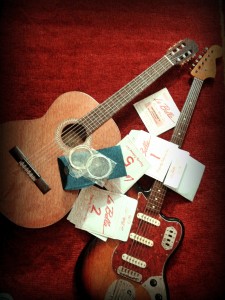
What do the classical guitar and the Fender Bass VI have in common?
Both instruments were developed using types of strings that are practically extinct.
First, let’s talk nylon strings. When these appeared after WWII, classical guitarists, led by Andrés Segovia, ditched gut overnight. Nylon strings were louder and brighter, and they offered better consistency, superior intonation, and longer life.
Few living guitarists have ever actually played gut strings, which really are made from animal guts (usually cows, goats, or sheep). I’ve never tried them myself.
But one of my darkest secrets is the fact that I started out as a teenaged lute player. (I have a photo of myself playing on a hay bale at a Renaissance Faire, wearing a feathered tudor cap and white tights. And you will never, ever see it.) I experimented with gut lute strings, only to run screaming. Total tuning nightmare, especially on an Elizabethan-era axe with friction tuning pegs, not to mention lots of unison- and octave-tuned strings. Guitarists were smart when they ditched the stuff.
But I recently bought a new ukelele, which came strung a set of Aquila strings from Italy. They have several lines of faux-gut nylon strings made from a proprietary material called — wait for it — “nylgut,” which allege to capture the sound of gut without the tears. They sounded cool on the uke, so I ordered a few guitar sets. At between $12 and $21 dollars per set, depending on the bass-string wrap material, they’re pricy, but not crazy expensive — about the same as other high-end, E.U.-made brands, like Savarez or Thomastik-Infeld. (Aquila’s US distributor is Just Strings.)
And holy cow, do I love ’em! They don’t look anything like gut strings, which resemble, well, dried-out intestines. But they really do capture a lot of “gutness.” Their tone is quieter and warmer than conventional nylon, with markedly less string noise (a great thing for a very rusty classical player like me). Check out this demo:

 I’m not much of a player, though I’ve used the instrument a lot on Tom Waits records. I bring the Deering to sessions, but he always says, “Why don’t you play one of mine?” He has a couple of beat-to-hell early-20th-century open-backs with crusty old strings — a sound he describes as “death banjo.” Which is especially morbid given yesterday’s sad news.