I’ve just finished recording a concert’s worth of live looping performances. I’ll be posting these a day at a time, starting later today and continuing through Thanksgiving, 2018. (And there’s a daunting round-number birthday in there somewhere.) I’ve covered my looping setup before, but it’s changed a lot since the last time I wrote about it.
MainStage users, you can download my looping template here. It includes no user patches or third-party plug-ins — it’s just a raw template. But if I’d had this when I started out, it would have saved me a day or two!
I haven’t posted any new video in months and months. It’s not just laziness or business, though I suffer from both. I’ve just been locked away in my studio, trying to create a new live looping system.
I still haven’t nailed it down, so I’m not going to get into a complete run-down yet. But here are the basic ideas.
• I’ve moved from a hardware looper to software looping. When I started this godforsaken looping project years ago, I’d just finished a lot of work on Apple’s then-new MainStage software. At the time, the program’s looper simply wasn’t reliable enough for live performance. Also, my intense signal processing was pushing my MacBook Pro to its limits. But since then, the program has gone through many upgrades. Meanwhile, after years of relative stagnation, Apple finally issued a major MacBook Pro upgrade in 2017. Between the more powerful computer and the refined software, I could finally shift looping and signal processing to the computer. Yeah, there are a couple of disadvantages. For one thing, MainStage’s looper lacks a “copy” function, something I’ve come to rely on a great deal in my arrangements. But it sure is nice not having to run the entire mix through the relatively cheap hardware looper convertors — just the snazzy ones in my Apollo interface. (Of course, now that I’ve transitioned, Electro-Harmonix has just announced a compelling-looking 6-track looper. I’ll have to check that out…)
• I’ve put aside for now the Fishman TriplePlay MIDI pickup. I have no complaints about TriplePlay, which is far and away the best MIDI pickup ever created, and a product I recommend without reservation. But I wanted to be free from the hardware setup. This way, I can plug in any guitar, any time. (I’ve been experimenting with acoustic looping — more on that soon.) I’m still using MIDI sounds, but again, it’s all in software via Jam Origin’s brilliant MIDI Guitar plugin. It works incredibly well without a MIDI pickup, but it’s not nearly as fast as TriplePlay. It’s fine for doubling, or for melodic and textural stuff, but it’s just not speedy enough to play MIDI drums at even moderate tempos. Which bring me to the other big departure …
• I confess: I’m playing to a drum machine. I’m triggering and changing patterns using a KMI !2 Step foot controller. I really wrestled with this decision. I loved the idea of using no machine tempos — it all came from the hands. But at some point I realized that the main reason I was committed to that approach was for bragging rights: “No prerecorded tracks, and no machine rhythms” I could boast. But who cares except geeks like me? Anyway, I still have misgivings about the change, but I’m going with it for now. I think that means, though, that I’ll create more arrangements without percussion, just so I’m not locked to the machine for an entire set.
Meanwhile working with a tempo clock lets me do fun stuff with synchronized effects. I’m especially besotted with Sugar Bytes’s Effectrix, a mind-bending multi-effector that lets you activate and edit effects on a note-by-note basis. You hear it a lot in the “solo” in this video.
I’ve played a few shows with the new setup. The first one was flawed but promising. The second was an unmitigated disaster. Then I doubled up on practicing and (not kidding) started meditating again, which helped a lot. Last time I tried this live, it went really well! We’ll see how it goes at my gig this week.
Anyway, it’s still a work in progress. I’ll keep the curious updated.
I played this cover tune with no irony whatsoever. I love the original.
I was polishing up my solo solo version of this lesser-known Mancini tune, and I was reminded once again of the late composer’s genius. Sure, we all know he was a great tunesmith and brilliant orchestrator. But the deeper you dig into his compositions, the more remarkable things you uncover.
Even though Mancini worked exclusively in pop idioms, I rank Hank as one of the 20th century’s greatest composers. Everything he composed seems to have some remarkable and unlikely compositional twist, even the best-known tunes we take for granted. Consider the slippery chromaticism and crunchy minor-3rd modulations of the Pink Panther theme. Or the familiar “Baby Elephant Walk” melody — if you take a step back, you realize how bizarre it is, rocketing up as an arpeggio before leaping down to a dissonant note. It’s also easy to forget how shocking the Peter Gunn theme was, with those violent dissonant accents, not to mention its unprecedented fusion of brainy Stan Kenton harmonies and greasy guitar rock. (Jobim is the only parallel I can draw in terms of writing wildly original chromatic themes that somehow become universally beloved pop melodies.)
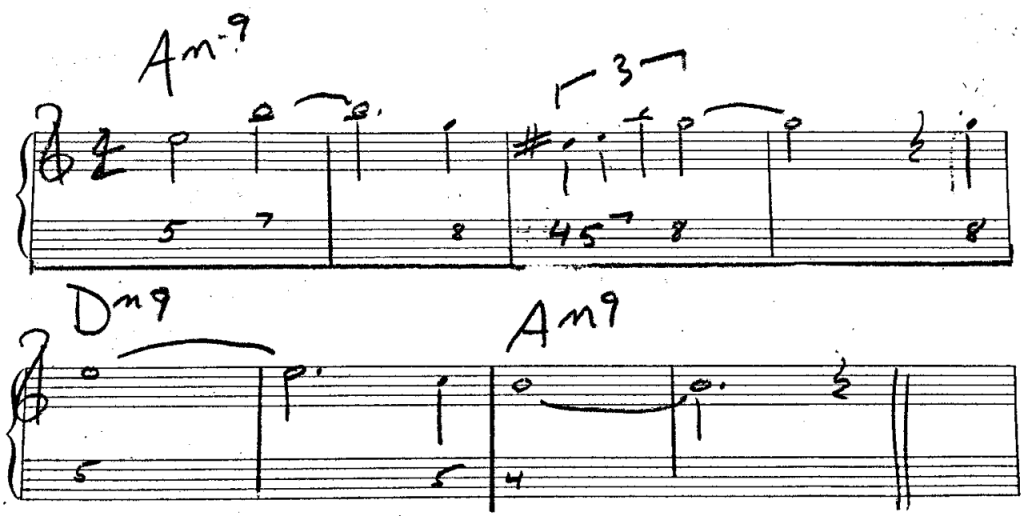
This song is Mancini’s take on the exotica style created by the likes of Martin Denny and Les Baxter. (Mancini was far too tasteful to include exotica’s signature big-call effects, but I lack such restraint.) But check out the cool melody and the way is straddles the underlying harmonies:
We’re in A minor, but no A notes appear in the main melody. Instead, the tune lingers on the 9th, emphasizing B over the Am7 chord and E over the Dm7. Eventually an A does appear — but not till the downbeat of the B second, by which point we’ve embarked on a long, twisted trail of chromatic modulation.
My Mancini obsession goes way back. In the ’90s, I was privileged to play in Oranj Symphonette, a jazz group lead by cellist Mat Brubeck (yeah, Dave’s son) that also included peerless keyboardist Robbie Burger, mad multi-instrumentalist Ralph Carney, and drum titan Scott Amendola (later replaced by the equally awesome Pat Campbell). Sadly, our two Rykodisc albums are out of print, but there’s buttloads of our stuff on YouTube.
No, I don’t mean like, “What’s better: B-flat or F-sharp?” Rather, is there a single note from a great recording or performance that haunts your dreams?
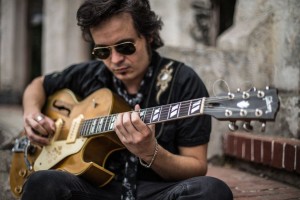
Here’s what go me on the topic: One of my Premier Guitar colleagues, Gary Ciocci, recently turned me on to El Twanguero (aka Diego Garcia), a brilliant Spanish-born, Argentina-based electric guitarist who’s created a head-spinning fusion of classic Latin jazz and rockabilly guitar. The only thing I don’t worship about the great Afro-Caribbean music of the 1950s and ’60s is the fact that it rarely includes guitar. But in Garcia’s retro fantasia, it’s as if the great Cuban and Puerto Rican mambo kings had migrated to Memphis instead of settling in NYC.
Diego “El Twanguero” Garcia: ¡Bien tocado, señor!
When I explored Garcia’s YouTube channel, I immediately clicked on his version of “Cherry Pink and Apple Blossom White,” a Perez Prado classic that topped the charts in 1955. (You probably know the tune even if you don’t recognize the title — it’s been in a zillion movie soundtracks.) I was eager to hear how Garcia would interpret the famous trumpet slur — perhaps the booziest single note ever recorded. (Yes, theory sticklers — I’m using the word “note” to mean a single articulated note, even when it spans multiple pitches over its duration.)
The tipsy note appears right at the top — it’s the fourth pitch in the trumpet melody. But it gets boozier and woozier with each repetition, and by its dead-drunk appearance at 2’27”, it’s amazing anyone’s still standing up.
Okay, try to convince me that it isn’t the sleaziest note ever! (Just for fun, here’s a live performance, where you can see what Prado looks like when emitting his signature grunt.)
How the hell would you render that on guitar without period-inappropriate distortion and locking tremolo? Take it away, Sr. Garcia!
Love it! ¡Bien tocado, Señor!
That got me thinking about other favorite notes. My #1 choice was easy — it comes at the end of this post. But two others also sprang to mind.
George Harrison’s “It’s All Too Much” used to be considered one of the Beatles’ least important tracks, though it seems to have been critically rehabilitated over of the course of the last few psychedelic revivals. It was cut in 1967 between the recording and release of Sgt. Pepper, just when the Beatles were discovering LSD. (It shows). But it wasn’t issued until 1969, when it appeared as a throwaway on the Yellow Submarine soundtrack — the first album I ever purchased with my own money. (And I’ve never recovered from the horror of discovering that side B features no Beatles material — just George Martin’s twee orchestral soundtrack.) But that blast of sustained feedback carved its way into my consciousness.
The experts say George played it, though I doubt anyone present was coherent enough to recall. I’m not saying it ain’t George, though I can’t help noting that whenever you investigate a particularly ferocious bit of Beatles guitar work, the perpetrator always seems to be Paul. (Examples: “Helter Skelter” and the solos on “Taxman” and “Good Morning.”) I dunno — maybe acid unleashed Harrison’s inner beast.
Another note that’s possessed me for decades is from Miles Davis’s heartbreaking take on Rogers and Hart’s “It Never Entered My Mind.” (From Workin’ — the first jazz album I bought with my own cash, at age 14.) Man, you could write a dissertation on the first eight bars of Miles’ solo, and someone probably has. Even though the notes are few and far between, I dare you to try playing along, matching the trumpet phrasing. But the highlight for me is the sublimely out-of-tune note in the fifth bar of the trumpet head. (It first appears at 0’33” in this clip.)
The performance is in A-flat, and the special note is a very flat E-flat — about halfway to D-natural. Man, how does something so wrong feel so … not just right, but transcendent?
That was my favorite note for many years, until I became a born-again Ellingtonian. Friend/genius Stephen Yerkey turned me on to Ellington’s 1938 remake of his own “Black and Tan Fantasy,” whose original 1927 version is universally regarded as one of the most important early jazz discs. But the 1938 remake is equally brilliant. Duke’s band was at or near the height of its powers. The orchestration is sublime. The piano work is radical. Each solo is a jewel. And then there’s THE NOTE.
Now, there’s nothing I find more musically distasteful than a cheesy, star-searchin’ vocalist wowing the crowd with a long sustained note. I hate it just as much when operatic singers do it (as did many of the great opera composers). And using the national anthem at ball games as a pretext is just plain nauseating.
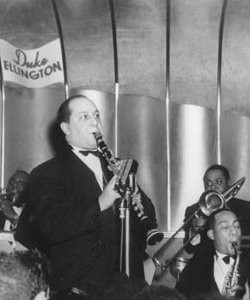
Did Barney Bigard play the greatest note ever?
Yes, THE NOTE is impossibly long and difficult. But there’s more here than sheer virtuosity. The painfully slow glissando literally makes you dizzy, as if the world were tilting off-axis. (It’s more psychoactive than the Beatles on acid!) It exerts exquisite tension against the backing harmonies, and it lets Duke display his most Debussy-like side in his watery, chromatic piano accompaniment. And the dismount is astonishing: Another wind player would be gasping on the floor, but incomparable clarinetist Barney Bigard (also featured on the 1927 original) concludes with a soft, casual phrase, as if he had all the time and breath in the world. For me, this is the ultimate musical embodiment of “cool” in its most profound African diaspora sense.
Play it, Mr. Bigard! The miracle commences right after 1’15” (but please, treat yourself to the entire performance).
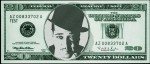
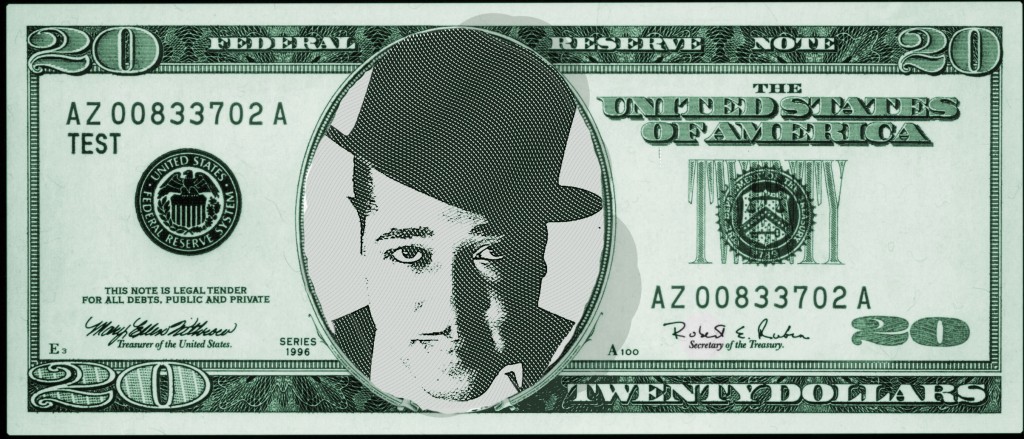
(I know I’ve said this about 50 times on this blog, but I repeat it whenever possible: In much of the civilized world — Europe in particular — the arts are considered precious, and musicians routinely appear on currency. If Americans gave a crap about culture, our greatest composer would grace the $20 bill, not genocidal Jackson. Though admittedly, there’s a strong case for Harriet Tubman.)
Okay, enough of my yakkin’! What’s your favorite note?
I’ve long been obsessed with Sam “The Man” Taylor’s epic sax solo on the Chords seminal 1954 rock ’n’ roll hit, “Sh-Boom.” But I never got around to learning, transcribing, and analyzing it till now. I heard it about 100 times while making and editing this video, and it still thrills me on every listen.
If you’re like me, you know it’s wise to study performances by non-guitarists, but seldom get around to doing it systematically. For once I followed through, and — at risk of sounding like a pedantic dork — I’ve analyzed what I heard and suggested ways to incorporate the concepts in styles far removed from the original doo-wop context.
You can download my transcription (in standard notation and guitar tab) here.
The final part of the video is a rant about how segregation shaped the course of early rock and roll, in which I piss all over the Crew Cuts’ tepid cover version of “Sh-Boom.” (Spoiler alert: It blows.) This was partially inspired by recent despicable comments from musical felon Pat Boone. I’ve linked to the following videos before, but I’m posting them again because the cost of quality music is eternal vigilance against sonic shit-shovelers.
Holy crap! It’s the coolest man in the universe! This foreshadows Hendrix, Prince, and the Beatles. Even lip-synched, it’s everything badass in one minute and 50 seconds. (And it speaks volumes about segregation in midcentury America.)
And then there’s this:
Unholy crap! It’s the least cool man in the universe. And this foreshadows nothing except the worst music of the last 60 years (though it too speaks volumes about race in 20th-century America).
Why beat this dead horse? Why pick on ol’ Pat 60 years after the fact? Maybe he regrets his musical misdeeds. Maybe he’s even developed a more nuanced view of race and racism.
Naw. When self-avowed white supremacist Dylann Roof murdered nine African-American churchgoers on June 17th, 2015, Boone leapt into action, penning an angry editorial that condemned … politicians who dared to refer to the atrocity as “racist.”
FUPB. There’s no statute of limitations on your crimes.
Psst…this week I embark on a grueling two-city solo guitar tour.
I’m playing my first ever L.A. solo show next Tuesday, the 12th, with one of my favorite players on the planet: the brilliant Mark Goldenberg. I’d previously know his pop work, but only became aware of his amazing solo playing last year when we both performed at one of Teja Gerken‘s guitar events. It was love at first note. We bonded on our affections for Ellington and ’60s L.A. pop, and the fact that we were both Ted Greene students. Plus, he’s just a cool guy.
The show’s at Genghis Cohen (740 N. Fairfax near Melrose). Danielle D’Andrea plays at 8:00 PM, Mark’s on at 9:30, and and I play a bit after 10:00. Maybe Mark and I will even work up a duet or two.
Admission is 10 bucks. The show is all-ages. If you’re in SoCal and free on the 12th, please join us!
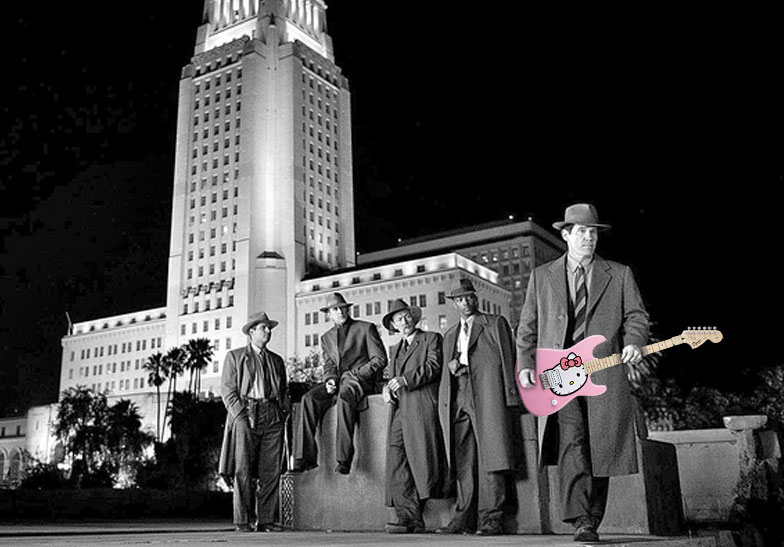
My pal Bill Selby drew this amazing illustration. I’m going to hell for defacing it in Photoshop.
And then, on Thursday, the 14th, I play my monthly solo show at my beloved local dive, San Francisco’s El Rio. This one’s special too: My guest star is another astonishing player, Giacomo Fiore. Giacomo is rightly renowned as one of of our greatest avant-garde classical guitarists, specializing in difficult modern repertoire. But this time, Giacomo’s performing an all-electric set. I have no idea what to expect, though I’m certain it will be astonishing. (In addition to releasing some remarkable recordings, Giacomo lectures at several noted Northern California universities and conservatories, and he gets excellent marks on Rate My Professor. Just sayin’.)
This show is free, but over-21 only. I play at 7PM sharp, and Giacomo starts around 8.
Remember, you heard it here first — off the record, on the QT, and strictly hush-hush.*
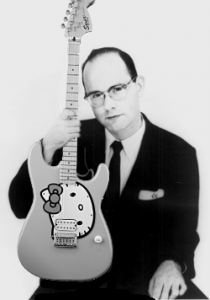
* This quote, the post title, and the noir pics are inspired by James Ellroy’s L.A. Quartet, probably the greatest series of hardcore crime novels ever. (And Ellroy’s newly released prequel, Perfidia, is every bit is awesome.)
I recently reviewed the gorgeous little Veillette Avante Gryphon for Premier Guitar and liked it so much that I bought one. This was my first opportunity to record it in my studio.
The Avante Gryphon is a relatively low-cost version of Woodstock luthier Joe Veillette’s Gryphon, an 18.5″-scale 12-string designed to be tuned a minor seventh (an octave minus two frets) above standard. But while 12-string guitars feature octave-tuned string pairs, here all six courses are unisons, as on a mandolin. In fact, the Avante Gryphon sounds a lot like a mandolin, but with a wider range and guitar-like tuning. And unlike the couple of janky plywood mandolins I own, it plays gloriously in tune. It’s made (very nicely!) by Korean CNC robots and sells for $1,400, as opposed to $4K+ for Veillette’s hand-built models.
For years I’ve been looking for the right upscale mandolin, but now I’m happy I found this instead. My original motivation was a high-tuned soprano instrument for multi-guitar arrangements, or for magic-fairy-dust studio overdubs. But the thing is so fun — and sounds so darn pretty — that I can’t stop playing it solo. This Bach prelude, for example:
I won’t recap my review here—check it out if you’re curious. Instead, let’s yak about Johann Sebastian! (more…)
My pal Josh Hecht is making a documentary on Howlin’ Wolf. Josh, a noted engineer and audio instructor who came of age hanging out in Chicago blues clubs in the ’60s and ’70s, has corralled great interviews with the likes of Sam Phillips, Jimmy Page, and the late Hubert Sumlin, Wolf’s longtime guitarist. He also speaks with younger Wolf fanatics such as Dan Auerbach and Kirk Hammett. This work-in-progress will be cool indeed.
(Don’t be surprised that Kirk is a Wolf worshipper. He’s an extremely well-rounded listener, a lifelong guitar student, and an exceptionally cool and smart dude. Long after he became a star, he studied music a San Francisco State University, where Josh was one of his instructors. Josh shot cool footage of Kirk in his practice room, playing “Smokestack Lightning” on a funky old Epiphone — a Coronet, I think.)
Josh dropped me a note yesterday, telling me he was going over to Kirk’s to shoot additional interview footage, and asking whether I had ideas for further questions. Here’s what sprang to mind:
Many of the interviewees point out the things that rock drew from from Wolf: the riff-based composition, the power and aggression, the distortion. But it’s also interesting to consider the ways later players veered from Wolf’s path, and ponder what was left behind.
1. Take groove: Wolf’s rhythms are powerful but rubbery. The beat wobbles and floats like surfboard. The note placement floats relative to the beat, like a skateboard atop the surfboard. Today’s players are more like slot cars speeding along a pre-carved groove. We’re metronomic and predictable in comparison, even when not performing to click. Bands play together in tight lockstep, favoring even note values and motoric rhythms. Where did the looseness go?
2. Or take distortion: We’ve been in an overdrive arms race for decades, using fuzz pedals, heavier amps, aggressive signal processing. But doesn’t the relatively light distortion of Wolf’s guitarists permit tonal nuance, dynamic range, note-per-note color we can’t equal? So many of our tones are always on 10, squeezed to maximum density like toothpaste. What did we surrender to get there?
3. Or phrasing: Consider, say, Sumlin’s solo on “Shake for Me,” full of oddball phrases of uneven length. Today’s players tend to lock into a single type of vibrato. In “Shake,” there aren’t even two notes with identical vibrato. He smears in and out of notes in ways no one seems to do these days. It’s like we’re punching out notes on an assembly line, while Sumlin is carving each one individually from wood.
What happened? How might it have gone differently? Might any of those aesthetics return?
I have no idea whether Josh will use my questions, and if so, what response they may elicit. But what do you think?
Some inspiration:
Sumlin’s solo above isn’t quite as awesome as on the studio version, which may be my fave solo ever. (God knows, I’ve stolen from it often enough.) But still.
Are there any particular guitar solos you’re obsessed with lately?
Here’s one I can’t stop listening to: Jim Hall’s solo on Sonny Rollins’ 1964 recording of “God Bless the Child.”
This may seem like a weird statement, given how much self-indulgent wanking infests this site, but I have a love/hate relationship with guitar solos. (Or more like a hate relationship leavened by occasional stirrings of love.) That’s especially true with singer/songwriter tracks. A good song drags you into its emotional world, and so often it strikes me as emotionally jarring to suspend the drama for a fretwork display. It can be like an ill-timed intermission in a great movie, as if you were watching Citizen Kane or Grand Illusion, and they paused the film two-thirds of the way through to bring out a juggling monkey.
That’s one reason I love this solo so much. Hall just plays beautifully all the way through. He’s like the Loch Ness Monster, undulating continuously just beneath the surface and gently lifting his head above the waterline when his moment comes.
Another is the sheer bravery with which Hall employs silence. Talk about pregnant pauses! It would be fascinating to transcribe only the rhythms of the solo, not even the pitches. The asymmetrical phrases. The late entries. It’s so suspenseful. So poignant. So unpredictable. So frickin’ brilliant.
He’s such a genius, I almost feel guilty Photoshopping in a joke guitar.
Equally amazing is liquid blend of chords and melodies. For many players, that’s a binary distinction: Either you’re soloing, or you’re comping. This is just…music.
But the thing that amazes me most of all, I think, is Hall’s mastery of register. Baroque music scholars sometimes refer to a technique known as “compound melody,” best exemplified in the music of — who else? — J.S. Bach. Compound melodies are melodic lines that imply multi-voice counterpoint, even when they’re strictly single notes. A tune might center in one register, then leap high or low, establishing a beachhead in another register before returning to the original one. It then bounces back and forth between the regions, almost as if two tunes were being played simultaneously on adjacent channels, with the listener flicking back and forth between them.
I’m not sure I’ve explained that coherently. But Hall does it.
Jim Hall’s students (including Bill Frisell, whose playing this track so vividly anticipates) report that he kept a sign inside his guitar case that read “Make musical sense.” For many of us, soloing is about practice, practice, practice, and then when the moment comes, we turn off part of our analytical mind and hope that our instincts and muscle memory huck up something acceptable. But I get the sense that Hall, in pursuit of “musical sense,” never turns off his analytical mind. That’s not to say his approach is cold or scientific—he wears his heart on his sleeve here! But he’s always intelligent and thoughtful.
It’s said that improvisation is spontaneous composition. Sure, sometimes. But it’s rarely this spontaneous, or this composerly.
Gotta listen one more time—BRB.
Yeah, it’s still amazing. 🙂
So what are your current guitar solo obsessions? Any style. Any skill level. Anything that makes you feel intense things.
Anyone have much experience playing solo instrumental guitar gigs?
Even though I’ve been playing since the Pleistocene, I’ve only performed solo once since I was a teenaged classical guitarist. But I’ll be making the stumble leap this Wednesday, Sept. 11th, when I perform north of San Francisco at the Sleeping Lady Cafe in Fairfax. I’ll be a guest at Teja Gerken’s monthly fingerstyle guitar showcase, performing alternating tunes with Teja and Mark Goldenberg. (Gig details here.)
Both Teja and Mark are gifted players and composers — check out the evidence here and here. I believe they’ll be playing acoustically, while I’ll be dragging up my whole frickin’ looping/synth rig. Because what could provide better counterpoint to an evening of refined and intelligent fretwork than a goddamned electronic racket?
Oh — that one solo gig? It too was a multiplayer solo guitar night featuring some astonishing players: Will Bernard, Jim Campilongo, and Buckethead. Will, Jim, and Brian were as amazing as you’d expect. Meanwhile I put everyone to sleep by performing the entire Bach A Minor Lute Suite on steel-string acoustic. (I’m sure the audience was duly impressed by my formidable memorization skills as they nodded off.)
I’m not repeating that mistake! This time it’ll be fuzz and feedback, with a double side order of ring modulation! :pity:
So got any survival tips for performing solo? Any good jokes for during the inevitable laptop crash and reboot?
If all else fails, I can borrow a trick that the late, lamented Danny Gatton once shared with me in an interview: A lifelong tinker, Gatton built a stompbox designed to blow the power in any club. If he didn’t like how the gig was going, he’d click it on, plunging the venue into darkness and calling it a night. (Or so he claimed.) Hmm — maybe that’ll be the next tonefiend DIY project….