I tend to regard the New Year’s resolution like New Year’s drinking: not necessarily a bad tradition, but one I feel no guilt about ignoring most years.
But since I have some specific musical goals in 2013, I figured I’d share ’em — and open the floor to anyone who feels inspired to disclose his or her sonic goals for the coming year. Please post your personal promises to comments!
UPDATE:Here’s a direct link via SoundCloud. The file is downloadable for free. Sheesh — never occurred to me that folks might, like, actually download it and overwhelm my feeble little DropBox account!
While most people are baking cookies or lining up at the grocery store for 45 minutes to buy those frickin’ chives they forgot the other day, Dawn Richardson and I just put the finishing touches on Mental 99’s chaotic cover version of the Doors’ “Hello, I Love You.” (Mental 99 is our digital guitar/analog drums duo band.)
Have a free copy on us! Grab it here. (Download available.)
Why? Because we love you, man!
Seasons best from Mental 99!
(Nerd details: all guitar tracks played on my James Trussart Steelcaster though Apple’s MainStage software. Drums tracked at Fantasy Studio A, Berkeley, California, by Jason Carmer and Alberto Hernandez.)
Some boutique stompbox builders pursue endless refinements of classic pedal designs, developing ever-more-suave iterations of the Tube Screamer and Ross Compressor.
And some just want to blow shit up.
Guess which category Portland, Oregon’s Devi Ever falls into? Hint: Her extensive line of guitar and bass pedals includes such anarchy boxes as the Little Shit, the Ruiner, the Heroin Lifestyle, and the Truly Beautiful Disaster.
Here’s what I’m talking about: Check out Devi’s video demo for her Shoe Gazer fuzz…
…or this one of Wilco’s mighty Nels Cline giving Devi’s Soda Meiser a workout:
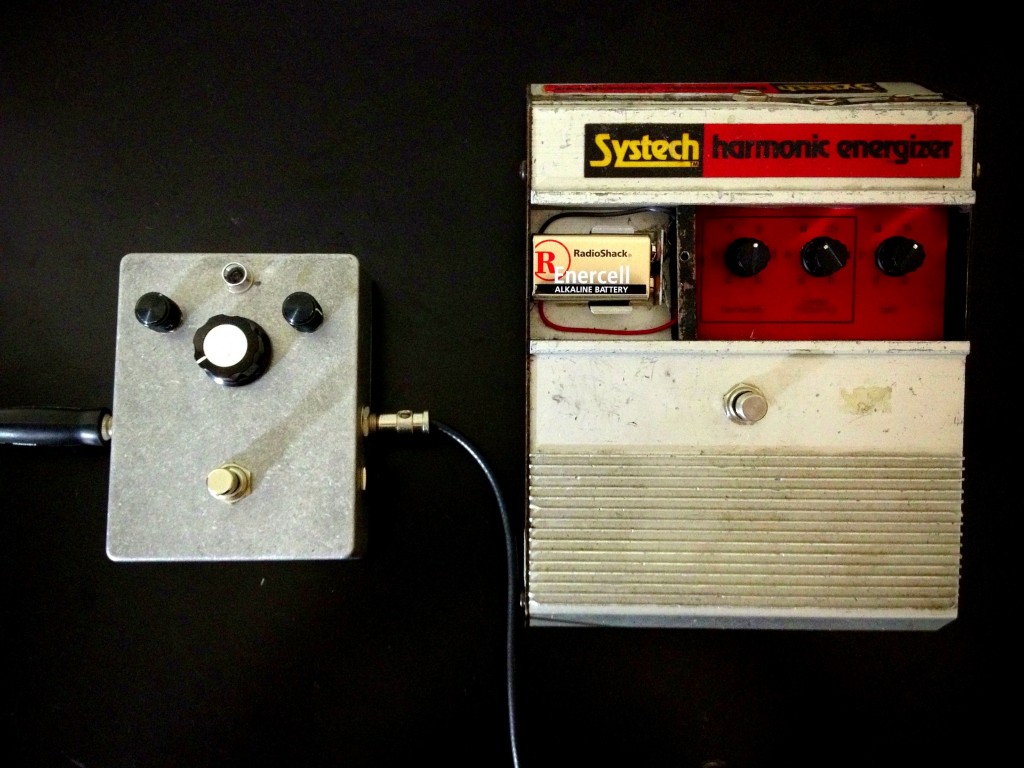
A homely clone cowers in the shadow of a ramshackle original.
Okay, here’s an old weirdo I’ve been meaning to write about for ages. The Systech Harmonic Energizer is an ultra-rare filter/distortion effect from the ’70s that takes the fuzz-wah formula in some interesting directions. Its signature is edgy, ultra-resonant filter sounds. You’re most likely to have heard it generating Frank Zappa’s nasal midrange squawk, but it does lots of other abrasive tricks too. I used this one on Tom Waits’s “All Stripped Down,” and on “Jets” by Action Plus.
The S.H.E. doesn’t do pretty. Most of its sounds are so strongly flavored, they’re hard to use as a primary tones. But it’s great for things like clanky percussive accents, or walloping low-frequency assaults.
Hey, I’m totally guilty of fostering simplistic analog vs. digital arguments. After all, I launched this blog over a year ago with an Amps vs. Models listening contest. (The prizes have long since been claimed, but you can still take the test.) But maybe we should spend a little less time arguing about how faithfully that amp model mimics the sound of an amp from 1965, and a little more time exploring the cool and meaningful musical applications of post-analog tone production?
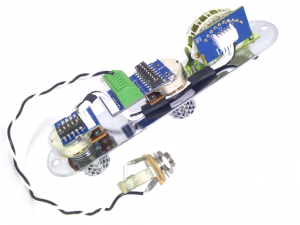
Prewired replacement electronics provide access to many popular wiring mods, minus the soldering.
Larry Santellan of Santellan Sounds, maker of the Elec-Trix tone modules, sent me some samples to check out. These pre-wired circuits offer quick access to some of the “greatest hits” of alternate wiring, with an emphasis on Strats and Teles. He has pop-in modules for 5-way Teles, Vari-Tones, passive overdrives, vintage/modern switching, and more.
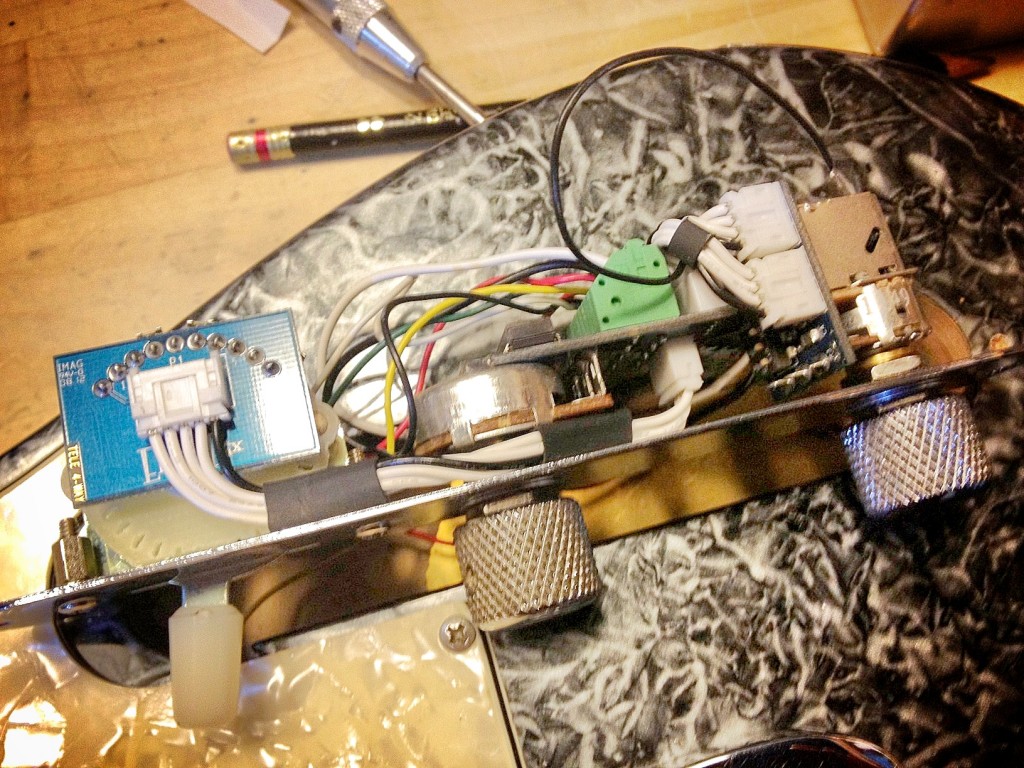
I haven’t had the time to try everything Larry sent, but for a few months I’ve had his 4-Way Fat Tone Monster Deluxe Wiring Kit in my Tele-like G&L ASAT. It lets me dial in the three standard sounds, plus that humongous series-pickups BLAT! A push/pull pot bypasses the tone control. (I never hear meaningful differences between bypassed tone controls and wide-open ones, but this setup lets me toggle between a bright, wide-open tone a muted one.)
Installation was relatively easy, and the parts and workmanship are top-notch. If you’re interested in alternate pickup wiring options, but don’t have the skill, patience, or time to solder it yourself, well, check out the Elec-Trix catalog.
Solder-free configuration via clever ribbon connectors.
Last winter I tried an odd experiment: a website where players were encouraged to post their best tone secrets — the kinds of tricks and techniques that are almost too good to share. But in order to get, you had to give: The site was password-protected, and the password was only sent to those who contributed secrets.
Musicians responded, no doubt encouraged by the cool prizes awarded to the top secrets, as judged by user ratings. I also asked some cool musician friends to contribute the first round of secrets, yielding tips from the likes of composer/virtuoso Lyle Workman, metallurgist-turned jazzbo Alex Skolnick, original Chili Peppers guitarist Jack Sherman, boy genius Blake Mills, and other great players.
Once the contest ended, traffic slowed, but the site has slowly but surely grown. And now, as an experiment, I’ve removed the password protection. Now anyone can visit the Secret Room, AKA tonesecret.com, even if they haven’t coughed up a secret. So please do!
It’s a fascinating document. Naturally, the quality of secrets varies, as does the level of expertise needed to make the most of them. I exerted a light editorial hand — only silly or flat-out-wrong tips were vetoed, and I didn’t do much in the way of spelling and grammar repair. Sometimes the contents are a little repetitious — but trust me, there is much wisdom and originality throughout.
I hope you find something helpful — and I hope you’re moved to contribute some secrets yourself using the site’s submission form. And who knows? There may be more tawdry bribes fabulous prizes lurking around the corner…
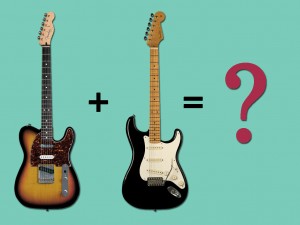
I’ve been coveting one of those “Nashville-Style” Telecasters — you know, the hot-rodded, three-pickup versions popularized by Nashville session superhero Brent Mason, and now a regular Fender production model.
Then it dawned on me: Since some of Mongrel Strats I’ve been playing with have strong Tele tendencies, why not flip the equation? Instead of a Tele that acts like a Strat, why not a Strat that thinks it’s a Tele?
The Fender version replaces the usual Tele 3-way switch with a 5-way, as shown in this wiring diagram, though many players prefer to keep the 3-way switch and add the middle pickup via a blend knob, as in this other wiring diagram.
I took the latter approach, and I am flipping out over all the new tones it unlocks. Check out this little video demo:
After auditioning so many different tone-control schemes over the course of the Mongrel Strat Project, I wound up with more tone circuits than I have Strats, so I figured I’d victimize a bass — specifically, a 1954 Fender P-Bass reissue with a Seymour Duncan Quarter-Pound pickup, which I’ve written about here. It’s a minimalist one-pickup model with basic volume and tone controls.
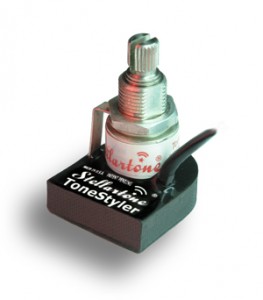
I was eager to audition a multi-capacitor tone control like I wrote about here. (Actually, it’s literally the same tone control — the guitar where it used to reside now houses the Stellartone ToneStyler tone pot covered here.) And while I had the patient on the operating table, I figured I’d also install the Black Ice distortion cube I wrote about here. (My friends in the medical profession assure me that patients always appreciate it when surgeons indulge in improvisational operating-theater mods.)
(Quick memory refresher: The Vari-Tone appeared in several historic Gibson guitars, notably the ES-345. It uses a half-dozen different-sized capacitors to alter the voicing of the tone pot. It also adds an inductor, which preserves lows while the capacitors remove highs. Result: the rolled-off settings have a somewhat piercing, nasal character, as opposed to the usual dark, wooly sound of a rolled-off tone pot.)
Like some cool DIY versions of the project, the ToneStyler omits the inductor. And while it looks like a conventional tone pot,it’s actually a 16-position switch that selects between stepped capacitors, all of them smaller than in a conventional tone control. Result: rolled-off tones that maintain more volume and impact than in a conventional tone control.