Tag: tone

  • Happy Humbucker-Sized P-90s!

    Happy-P-90s

    Just in time for the single-coil holiday season: my comparison review of 16 humbucker-sized P-90 pickups is live at Premier Guitar. This heartwarming holiday fun-fest has it all: Mouth-watering adjectives. Freshly baked audio clips. Irate manufacturers. Don’t miss it!

    This was a fun, if challenging project. Comparison pickup reviews are such cans of worms! Not only are they sadistically labor-intensive, but the differences between one pickup and the next are easily overshadowed by other variables in the tone chain.

    After much thought about how to create meaningful comparisons, we came up with an intriguing process: I tested all the pickups in the same guitar, with identical setups, and ReAmped them through the same combo amps with identical recording settings. If this were an amp or pedal review, I would have used the same performances throughout, but of course, each example had to be played anew with each pickup, so I spent much time matching performances to guard against misleading variations in touch and intensity. It’s not a perfect solution, but better than most, and in the end quite revealing.

    And what did it reveal, exactly? You’ll find out at the link. Beyond that, I can report that:

    • All the products sounded pretty good.
    • They sounded more similar than you might expect.
    • I’m gonna find me a guitar to house a set of my favorites — though I’m not sure which ones are my faves! Really, they’re close enough that, say, the tone of a particular body wood alone would be enough to sway the decision. It’s not so much a case of “better or worse” as “brighter or darker” and “louder or quieter.”

    As mentioned in the article, there’s no “gold standard” of P-90 tone — or rather, every P-90 lover has his or her own standard. Gibson’s ’50s original are notoriously inconsistent in their output, even their magnet type. Plus, the mere fact that you’re winding coils around a narrow, tall humbucker bobbin rather than a wide, low P-90 one has sonic implications. So I tend to think of this entire pickup category as either “single-coils that are ballsier than Fender single-coils,” or, in the case of hum-canceling models, “humbuckers with brighter highs and clearer mids.” (Or as my ol’ pal Steve Blucher from DiMarzio calls them, “humbuckers that hum.”)

    Funny thing: I love P-90s, but don’t own any guitars fitted with them. Not yet. :satansmoking:

    So talk to me about P-90s! Your faves? Beloved P-90 guitars? Fave P-90 players and performances?
  • Cue the Drummer Jokes!
    Playing Drums with MIDI Guitar

    strung_out_121213_small

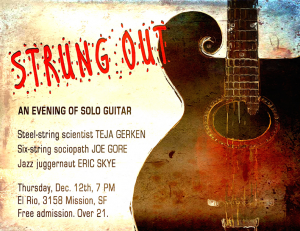
    I’m thrilled to bits about a show I’m playing Thursday eve in San Francisco featuring two guitarists of impeccable skill and taste, plus me.

    Teja Gerken and I are co-hosting a monthly solo guitar night at El Rio, my groovy neighborhood dive.Our guest is the amazing Eric Skye who, among other things, plays gorgeous solo guitar versions of classic Miles Davis tunes. If you happen to be in cold, cold San Francisco this week, stop by and say hi!

    I’ve been doing the digital looping thing with Mental 99 for a few years now, and man, trying to work out solo arrangements with live-looped MIDI drums has been seriously humbling. You know all those jokes we love about how drummers speed up, slow down, drool, and generally disappoint? I can do all those things and everything else a drummer does, except occasionally play a competent groove. Some of the problems have to do with MIDI tracking in general, and some are simply general suckage. Man, it sure makes me appreciate my brilliant musical partner Dawn Richardson, who never speeds up and drools only rarely.

    animal_drums

    But those who can’t, teach. So I whipped up a little tutorial on playing drums with MIDI guitar. The first half covers the moves, and the second half features a live improv based on my fave afrobeat pattern. (Tony Allen is my rhythm god.) It also includes some of the hybird synth/guitar sounds I’ve been exploring, like double single-not lines an octave lower, mixing trashy guitar and trashy organ, and of course, space pigeons. (I stole the organ line from my pal Robin Balliger.)

    In other news: I’ve been speaking to the ultra-knowledgable Rob Hull from Tube Depot about creating a minimalist DIY amp kit inspired by our conversations here. Lots more details to come. Tube Depot has a track record of making real nice amp kits, and Rob’s documentation/build instruction are the best in the biz. I reviewed their cool tweed Champ clone kit here.

    Oh — anyone score any good holiday presents yet?

  • Getting It Right the First Time

    Oh man — I got to open for Television last night in San Francisco, accompanying storyteller Dennis Driscoll. These days the band includes original members Tom Verlaine, Billy Ficca, and Fred Smith, plus Jimmy Rip filling in quite capably for original guitarist Richard Lloyd. They’ve been doing shows where they play their debut album, Marquee Moon, in its entirety (though they mixed and matched songs last night).

    Television recorded other cool records, including a lovely 1992 reunion album. But Marquee Moon is one of those instances in which an artist’s aesthetic is etched in stone from the beginning. The two-guitar interplay … the abstract, almost architectural arrangements … the contrasts between stiff and loose time … Verlaine’s free-floating rhythm and quavering 16th-note-triple vibrato—all were present from the get-go 36 frickin’ years ago.

    Of course this picture of Television sucks—I took it! L-R: Fred Smith, Billy Ficca, Tom Verlaine, Jimmy Rip.
    Of course this picture of Television sucks—I took it! L-R: Fred Smith, Tom Verlaine and Jimmy Rip, with a little bit of Billy Ficca’s hair in the background.

    I couldn’t help comparing Television’s artistic arc to that of their contemporaries, Talking Heads. Sure, the latter’s debut, Talking Heads ’77, is a classic, but had the band stopped recording after its release, we’d have only a vague inkling of what the group would become. More than once Jerry Harrison has told me that today’s bands rarely have the luxury of defining themselves over the course of several albums as Talking Heads did, slowly finding their audience and refining their sound. Today’s music business demands spectacular success from the start. A latter-day Talking Heads (if you can imagine such a thing) wouldn’t have the luxury of recording three albums before releasing a bona-fide hit like Remain in Light.

    Most great musicians evolve over time—imagine how we’d regard the Beatles, the Stones, Springsteen, Prince, or Dylan if they’d thrown in the towel after one album. That, I think, seems intuitive to most of us. The talent is there—it simply needs time to reach its apogee.

    But artists who seem to materialize fully formed mystify and fascinate me. I’m not just talking about Mozart syndrome, prodigies who display phenomenal talent while very young. Mozart grew artistically throughout his brief life. His juvenile works barely hint at the later masterpieces.

    On the other hand, consider Charlie Christian, whose style was fully realized from his first recordings with Benny Goodman in 1939, soon after the guitarist’s 23rd birthday. At his initial audition/gig, this kid from Oklahoma was mocked by the Goodman band hipsters for his hick cowboy clothes—until he blew them off the bandstand with 20 consecutive choruses of “Rose Room.” It was the most radical guitar sound the musicians had ever heard. From his first sessions to his last a mere two-and-half years later, Christian’s style never evolved. It was perfect from Day 1.

    Dig it! (Charlie’s solo starts at 1:10.)

    Another fascinating case: I’ve always had a soft spot for Cheap Trick, though I don’t know their music exhaustively. Like many listeners, I relate more to the relatively raw live versions of their hits on the Budokan album than to the tepid studio originals. The Budokan version of “I Want You to Want Me” has so much more power and passion than the slow, limp, overdub-laden version on In Color. But it wasn’t till 1996’s Sex, America, Cheap Trick compilation that I encountered the original demo of “I Want You to Want Me.” And holy crap—it’s simply one of the most perfect rock and roll tracks ever.

    Wow. No overdubs. Monster groove. Fabulous lead vocal. A perfect distillation of Elvis, Chuck Berry, and the Beatles. With all due respect to this long-running and hard-working band, I don’t believe they ever again nailed it quite like this.

    Since I’m already probably picking fights, I may as well blurt out that I view the first Doors album and Are You Experienced? in a similar light. Not that Strange Days and Electric Ladyland aren’t great—just that both Hendrix and the Doors entered the public consciousness with their artistry fully formed, and that they never recorded anything that wasn’t implicit in those initial recordings.

    Why do some artists just seem to come out of the chute fully mature, while others need time to realize their potential? And which ones would you include on a “Getting It Right the First Time” list?

  • The Lipstick Lab
    New Experiments with Old Pickups

    Do you ever get an idea that you just know is going to work out brilliantly? And then discover you were totally wrong?

    That’s how it was when I finally reassembled my generic Mexican Strat with Duncan lipstick tube pickups. After I recorded a demoing of it here almost two years ago, the guitar lay in pieces alongside my workbench. I’d stare at decapitated body, feeling guilty and dreaming of all the fantastic mods I’d attempt when I finally got around to reanimating it. I had various ideas for the tone control: Maybe a two-band PTB control? Nope—totally underwhelming results. Perhaps a two-in-one TBX? Meh—even less interesting. I drew a blank, and the guitar wound up with a disappointingly normal tone circuit.

    But I did discover some cool twists along the way. Details after the video:

    My flatwound string addiction is only getting worse, but this is the first time I’ve combined flats and lipstick tubes. (Has anyone done that since the ’50s?) The results were fascinating. As happens when you put flats on an electric 12-string, you encounter a paradoxical increase in highs, despite the darker-toned bass strings. (Maybe it’s because the treble strings ring truer with less phase-canceling interference from roundwound bass strings.) As you can hear, this instrument doesn’t lack for zing.

    The opposite, actually — treble notes explode from the instrument, often more than you’d like. I experimented with various action and pickup height adjustments, but no matter how I set things, it was difficult preventing certain notes from shrieking. The only solution was to play the damn guitar for a few hours and grow accustomed to the touch. (more…)

  • The Fender TBX:
    A Cool 2-Band Tone Control

    You can TELL it's Photoshopped! There's no TBX!
    You can TELL it’s Photoshopped! There’s no TBX!

    Thanks again to everyone who chimed in on the “What your favorite mod?” discussion. I got tons of great ideas from your comments.

    Like this one, which I’ve been meaning to explore for ages: the Fender TBX tone control circuit, which appears in several Custom Shop instruments, notably the Clapton signature Strats. Like the G&L PTB circuit I’m so apeshit about, it’s a 2-band passive tone control — but one that sounds very different.

    The PTB is a two-knob circuit that lets you siphon off highs, lows, or both. I’m agog at how well it works with humbuckers — you can get so many cool sounds by rolling off lows on the way to a fuzz, as heard here.

    But TBX (it stand for “treble bass expander”) is a one-knob circuit, tbough that single knob rotates two stacked pots. The control has a center detente. Set here, it’s like a regular tone control, wide-open. Turn it counter-clockwise and highs vanish, per usual. (You could “tune” the roll-off frequency with various capacitors, though I went with the stock .022uF.) But when you rotate clockwise, the absence of lows makes glassy highs erupt.

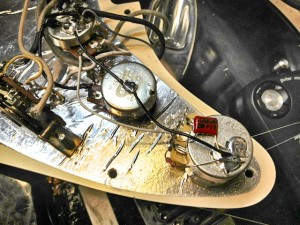
    The dual pot cut highs or lows.
    The dual pot cut highs or lows.

    Technically, it’s not a boost, but it sure feels like one. Dirk Wacker, my now-colleague at Premier Guitar, dissects the circuit far more capably than I can here. (And he goes way beyond in this subsequent article on TBX mods. Man, I have some catching up to do!) He makes a good case for replacing the stock resistor with another value, but I went with the original 82K to establish a point of reference. I’ll try his mod when I restring, and I’ll update you here.)

    BTW, you need the Fender TBX kit for this project — it uses highly customized pots to work its magic, and a standard stacked pot won’t do. But it’s cheap: You can find the TBX kit, with the pot, hardware, and passive components, online for about $15.

    I put it into the mongrel strat I’ve been using as my digital synth/looping guitar. I’d been using a Stellartone Tone Styler, a cool Vari-Tone variant that switches between multiple capacitors. I dig it, but it’s the old model which clicks, rather than fades, from setting to setting, and it requires a powerful twist of the wrist to go from maximum to minumum, which I do every time I grab an EBow. Since I hadn’t gotten around to replacing it with the smooth-action version, I figured I’d try the TBX.

    And I’m glad I did. It’s a super-easy install, at least to the extent that any job that requires removing both strings and pickguard can be easy.And here’s how it sounds:

    I’m going to keep this one around for awhile. You’re hearing it through an analog rig, obviously, but I want to find out whether that extra shot of highs does anything meaningful when playing digitally. I’d also like to experiment with different cap and resistor values.

    And now I can’t help wondering whether this would sound cool with humbuckers. Anyone have any experience with that?

  • Logic Pro X:
    What’s New for Guitarists & Bassists?

    Inside Logic Pro XAs promised: an overview of Apple’s new Logic X Pro, with an emphasis on what’s new and cool for guitarists and bassists. Lots of movies and audio!

    It’s here.

    This is an exciting post for me, and not just because I get a desperately needed break from Klons and Screamers. I’m thrilled to bits about Logic Pro X and MainStage 3, though I’m still wrapping me head around them. (Yeah, I worked as a developer for both products, but I didn’t get a proper program-wide view until last week’s release.)

    Also, it’s my first story for Premier Guitar, whose staff I’ve just joined as a senior editor. I’m stoked because it reunites me with PG editor Shawn Hammond and senior editor Andy Ellis, both of whom I remember fondly from my Guitar Player magazine days.

    There’s much talent and coolness on the staff. I’m a happy little guitar nerd. Plus, the schedule is loose enough that I can still record, perform, and continue to work with audio/software clients.

    What does the gig mean for this blog? Good things. I have no plans for a major course change — there are too many things I can only cover on a non-commercial site, including some of the topics closest to my heart. Meanwhile, working with PG will keep me more up-to-date on new music, new gear, and scurrilous guitar community gossip. In some cases, though, I may link to a PG article I’ve written rather than duplicate the work here. Today, for example. 🙂

  • Fuzz Detective:The Case of the 12 Germanium Fuzzes

    Fuzz Detective:
    The Case of the 12 Germanium Fuzzes

    As threatened, the Fuzz Detective video:

    WHAT: Twelve germanium fuzz circuits compared and analyzed. These represent the sounds of almost every fuzz pedal introduced between 1962 and 1968.

    WHY: A tool to help players identify the circuits most relevant to their musical needs. This isn’t about particular brands of pedals, but the circuits they employ. If you hear something you like, you can either do as I did and build a clone from the schematic, or buy one based on that particular design. (The relative merits of rival clones is another story.) Of course, if you’re rich and you desire an ancient pedal that probably doesn’t sound as good as a new clone, you can always purchase a vintage original. 😉

    HOW: I tried to establish a “level playing field” by removing as many sonic variables as possible. I used the same signal chain, the same guitars, the same musical material, etc. (Tech details below.)

    WHO:

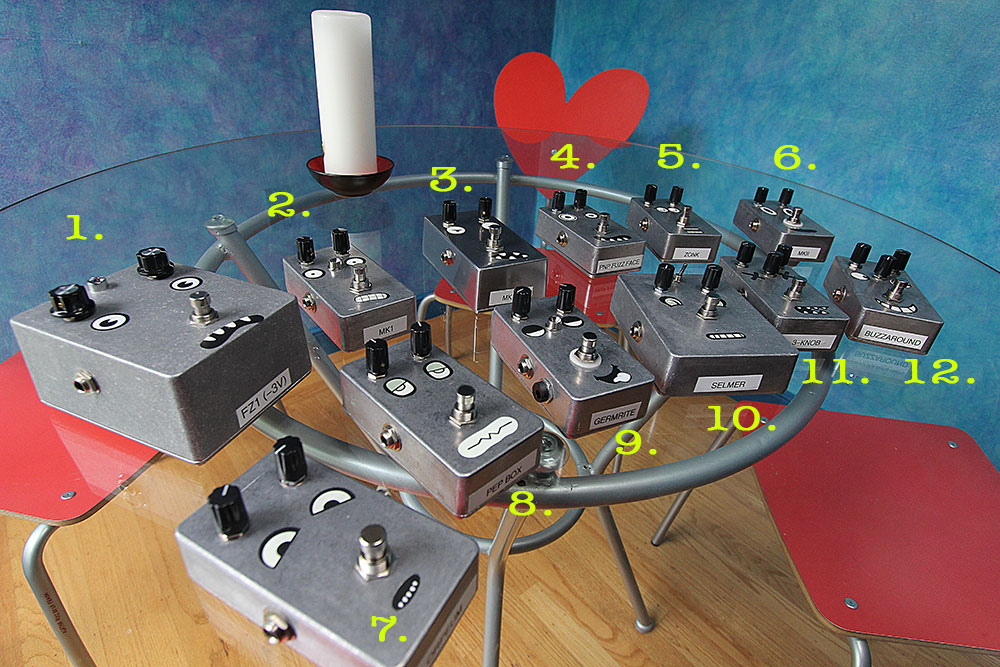
    1. Maestro FZ-1 Fuzz Tone
    2. Sola Tone Bender Mk 1
    3. Hornby-Skewes Zonk Machine
    4. Sola Tone Bender “Mk 1.5” (similar to Vox Tone Benders)
    5. Dallas-Arbiter Fuzz Face
    6. WEM Pep Box Rush
    7. Sola Tone Bender Mk II (same as Marshall Supafuzz)
    8. Mosrite Fuzzrite (germanium version)
    9. Orpheum Fuzz (germanium version)
    10. Selmer Buzz Tone
    11. Sola Tone Bender Mk III (same as Park Fuzz Sound, Carlsbro Fuzz)
    12. Baldwin-Burns Buzzaround.

    WHEN: Like, now, man! (more…)

  • Fuzz Detective: The Plot Thickens!

    Man, I’m glad I announced my intentions about this project! Thanks to your links and suggestions, the “Fuzz Detective” project has grown vastly more ambitious. I need a few more days to make my test recordings are assemble the results, but I believe this will be the most complete and “scientific” audio comparison of 1960s fuzz circuits yet attempted. I’m posting this update to share my current plans — and solicit last-minute suggestions for improving them. —Joe

    Wanker's Dozen: twelve Germanium fuzz pedals compete on a level playing field.
    Wanker’s dozen: twelve germanium fuzz pedals will finally compete on a level playing field.

    I’ve been a busy little solder monkey! Dig my new pedals:

    1. Maestro Fuzz Tone FZ-1 clone
    2. Sola Tone Bender “Mk I” clone
    3. Sola Tone Bender “Mk 1.5” clone (near-twins: Vox Distortion Booster, Italian Vox Tone Benders)
    4. Dallas-Arbiter Fuzz Face clone (very similar to Tone Bender Mk 1.5)
    5. Hornby-Skewes Zonk Machine clone (near-twin: Tone Bender Mk 1)
    6. Sola Tone Bender “Mk II” clone (near-twin: Marshall Supafuzz)
    7. Orpheum Fuzz clone
    8. WEM Pep Box Rush clone
    9. Mosrite Fuzzrite clone (germanium version)
    10. Selmer Buzz-Tone clone
    11. Sola Tone Bender Mk III (“3-knob”) clone
    12. Baldwin-Burns Buzzaround clone

    About the Fuzz Detective project:

    I’m attempting to create a comprehensive comparative sound library of germanium-transistor fuzz pedal circuits.

    There’s no shortage of audio clips and demo videos featuring the great stompboxes of the ’60s and their modern clones. Yet it’s difficult to make qualitative comparisons between circuits because there are so many other variables at play. Who performed the examples? Using what gear? Were the examples recorded in a pro studio or on a mobile phone? Are the pedals ’60s originals or modern clones? What’s the condition of the transistors? And so on.

    This isn’t about, say, deciding who makes the best Fuzz Face clone. The focus is the circuits themselves. The Fuzz Detective project aims to “level the playing field” by removing as many variables as possible. (more…)

  • Tonefiend Book Week 2013: Epilogue

    Monday: Theory and Technique
    Tuesday: Gear
    Wednesday: Repairs and DIY
    Thursday: Biography
    Friday: Fiction

    Thanks to all my smart and cool readers who contributed to the first (maybe annual?) Tonefiend Book Week! I loved chatting about some old favorite books, and getting exposed to so many cool new ones.

    An encyclopedia of rad.
    An encyclopedia of rad mods.

    I have just two quick additions: the first concerns an exciting new acquaintance, and the other a sad departure.

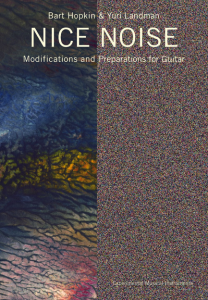
    In comments to Tuesday’s post on DIY and repair books, reader smgear mentioned Nice Noise, a book on prepared guitar by Bart Hopkin and Yuri Landman. I immediately ordered a copy, and received it the other day. I’m blown away. It’s a small-format book, a mere 72 pages, but it is a veritable encyclopedia of alternate guitar treatments.

    Hopkin (he edited the journal Experimental Musical Instruments and wrote the fabulous alternate instrument books Gravikords, Whirlies & Pyrophones and Orbitones, Spoon Harps & Bellowphones) and Landman (he builds mutant guitars for Sonic Youth, Liars, Melt Banana, and other artists) discuss pretty much every avant-garde guitar mod I’ve ever heard of, and many besides. It’s not just a catalog — it’s a detailed how-to, meant to be consumed alongside the pair’s online audio library of musical examples. I’m sure you’ll be reading about it more here, because I’m definitely going inflict some of these rad alterations on some unwitting guitars.

    One of the finest rock-and-roll novels.
    A great rock-and-roll novel.

    An a sadder note, the death of Scotland’s Iain Banks this weekend reminded me of a book that should have been inclued in Friday’s installment on musical fiction. Both funny and moving, his 1987 novel, Espedair Street, is simply one of the finest rock-and-roll novels ever. Its protagonist is a fabulously successful rock star (think Floyd or Fleetwood Mac in their prime) who must process his own past while grappling with the prospect of suicide.

    Readers in the UK, where Banks is hugely popular, may be surprised to learn he’s strictly a cult figure in the States. While Espedair Street is his only work to focus on the music world, he wrote many fine novels marked by wry humor and vast empathy. (The Crow Road and Whit are two other favorites of mine.) He also wrote scads of science fiction under the name Iain M. Banks. Banks, 57, had only recently learned he was dying of cancer. In April he composed a final communique to his readers, writing:

    I’ve asked my partner Adele if she will do me the honour of becoming my widow (sorry – but we find ghoulish humour helps). By the time this goes out we’ll be married and on a short honeymoon. We intend to spend however much quality time I have left seeing friends and relations and visiting places that have meant a lot to us.

  • Tonefiend Book Week 2013
    Tuesday: Guitar Gear

    Monday: Theory and Technique
    Tuesday: Gear
    Wednesday: Repairs and DIY
    Thursday: Biography
    Friday: Fiction

    This week we’re talking about our favorite guitar/music books. The plan is simple: I discuss a few titles I’ve found particularly enlightening, useful, or entertaining, and then you jump in and do the same. I’ve organized the days of this week by subject matter. Today’s topic is guitar gear.

    Guitar gear books seem to fall into three categories:

    1. Pornographic. Lavish publications featuring beautiful photos of rare instruments, often focusing on a single manufacturer or collector.
    2. Encyclopedic. Thick reference books covering wide swaths of guitar history.
    3. Pragmatic. Books that explain the inner workings of guitar technology, with an emphasis on how to turn this info to your musical advantage.

    Even if I weren’t a jaded former guitar mag editor, I doubt I’d have much interest in coffee-table guitar porn books (and the occasional guitar porn magazine). Or at least, no more interest than I’d have in photos of, say, beautiful watches, speedboats, or nutcrackers. I’m not a guitar collector.

    Not on <i>my</i> coffee table, you don't!
    Not on my coffee table, you don’t!

    Hey — stop laughing! Yeah, I own more than 20 guitars. (The exact number depends on whether I count guitars I’ve loaned out indefinitely and ones I’ve borrowed indefinitely.) I appreciate my instruments greatly, and I am very aware of how fortunate I am to have access to so many musical tools. But in the end, they are just tools to me, with little significance beyond their musical applications.

    I realize this is a pretty weird attitude for a guitar dude, and one reason why I was probably never a perfect fit as a guitar mag editor. (I must be missing some crucial male gene, because I’m equally blasé about cars and sports. With rare exceptions.)

    The classic reference book.
    The classic reference book.

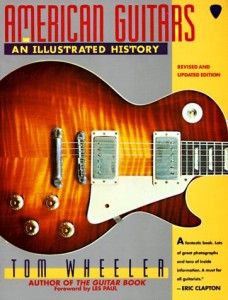
    Reference books are a different story, especially the books of George Gruhn and Walter Carter, and those of Tom Wheeler. Sure, some of their weightier works have guitar porn aspects, but always paired with vast historical knowledge and the expertise of longtime industry insiders. Gruhn and Carter may know more about American guitars than anyone. But I always gravitate to Tom Wheeler’s books, and not just because he’s a longtime friend and mentor. Tom is a fine writer, an impeccable researcher (he’s been a journalism prof for the last 20 years), and he still conveys a teenager’s passion for the instrument. Tom is my hero.

    (Bonus question: Has Wikipedia rendered the guitar reference book obsolete?)

    But these days, the gear books that excite me most are the technically slanted, nuts-and-bolts titles. It’s one thing to ogle pretty instruments, and another to explain how they work, why they sound the way they do, and what that all means for the music we make today. And that’s why I love the books of Dave Hunter. (more…)