
Categories
Acoustic

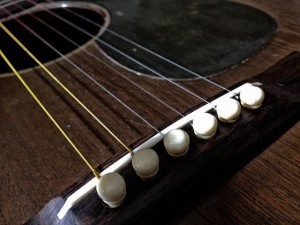
Acoustic Strings: Bronze vs. Nickel

Like Talos the Giant from Jason & the Argonauts, most modern acoustic strings are made from bronze. Like him, they can be cruel and inflexible.

UPDATE: I’ve updated the audio examples to include 80/20 bronze strings, as detailed in this newer post.

Can I share my steel-string psychodrama?

I’m lucky enough to own many electric guitars, but I’ve played one steel-string acoustic almost exclusively for many years — a small-bodied Lowden with a tone that a very famous manufacturer of acoustic pickups once described as “like a f%^$ing cannon!” Its sizzling-bright treble and modest low-end make it a great recording instrument. (Engineers often boost highs and roll off lows when processing acoustic guitar, but this model is practically “pre-EQ’ed.”)

But it’s not an easy guitar to play. It seems to amplify string noise, flubbed notes, and all other playing imperfections. “This is a ‘tough love’ guitar,” muttered one singer/songwriter friend.

So when I bought a second steel-string recently, I wanted something warmer, softer, and more flattering, and I found it in a pretty old small-bodied Martin. The day I bought it, I restrung it with treble strings to record my recent Nashville high-strung demo, then popped on a set of the phosphor-bronze strings I’ve been using for years on the Lowden.

And I was seriously bummed out by the tone, as I lamented over at the forum.

The problem was, my sweet, soft antique suddenly sounded a hell of a lot like the Lowden, with blistering treble and cruel string noise. And I realized in a flash that a lot of the qualities I’d attributed to the Lowden were, in fact, a result of the modern, coated phosphor bronze string I’d been using. So I ordered some alternatives and made a few test recordings to demonstrate how dramatic the differences are.

Have a listen:

Categories
Acoustic Amps Bass Digital DIY Effects Gigs guitar Music Pickups Recording Technique The Secret Room Tonefiend DIY Club

Contest: Build the Tonefiend Forum!

tonefiend forum
A sad, desolate place — but not for long!

One cool thing about going indie with tonefiend  is that fact that I can finally host my own geek forum! It’s already up and running — but it’s a sad, vacant space that desperately needs to be populated by cool people and cool ideas.

How to get there? Sleazy bribes! Cool prizes!

Here’s the deal: I’ve pre-populated the forum with a few topics and threads. Just come on over, register, and chime in on any thread that interests you — or better yet, start one of your own. And on September 1st, 2012, the three forum members who have consistently contributed the liveliest content as judged by some dork me will get a bitchin’ stompbox laboriously hand-built by the same dork me. I can’t disclose exactly what the pedals will do, but I can promise they will be cool, useful, and genuinely unique — original designs, not some lame-ass Screamer clones. And if I manage not to vaporize my hand with the TechShop laser-cutter I’ve been learning to use, they’ll even have wicked laser-etched enclosures.

Naturally, I hope the tonefiend forum will also be cool and unique, and that you’ll enjoy geeking out there even when there’s no contest. But hey, I’m not above greasing the skids with free stompboxes as needed.

Please read the forum rules, though.

FORUM RULES: Be cool.

Categories
Acoustic Amps Bass Digital DIY Effects Gigs guitar Music Pickups Recording Technique The Secret Room Tonefiend DIY Club

The Secret Room: Not So Secret Anymore

Now with more secrets — and less secrecy.

Last winter I tried an odd experiment: a website where players were encouraged to post their best tone secrets — the kinds of tricks and techniques that are almost too good to share. But in order to get, you had to give: The site was password-protected, and the password was only sent to those who contributed secrets.

Musicians responded, no doubt encouraged by the cool prizes awarded to the top secrets, as judged by user ratings. I also asked some cool musician friends to contribute the first round of secrets, yielding tips from the likes of composer/virtuoso Lyle Workman, metallurgist-turned jazzbo Alex Skolnick, original Chili Peppers guitarist Jack Sherman, boy genius Blake Mills, and other great players.

Once the contest ended, traffic slowed, but the site has slowly but surely grown. And now, as an experiment, I’ve removed the password protection. Now anyone can visit the Secret Room, AKA tonesecret.com, even if they haven’t coughed up a secret. So please do!

It’s a fascinating document. Naturally, the quality of secrets varies, as does the level of expertise needed to make the most of them. I exerted a light editorial hand — only silly or flat-out-wrong tips were vetoed, and I didn’t do much in the way of spelling and grammar repair. Sometimes the contents are a little repetitious — but trust me, there is much wisdom and originality throughout.

I hope you find something helpful — and I hope you’re moved to contribute some secrets yourself using the site’s submission form. And who knows? There may be more tawdry bribes fabulous prizes lurking around the corner…

Categories
Acoustic guitar Recording

How Nashville High-Stringing Works

You don’t have to be high in Nashville to enjoy Nashville high-strung.

Nashville high-strung tuning is one of the guitar’s great magic tricks. It has a delicious, “secrets of the Guild” quality — you feel like an insider just knowing what it is.

Not that I did know what it is until embarrassingly late in life. For the sake of my fellow late-bloomers, I’ll explain: You replace your guitar’s lowest four strings with thinner strings tuned an octave higher than normal.

You can think of it as using the higher-pitched of a each pair in a 12-string string set. (Or the top two strings of a normal set, and the top four strings from another normal set, with the first string as the third string, the second string as the fourth, etc.)

I love how this tuning can work subliminal magic, or step front and center for marquee riffs. Nashville session players conceived it as a way to add stereo shimmer to doubled acoustic guitar tracks. But rock players have used it to great effect as a foreground sound, as heard on the Stones’ “Wild Horses,” Floyd’s “Hey You,” Kansas’s “Dust in the Wind,” and Tracy Chapman’s “The Promise.”

Here’s a quick little demonstration, both solo and in a mix:

Categories
Acoustic Bass guitar

In Search of Ancient Strings

PLUS: New Contest! Name the Classic 6-String Bass Riffs and Win a Seymour Duncan Pickup Booster Pedal!

"We both love candlelight, long walks on the beach, and really expensive old-school strings."

NOTE: The contest is at the bottom of this post. You can skip ahead if you don’t care about rare and expensive guitar strings.

What do the classical guitar and the Fender Bass VI have in common?

Both instruments were developed using types of strings that are practically extinct.

First, let’s talk nylon strings. When these appeared after WWII, classical guitarists, led by Andrés Segovia, ditched gut overnight. Nylon strings were louder and brighter, and they offered better consistency, superior intonation, and longer life.

Few living guitarists have ever actually played gut strings, which really are made from animal guts (usually cows, goats, or sheep). I’ve never tried them myself.

But one of my darkest secrets is the fact that I started out as a teenaged lute player. (I have a photo of myself playing on a hay bale at a Renaissance Faire, wearing a feathered tudor cap and white tights. And you will never, ever see it.) I experimented with gut lute strings, only to run screaming. Total tuning nightmare, especially on an Elizabethan-era axe with friction tuning pegs, not to mention lots of unison- and octave-tuned strings. Guitarists were smart when they ditched the stuff.

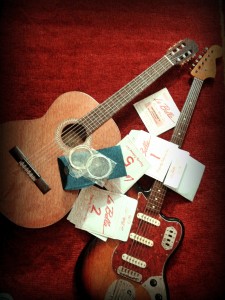
But I recently bought a new ukelele, which came strung a set of Aquila strings from Italy. They have several lines of faux-gut nylon strings made from a proprietary material called — wait for it — “nylgut,” which allege to capture the sound of gut without the tears. They sounded cool on the uke, so I ordered a few guitar sets. At between $12 and $21 dollars per set, depending on the bass-string wrap material, they’re pricy, but not crazy expensive — about the same as other high-end, E.U.-made brands, like Savarez or Thomastik-Infeld. (Aquila’s US distributor is Just Strings.)

And holy cow, do I love ’em! They don’t look anything like gut strings, which resemble, well, dried-out intestines. But they really do capture a lot of “gutness.” Their tone is quieter and warmer than conventional nylon, with markedly less string noise (a great thing for a very rusty classical player like me). Check out this demo:

Categories
Acoustic Amps Effects Gigs

Amped-Up Acoustic Guitars

What could possibly go wrong?

There are two ways to approach amplifying an acoustic guitar: trying to duplicate the natural sound, only louder, and NOT trying to sound naturalistic at all. This post is about the second approach.

I love playing acoustic through an electric guitar amp (as opposed to a dedicated acoustic amp). True, the tubes and speakers amputate all high frequencies. But if you think of the instrument not as an acoustic guitar, but an idiosyncratic electric variant, it opens up amazing possibilities.

More often than not, I prefer to play acoustic gigs that way. I did a fun benefit show last year playing rock and R&B covers with a band consisting of Flea, Tracy Chapman, and drummer Dawn Richardson. Tracy had a beautiful, ultra-hi-fi acoustic tone, and the ratty, rumbling sound of my acoustic through a small combo was — well, let’s just say it was a very strong contrast.

Admittedly, relatively few  players exploit this technique. One notable exception is Daniel Lanois. He’s best known as a producer (U2, Peter Gabriel, Bob Dylan, etc.), but he’s also a phenomenal player who does amazing things with an acoustic guitar, an inexpensive magnetic soundhole mic, and small vintage Fender amps. I’ve watched him play up-close a few times, and he’s incredibly adept at conjuring a variety of tones and controlled feedback from this setup.

It’s definitely a white-knuckle playing experience. You have to listen carefully and nix unwanted feedback with quick damping technique. But it can be so expressive!

I’ll talk more about the technique in a bit. But first, check out this short video demo featuring distortion and other stompbox effects, controlled (and not-so-controlled) feedback, and a lot of awkward twisting and turning as I grapple with the tone: 

Categories
Acoustic guitar Technique

Expensive Picks, Part 2: V-Picks

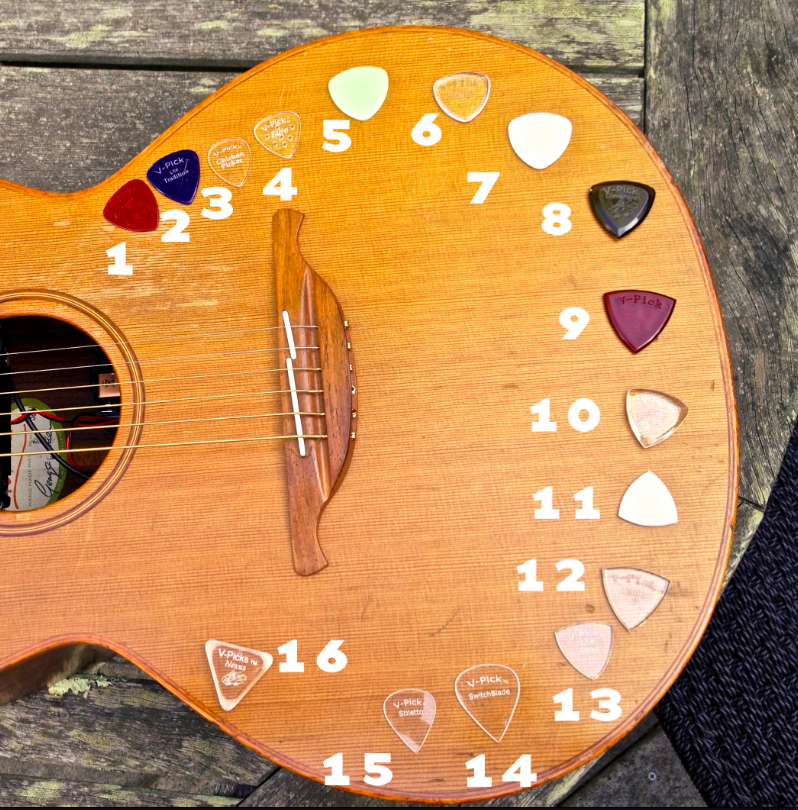
Sixteen Current V-Pick Models (clockwise from upper left): 1. Ruby Red Traditon Ultra Lite; 2. Tradition Lite Sapphire Blue; 3. Chicken Picker; 4. Euro; 5. Nite-Glow Medium Rounded; 6. Pearly Gates Medium Round; 7. Medium Rounded; 8. Dimension Buffed Smokey Mountain Series; 9. Ruby Red Medium Pointed; 10. Dimension Junior Buffed; 11. Pearly Gates Small Pointed; 12. Medium Pointed; 13. Small Pointed Lite; 14. Switchblade; 15. Stiletto, 16. Nexus Unbuffed.

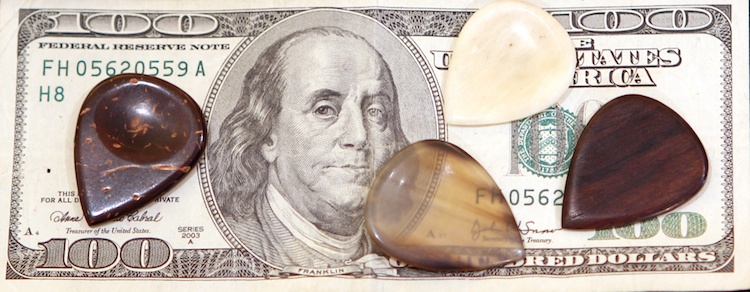
Readers had a lot to say about a recent post on high-end guitar picks. I focused on some of those ultra-hard picks made from natural materials, such as stone, bone, wood, and horn, plus ones made from synthetics designed to mimic those materials, such as GraphTech’s Tusq series. I’d concluded that, while these picks cost a lot more than garden-variety plastic picks, they offer unique benefits, including stronger fundamentals, more low-end mass, and varying amounts of percussive treble “slice” that can help a guitar track stand out in a mix.

Anyway, several readers spoke highly of V-Picks, a small handmade pick company from Nashville run by Vinni and Nancy Smith. I bought a few, and was deeply impressed. So I got a bunch more and made the set of reference recordings included here. Have a listen!

Categories
Acoustic Bass guitar Recording

About Those Expensive Picks . . .

UPDATE: I’m proud to announce that the first part of my report on high-end picks has been selected to appear in the debut issue of Pure Guitar, a new digital guitar mag whose editorial staff includes my two music journo mentors : Tom Wheeler and Jas Obrecht. Also on board: jazz ace Wayne Goins, session superhero Tim Pierce,  Nashville’s leading guitar tech, Joe Glaser, and other preeminent axe experts.

You’ll find my article here — but frankly, I recommend starting at the homepage of issue #1 and reading all the way through!

Congrats, guys, on the new mag. I’m psyched to be part of it.  :beer:

Categories
Acoustic Amps Bass DIY guitar

We Have a Mutant Winner!

Not a turkey: Dave Wetherby's eye-catching Colorcaster

The contestants were formidable. The competition was fierce. But by the time yesterday’s deadline arrived, one mutant stood triumphant — so triumphant that we are spared the interminable silliness responsibility of a run-off round.

And the winner is Dave Wetherby’s kaleidoscopic Colorcaster. Congrats to Dave, who will receive as a prize a super-freq Uglyface, a fuzz pedal that only a mutant could love. Congrats, Dave! :beer:

Here again are Dave’s original comments from the posting thread

Categories
Acoustic Amps Bass DIY Effects guitar

Mutant Beauty Pageant:
Choose the “Winner!”

Hope everyone had a nice Thanksgiving!

At the moment, I’m particularly thankful that, despite being a jaded old musician, I can still encounter instruments that, um, take my breath away. And if you can view all the Mutant Beauty Pageant contestants without spewing your beverage all over your computer, you’re made of stern stuff indeed.

Exaggeration? You be the judge. Literally!

As specified in the “rules,” the submission deadline has arrived. Now it’s time to choose the most beautiful mutant. Just select your three favorites from the photo gallery below.