It’s the latest chapter in my ongoing search for the right acoustic strings. Most available options simply sound far too harsh and bright to my ears, especially for fingerstyle playing on the small-bodied guitars I favor. Even though the Martin silk-and-steels I used were dramatically quieter than most bronze strings, I dug their warmth and strong fundamentals — and the absence of the hyped sizzle of bronze.
Several of you responded in comments with string suggestions, including several types I barely knew existed. Despite some rather shocking expenditures for these high-end, imported strings, I found much to love. Now I’m rich in tone, if nothing else.
Since I’m hot on the trail of a cool new fuzz circuit, I haven’t yet had time to record demos (and besides, I’d rather wait till the strings wear in a bit). But I’d like to share details about several products that impressed me. (more…)
Silk and steel — bad-ass, or strictly for wusses?.
It’s been a long, long time since I’ve tried silk and steel strings.
I’ve always thought of them as a transitional set for students migrating from nylon to steel strings. At least that’s how my mom used to explain them to me back when she was giving me my first lessons. Like many players, I viewed them more as a remedy for tender fingertips than a sound you’d actively seek out.
But over time, almost everything I thought I knew about strings turned out to be wrong. So I figured I’d give silk-and-steels a fresh listen.
This thread over at the Acoustic Guitar Forum seems like a fair summary of common attitudes about these strings. Opinions seems divided between players who simply find silk-and-steel strings too soft and quiet to be of much use, and those who enjoy them for fingerstyle playing, especially on small-bodied guitars.
I’ve been frustrated finding the right strings for the old Martin acoustic I picked up last year. I had a violent reaction against coated bronze strings, which I wrote about here. But I was kind of digging the way Martin Marquis 80/20s bronze strings sounded on the instrument, as heard in this video. Sometimes, though, the tone is just too harsh and clacky, so I wanted to try something lighter and softer.
I slapped down this quick duet performance of “Drewrie’s Accordes,” an anonymous lute duet found in The Jane Pickering Lute Book, a manuscript anthology of late 16th-century lute pieces. (This would have been played on gut strings in its day, and is usually performed on nylon-string classical guitar or lute today. My steel treble strings are definitely not historically correct, though some wire-stringed fretted instruments such as the cittern did exist in the Renaissance.)
Observations after the video.
Compared to all-metal strings, the silk-and-steels are definitely quieter, with less treble bite. I like their soft, malleable feel for intricate fingerstyle playing like this. They offer relatively smooth transitions between unwound and wound strings. They exhibit less clacky string and fingernail noise. Playing aggressively with a pick definitely “overloads” them, and would no doubt destroy the windings in short order. Even when playing exclusively fingerstyle, you get the sense that the bass strings aren’t long for this world. But I enjoy their sweet, quasi-classical tone, which to my ear does indeed split the difference between nylon and all-metal strings.
Still, I’m not sure I want to commit to having these on the guitar all the time. (I wish the guitar had a switch to toggle between a bronze and silk-and-steel sound!) Also, these are lighter than I usually play (the treble is .0115, and I pretty much never go below .012). But the relaxed tension does seem to suit this particular guitar.
How about you guys? Any experience with these soft-spoken strings? Do you think they sound cool, or are they merely a salve for sore fingers? And has anyone tried John Pearse silk-and-bronze strings? (That’s probably the next stop on this particular string quest.)
P.S.: This is also a pretty good example of how I apply lute techniques to steel-string playing, as I mentioned here. For most of the fast bits, I pick alternately using my right-hand thumb and index finger. A proper classical player would be more likely to alternate index- and middle-finger. Also, my right thumb sometimes drifts “behind” my right-hand fingers (that is, closer to the bridge). Classical players rarely position their picking thumbs closer to the bridge relative to the fingers. It’s not conscious on my part — it just what my hand does when I’m trying to brighten the bass notes and darken the trebles.
If you’ve been reading this blog for a while, you may have noticed a recurring pattern: I attend some interesting event and promise to report on it, only to get subverted by work, crowds, jabbering with old acquaintances, and jetlag. True to form, I’ve spend the first two days either demoing TriplePlay, or staggering to the coffee bar. Yesterday I spent hours staring at these Guitar Grip guitar hangers, which are mounted on the wall right next to the spot where I’m playing. They remind me of the human-hand candelabras from Jean Cocteau’s La belle et la bête.
It’s been fun playing for so many hours, though I’m still not very good at the MIDI guitar/drums thing. I was having a fairly disastrous moment when John McLaughlin came by. Isn’t that always how it is? You’re having an off day, and then you look up and see that frickin’ McLaughlin. Is it just me, or does everyone hate that? :shake:
This is my first time here, but the old hands tell me that the show is relatively dead, and that a lot of manufacturers have either already given up on Messe, or are planning to next year. We’ll see what transpires tomorrow afternoon and Saturday, when the show opens to the public. (So far, it’s industry-only.) And I really will try to scope out some gear!
UPDATE, 03.07.13:I should have mentioned a point that several readers noted in comments: The capo only alters the tuning of open strings. Which means that while you can play many harmonies normally available only in dropped tunings, any notes above the capo appear at their usual frets. For example, all barre chords are played exactly as in standard tuning.
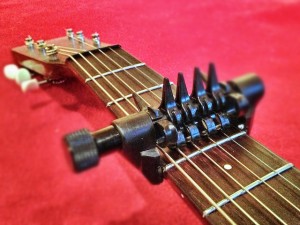
After all the digital guitar stuff I’ve been writing about lately, I really wanted to spend an afternoon without plugging in any frickin’ USB cables. So I finally got around to experimenting with the SpiderCapo I picked up last year on a whim.
The SpiderCapo his six independently adjustable clamps, each of which can either stop the string or let it ring freely. That means you can dial in most dropped tunings without actually detuning any strings — instead, you transpose the entire voicing up. It’s a lot of fun to play, and seems like it could be a cool composing tool if you’re the sort of musician who gets inspired by unfamiliar tunings. Plus, it looks kind of wicked when you fret the unstopped strings behind the capo.
Here’s a little video I made, noodling around in a few tunings I particularly liked:
Anyone else tried one of these? Or any other “tricky” alternate-tuning capo? How about those gadgets that (unlike the SpiderCapo) can stop strings at differing frets?
Oh wait — that was last month. Now it’s January. NAMM time!
I’ll be there for the duration, partly to hang out with my Pure Guitar pals, and partly to meet with Fishman about the upcoming TriplePlay release. But mostly to gawp at the weird shit admire the musical instrument industry’s latest offerings. :oogle:
I’ll be posting my findings here, and also doing a little write-up for my friends at Create Digital Music, one of my fave musician sites.
Actually, I have this perverse fantasy of spending an entire show in Hall E: the Anaheim Convention Center’s low-rent basement/dungeon, a dark, inhospitable region where Fender and Gibson fear to tread. That’s where the industry leaders of tomorrow rub elbows with mad scientists and perennial laughingstocks (AKA “my peeps”).
Any of you guys going? And if not, anything special you’re curious about?
“We are all interested in the future, for that is where you and I are going to spend the rest of our lives.” — Criswell, Plan 9 from Outer Space
UPDATE:Wow, I can’t believe all the cool stuff folks have been posting to comments. I find myself feeling quite inspired about the future of instrument — when I’m not laughing so hard I spit coffee all over my laptop. Thanks for all great ideas. Keep ’em coming! 🙂 :thumbup:
Prophecy is for suckers. Who’s stupid enough to go on record with bold prognostications about the future of music and music-making, given the near-certainty that the words will reappear someday to bite you on the ass?
Well, me. And, I hope, you.
So I invite my fellow foolhardy loudmouths to join me in sharing their half-assed guesses wise and well-informed predictions about our brave new fretboard future.
The author of the most compelling prediction wins one of my hand-built stompboxes. So does the author of the one that makes me laugh hardest.
Post your predictions to comments. I’ll go first. 🙂
In comments to a recent post on 3D-printed guitars, we were discussing the pros, cons, and general aesthetics of instruments molded from plastic. But this isn’t exactly a new idea.
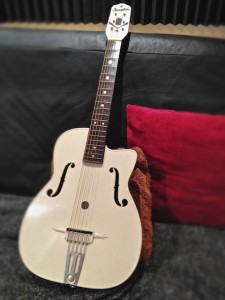
Back in the 1950s, luthier Mario Maccaferri conceived a line of plastic guitars and ukuleles. (This was many years after Maccaferri designed the D-hole Selmer guitars that will forever be associated with the Gypsy jazz of Django Reinhardt.) These plastic guitars were never very popular, and they’re not particularly valuable today.
I bought the one pictured here a few years ago at one of the music shops in London’s Denmark Street (I forget which one). I paid a couple of hundred bucks, and felt like a chump.
But I’ve grown attached to this guitar. It’s lovely to look at, and it plays great. The neck is substantial yet comfy, and it intonates well throughout its range. The tone isn’t warm, complex, or rich. But the Maccaferri has a cool, lo-fi character this sits well in a mix. I also like using it to double conventional acoustic guitars — the sharp, percussive tone adds a rough, aggressive edge.
This clip from the short-lived British sketch-com Snuff Box made me think about great guitar teachers — and not-so-great ones.
I was lucky — I had some truly memorable teachers, starting with my mom, who taught me her coffeehouse folk. When she decided I needed a more advanced instructor, she recruited Larry, a friend’s 16-year-old Who-fanatic son. (He grew up to become renowned classical guitarist Lawrence Ferrara.) Katherine Charleton (later Calkins) mutated me into an early music geek. And I got to take a few lessons from Ted Greene was I was 17 or so, though he wouldn’t take me as a weekly student. He’d listen to me play got a bit, then dispense pages and pages of chord progressions and melodic sequences, the material that wound up on his Solo Guitar Playing books. I paid Buckethead for a few lessons when he was 17, but it was mainly just to hang out and watch him do his amazing thing. My last great teacher was the sublime Martin Simpson — I finagled a couple of lessons from him when he lived 90 minutes from me in Santa Cruz.
How about you guys? Which teachers inspired you the most? What was the best advice you ever got from a teacher? The worst? Do you teach yourself? Does teaching affect the way you play? Like that.
I’m 200 years old, but I can still kick your ass, punk!
UPDATE: I’m proud to announce that my fingerstyle video lesson based on the 200-year-old etudes of Mauro Giuliani has been selected to appear in the debut issue of Pure Guitar, a new digital guitar mag whose editorial staff includes my two music journo mentors : Tom Wheeler and Jas Obrecht. Also on board: jazz ace Wayne Goins, session superhero Tim Pierce, Nashville’s leading guitar tech, Joe Glaser, and other preeminent axe experts.
You’ll find my article here — but frankly, I recommend starting at the homepage of issue #1 and reading all the way through!
Congrats, guys, on the new mag. I’m psyched to be part of it. :beer:
A quick update to last week’s post about bronze and nickel strings: Over in the forum, Bear suggested trying 80/20 bronze strings. It’s a little embarrassing to admit, but I thought some of the strings I’d stocked up on and tried were 80/20s, but just realized they were another variety of phosphor bronze. D’oh!
So I got a nice, simple set of uncoated 80/20 Martin Marquis, popped them on, and realized that I don’t hate bronze strings — just phosphor bronze (and just on my particular guitars). I’m happy now.
Anyway, if you’re curious, I’ve updated the audio examples to include this third string type along with the phosphor bronze and nickels. Have a listen if you’re curious: