Categories
Amps DIY

Mojotone British 45 Kit

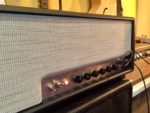
I almost always play small combo amps of 20 watts or less. But I wanted something with a bit more clean headroom for a possible upcoming project — and to demo my stompboxes. I’ve always enjoyed playing JTM-45s when I’ve reviewed them for guitar mags, so I ordered Monotone’s British 45 kit.

I’d previously had a great experience building Mojotone’s Marshall 18 watt clone kit when I reviewed it for Premier Guitar a couple of years ago. It turned out great, and I use it regularly.

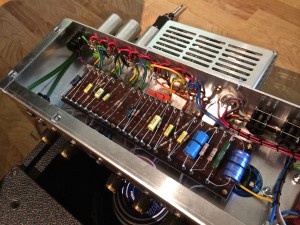
Mojotone provides high quality parts, nearly labelled and organized in plastic compartmented boxes. But beware: The company provides no build instructions — just a layout diagram and a schematic. You need amp building experience or help from an expert. Click play for a slideshow about he build:

img_6083

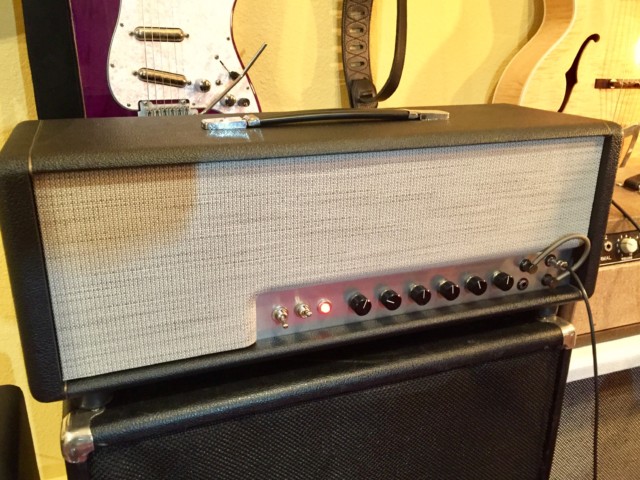
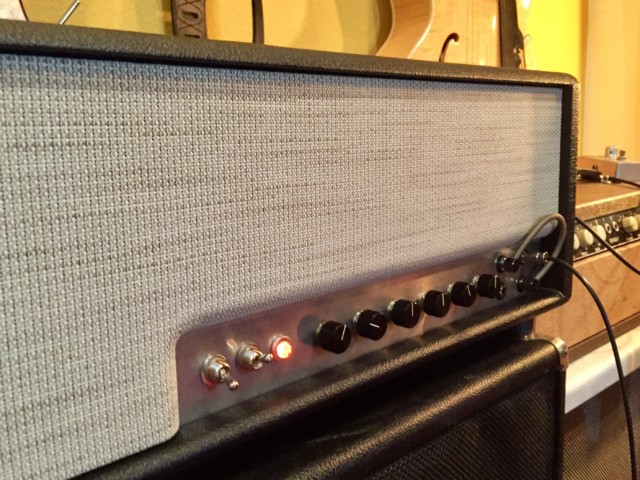
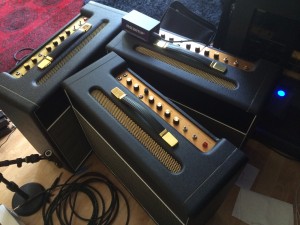
This is Mojotone's new offset head cabinet. (The amp chassis first in other Mojotone cabinets as well.)

img_6085

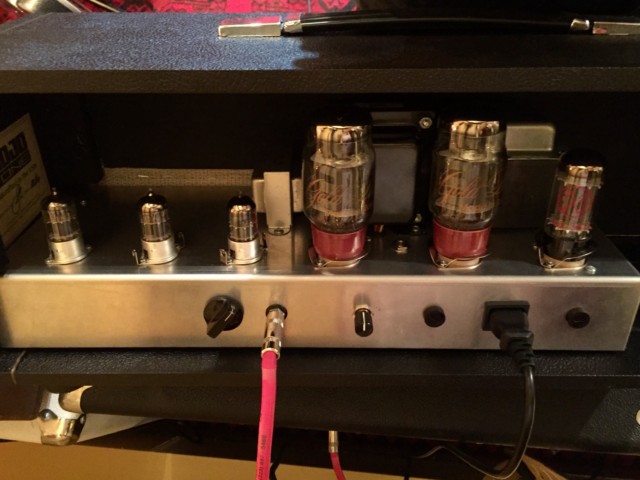
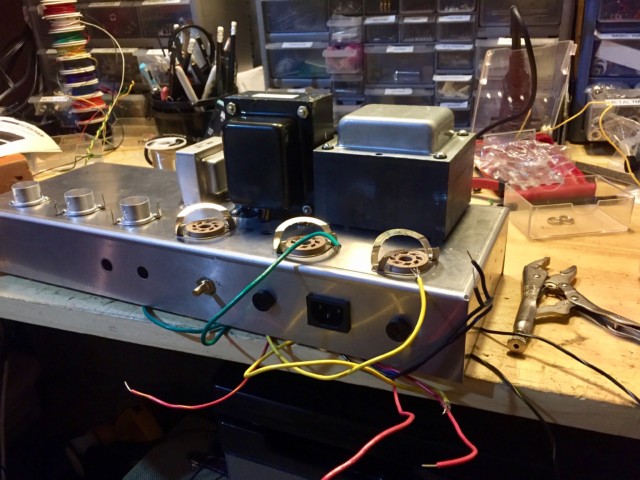
The two power tubes can be either EL-34s or KT-66s. (I chose the latter, just for a new experience.)

img_6026

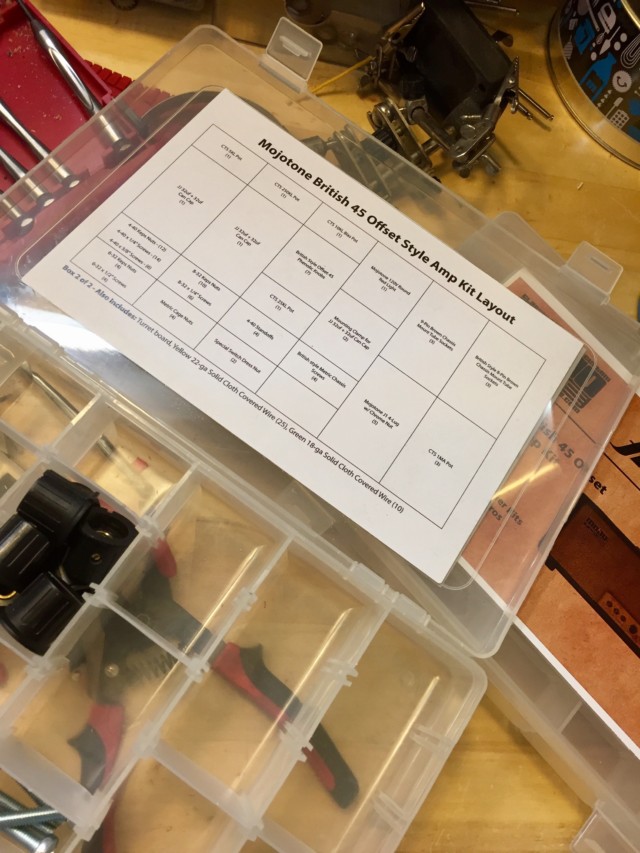
The parts come neatly labeled and organized in plastic bins — a BIG help!

img_6073

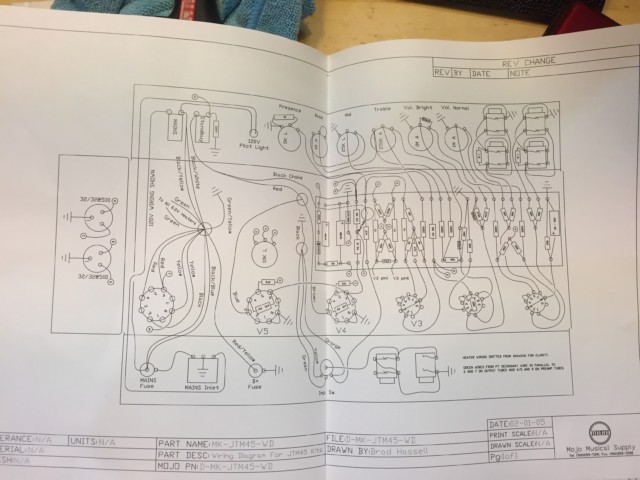
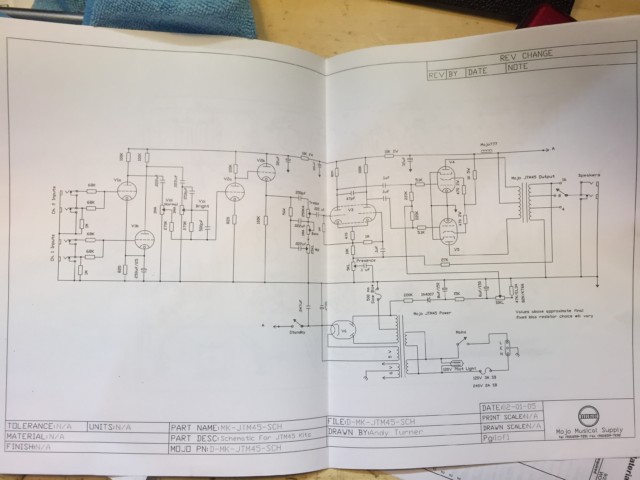
Warning: the kit includes no build instructions — just this layout diagram and a schematic.

img_6072

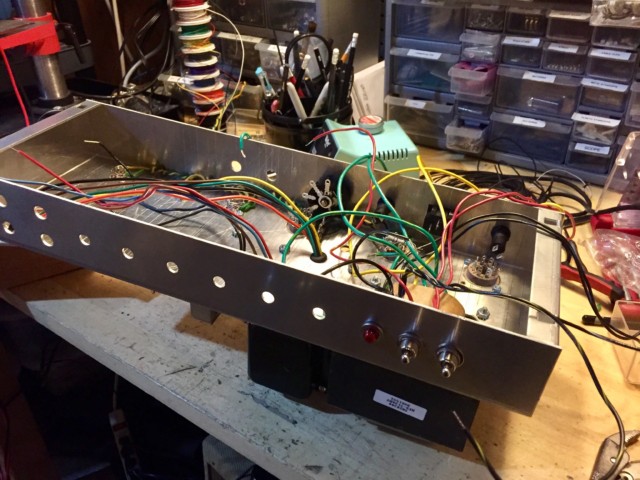
I ALMOST managed to assemble it, but I needed a rescue at the end. (Thanks to Bruce Clement of BC Audio, a brilliant boutique builder here in San Francisco.)

img_6011

Mojotone supplies their own branded transformers (which sound fab).

img_6016

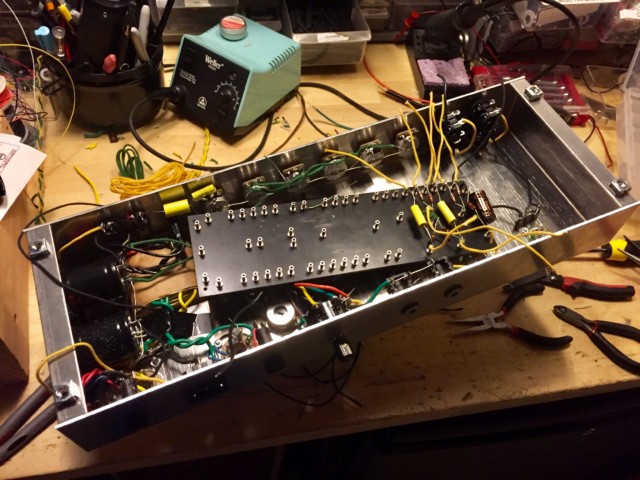
It's a turret board build. (The board and turrets are pre-made, as opposed to some kits, which require you to insert the turrets yourself.)

img_6008

This is probably not a good first build — maybe start with a nice little tweed Champ kit?

img_6084

The a plexi faceplate, which I left omitted. I also substituted my own knobs.

img_6083 thumbnail
img_6085 thumbnail
img_6026 thumbnail
img_6073 thumbnail
img_6072 thumbnail
img_6011 thumbnail
img_6016 thumbnail
img_6008 thumbnail
img_6084 thumbnail

I nearly made it through myself. (Translation: I soldered everything together and it didn’t work.) So I had to hire Bruce Clement of BC Audio here in San Francisco to rescue me. (Bonus: Bruce loaned me one of his JTX50 heads. Man, it’s one of the best-sounding Marshall derivatives I’ve ever heard. It’s among his Octal-Plex series amps, which use octal preamp tubes in Marshall-inspired designs.)

Categories
Amps

My Favorite New Amps: Carr Skylark & Lincoln

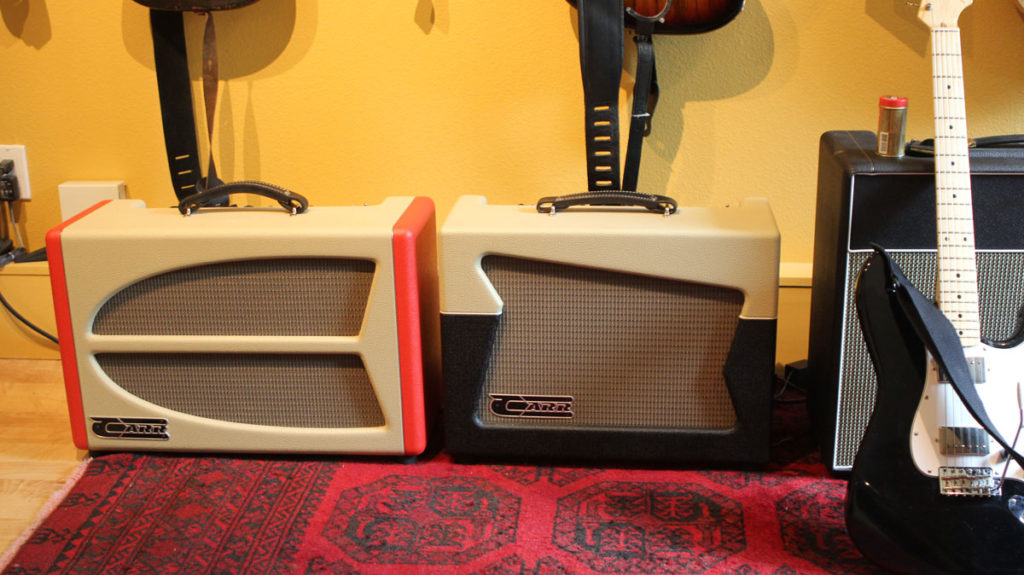
Carr Lincoln and Skylark amps.

I’ve been using my Carr Skylark amp incessantly for the last 18 months or so. I’d originally reviewed it for Premier Guitar magazine, and then I bought one for myself. I dig the fact that, while Skylark is inspired by 1960s Fender amps, builder Steve Carr made numerous departures from the Fullerton template. To my ear Skylark sounds better than my ’60s originals. That’s especially true of its re-voiced tone stack, where the ranges are smaller and subtler than on vintage Fenders, with more of a Matchless-style “no bad settings” sensibility.

For better or worse, history repeated itself earlier this year when I reviewed Carr’s Lincoln in PG. Lincoln is to Vox what Carr is to Fender — not a clone, but vintage-inspired model with its own character and unique twists. Its dual EL-84 architecture makes it a cousin of the AC-15. But I think of it more as a “fantasia on a theme by Vox.” It’s captures the Vox qualities I dig, minus the ones that can make dealing with vintage Voxes a major drag.

Carr-Skylark-Wiring-WEB
Skylark features true point-to-point wiring, with no circuit or turret board. (Lincoln, however, uses bits of circuit board for non-audio functions such as channel-switching.)

If you’ve listened to many of my videos and demo clips from the last year or so, you’ve heard these amps, so I figured I’d focus on them. For tech details, see the reviews. This video is more about how the amps inspire me musically.

From their flawless cabinetry to their ravishing tones, these amps are simply stunning. Cheap, they ain’t, but I felt like I was (RATIONALIZATION ALERT!) investing in musical art. Or maybe I’m making up for not buying a Trainwreck amp back in the ’90s when they were affordable.

I especially love how these Carr amps sound with my flatwound-strung guitars, and I used them on most of the demos for my pedals because they’re so very flattering. Ironically, I thought I’d given up buying new amps, because I was having so much fun building from kits. But trust me — both these instruments sound way better than any of my kit amps. Have a listen!

Categories
Amps Uncategorized

The 18-Watt, Bletchley-Style

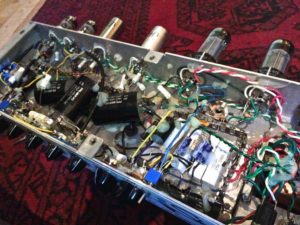
How come my DIY amps never look this pretty inside?

A couple of weeks ago I posted here about a Premier Guitar project in which I built two Marshall 18-watt clone kits. Meanwhile, the magazine received a review model of Marshall’s latest iteration of the 18-watt, a high-end, hand-wired version that sells for $2,700. My new review is online at PG, if you’re curious to hear a proper Marshall as well as the clones.

My take: It’s a beautifully built, hand-wired amp that sounds as least as good as either clone. Unlike the kits with their single 12″ speakers, the Marshall has a pair of 10s, which I think I prefer in this circuit. At $2,700, though, it’s pretty darn expensive, even for a beautiful, hand-made instrument. But I’ll be sad when I send the review model back to Bletchley.

Categories
Amps

18 Wicked Watts

I had a blast building and testing two Marshall 18-watt kits for a Premier Guitar story — and I emerged with new respect for this cool 1965 design.

These mini-Marshalls were neglected in their day, but are now treasured. The oft-heard claim that they provide plexi tones at reasonable volumes is only partially true — these are open-backed combos powered by a Vox-like pair of EL-84s tubes. But while they have roughy the same horsepower as the era’s Fender Deluxe and Vox AC15, their tone is undeniably ’60s Marshall. In the studio, they sound far larger than their actual size. And out of the studio, they’re still pretty darn loud.

I've never seen three 18-watts in the same place before.
I’ve never seen three 18-watts in the same place before.

Even though the Mojotone and Tube Depot kits I built share the same schematic (and identical cabinets, both made by Mojotone), the build experiences and final results differed greatly.

And just when I thought I’d scaled the Everest of 18-watt ecstasy, I get a real Marshall 18-watt reissue for an upcoming Premier Guitar review. Stay tuned.

Are any of you guys 18-watt fans? Any observations to share?

Categories
Amps guitar Recording

Attenuation Nation:
Loud Sounds at Low Volume?

skrinking-ray

I just tried an interesting tone comparison, one I’ve never seen attempted. It concerns the search for loud amp sounds at low volumes.

Have any of you ever experimented with speaker attenuators — the passive load boxes that reside between your amp output and speaker input, which let you crank the amp while maintaining a low level from the speaker?

I’ve worked with one model before, a borrowed THD Hot Plate, and thought it performed well. I decided to purchase my own attenuator after several Premier Guitar reviews of large amps. As a small amp fan (not to mention an aging player with fragile ears), I wanted to minimize the aural assault of evaluating loud-ass amps.

But first, I wanted to determine whether it’s legit to evaluate amps at attenuated levels. Does attenuation inevitably alter the tone? And if so, can you compensate for via recording software?

Online opinions about attenuators range from “works like a charm!” to “totally killed my tone!” So I picked up a Swart Night Light and started recording and measuring. (I didn’t compare rival products. I just went with the Swart for its reasonable price, solid online reviews, and dual outputs for driving two cabs. I didn’t A/B it with a Hot Plate, though the results seem roughly similar.)

I direct-recorded a brief guitar phrase using my black Les Paul with Bigsby and PAFs, and then ran it through a ReAmp to my early ’60s Tremoverb, a 35-watt Fender with two 6L6 power tubes. I dimed the volume and left the EQ flat. Tt was insanely loud in my small studio. After recording that, I tracked the same clip again using the attenuator at each of its three settings. The lowest attenuation setting reduced the sound from insanely loud to very loud. Medium attenuation reduced to somewhat loud. Strong attenuation produced a sound quiet enough to speak over. I recorded the results through Royer R-121 ribbon mic. I added a touch of plate reverb, but no compression or EQ. (Though I did normalize the files so they played back at similar levels.) In other words, you hear the same clip four times through a head whose settings never vary.

So did the tone change? Have a listen:

Do you hear what I hear?

IMHO, none of the clips sound particularly great. (Most amps, including this one, don’t sound their best at 10.) But the unattenuated loud sound has some qualities the others examples lack. The attenuated clips have a little less low-mid impact, and the higher-register single notes that sound a bit thin and prickly even on the original sound even thinner and pricklier post-attenuation.

Why, since the amp settings don’t change, and the performance are identical? Mics can respond differently at different sound pressure levels, and the relatively restrained speaker movement alters the result as well. Conclusion: the timbres of the attenuated signals are fairly faithful to the original, but there are slight spectral differences and a bit less body/fatness, especially on single notes.

Then I introduced some additional wrinkles:
Categories
Amps DIY

Hey, Gang! Let’s Design a DIY Amp!

Let’s not just talk about one-knob gear — let’s design some! Any interest in conspiring to create a minimalist DIY amp?

Frankly, the intensity of the reaction to my recent One Knob Manifesto startled me. I had a general sense there was a growing interest in minimalist gear, but I was no idea the sentiment was so intense. (Though I’d hesitate to draw too many conclusions based on a focus group of the obsessive geeks who hang out here.)

Now, don't get your hopes up — we probably won't create anything QUITE this awesome.
Now, don’t get your hopes up — we probably won’t create anything QUITE this awesome.

Since posting that piece, folks have been sending me info on relevant new products, like Henretta’s no-knob stompboxes and the Mill Hill Love amplifier, reportedly being used by Jonny Lang.

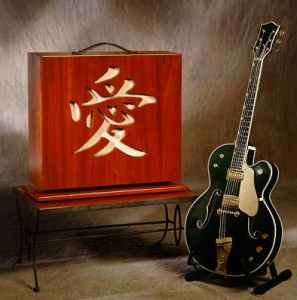
The limited edition Love amp fascinates me. Not its ornate furnishings, but the minimal controls: no tone stack, not even a volume control. It’s pretty much exactly what I was talking about when I expressed an interest in an amp with nothing but an on/off switch. That desire became even more focused last week when I reviewed a fabulous amp from a new Colorado Springs company called Toneville. (I’ll link to the Premier Guitar review when it goes live in a couple of weeks.) The Toneville Beale Street model I reviewed features a full compliment of blackface-style controls, but the tone controls are voiced so that the tone stack can largely be removed from the circuit, and there’s also a pot to remove the negative feedback loop for a more tactile/primitive response. As with some other ultra-high-end amps I’ve written about recently (like the Little Walter 50/22 covered here), the tone controls sound great wide-open, and it matters surprisingly little where you set the volume — you just drive it hard enough to warm things up, and then shape the tone from the guitar. With a nicely voiced and biased amp, you need far fewer controls than you might think. And the more crap you omit, more livelier the reponse and the more immediate the tone

The no-controls Mill Hill Love amp.

So why don’t we collectively create something in this vein? A simple but great-sounding tube amp with nothing but an on/off switch? I’ve never designed anything such thing and have little relevant expertise beyond the knowledge that, unlike 9v stompboxes, AC-powered amps can kill you. But I’ve built enough kit amps to know that a one-knob head can be easy, potentially inexpensive (though you could invest in ultra-premium tranformers, vintage tubes, NOS parts, and so on), and it should sound stunning. If we come up with a plan, we can source the parts, create step-by-step instructions, and probably get a vendor to put together a kit for us. (I’m thinking out loud here, so bear with me.)

I’m not firm on many details other than these:

  • head-only design (at least initially)
  • low-wattage for home/studio use — something you can crank without self-evicting
  • should sound big and bad-ass (not a cheap, practice-amp sensibility)

Any interest, folks? And more important, any ideas? And more important, any ideas? What would make this fun, useful, and bitchin’?

Categories
Acoustic Amps DIY Effects guitar

Tonefiend Book Week 2013
Wednesday: Repair and DIY

Monday: Theory and Technique
Tuesday: Gear
Wednesday: Repairs and DIY
Thursday: Biography
Friday: Fiction

Tonefiend Book Week is simple: I discuss a few titles I’ve found particularly enlightening, useful, or entertaining, and then you jump in and do the same. I’ve organized the days of this week by subject matter. Today’s topics are repair and DIY.

I'm indispensable.
I’m indispensable.

Sorry in advance if my faves in this category are a bit predictable!

For any repair topic, I turn to the redoubtable Dan Erlewine. Dan knows his stuff like no one else, plus he’s a terrific writer, with a rare talent for explanation and a charming sense of humor.

Dan has serviced the instruments of countless great players. (I’d insert a list, but it might wear out my comma key.) Better yet, he makes comprehensive notes and measurements. You learn much about, say, Albert King, just by studying Dan’s numbers.

Now, I’m the furthest thing from a guitar tech. (Just ask San Francisco’s brilliant Gary Brawer, who regularly rescues my guitars from clumsy abuse and ill-considered DIY attempts.) But for players who simply need help with basic setup, maintenance, and modification tasks, Erlewine’s books — The Guitar Player Repair Guide and How to Make Your Electric Guitar Play Great — are godsends. Get ’em both. You won’t be sorry. (The digital versions live on my iPad for workbench reference.)

"Me too!"
I’m indispensable too!

I never had the pleasure of editing Dan’s columns when I worked at Guitar Player — Jas Obrecht jealously guarded that privilege. But the entire staff would laugh itself silly over Dan’s April Fools columns, like the one where he explained how to install a Floyd Rose tremolo on a pre-War Martin. (If I recall correctly, the process involved filling the body with cement.) Another year, he suggested using kitchen objects as lutherie tools. The photos included a kitchen table used as a clamp for a glue job on some über-valuable axe. (Touch of genius: The pic showed the poor guitar being crushed by a weighty trestle table, where Dan’s kids sat enjoying large bowls of breakfast cereal.) That one prompted a very famous guitar maker to write a shrill letter to the editor. (“It’s highly irresponsible for Mr. Erlewine to recommend using a heavy kitchen table as a clamp. Proper clamps don’t even cost that much!”) The luthier followed this with a frantic phone call, explaining that someone had alerted him to the joke, and begging us not to run the letter. We didn’t. (Dagnabbit!)

Categories
Amps Effects guitar Music

Tonefiend Book Week 2013
Tuesday: Guitar Gear

Monday: Theory and Technique
Tuesday: Gear
Wednesday: Repairs and DIY
Thursday: Biography
Friday: Fiction

This week we’re talking about our favorite guitar/music books. The plan is simple: I discuss a few titles I’ve found particularly enlightening, useful, or entertaining, and then you jump in and do the same. I’ve organized the days of this week by subject matter. Today’s topic is guitar gear.

Guitar gear books seem to fall into three categories:

  1. Pornographic. Lavish publications featuring beautiful photos of rare instruments, often focusing on a single manufacturer or collector.
  2. Encyclopedic. Thick reference books covering wide swaths of guitar history.
  3. Pragmatic. Books that explain the inner workings of guitar technology, with an emphasis on how to turn this info to your musical advantage.

Even if I weren’t a jaded former guitar mag editor, I doubt I’d have much interest in coffee-table guitar porn books (and the occasional guitar porn magazine). Or at least, no more interest than I’d have in photos of, say, beautiful watches, speedboats, or nutcrackers. I’m not a guitar collector.

Not on <i>my</i> coffee table, you don't!
Not on my coffee table, you don’t!

Hey — stop laughing! Yeah, I own more than 20 guitars. (The exact number depends on whether I count guitars I’ve loaned out indefinitely and ones I’ve borrowed indefinitely.) I appreciate my instruments greatly, and I am very aware of how fortunate I am to have access to so many musical tools. But in the end, they are just tools to me, with little significance beyond their musical applications.

I realize this is a pretty weird attitude for a guitar dude, and one reason why I was probably never a perfect fit as a guitar mag editor. (I must be missing some crucial male gene, because I’m equally blasé about cars and sports. With rare exceptions.)

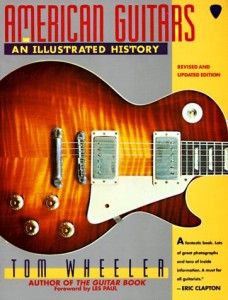
The classic reference book.

Reference books are a different story, especially the books of George Gruhn and Walter Carter, and those of Tom Wheeler. Sure, some of their weightier works have guitar porn aspects, but always paired with vast historical knowledge and the expertise of longtime industry insiders. Gruhn and Carter may know more about American guitars than anyone. But I always gravitate to Tom Wheeler’s books, and not just because he’s a longtime friend and mentor. Tom is a fine writer, an impeccable researcher (he’s been a journalism prof for the last 20 years), and he still conveys a teenager’s passion for the instrument. Tom is my hero.

(Bonus question: Has Wikipedia rendered the guitar reference book obsolete?)

But these days, the gear books that excite me most are the technically slanted, nuts-and-bolts titles. It’s one thing to ogle pretty instruments, and another to explain how they work, why they sound the way they do, and what that all means for the music we make today. And that’s why I love the books of Dave Hunter.

Categories
Acoustic Amps Bass Digital DIY Effects Gigs guitar Music Pickups Recording Technique

Tonefiend Book Week is Coming!

Tonefiend Book Week 2013

Next week at tonefiend we’ll be talking about our favorite guitar/music books. I’ll write about some of the titles I find especially useful, inspiring, or entertaining, and I hope you’ll chime in with some of your recommended reading.

Since there’s so much potential material here, I suggest we focus on a different book category each day. Here’s my proposed schedule:

Tonefiend Book Week is strictly an experiment, and a selfish one at that. If the past is any guide, the obsessive geeks experienced and sophisticated players who frequent this site will introduce us to lots of lively lutherie-linked literature. And I’ll do my best to keep up!

So scour your bookshelves, real and virtual. This shit is about to get real promises to be a most edifying conversation.

Categories
Acoustic Amps Bass Effects guitar Recording Uncategorized

The View from Here

IMG_6230

If you’ve been reading this blog for a while, you may have noticed a recurring pattern: I attend some interesting event and promise to report on it, only to get subverted by work, crowds, jabbering with old acquaintances, and jetlag. True to form, I’ve spend the first two days either demoing TriplePlay, or staggering to the coffee bar. Yesterday I spent hours staring at these Guitar Grip guitar hangers, which are mounted on the wall right next to the spot where I’m playing. They remind me of the human-hand candelabras from Jean Cocteau’s La belle et la bête.

It’s been fun playing for so many hours, though I’m still not very good at the MIDI guitar/drums thing. I was having a fairly disastrous moment when John McLaughlin came by. Isn’t that always how it is? You’re having an off day, and then you look up and see that frickin’ McLaughlin. Is it just me, or does everyone hate that? :shake:

This is my first time here, but the old hands tell me that the show is relatively dead, and that a lot of manufacturers have either already given up on Messe, or are planning to next year. We’ll see what transpires tomorrow afternoon and Saturday, when the show opens to the public. (So far, it’s industry-only.) And I really will try to scope out some gear!

IMG_6239
Stay classy, Marshall!
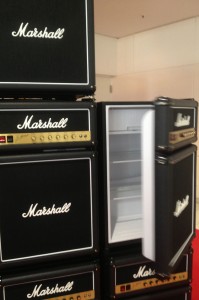
Now we're talking —  refrigerators!
Now we’re talking — refrigerators!