Categories
DIY guitar Pickups

A New Look at an Old Wiring Scheme
(and another cheap guitar makeover!)

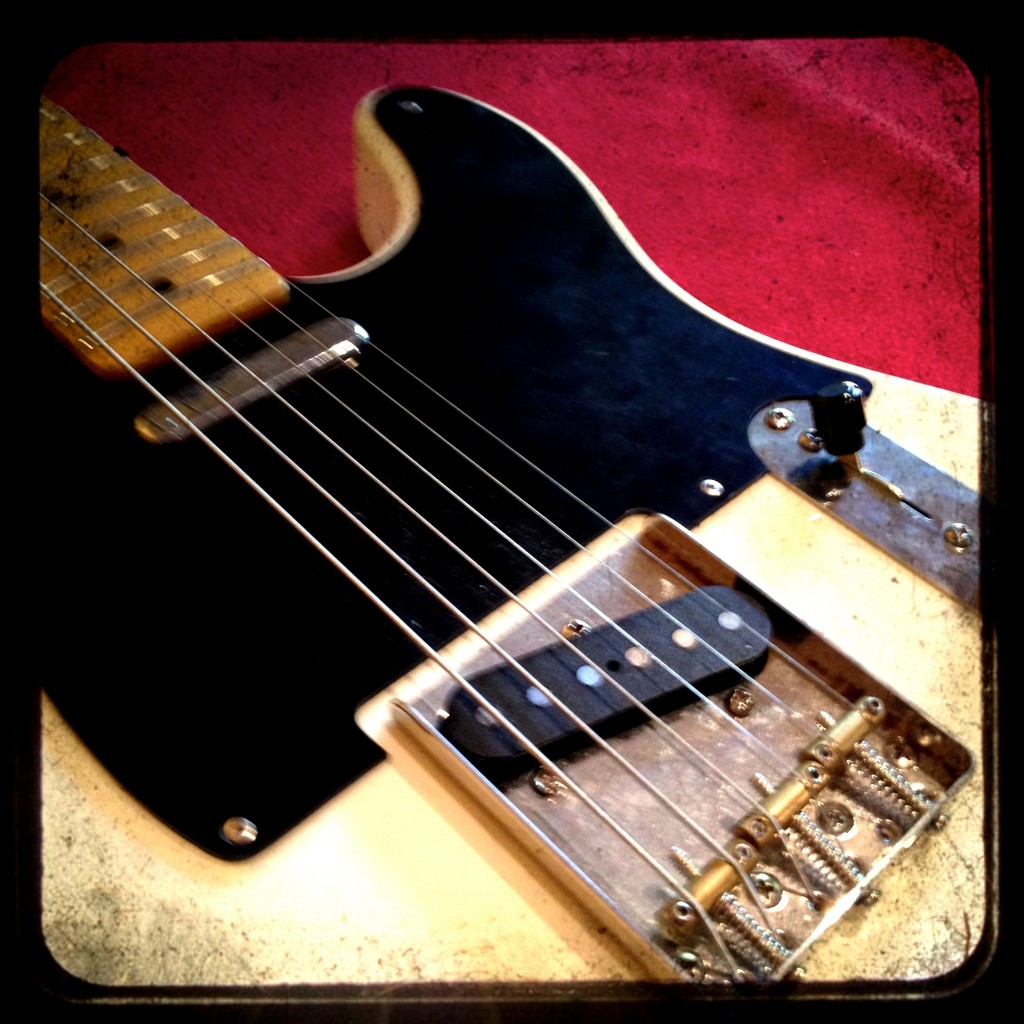
An iPhone photo app makes this new Squier Tele look old. Duncan's Vintage Broadcaster Set makes it SOUND old.

Sometimes an antiquated idea can acquire new relevance.

Example: The ancient Fender Broadcaster wiring scheme, in which the guitar has no tone control per se, but the second knob acts as a pickup-blend control. I wired up a guitar this old-fashioned way, with some very surprising results.

My experiment had other motives: I wanted to check out Seymour Duncan’sVintage Broadcaster Set, which replicates those earliest Telecaster-family pickups. And once again, I wanted to see just how much of a sonic upgrade a simple pickup replacement could bestow on a humble guitar: in this case, a cheap, Chinese-made Squier Telecaster.

Check out the results in the demo video.
Categories
DIY Effects guitar Tonefiend DIY Club

Build the World’s Wickedest Overdrive
(for less than $30)

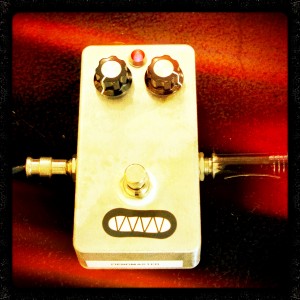
"Who are you callin' ugly?"

UPDATE: My thanks to reader William Badjek, who found in error on page 31 of the v01 project file, which would have prevented the tone control from working properly. (The schematics, however, were correct in v01.) If you’ve encountered that issue, please revisit that page of the v02 project file, now available at the link below. My apologies to anyone who got stuck on this!

Hey, DIY victims fans!

Here’s the project file for Tonefiend DIY Club Project #4: the Fiendmaster, a fab-sounding update of the Dallas Rangemaster, the circuit that put the punch in so much classic British rock. If your record collection includes a lot of albums from around 1970 featuring skinny guys with long hair and flared trousers, you need one of these!

It sounds incredible. It’s a relatively easy build. And unlike strict clones, this version runs on a regular modern power supply like the rest of your pedals. It also includes a knob that fades between the original’s bright, snappy Brit blues sound, and the humungous sludgetone that spawned Sabbath. You can round up all the parts from the usual suppliers for less the 30 bucks, or just order a pre-assembled kit from Mammoth Electronics.

View a brief demo video of the final product here. Learn more about the circuit’s significance here. And fill your cranium with everything you need to know about germanium here. Happy soldering!

Categories
DIY Effects Tonefiend DIY Club

Meet the Fiendmaster!
(A new Tonefiend DIY Club project)

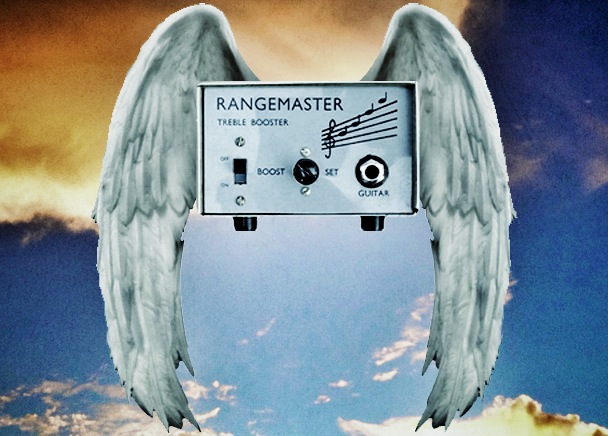
Technically speaking, original Dallas Rangemasters didn't have angel wings, though they probably should have. However, the musically illiterate treble staff IS historically accurate.

The next Tonefiend DIY Club project is a cool update of the Dallas Rangemaster treble booster — for my money, the wickedest overdrive ever. I’ll post all the project files within the next week, but I’m introducing the project here so you can listen to the pedal, decide if you’re interested, and if so, start rounding up the parts.

Like our first project, this is a single-transistor distortion device. But this one gets it glorious Brit-rock tones from a funky old germanium transistor.

At the end of this post is a parts list, plus names of dealers who sell reliable germanium transistors. And once again, Mammoth Electronics is offering a pre-assembled kit with everything needed to build a ready-for-gigging Fiendmaster. [FYI, neither I nor Seymour Duncan have any financial stake in this item. I’ve simply asked Mammoth to put together a kit for your DIY shopping convenience.] You can order the kit here. If you don’t see it on the page yet, check back — it’ll be up soon.

Check out this brief video to hear the wicked beast in action:

Categories
DIY Effects

The Germanium Mystique

Germanium is actually a boring, silvery-gray color. Aren't you glad I added cheesy digital effects?

“Germanium” is a magical word among guitar gearheads, right up there with “pre-CBS,” “true bypass,” “matched tubes,” “point-to-point wiring,” and “scatter-wound.” And like those other phrases, it owes its cachet to a mix of fact and fancy.

Germanium was used extensively in electronic component production the 1950s and ’60s, but was abandoned in favor of silicon components, which boasted superior performance, consistency, and value. Today no one cares about rare and finicky germanium components except certain audio geeks — especially the ones who play guitars.

In the stompbox realm, you’re liable to encounter two types of germanium components: germanium diodes, which lend distortion pedals a softer, smoother tone relative to silicon diodes or LEDs, and germanium transistors, which are typically used in clones of ’60s drive and fuzz pedals. Germanium components are usually available only from specialized distributors, who inevitably sell them for many times the cost of their silicon equivalents.

Compared to silicon transistors, germaniums are . . . different. 

Categories
DIY Effects guitar Recording

Roll Your Own Reverbs!
Simulate Spaces with Impulse Responses

Location, location, location: IR reverbs can make your guitar sound like it was recorded ANYWHERE!

Impulse response reverbs are one of the handiest tools in the digital-audio junk drawer. If you’re new to the concept, prepare to be amazed. (And if you’re familiar with the technology, jump to the end of this post to score some cool free reverb sounds.)

Impulse response reverbs, also known as IR or convolution reverbs, fake the sounds of genuine acoustic spaces. Say you want to be make your tracks sound as if they were recorded in a 12th-century dungeon: Just visit your nearest medieval castle and set up a small PA system in the dungeon. Next, play a test signal (usually a sine-wave sweep or a starter-pistol shot) and make a recording of it echoing in the space. Back at your studio, your IR software compares the new recording to the original test tone, and creates a reverb preset that you can apply to any audio source. Just slap it on a guitar track, say, and voilà — you’re rocking out in the dungeon, minus rats, mildew, and torture implements.

But wait, there’s more! You can use the same technology to mimic hardware effects and speakers. Just run the test signal through an amp or effect, and you’ll have a digital clone of the physical device. Here’s a brief video demonstrating the idea:

Categories
DIY guitar Pickups

Lithuanian Mutants

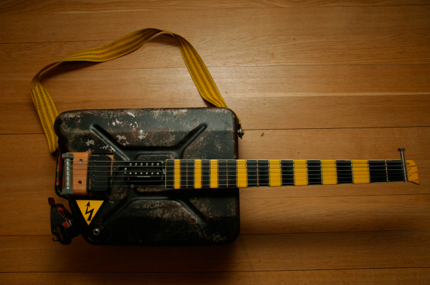
Sadly, the Mutant Beauty Pageant ended weeks ago. But I suspect you’ll enjoy the pics I received from Lithuanian reader Dmitrij Timofejev. Dmitrij, what does that sideways humbucker sound like? BTW, the is the less radical of Dmitrij’s two guitars.

Categories
DIY Effects guitar Pickups

Fun with Onboard Boosters!

Put more ELECTRIC in your guitar!

Lately I’ve been obsessed with mounting boosters inside my electric guitars.

Why bother? Especially when you can just get a clean-boost stompbox and use it on all your guitars? Because:

    a) certain guitars just seem to sound best with a particular boost circuit;
    b) you can “play” the booster by riding the gain setting, and;
    c) why leave well enough alone when there’s an exciting opportunity to screw things up?

Two examples: a squeaky-clean boost inside a lipstick tube Strat (which I previously wrote about here), and a dirty little germanium overdrive inside an old Les Paul (a guitar I previously wrote about here).

Listen to the results!

Categories
DIY guitar Pickups

Cheap Guitar Makeover!

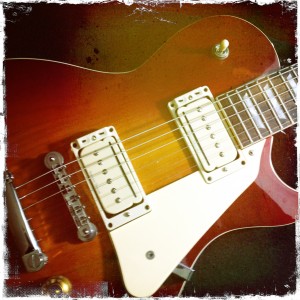
A while back a couple of readers brought up Jimmy Page’s Les Paul wiring scheme, which made me want to set up a dual-humbucker guitar with lots of those tricky series, parallel, and split-coil tricks. Meanwhile, I wanted to do a sequel to my last cheap guitar makeover, but this time with a solidbody instead of a semi-acoustic. Also, I’d been meaning to try a pickup combo recommended by the mavens at Seymour Duncan: a pair of P-Rails combined with Triple Shot Mounting Rings.

So I slaughtered all three birds with a single stone: I picked up a late-’80s Aria Pro II for $200 and retrofitted it with that absurdly versatile pickup scheme. Have a listen!

Categories
DIY Effects Tonefiend DIY Club

Three Useful, Easy & Cheap DIY Tools

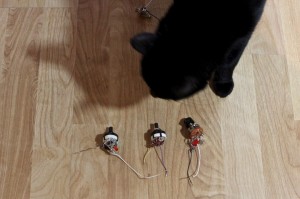
My cat hates when I play distortion pedals. I don't think he especially appreciates my non-distorted playing either.

Reader Derick just posted a comment on the DIY Project #1 page about his experiences with using different diodes for the Bad-Ass Distortion Pedal project. He’s inspired me to share a few cool tools you can use to make your DIY work easier and more creative. If you’ve worked through some of projects, or think you might, you should think about adding some of these to your workbench.

Categories
Acoustic Amps Bass DIY guitar

We Have a Mutant Winner!

Not a turkey: Dave Wetherby's eye-catching Colorcaster

The contestants were formidable. The competition was fierce. But by the time yesterday’s deadline arrived, one mutant stood triumphant — so triumphant that we are spared the interminable silliness responsibility of a run-off round.

And the winner is Dave Wetherby’s kaleidoscopic Colorcaster. Congrats to Dave, who will receive as a prize a super-freq Uglyface, a fuzz pedal that only a mutant could love. Congrats, Dave! :beer:

Here again are Dave’s original comments from the posting thread