
Categories
Bass guitar Technique

Are Your Sinister — or Dextrous?

“Why is everything upside-down?”

You know the origin of the word “sinister,” don’t you? It’s the Latin word for “left,” which, according to etymologists, became associated with evil, thanks to the medieval belief that left-handed people were deceitful and probably possessed. Meanwhile, “dexterous,” which means adept with your hands or brain, is from the Latin “dexter,” meaning “right.”

What are the odds that a right-handed person came up with those ideas? 😉

Lefty guitarists have it tough. They have fewer instruments to choose from, and they usually can’t just pick up any old guitar and start jamming. When I wrote for Guitar Player, we tried hard not to be “side-ist,” and would always refer to the “picking hand” and “fretting hand” rather than the left and right when discussing technique. But still.

I have left-handedness on the brain because I upgraded a left-handed guitar for a friend. I threw caution to the wind and recorded a demo video upside-down, without restringing. It ain’t pretty — but it sure is interesting! I’ve never undergone any sort of neurological testing, even though I look like the sort of person who should have electrodes permanently attached to his skull. But after playing upside down for a few minutes, I could practically feel parts of my brain pulsating with unaccustomed energy. I held a wine glass in my right hand, and it felt wrong. Then in my left, and it still felt wrong. And man, was it tough typing! It was a weird, disorienting mental high. 

Categories
Technique

Simple But Deadly Pinky Exercise

Don't hate me for this.

A little something to make your weekend miserable productive:

I learned this pinky-strengthening exercise many years ago from one of my teachers. If the fourth finger of your fretting hand is the runt of the litter, skill-wise, these combination barre-chord/hammer-on routines may help. Plus you’ll learn some cool retro R&B riffs!

Categories
Acoustic guitar Technique

Expensive Picks, Part 2: V-Picks

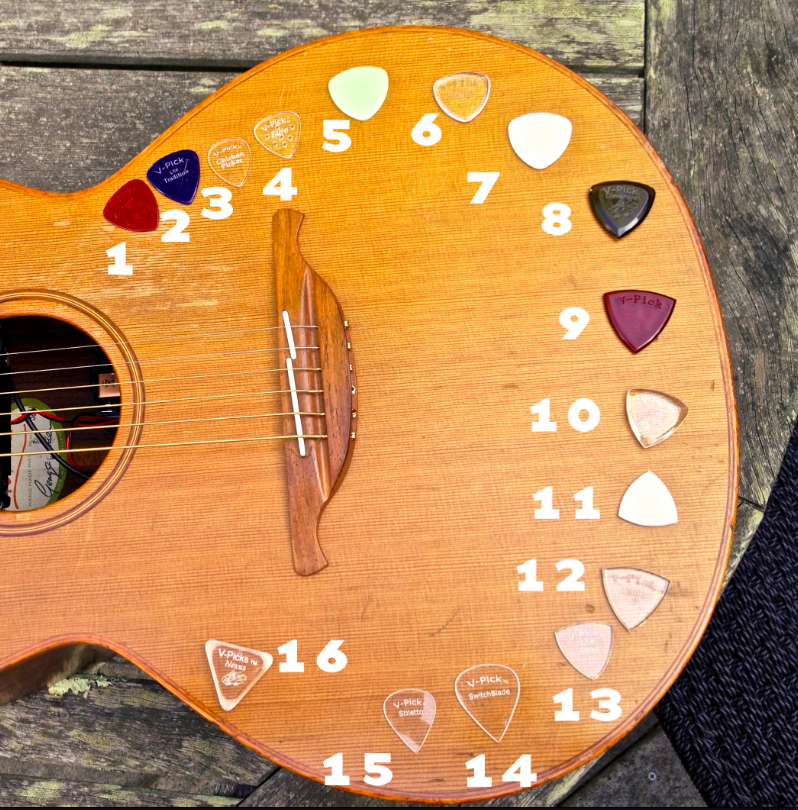
Sixteen Current V-Pick Models (clockwise from upper left): 1. Ruby Red Traditon Ultra Lite; 2. Tradition Lite Sapphire Blue; 3. Chicken Picker; 4. Euro; 5. Nite-Glow Medium Rounded; 6. Pearly Gates Medium Round; 7. Medium Rounded; 8. Dimension Buffed Smokey Mountain Series; 9. Ruby Red Medium Pointed; 10. Dimension Junior Buffed; 11. Pearly Gates Small Pointed; 12. Medium Pointed; 13. Small Pointed Lite; 14. Switchblade; 15. Stiletto, 16. Nexus Unbuffed.

Readers had a lot to say about a recent post on high-end guitar picks. I focused on some of those ultra-hard picks made from natural materials, such as stone, bone, wood, and horn, plus ones made from synthetics designed to mimic those materials, such as GraphTech’s Tusq series. I’d concluded that, while these picks cost a lot more than garden-variety plastic picks, they offer unique benefits, including stronger fundamentals, more low-end mass, and varying amounts of percussive treble “slice” that can help a guitar track stand out in a mix.

Anyway, several readers spoke highly of V-Picks, a small handmade pick company from Nashville run by Vinni and Nancy Smith. I bought a few, and was deeply impressed. So I got a bunch more and made the set of reference recordings included here. Have a listen!

Categories
guitar Technique

A Very EBow Christmas!

Sustain that seasonal spirit!

WARNING: THIS POST CONTAINS HOLIDAY MATERIAL. THOSE WITH SEASONAL MUSIC ALLERGIES SHOULD CONSULT THEIR THERAPISTS BEFORE PROCEEDING.

Nothing says “Christmas morning” like an ugly piece of molded plastic with a battery inside! But unlike so many cheap plastic toys, the EBow is a treasure that can delight you for decades.

While racking my brain for a holiday post without too much bad attitude, it occurred to me that “Silent Night” makes a perfect little EBow exercise. If you play it in G, starting on the the 7th fret of the third string, the melody spans almost the entire range of the string. And it includes lots of those melodic leaps that are so tough to play smoothly on EBow. In other words, this simple, familiar tune is a serious workout!

Categories
Digital Effects Gigs guitar Technique

Let’s Talk Looping!

Here’s a little video I made yesterday using the looping setup I’ve been using live.

Any other looping geeks out there? I didn’t set out to be one—I just wanted to do a duo band with percussionist extraordinaire Dawn Richardson. Looping seemed, well, kind of ten years ago, but I got sucked in, and it turned out to be a cool format for a lot of the sound design I was doing in Apple’s MainStage software. So there.

As always in looping, it’s easy to build big textures, but difficult to break them down. That’s where I always choke.

FYI, Dawn and I made an album this way, and are working on a second. More info here.

Categories
Bass guitar Technique

Practice Without an Instrument [VIDEO]

For players who have a little bit too much of a life: five fretting-hand exercises you can practice when you’re away from your guitar or bass. Make sure to run through them in public places so bystanders can alert the mental health authorities admire your prowess.

Categories
guitar Technique

Vibrato: Do You Shake It Like Ethel?

Can you shake it like Ethel? And more important, SHOULD you?

Almost all of us are guilty of it: repetitive, auto-pilot vibrato.

Can you blame us? Between choosing the right notes, and trying to play them in tune and in time, we don’t always have surplus brain cells to shape each note individually. So much simpler to stamp each one with the same prefab wiggle!

One of the wickedest observations about shred guitar came from one of the greatest shred guitarists, Paul Gilbert. In a conversation many years ago when he was a youngster, he noted that a lot of players seem to have pilfered their vibrato technique from Ethel Merman.

Categories
Acoustic Bass guitar Technique

Cruel Finger Exercises [Part 2]

In Part 1 of this series, I introduced 24 fingering patterns that can be jumping-off points to any number of warmup and dexterity-development exercises. As threatened, this installment introduces additional technical hurdles guaranteed to challenge even advanced players. Try these out—but only after you can play the everything in Part 1 comfortably and consistently (“like identical pearls on a string”).

Categories
Acoustic Recording Technique

Acoustic EBow: Insane, or Merely Crazy?

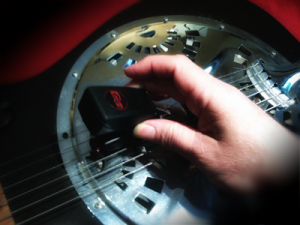
EBow on a Dobro? Oh, yeah!

If you’ve screwed around much with an EBow—you know, that battery-powered plastic thingie that you slide against your guitar strings to magnetically invoke infinite sustain—you may have also noticed that it works on steel-string acoustic guitar, especially on the unwound first and second strings. It’s hardly an earth-shaking tone— just a thin whine, really— though you can sometimes use it to good effect, compressed and processed within a mix.

But when I got my first Dobro last year (okay, I was a little slow getting around to it) the technique really came alive for me, and I’ve been using it on tons of tracks ever since.

Categories
Acoustic Bass guitar Technique

Cruel Finger Exercises [Part 1]

Here’s a deceptively simple finger exercise that can serve as a basic warm-up, an overall strength-builder, and, if you take it far enough, the cruelest torture regimen this side of 16th-ventury Spain a great way to expand both your technique and your melodic imagination.

The basic idea is simple, something appropriate for a very first guitar lesson. But as you start adding variations, it can challenge even very advanced players.

Bass players, don’t miss the fun. Everything here applies to you too— only it’s harder given your longer scale.