You know the origin of the word “sinister,” don’t you? It’s the Latin word for “left,” which, according to etymologists, became associated with evil, thanks to the medieval belief that left-handed people were deceitful and probably possessed. Meanwhile, “dexterous,” which means adept with your hands or brain, is from the Latin “dexter,” meaning “right.”
What are the odds that a right-handed person came up with those ideas? 😉
Lefty guitarists have it tough. They have fewer instruments to choose from, and they usually can’t just pick up any old guitar and start jamming. When I wrote for Guitar Player, we tried hard not to be “side-ist,” and would always refer to the “picking hand” and “fretting hand” rather than the left and right when discussing technique. But still.
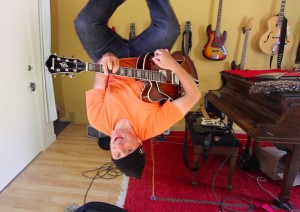
I have left-handedness on the brain because I upgraded a left-handed guitar for a friend. I threw caution to the wind and recorded a demo video upside-down, without restringing. It ain’t pretty — but it sure is interesting! I’ve never undergone any sort of neurological testing, even though I look like the sort of person who should have electrodes permanently attached to his skull. But after playing upside down for a few minutes, I could practically feel parts of my brain pulsating with unaccustomed energy. I held a wine glass in my right hand, and it felt wrong. Then in my left, and it still felt wrong. And man, was it tough typing! It was a weird, disorienting mental high.
(FYI, I’m not fully ambidextrous, but I’ve always had a lot of left/right confusion, and to this day, I often blurt out “Turn right here!” when I mean the opposite.)
When I taught guitar, I wouldn’t have dreamt of encouraging someone to “switch sides” — left-handed students played left-handed. But I never actually had a left-handed student who was a total beginner. If I had, wouldn’t it have made sense to teach them right-handed, since both hands are equally unskilled when you’re starting out? I always thought so, but never had a guinea pig student to help me test the theory.
Musically speaking, this seemed like a profitable exercise. Obviously, muscle memory is largely negated. You can’t execute vibrato in your usual fashion. You’re less likely to play your stock licks. It’s hard to overcome the tendency to want to start all single-note phrases on the (now) lowest-pitched string. Difficult barre chords become easy. Easy ones become impossible. The first string seems absurdly thin. Bending it (downward, of course) is almost too easy. It definitely provided insight into the technique of Albert King, the best-known left-handed player to play a righty guitar upside-down. That, in turn, made me think of Hendrix, whose blues style was so heavily influenced by that particular King. (Jimi too was also a lefty who played an upside-down guitar, though he restrung so that high-pitched string was nearest the floor, the opposite of King’s approach.)
Even though my tone suffered, I found myself becoming more mindful of tone production. I had to map out chords and phrases in my mind earlier than I would if playing right-handed, which at times forced me to play more simply and melodically.No prefab licks. No gratuitous bursts of speed. I hated every frickin’ second of it!
Has anyone else tried this? Lefties, have you by necessity developed an ability to play right-handed guitars upside-down? Did you learn left-handed? If you learned right-handed, do you regret the decision? Is your picking hand more skilled than your fretting hand? And how much basis is behind the notion that left-dominant brains really are different? Are you more creative and artistic? Or are you just plain SINISTER?


Leave a Reply