UPDATE: I’ve added a page listing all the “How To” posts on this site. Just click the cleverly titled How-To Posts Are Here! box at upper-right of each page.
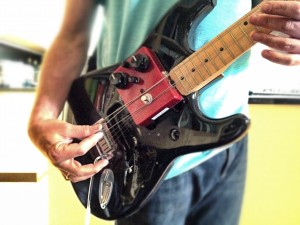
Several readers asked for more specific tech advice on how to wire up battery-powered effects inside a guitar or bass, so I created a step-by-step tutorial, which you can download here.
Some historical background: Since the ’60s, many guitar companies have toyed with the notion of installing battery-operated effects inside guitars.
And “toyed” is probably the perfect verb for it. Onboard effects have earned a reputation as cheesy, low-budget products. In many cases this reputation is justified. (And sometimes it’s not — the Electra guitars of the ’80s were never particularly popular, but their simple onboard distortion circuit has generated hundreds of “boutique” clones, not to mention our own Bad-Ass Distortion project).
And why would you want to put an effect inside a guitar or bass? You can use a stompbox with any electric instrument, but an onboard effect is married to one axe till solder-do-they-part.
I have an ironclad rebuttal to such concerns:
Whatever.
There are many reasons you might consider mounting effects inside a guitar. Maybe you like playing through a particular booster 100% of the time, whether you’re Brian May, or just someone who can’t stand the sound of single-coils without a little extra oomph. Maybe you want to be able to manipulate controls on the fly without scuttling around on the floor. Or maybe you just want to freak people out by activating a hidden fuzz-bomb circuit on an innocuous-looking guitar.
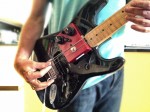
Which was precisely my motive in installing a fuzz circuit inside a Hello Kitty Stratocaster, as demoed here. I’ve posted similar experiments before, like the onboard clean boost I put in a Gretsch baritone guitar, or the germanium-driven Rangemaster I embedded in the Pagey Project Les Paul. This time, though, I took pictures and made notes of the process, which is relatively simple, and doesn’t change much from effect to effect. You should be able to use these guidelines to install whatever you like wherever you want.
Note that this tutorial does not explain how to make or customize effects, though there’s plenty of info on those topics on the DIY Club page. These tips explain what to do after you’ve assembled your effect on perfboard (or pilfered it from inside someone else’s stompbox).
Any of you guys have experiences, good or bad, with mounting internal effects? Are there cases where it lets you do things you can’t with a conventional stompbox? Or do feet on the floor provide everything you need?


Leave a Reply