Hey, smart people — let me get your take on this. I’ve been playing with a new tone control idea that’s so simple, I can’t believe no one’s done it before. (Chances are someone has.)
Here’s the idea: Conventional electric guitar tone controls employ a single pot and single capacitor connected to ground. As you turn the pot, more signal goes to ground for a darker sound. The capacitor value determines the cutoff frequency — the larger the cap, the lower the cutoff frequency and the darker the sound. In other words, the cutoff frequency is fixed, but the percentage of signal that gets cut off changes as you move the pot.
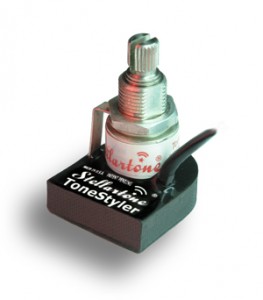
Meanwhile, the Gibson Vari-Tone circuit uses a rotary switch rather than a pot, and a set of capacitors of ascending size. The small caps have a brighter tone, and the large ones sound darker. But once a cap is engaged, it’s engaged all the way. In other words, the cutoff frequency varies as you move the switch, but not the percentage of affected signal—it’s always 100%. (The Stellartone ToneStyler employs the same concept, with as many as 16 caps arranged around a rotary switch.)
But do you really need all those caps? Why not use the tone pot to fade between a small cap and a large one, like so:
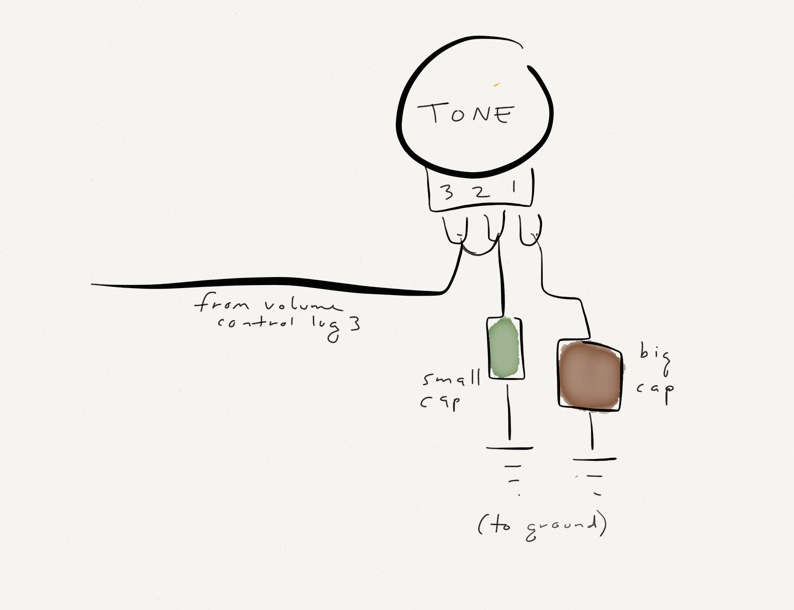
Here, the brighter/lower-value cap is engaged when the pot’s all the way up. As you roll it back, the larger cap is introduced, producing greater capacitance and a deeper treble cut. When you arrange caps in parallel, their total capacitance is the sum of their values. For example, I tried a .0047µF cap and a .047µF, so the minimum value is .0047µF (a very modest cut) and the maximum is approximately .052µF (a very dark tone).
So far I’ve only tried this on breadboard, though I plan to deploy it in a new “parts” guitar I’m assembling. So far it sounds … really good. A lot like a ToneStyler, actually, but with fewer parts and handpicked values. The only tricky thing was finding a good pot value where all the action wasn’t bunched up at one end of the knob’s range. A reverse-log pot worked best for me—I got nice results with both a C500K and C1M.
I often use similar wiring to alter the value of the input cap on distortion pedals. (High values filter our more bass for a brighter/cleaner sound.) But I’m not aware of anyone having tried this on a guitar tone control.
Another issue is the fact that, in this circuit, the tone pot always has a cap engaged. You could use a really tiny value for the smaller cap so there’s little perceptible cut at the minimum setting, but that can make a substantial part of the pot’s range a little too subtle. So my plan is to combine this with a Ned Steinberger-designed JackPot as the volume control. This part has an “off” setting that bypasses the tone circuit entirely for a maximum-bright sound. That way, I’d choose for the smaller cap a value that provides the minimum treble cut I’m likely to want. (I suspect I’ll wind up with something between .0022µF and .0047µF.)
Have any of you seen or heard of such a guitar circuit? If so, any observations or advice?