Categories
Amps DIY

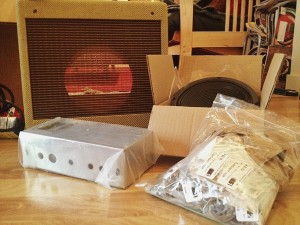
Review: Tube Depot Tweed Champ Kit

When you make DIY stompboxes powered by 9-volt batteries, your biggest fear is a solder burn (or dropping your drill on your iPad, but that’s another story). DIY amps are different: AC voltage can kill you, so a klutz like me approaches amp builds with caution.

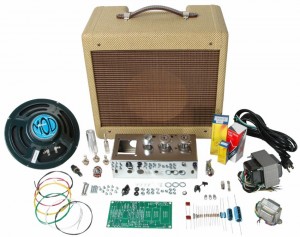
Which brings me to one of the great things about Tube Depot’s Tweed Champ Vacuum Tube Amp Kit: the fantastic assembly manual. Other great things include the price ($499, roughly half the price of a non-kit Champ clone of comparable quality). The design (which follows the original circuit, but substitutes an intelligently designed circuit board layout for the original turret board). And most of all, the tone.

I’ve got lots more to say about the kit, the fun I had building it, the lore of the 5-watt ’58 Champ, and the pros and cons of Class A amps (the Champ is the only Fender classic that merits the classification). But first, have a listen!

Categories
Amps DIY guitar Recording

Small Amps for Small Spaces?

I’ve got a Tweed Champ kit, and I’m not afraid to use it. Or at least not VERY afraid.

Why do they make amps so damn loud?

It’s not just a cranky question from a guitarist who’s drawing depressingly close to the “Get off my lawn!” years. I ask sincerely: Why?

Big amps make total sense — but only if a) it’s 1969, b) you’re playing venues with Jurassic sound reinforcement, and c) you’re a guitarist in danger of being drowned out by Keith Moon or John Bonham.

Okay, end of harangue — I’ll have time for that when I’m chasing kids off my lawn (after I move to the suburbs and GET a lawn). But as I get psyched up to build this review model of Tube Depot’s Tweed Champ kit in the coming days, I figured I’d ask what folks are using these days to get cool amp tones in their bedrooms and basements. Not dedicated practice amps, necessarily, but great-sounding stuff that happens to be ultra-low-wattage? Name your petite-amp poison!

Anyway, I’m stoked about this kit. I’ve already completed a few amp clones from Ceriatone. They were fun to build and sounded great. But I can tell right off the bat that this Tube Depot kit has at least one major advantage over its Malaysian cousins: This one comes with a fabulous 40-page instruction manual. (Most clone vendors simply link you to a schematic.)  Having  created a few step-by-step instruction manuals myself, I can testify how much painstaking work these entail. Hats off to Tube Depot’s Rob Hull for doing it right!

Details and build report to follow. But now, let’s talk tiny-amp tone!

Categories
Amps DIY

My Sad Little Amp

My amp has a sad.

Thank heaven I became a guitar geek shortly before my 12th birthday. If I hadn’t, I probably would have requested a minibike for my bar mitzvah present a year later, instead of my first electric guitar. And today I’d be an over-the-hill biker instead of an over-the-hill guitarist.

My schoolteacher mom had a colleague whose son worked at Fender in Fullterton, California, not far from where I grew up. (Sadly, I’ve forgotten his name). Shortly before my big day, we visited his mobile home (let’s face it: the musical instrument industry has never been lucrative) to audition some decidedly post-CBS guitars he was selling. I opted for a black Jazzmaster, though I was tempted by the paisley Tele. It was my sole electric throughout high school, though I sold it at exactly the wrong time: five minutes before new-wave guitarists such as Tom Verlaine and Elvis Costello made it cool again. (Though I shouldn’t complain, since I managed to procure my pre-CBS Strat around that time.)

The Fender guy didn’t have extra amps on hand, but I slavered over the oversized amps in the early-’70s Fender catalog.Which sleek silver combo would greet me on the big day?

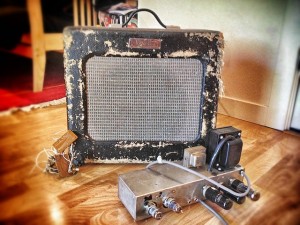
To my horror, I received an ancient, teensy-weensy combo amp, an ugly thing spray-painted black. I was mature enough not to express anything other than delight, but my heart ached. I wanted an amp as big and loud as my dreams, not this sad relic. They told me I was a man when I turned 13 — but I didn’t feel like one without the Dual Showman of my dreams.

My disappointing amp was a tweed 1952 Deluxe — which makes it sound like this story will have a happy ending. Sadly, no. 

Categories
guitar

A Very Vintage Strat

The ’80s were tough on guitars.

Last weekend I went to a memorial service for a music pal I hadn’t seen since the ’80s. Judging by the pictures I saw and the stories I heard, Brett remained the gentle, generous music lover I’d remembered till he died in his sleep a few weeks ago.

I ran into lots of old music friends and bandmates, and we alternately smiled and winced as our old photos and concert videos flashed on the big screen. Were we really that skinny? Did we actually wear that stuff without being coerced at gunpoint?

Like we tend to do at such moments, I left brimming with resolutions: Appreciate life. Cherish friends. Remember that music is a joy as well as a job. And do something nice for my sad old Strat, the guitar in all those old photos and videos.

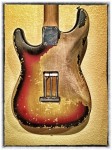
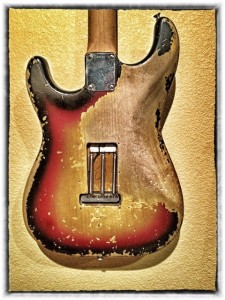
See, back then I only had one guitar — an all-original ’63 Strat I’d picked up in 1980, when pre-CBS Fenders were still perched on the precipice between collectible and affordable. (I paid $450, a staggering investment for me at the time.) It remained my only serious guitar for a decade. It was in near-perfect condition when I bought it, and it was a battered ruin by decade’s end. (The ’80s were a tough time for guitars, what with all those studded belts.) I was a young player with a bad attitude and little concern for collectibility, as opposed to the middle-aged player with a bad attitude and little concern for collectibility that I am today.

I’ll some thoughts about Strats then and now. But first, have a listen:

Categories
guitar Pickups

Mixing Magnets in One Pickup

Aggressive on the bass side, sweet on the top.

I was talking to Seymour the other day about the types of magnets used in vintage Fender pickups. I knew that Fender used strong, punchy alnico V magnets in most of their models, but I didn’t know that the earliest Teles used softer-sounding alnico IIs, or that the first Strats used even softer-sounding alnico IIIs, a detail confirmed by Fender’s page on the topic.

I recently had a chance to compare the sound of alnico II and alnico V while hacking together guitars for the Mongrel Strat Project. I’d tried an Alnico II Pro in the middle position of this mongrel, and liked it. But as I continued to experiment, I gravitated back to the more traditional alnico V sound — maybe because I play so much in lowered tunings, and in bands without bass, so I really like the strong, defined fundamental you get from an alnico V.

But until now I’d never tried literally splitting the difference via Duncan’s Five-Two, a hybrid that has three alnico V rods for the bass strings and three alnico II rods for the trebles. The idea behind this arrangement is to deliver a bold, snappy sound in the low resister, but with some softening and sweetness on top.

How does it sound? You tell me — here’s a demo video I made. Plus, there’s a micro-contest: The first person to name the tune I’m playing will have their name immortalized for the ages mentioned in an upcoming post. (That might be better than a poke in the eye, depending on whose eye it is.)

Have a listen:

Categories
Amps guitar Pickups

Behold the Synyster Kitty!

Kitty power!!!

Okay, as promised: One more quick video featuring the Hello Kitty Strat, this time with one of those new Duncan Synyster Gates Invader pickups. I’m told the ceramic-magnet Invader is literally the hottest possible non-active pickup. I’m inclined to believe it.

Take this one with a grain of salt. As much as I love trying to make a pink $99 guitar and a Lunchbox amp sound as heavy as possible, this pickup just might sound a wee bit heavier with a big-ass mahogany guitar and a big-ass tube-dude amp. But still.

FYI, here’s the earlier post I did using a Duncan Phat Cat pickup, plus the same built-in fuzz.

Behold, mortals:

Categories
DIY Effects guitar Pickups

Hello Kitty Strat: Not for Pussies!

Would this be anything less than awesome? I think not.

As I gloated last week, Jane Wiedlin gave me her Hello Kitty Stratocaster  — the most bitchin’ $99 guitar ever conceived! I finally had a chance to destroy/customize it yesterday, in what will no doubt be the first of many desecrations/enhancements.

I’d ordered one of those Synyster Gates Duncan Invaders with the pretty white pole pieces for the guitar, but just couldn’t wait to experiment, so I browsed through the ol’ pickup collection, and found a nice Duncan Phat Cat I’d used in a Les Paul experiment some months ago.

I don’t generally recommend choosing pickups because of their names, but come on! Kitty + Cat? How could I resist?

Turns out it was a lucky choice. I hadn’t planned to install a pickup that was actually lower in output than the stock humbucker, but it lets me get nicer clean sounds, and coughs up more than enough crunch when goosed with distortion. Speaking of which: the other custom feature is a built-in-distortion circuit activated via push-pull pot (I took lots of pics of the process for a DIY built-in-effects tutorial I’ll be posting very soon.)

View the carnage in this little video. Thanks, Jane Weidlin! Sorry, Stevie Nicks!

Categories
guitar

It Pays to Have Cool Rock Star Friends!

Sadly, it's ony Photoshop. Jane just WISHES she had a Hello Kitty triple-neck!

It was a perfect weekend here in SF: Unseasonably warm weather. BBQ in the garden. A fun recording session for a new project by Jane Wiedlin and Belinda Carlisle of the Go-Gos. And there was something else. . .

Oh yeah — Jane frickin’ gave me her Fender Hello Kitty Strat! Yes, the very same model played by Jimmy Page, John Lennon, Keith Richards, and Johnny Marr. (At least in my imagination.)

I love you, Jane!

So of course we started talking about how to customize it. Travis Kasperbauer, Jane’s engineer/husband, proposed installing an Seymour Duncan Invader pickup (maybe one of those white-capped Synyster Gates models…)

Jane suggested blinging it out with lots of beads and jewels and other eye-catching decor. And Jane know her eye-catching decor — her place is filled to bursting with mid-20th century kitsch, and her steampunk-themed studio could be the Addams Family basement where Wednesday and Pugsley rehearse with their punk band while Lurch runs Pro Tools. How often do you get to record 12-string overdubs while sitting next to a disembodied brain floating in a tank?

Categories
DIY guitar Pickups

“Nashville” Tele Wiring . . . in a Strat?!

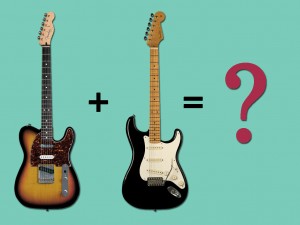
What do you get when you cross . . .

I’ve been coveting one of those “Nashville-Style” Telecasters — you know, the hot-rodded, three-pickup versions popularized by Nashville session superhero Brent Mason, and now a regular Fender production model.

Then it dawned on me: Since some of Mongrel Strats I’ve been playing with have strong Tele tendencies, why not flip the equation? Instead of a Tele that acts like a Strat, why not a Strat that thinks it’s a Tele?

The Fender version replaces the usual Tele 3-way switch with a 5-way, as shown in this wiring diagram, though many players prefer to keep the 3-way switch and add the middle pickup via a blend knob, as in this other wiring diagram.

I took the latter approach, and I am flipping out over all the new tones it unlocks. Check out this little video demo:

Categories
Bass DIY Pickups

A Cool Alternative Tone Control for Bass

Looks vintage, but it ain't.

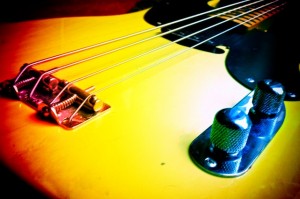
After auditioning so many different tone-control schemes over the course of the Mongrel Strat Project, I wound up with more tone circuits than I have Strats, so I figured I’d victimize a bass — specifically, a 1954 Fender P-Bass reissue with a Seymour Duncan Quarter-Pound pickup, which I’ve written about here. It’s a minimalist one-pickup model with basic volume and tone controls.

I was eager to audition a multi-capacitor tone control like I wrote about here. (Actually, it’s literally the same tone control — the guitar where it used to reside now houses the Stellartone ToneStyler tone pot covered here.) And while I had the patient on the operating table, I figured I’d also install the Black Ice distortion cube I wrote about here. (My friends in the medical profession assure me that patients always appreciate it when surgeons indulge in improvisational operating-theater mods.)

Demo and details after the break: