
Tag: guitar

  • The Class A vs. Class A/B Slugfest!

    The Class A vs. Class A/B Slugfest!

    Which kick more ass? Class A or Class AB?

    The recent experience making a DIY Class A Champ  reignites for me the eternal debate between the merits of Class A and Class A/B amps. (I link once more to Dave Hunter’s excellent short article on the topic, since he explains the distinction so much better than I can.)

    Like most American players of a certain age, I grew up without access to great Class A amps. (I’m going to take the lazy way out here, and lump Voxes and their kin into the Class A category, despite the distinctions that Dave H. explains so well.) My initial exposure to various ’90s Vox reissues and other “Voxoids” of the era was enough to spark my interest. (And is “spark” the perfect verb for great Class A amps, or what?) But it wasn’t till I encountered Matchless amps and real vintage Voxes that I totally got it.

    But still, I go back and forth constantly. And whenever I switch between categories, I think, “Ah! There’s what I was missing,” though I tend not to miss it when I’m playing an amp of the opposite type. So at least I’m usually happy.

    Overall I’ve probably favored Vox-type amps over Fender- and Marshall-flavored ones, though I’m the sort of player who’s rarely interested in macho rock and metal distortion. (If that weren’t so, I’d be an A/B purist!) But having said that, my fave amp these days is the decidedly A/B brownface Tremolux I use in the lion’s share of my videos. So put me down as perennially undecided.

    How about you? Do you pledge your allegiance to the explosive harmonic energy of Class A or the focused impact of Class A/B? And has anyone explored switchable schemes, as found on some Mesas and modded Marshalls?
  • Review: Tube Depot Tweed Champ Kit

    Review: Tube Depot Tweed Champ Kit

    When you make DIY stompboxes powered by 9-volt batteries, your biggest fear is a solder burn (or dropping your drill on your iPad, but that’s another story). DIY amps are different: AC voltage can kill you, so a klutz like me approaches amp builds with caution.

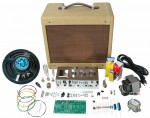
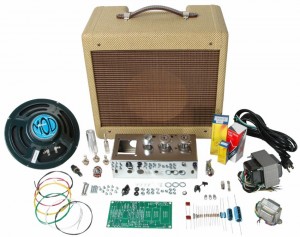
    Which brings me to one of the great things about Tube Depot’s Tweed Champ Vacuum Tube Amp Kit: the fantastic assembly manual. Other great things include the price ($499, roughly half the price of a non-kit Champ clone of comparable quality). The design (which follows the original circuit, but substitutes an intelligently designed circuit board layout for the original turret board). And most of all, the tone.

    I’ve got lots more to say about the kit, the fun I had building it, the lore of the 5-watt ’58 Champ, and the pros and cons of Class A amps (the Champ is the only Fender classic that merits the classification). But first, have a listen! (more…)

  • The Last Affordable Vintage Amps?

    The Last Affordable Vintage Amps?

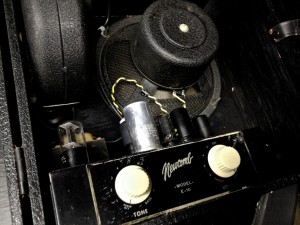
    You can probably get cool tones from any old crap with a tube in it, such as this ’60s PA amp.

    There were lots of interesting replies to last week’s post on small amps. Thanks for all the tips about some of today’s best tiny terrors!

    The discussion reminded me of a cool old amp that’s been gathering dust in my garage — and also of a notion of mine I call the “any old crap” theory. The idea is simple: Any funky old amp, including P.A. models never intended for guitar, usually has some compelling sounds in it. Plus, those old Newcomb, Masco, and Tapco amps are among the few remaining affordable vintage amps.

    Case in point: This early-’60s Newcomb P.A. amp I picked up a few years ago at my local cool guitar shop. Actually, my pal/hero Tchad Blake spotted it and bought it for a hundred bucks or so. He was here in San Francisco working on Tracy Chapman’s Where You Live album. When we finished the project, he decided he had too much gear to schlep back to the UK, so I took it off his hands. I used it on Tom Waits’s Orphans album, and then promptly forgot about it till last week. So I fired it up and made a little video demo with an old cheap guitar that didn’t cost much more than amp: (more…)

  • A High-Tech Plastic Guitar — from Half a Century Ago

    A High-Tech Plastic Guitar —
    from Half a Century Ago

    Plastic guitars are not a new idea!

    In comments to a recent post on 3D-printed guitars, we were discussing the pros, cons, and general aesthetics of instruments molded from plastic. But this isn’t exactly a new idea.

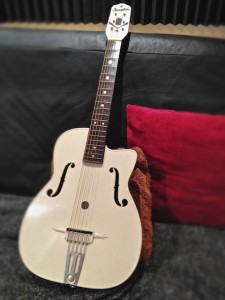
    Back in the 1950s, luthier Mario Maccaferri conceived a line of plastic guitars and ukuleles. (This was many years after Maccaferri designed the D-hole Selmer guitars that will forever be associated with the Gypsy jazz of Django Reinhardt.) These plastic guitars were never very popular, and they’re not particularly valuable today.

    I bought the one pictured here a few years ago at one of the music shops in London’s Denmark Street (I forget which one). I paid a couple of hundred bucks, and felt like a chump.

    But I’ve grown attached to this guitar. It’s lovely to look at, and it plays great. The neck is substantial yet comfy, and it intonates well throughout its range. The tone isn’t warm, complex, or rich. But the Maccaferri has a cool, lo-fi character this sits well in a mix. I also like using it to double conventional acoustic guitars — the sharp, percussive tone adds a rough, aggressive edge.

    Have a listen: (more…)

  • 3D-Printed Guitars?

    3D-Printed Guitars?

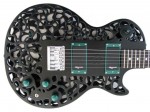
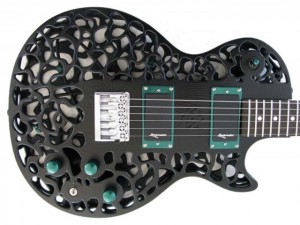
    The Atom guitar body was created on a 3D printer.

    During the Maker Faire a few months back, I wrote about the new wave of absurdly inexpensive 3D printers, and fantasized a bit about a not-too-distant time when many of us will be printing our own guitar parts at home.

    Create Digital Music — one of the music sites I visit daily — has been all over this topic recently. A few days ago, CDM kingpin Peter Kirn posted this excellent article discussing both the current limitations and eventual promise of this emerging technology. And this week Arvid Jense added this fine post focusing on six digitally printed instrument, including the eye-catching Atom guitar picture here. There are more interesting examples of luthier Olaf Diegel’s work at the Odd Guitars site.

    It’s hard to get a take on how good these instruments actually sound. Veteran electric guitar tinkerers know that you can slap strings and a pickup on just about anything, and a good player can make it sound pretty decent, and the plastic compounds used in most current 3D printing aren’t likely to be coveted for their acoustic properties. But it’s hard not to be intrigued by this smooth performance from multi-instrumentalist Dean Marks:

    So what would YOU print if you had one of these gizmos?

  • Cool Prewired Guitar Electronics

    Cool Prewired Guitar Electronics

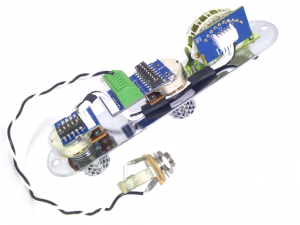
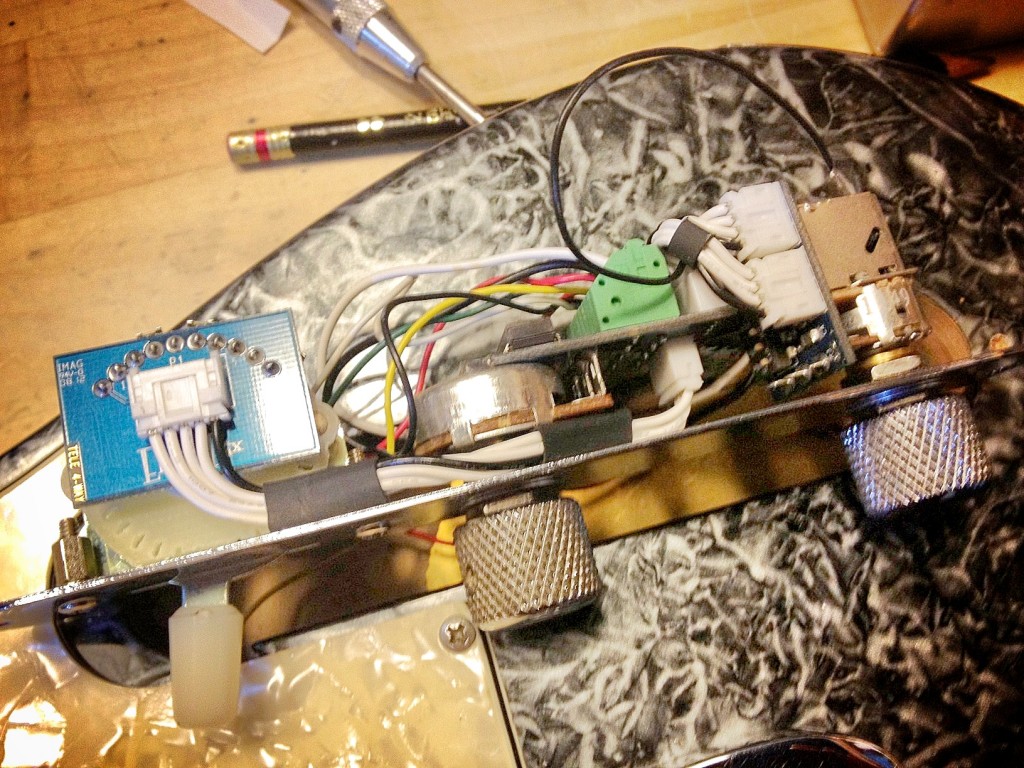
    Prewired replacement electronics provide access to many popular wiring mods, minus the soldering.

    Larry Santellan of Santellan Sounds, maker of the Elec-Trix tone modules, sent me some samples to check out. These pre-wired circuits offer quick access to some of the “greatest hits” of alternate wiring, with an emphasis on Strats and Teles. He has pop-in modules for 5-way Teles, Vari-Tones, passive overdrives, vintage/modern switching, and more.

    I haven’t had the time to try everything Larry sent, but for a few months I’ve had his 4-Way Fat Tone Monster Deluxe Wiring Kit in my Tele-like G&L ASAT. It lets me dial in the three standard sounds, plus that humongous series-pickups BLAT! A push/pull pot bypasses the tone control. (I never hear meaningful differences between bypassed tone controls and wide-open ones, but this setup lets me toggle between a bright, wide-open tone a muted one.)

    Installation was relatively easy, and the parts and workmanship are top-notch. If you’re interested in alternate pickup wiring options, but don’t have the skill, patience, or time to solder it yourself, well, check out the Elec-Trix catalog.

    Solder-free configuration via clever ribbon connectors.
  • Those Mysterious Burns Pickups

    Those Mysterious Burns Pickups

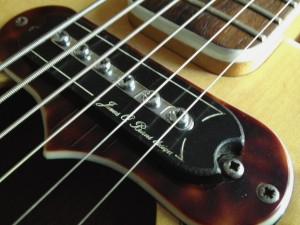
    A unique pickup in a “unique” guitar.

    I’ve never owned a Burns guitar, and I have only one with Burns pickups: a funky mid-’60s Baldwin Virginian I scored for $100 some 20 years ago. It’s a cheap plywood piece of crap — but it’s my piece of crap, and I’m quite attached to it.

    James O. Burns founded Burns London Ltd. in 1960 and had success underselling expensive American imports. Burns users included Hank Marvin, pre-Zep Jimmy Page, and most famously, Brian May, who used Burns’s Tri-Sonic pickups in his iconic homemade guitar.

    Cincinnati’s Baldwin company bought Burns in 1965 and quality suffered — much like the same year’s CBS/Fender debacle, only on a smaller scale. But the Baldwin/Burns marriage produced some interesting oddballs, notably the Baldwin Burns Buzzaround (a quirky fuzz pedal favored by Robert Fripp), plus a lot of weirdo guitars. Like this one.

    When I was playing with PJ Harvey, I used the Virginian to play the songs she’d written in “Gary Glitter tuning”: AAAAAA, as heard on “Rock and Roll Part 2,” and on this 1995 PJ Harvey clip from The White Room, a great British live music TV show of the era. (As on the UK’s long-running Later with Jools Holland show, bands would set up on multiple stages facing each other across a large room. Also performing the night we tracked this: Oasis, Paul Weller, and Bobby Womack.)

    Here’s how the same guitar and guitarist sound 17 years later. Listen and weep: (more…)

  • A Tale of Two Pedalboards

    A Tale of Two Pedalboards

    Is it just me, or do many guitarists these days find themselves alternating between separate analog and digital setups?

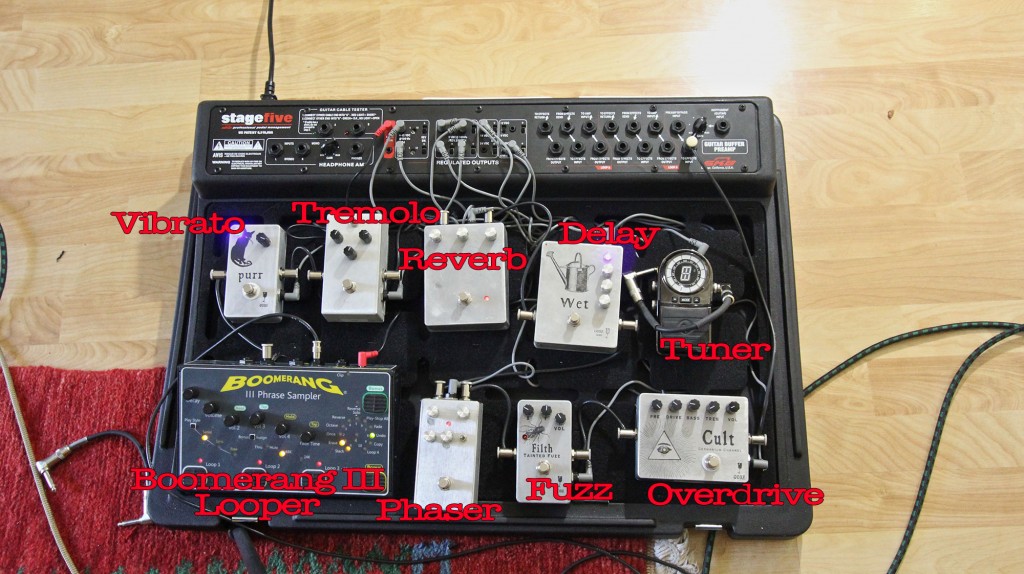
    I’m posting some pics of my current pedalboards (bearing in mind that, for reasons I’ll get into in a sec, my pedalboards only tend to stay “current” for a few days at a time). Both were assembled using store-bought housings, though I’ll talk a bit about total DIY boards as well.

    First, the mostly analog setup (the exception, of course, is the digital Boomerang III looper).

    Joe Gore’s mostly analog pedalboard.

    The case is a newly purchased SKB Stage Five, a full-featured unit in a relatively rugged molded plastic case. These retail for a whopping $540, but you can find them heavily discounted. (I forget the exact price I paid for mine, but it was under $300.) It’s loaded with cool features, like dual effect loops, a built-in buffered preamp, and support for 9- through 24-volt DC power, plus 9V AC for those digital pedals like Line 6 modelers and many loopers. There are even trim pots on a few power jacks to simulate dying batteries. I’m less impressed by some of the fittings (like the cheapo plastic jacks), though I suppose they keep the weight down. And make no mistake: This thing is heavy!

    Verdict: Too early to tell, since I haven’t subjected it to road abuse, but I trust it enough to at least give it a go. I think I’d be a bit disappointed had I paid full pop, but it strikes me as a fair deal if you can find it at a 40+% discount.  (more…)

  • Museum of Lost Effects:Maestro Rhythm ’N Sound for Guitar

    Museum of Lost Effects:
    Maestro Rhythm ’N Sound for Guitar

    Well, I’m not sure it’s fair to call it a “museum” when there’s only one exhibit so far. But it’s a really, really good one…

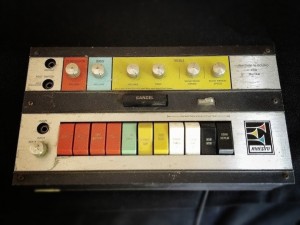
    I bought this Maestro Rhythm ’N Sound for Guitar for a pittance back in the ’90s. It’s a primitive multi-effect unit from 1968, with a cool octave-down bass tone, auto-wah, and two fixed filters. It’s got fuzztone (though mine has always been broken), and a weird, choppy tremolo reminiscent of the Vox Repeat Percussion effect. (Mine worked fine — until I broke it yesterday while trying and failing to fix the fuzz. Kill me now.)

    But the marquee feature of this hand-soldered contraption is the option of triggering four wonderfully cheesy analog percussion sounds. Bongo? Cymbal? Tambourine? Clave? At your command!

    Does it sound as weird as it sounds? No — weirder!

    You can’t assign specific specific notes to specific sounds — any input triggers the percussion, so the clicks and clanks tend to work best shadowing every note in a phrase, adding a weird edge. (I used them like that on Oranj Symphonette’s “Charade,” Erica Garcia’s “Yo No Tengo La Culpa,” and PJ Harvey’s “Maniac.”)

    But then it occurred to me you could more ambitious things with the percussion sounds via looping. Which is exactly what I do in this short, fuzz-free video.

    Check it out — and then let’s talk about this Museum of Lost Effects thing! (more…)

  • Guitar Lessons, Great and Otherwise

    This clip from the short-lived British sketch-com Snuff Box made me think about great guitar teachers — and not-so-great ones.

    I was lucky — I had some truly memorable teachers, starting with my mom, who taught me her coffeehouse folk. When she decided I needed a more advanced instructor, she recruited Larry, a friend’s 16-year-old Who-fanatic son. (He grew up to become renowned classical guitarist Lawrence Ferrara.) Katherine Charleton (later Calkins) mutated me into an early music geek. And I got to take a few lessons from Ted Greene was I was 17 or so, though he wouldn’t take me as a weekly student. He’d listen to me play got a bit, then dispense pages and pages of chord progressions and melodic sequences, the material that wound up on his Solo Guitar Playing books. I paid Buckethead for a few lessons when he was 17, but it was mainly just to hang out and watch him do his amazing thing. My last great teacher was the sublime Martin Simpson — I finagled a couple of lessons from him when he lived 90 minutes from me in Santa Cruz.

    How about you guys? Which teachers inspired you the most? What was the best advice you ever got from a teacher? The worst? Do you teach yourself? Does teaching affect the way you play? Like that.