Categories
Music

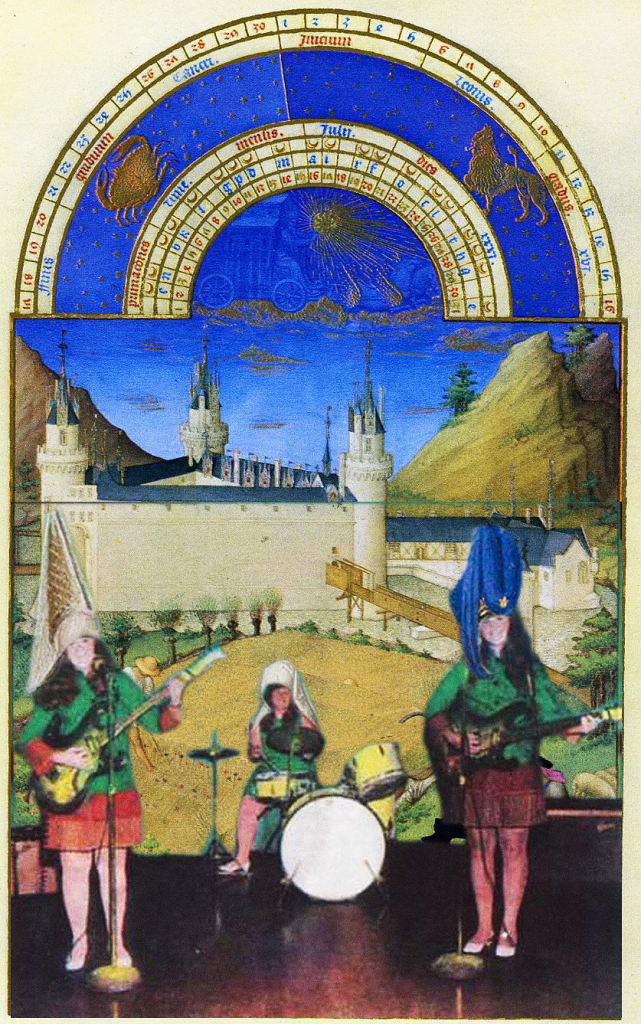
Were the Shaggs Medieval?

Were the Shaggs born in the wrong century?
Were the Shaggs born 600 years too late?

Here’s reader Freddie Lenzel, writing in response to my post on the bizarre late-medieval composition Fumee fume par fumee:

To me, it sort of sounds like The Shaggs from the Dark Ages. But seriously, it’s really interesting. Greetings from Spain, love your blog.

And I love your comment, Freddie! It really strikes a chord (pun intended), because the Shaggs have always sounded medieval to me. And I think I can explain why.

(But first: If you don’t know the Shaggs, stop reading this second and make your acquaintance with the group and their 1969 magnum opus, Philosophy of the World. Kurt Cobain cited it as one of the five-best albums of all time, and Frank Zappa insisted that the Shaggs were “better than the Beatles,” words that inspired this indie-trash tribute album. Meanwhile, NRBQ’s Terry Adams, who launched the Shaggs revival by getting Philosphy re-released in 1980, rightfully compared their homespun sound to Ornette Coleman’s free jazz.)

The Shaggs weren’t the only band to make an album before they knew how to play or write music, but they were one of the best. Many musicians, when first exposed to the Shaggs’ idiot-savant sound, compare it to what might result if you explained music to an alien species unfamiliar with the concept, and then sent them into the studio before letting them hear any actual music. Shaggs songs have no underlying chord structures, no consistent meter, no conventional phrasing, and little harmonization. It’s just odd, meandering “melodies” that stumble along until singer/guitarist Dot Wiggin happens to require a breath. Why, it’s practically…medieval!

Categories
Music

14th-Century Freakout!

Codex Chantilly
Codex Chantilly: the electrifying page-turner that blew the lid off the perverse musical excesses of the late Middle Ages!
NOTE: I am a known perpetrator of musical hoaxes, but this isn’t one of them. This bizarre composition really is over 600 years old.

As Marsellus Wallace once quipped: “I’m’a get medieval on your ass.”

I’ve been obsessing again on a medieval composition that’s fascinated me since my geeky teens. It’s Fumeux fume par fumee, a bizarre artifact from a bizarre moment in music history: France in the final years of the 14th century.

(If you’re wondering why I was listening to medieval and Renaissance music when I was 17 instead of Zep and Floyd, and what the stuff brings to my guitar playing today, read on. But first, that freaky music!)

The world that produced Fumeux fume par fumee wasn’t your storybook Middle Ages. We’re talking Hundred Years War, Black Death, Papal Schism — and a radical musical style of head-spinning complexity and abstraction. It was dissonant music for dissonant times. The death rattle of the Dark Ages.

The 14th century had witnessed the rise of ars nova, a florid and intellectual style characterized by bold new approaches to counterpoint and musical structure. But by the 1380s or so, ars nova had mutated into ars subtilior, an even more abstract and experimental style.

“Ars nova” means “new art.” It was.

“Ars subtilior” means “more subtle art.” It wasn’t — unless by “subtle,” you mean “characterized by extreme dissonance and chaotic rhythms.” And Fumeux is a perfect embodiment of this radical style.

Here’s what I’m talking about:

WTF, right?

You probably don’t need me to specify why this music is so freaky, but I will anyway: