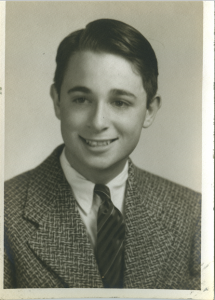
I just learned that longtime Guitar Player magazine editor Tom Wheeler has died. No details have been disclosed yet. [UPDATE: Apparently Tom succumbed to a heart attack while leaving a family gathering.]
Tom not only gave me my first job in guitar journalism — he gave me my first proper job ever. When he hired me as an assistant editor in 1988, I filled out my first W-2 form. Before that I was a deadbeat musician, music teacher, and student.
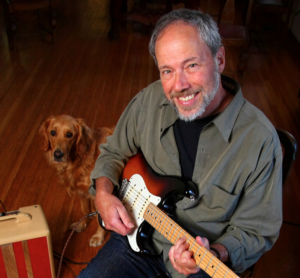 Many will talk about Tom’ titanic influence in the not-so-titanic world of guitar. He shepherded Guitar Player magazine through its most successful years. His The Guitar Book was the era’s standard reference for players and teachers. (My copy was worn out by the time I met Tom.) He joined the staff in 1977, and was head honcho from 1981 to 1991, when he left to assume a journalism professorship at the University of Oregon.
Tom was the finest mentor any young writer/editor could have wished for. (Well, so was then-senior editor Jas Obrecht, who is very much alive, well, and busy writing important music history books. So I was blessed with the two best mentors imaginable.)
I first contacted Tom the year before he hired me, pitching a monthly column on world music called Global Guitar. Tom wrote me a very nice rejection letter. I tried again the following year, and he declined a second time — but invited me down to Cupertino to interview for a new assistant editor position. I took the gig and commenced the long daily commute from San Francisco to Cupertino.
Tom took me under his wing in a big way. He gave me the opportunity to write a cover story my very first month (with the wise and wonderful Vernon Reid). He finally launched Global Guitar. And he was highly receptive to my story pitches and other editorial ideas.
Tom showed me the editing and publishing ropes with inexhaustible patience. He instilled a sense of ethics that guides me to this day: Be honest. Write clearly. And never forget that you’re there to serve the readers, not the publishers or the advertisers.
I happened to arrive at an exciting moment in guitar history, probably the greatest 6-string Renaissance since the ’60s. At that point the magazine focused on shred players, fusion maestros, and classic rockers. It didn’t take any special insight for me to realize we should also include upstarts like Sonic Youth, the Cure, and the Smiths, yet that indie/alt stuff hadn’t yet been embraced by the guitar mags. But Tom accepted such pitches and assigned me cover stories on those artists and many others. Today such coverage seems like a no-brainer, but it was quite controversial at the time. I received much reader hate mail, and those stories were sometimes blamed for the mag’s declining market share. Yet Tom backed me without fail. He also let me write about funk, the avant-garde scene, and players from Africa, Latin America, and Asia.
We held our staff meetings in Tom’s office — “Wheelie’s office,” we’d say — and it was always a bloody mess. There were inevitably overflowing mail bins of yet-to-be-heard vinyl and CDs and lofty towers of magazines and loose paper. That’s not to say Tom was disorganized — he never missed deadlines and rarely displayed stress during editorial crunches. There was always just a lot of crap in his office!
I was there for the last gasp of the mag’s original vision. Founder Jim Crockett and former editor Don Menn — two other lovely, supportive guys — soon departed, and GP was sold for the first of many times. After being the only magazine of its kind for decades (and effortlessly raking in big advertising bucks) there was increasing competition from Guitar World, Guitar for the Practicing Musician, and various spinoffs. Tom chafed under the corporate scrutiny, especially when the new publisher upbraided him for being late with some bullshit corporate report while a member of Tom’s family was undergoing a serious health scare. When a chance to teach journalism arose, Tom took it, and he recommended me to assume his role. (I didn’t really, literally or figuratively. We crafted a sort of halfway editor gig with Keyboard’s Dom Milano as publisher, which I held for a few years till I left to focus on playing.) Tom’s parting gift was a copyediting manual I have to this day.
It’s no secret that Tom really loved guitar. In fact, his most lasting contributions to the field may be the hefty tomes he authored after quitting GP. He’d always pause his work to check out whatever gear was passing through, and he played with the enthusiasm of a kid newly hooked on the instrument. Me, I have a neurotic love/hate relationship with the guitar and its players. Tom just reveled in all of it, in the purest possible way.
What I remember most about Tom, though, was his kindness. He was just plain nice! I remember one time when our newly hired NYC editor, Matt Resnicoff, was visiting. Matt, who had previously worked for Guitar World, was flabbergasted to witness Tom take a call from a random reader who wanted to ask about some arcane gear detail. “Whenever someone like that calls Guitar World,” Matt said. ”Our editor tells the receptionist, ‘Tell ’em to blow! We’re not a fucking information service.’”
I saw Tom a few times after he left. I’d run into him often at NAMM shows, and if I could drag him away from his admirers, we’d grab a sandwich. And I’d give him a ring whenever I played near Eugene. One time he came to an Oranj Symphonette gig with his local guitar buddy, Bill “Zoot Horn Rollo” Harkleroad of Capt. Beefheart fame. I was so nervous!
But whenever I think of Wheelie, I visualize one specific image: Tom, head down at his desk amid stacks of yet-to-be-processed paper, concentrating on an edit or page proof. (He was a great proofreader.) No matter how deeply focused he was, if you tapped on his door, he would pause, look you directly in the eye, and flash that all-American Tom Sawyer grin, his eyes sparkling exactly as in this photo. He’s not putting on that expression for the camera — he usually looked like that!
Later, when I briefly occupied the corner office, I would attempt to emulate him. I mean that literally: I’d think, “Pause, look up, eye contact, big smile.” But I never mastered the skill like Tom. He was a natural.
Farewell, my role model and mentor. You always were and will always be an inspiration, and I know that countless other players, craftspeople, readers, and writers feel the same. I am eternally grateful for your passion, wisdom, generosity, and kindness.
 I’d done a Guitar Player interview with Reeves Gabrels after the release of Tin Machine in 1989, and we’d stayed in touch. When Tin Machine II came out in September 1991, the band came to San Francisco to play at a music conference. My future wife Elise and I offered to show Reeves around the city. And Reeves invited David along, accompanied by an amiable bodyguard. We spent the afternoon tooling around town in my dumpy Mazda two-door hatchback with David perched astride the back-seat hump. (He insisted on taking the most uncomfortable seat.)
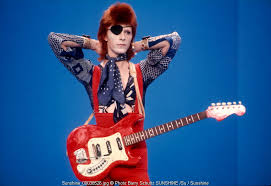 David and Reeves wanted to get piercings. First we grabbed lunch in Japantown (David had pork katsu, and treated everyone. His credit card was in his real name: David Jones.) Then we took them to the Gauntlet, SF’s premier piercing parlor at the time. It was David’s first piercing. He told us that he and his wife-to-be Iman were both getting simple single-ear piercings. It was an old sailor’s tradition, he said: The departing seaman and his love who stayed behind would get matching piercings as a symbol they’d be reunited some day.
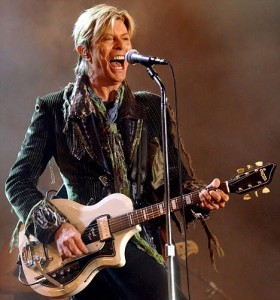 But the gentlemanly feat that most floored me was purely physical. By that point, Elise insisted that David, the out-of-towner, sit up front while she sat on the hump. When we got out to enjoy some view, David helped her out of the rear seat. It wasn’t just extending a hand — it was a deft and complex balletic gesture, as if levitating her out of the car, bowing slightly, and ushering her on her way. I can’t quite describe the impossibly graceful maneuver, and I couldn’t begin to replicate it. It was like something a 17th-century French courtier might do.
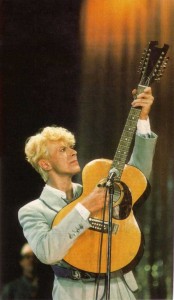 At one point David made an arch comment about a then-huge band he’d shared a flight with — something like, “They were nice enough kids, and I’m told they’re quite popular.” Back in my hotel room after the interview, the phone rang. “Oh, one thing,” said David. “Would you be so kind as to leave that comment out of the story? It wasn’t a nice thing to say, and I wouldn’t want to hurt anyone’s feelings.” I did as asked.
![Not About Music: Marvin Gore [1923-2015]](https://tonefiend.com/wp-content/uploads/Marvin-1928-99x150.jpg)