I just heard that Marianne Faithfull has died. It wasn’t a total shock — she’d been grappling with health problems for years. But it’s incredibly sad, and it makes me feel even more grateful for the few days that I got to spend playing and traveling with her in the summer of 2013.
She was booked for two outdoor shows in Northern California. My old pal, keyboardist Rob Burger, enlisted me, I think because her usual guitarist, Bill Frisell, couldn’t make the dates. Robbie is one of the two or three best musicians I’ve ever known. He’s played with … well, pretty much everybody, the fucker.

Robbie is one of several friends who knew Marianne far better than I. Another is Richard Fortus from Guns N’ Roses, who was her housemate for a time. Yet another is music journalism icon Sylvie Simmons, who Marianne sometimes treated like a kid sister. My encounter was relatively fleeting, but I can’t help jotting down some memories.
I knew Marianne’s legend, from Swingin’ London It Girl to brutally honest singer/songwriter. I’d seen her in Lucifer Rising and Girl on a Motorcycle. I’d heard how she fought for her rightful authorship of the Rolling Stones song “Sister Morphine.” Her vicious and uncompromising 1979 comeback album, Broken English, blew me away, as it did countless other listeners. And she was the featured speaker at a music journalism awards event I attended in LA. (She literally phoned in sick, delivering her address via loudspeaker.)
I’d also read the first of her two autobiographies, titled Memories, Dreams, and Reflections after the Carl Jung book with a near-identical title. It’s one of the best music bios you’ll ever read — and one of the few that was actually written by its subject. Most are ghost-written as-told-to tales. But Marianne had the literary chops to handle the job herself.
Marianne might not have grown up wealthy, but she was raised in an environment of extraordinary cultural privilege. Her parents were artists and intellectuals, and she was literally a baroness — her great-great uncle was Baron Leopold von Sacher-Masoch, who wrote Venus in Furs and gave us the word “masochism.” She was an extraordinarily intelligent and literate woman.
I was thrilled by this opportunity, but nervous before the first rehearsal because Marianne sometimes had a reputation as a prickly diva. She arrived last for rehearsal, draped in couture and managing something like regal grandeur in a practice space the size of a suburban bathroom. She was already stout by then, but you could still detect that youthful beauty in her face. She was … imposing and amazing.
But I figured I had a good opening line: “Hey, we’ve both worked with Polly Harvey and Tom Waits.”
“Polly Harvey,” she said, voicing the name with deliberate slowness. “Did you find her difficult to work with? I certainly did.”
I mentioned Tom, which elicited a stronger reaction. “Tom Waits — that arrogant little punk! He’s the most conceited man I’ve ever met aside from Macca. But then, Macca was a Beatle, wasn’t he? There’s not many who can say that.” Apparently the bad blood stemmed from her time performing the role of the Devil in the stage version of Waits’s The Black Rider. (I played guitar and banjo on the original album, but never performed it live.)

The backup was minimal — just Robbie on piano and me on baritone guitar. Happily, Marianne seemed satisfied with what we played, and she treated me nicely. I owe a lot to Robbie for helping me learn some of the material — and pointing out that I’d always played the “Broken English” riff incorrectly. (It starts on the second scale degree, not the first.)
Marianne treated us all to dinner at a fancy San Francisco sushi restaurant. An overweening waiter fawned as he took our orders. “Thank you,” she said, adding “Now fuck off” as he walked away. I’m pretty sure he heard her.
The first gig — at a rustic vineyard venue — went well enough, though there was one memorable rough spot. On one song, Robbie and I simultaneously bungled a chord change going into a bridge. This was a freak occurrence, because Robbie is the sort of musician who simply doesn’t make mistakes — everything sounds perfect on the first take, whereas I can rarely manage 16 clam-free bars. Furious, Marianne whipped her head around to glare at Robbie. “Now,” she told the audience, “we’re going to play it again from the beginning because he fucked it up.” Thanks, Robbie, for taking my bullet.
She, of course, was fabulous. That presence! That chilling, gravel-toned voice! Marianne was an actor as well as a musician, and you knew it.
The next gig was at an outdoor hippie festival in rural Northern California. The drive took many hours, and I got to sit next to Marianne in the passenger van. Man, I wish I’d recorded those conversations! We talked a lot about literature, particularly the Brontë sisters. How the fuck, I wondered, did Emily emerge from such a sheltered upbringing to conceive something as emotionally and sexually explosive as Wuthering Heights? Marianne attributed it to the influence of brother Branwell, the worldliest of the Brontë kids, who failed in multiple careers before succumbing to alcohol and opium addiction.
She loved to gossip about the music icons of the ’60s. Pete Townshend had recently been embroiled in scandal for possessing child porn, which he claimed was research material for his own autobiography. (He was eventually cleared of charges.) Marianne believed him 100%. And I was struck by how she remembered Keith Moon. Not as a drunken maniac, but as a nice guy. “Keith was a very, very kind man,” she said.

Then as now, I’ve suspected that Keith Richards did not play the guitar solo on “Sympathy for the Devil.” (Long story — let’s skip it for now.) But I figured I might get some info from Marianne, since she was at the frickin’ session, singing those woo-woos alongside Anita Pallenberg.
According to rock legend, hyper-literate Marianne had read Mikhail Bulgakov’s The Master and Margarita, a religious/political satire written in the 1930s, but censored by Russian authorities until the late ’60s. It depicts a charming, urbane Satan — AKA Professor Woland — wreaking havoc on pre-WWII Moscow. She reportedly shared the book with then-squeeze Mick Jagger, who promptly penned “Sympathy.”
I asked if the story was true.
“Well,” she replied, “have you read the book?”
Like three times!
“Have you heard the song?” she asked.
I nodded. Duh.
She gave a theatrical shrug that I interpreted as “Of course it’s fucking true.”
“Who played the solo on that song?” I asked with fake casualness.
She turned to stare out the window. Long seconds of silence. “I just knew,” she finally grumbled, “that you were eventually going to ask me something idiotic like that.”
For once I stood strong. “Look, I’m not asking that as some drooling Stones fan. I’ve devoted my life to the craft of guitar playing, and that recording was an important influence on several generations of players. Those details matter.”
Marianne seemed to buy it. She dropped the belligerence and sighed. “I guess you’ll have to ask Keith, won’t you? He is the guitar player, after all. You do know Keith, don’t you, darling?” (Yes, she really said “darling,” like on Absolutely Fabulous, where she had portrayed God.)
No, I didn’t know Keith. But one time when I was staying at the Mandarin Oriental in Knightsbridge on tour, I kept running into him and his bodyguard in the elevator and on the stairway. Only later did it occur to me that I had a great opening line: “Hey, you and I both played on Tom Waits’s Bone Machine!” (Though not on the same songs.) Maybe that line would have worked better with Keith than it had with Marianne.
We arrived at the venue and parked the van in a dirt lot near the ad-hoc backstage area. The vibe was vintage hippie. I saw Wavy Gravy wandering around.

The road manger helped Marianne down from the van — she was already having mobility problems. As her heels touched the dirt, she turned to me and asked, “Darling, do you think I’m the only one here wearing Chanel?”
That show also went fairly well, but I don’t think it connected with much of the audience, who probably had no idea who Marianne was or what she represented. Afterward she seemed tired and a bit melancholy.
That night we stayed in a modest motel near the event. John Prine, who had also appeared at the festival, was staying there too. We’d included one of Prine’s songs in the set. I’d known of both Prine and Marianne since my early teens. How weird, I thought, for these paths to intersect at a rural motel four decades later.
The next morning we drove back to SF. We talked more about books. I raved about Jake Arnott’s recent The House of Rumor. One of its labyrinthine subplots involved rocket scientist/Satanist Jack Parsons, who had inspired Marianne’s song “City of Quartz.” She earnestly advised me not to pursue Satanism. (“It can be very harmful.”) When we stopped for coffee in San Rafael, I dashed to a nearby bookstore for a copy. They didn’t have it. I promised to send Marianne the book, but I never did. Not long after we all said goodbye in San Francisco.
That was the last time I saw Marianne. I heard about her subsequent travails via Robbie: the near-fatal covid episode, its dire after-effects. I’m just grateful to have spent a few days in the company of such a fiery, imposing, and brilliant artist. Thank you, Robbie. Thank you, Marianne.
 I’d done a Guitar Player interview with Reeves Gabrels after the release of Tin Machine in 1989, and we’d stayed in touch. When Tin Machine II came out in September 1991, the band came to San Francisco to play at a music conference. My future wife Elise and I offered to show Reeves around the city. And Reeves invited David along, accompanied by an amiable bodyguard. We spent the afternoon tooling around town in my dumpy Mazda two-door hatchback with David perched astride the back-seat hump. (He insisted on taking the most uncomfortable seat.)
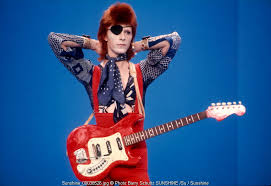 David and Reeves wanted to get piercings. First we grabbed lunch in Japantown (David had pork katsu, and treated everyone. His credit card was in his real name: David Jones.) Then we took them to the Gauntlet, SF’s premier piercing parlor at the time. It was David’s first piercing. He told us that he and his wife-to-be Iman were both getting simple single-ear piercings. It was an old sailor’s tradition, he said: The departing seaman and his love who stayed behind would get matching piercings as a symbol they’d be reunited some day.
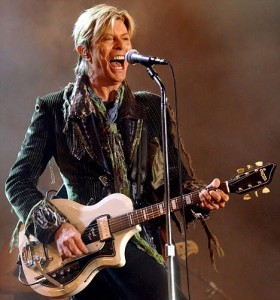 But the gentlemanly feat that most floored me was purely physical. By that point, Elise insisted that David, the out-of-towner, sit up front while she sat on the hump. When we got out to enjoy some view, David helped her out of the rear seat. It wasn’t just extending a hand — it was a deft and complex balletic gesture, as if levitating her out of the car, bowing slightly, and ushering her on her way. I can’t quite describe the impossibly graceful maneuver, and I couldn’t begin to replicate it. It was like something a 17th-century French courtier might do.
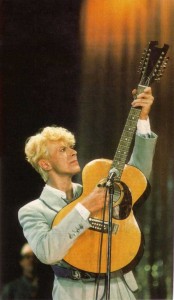 At one point David made an arch comment about a then-huge band he’d shared a flight with — something like, “They were nice enough kids, and I’m told they’re quite popular.” Back in my hotel room after the interview, the phone rang. “Oh, one thing,” said David. “Would you be so kind as to leave that comment out of the story? It wasn’t a nice thing to say, and I wouldn’t want to hurt anyone’s feelings.” I did as asked.