Categories
Music

“God Only Knows”: A Golden Anniversary Tribute

It probably wins my vote for prettiest pop-rock song of all time, and it’s a far-from-controversial opinion. “God Only Knows” and all the other great tracks from the Beach Boys’ incomparable Pet Sounds album are 50 years old. (The album was released on May 26th, 1966.)

I owe a big thanks to my pal Mark Goldenberg who inspired me to really learn the entire tune. Mark performs an exquisite solo version, far more lyrical and poetic than my relatively motoric reading. He and I are also preparing a duo version for an album project in the works.

I say “really learn” because you don’t appreciate the number of perverse composition tricks in the tune until you study it bar by bar. Example: the jarring leap into the bridge after the second verse. Or the way that chromatically snaking bridge seems to usher in a return to the chorus, but it’s only a three-bar tease (and in the “wrong” key at that) before a exquisite harmonic pirouette into the final verse. Or the fact that many, if not most, chords in the song don’t feature their root note in the bass. (Especially that verse! The voice leading simply makes no sense on paper, but it’s perfection in practice.) And while countless musicians have praised the outro’s beautiful choral polyphony, I haven’t got much to add, except to say that it’s frickin’ hard trying to cover all those parts! (I didn’t succeed — I only played as many as I could cram into my left hand.)

And oh, the guitar: It’s the latest installment in the ongoing Mongrel Strat Project.I’ve been hacking away at the same sad parts for years. Literally hacking, in this case: I had to route out the pickup cavity to accommodate a pair of über-retro PAFs (a Duncan Joe Bonamassa signature set). Yeah, a Strat with humbuckers isn’t a new idea. But the pickups used are almost always high-gain models designed for macho soloing. I wanted to try something low-gain and unpotted for relatively bright, resonant sounds not quite so far removed from traditional Strat tones. I’m finishing up a video about the project, and I’ll post it in the next few days.

Anyway: Happy birthday, beautiful. You wear your age well.:)

Categories
Music

“Eleanor Rigby” Rehearsal

Lucky me: I just started rehearsing for a duo project with one of my guitar heroes, the brilliant Mark Goldenberg. Here’s a run-through of “Eleanor Rigby,” one of the tunes we’re working on. It’s pretty rough still, and the recording quality ain’t great. But I love Mark’s playing so much here that I couldn’t resist sharing.

I’ve only known Mark a year or two, but we hit it off as soon as we met at one of Teja Gerkin’s solo guitar events. Mark played ravishing solo version of so many of my favorites: “God Only Knows,” “Shenandoah,” “Wichita Lineman,” “Mood Indigo,” and more. I love his ultra-dynamic touch and beautiful Bill Evans-style harmonies. Plus he’s just an cool guy.

And it turns out we both studied with the same teacher: the late Ted Greene. (I took lessons from Ted as a teen, with a few more sessions 20 years later. Mark studied with Ted long after he became a leading LA sideman and session player.) You can read more about Mark on his website. He’s recorded and toured with Jackson Browne, Bonnie Raitt, Linda Ronstadt, Eels, Natalie Imbruglia, Chris Isaak, Waylon Jennings, Willie Nelson, Peter Frampton and — hehehe — William Shatner. It’s a real thrill to collaborate with such an inspired player.

I’m playing a Gretsch TV Jones baritone on loan from my pal Xander Soren. Mark’s playing his magnificent mahogany Collings.

Categories
Music

My Brushes with Bowie

My morning, like everyone’s, started with a devastating gut-punch: “David Bowie died.”

I can’t say I knew Bowie, but I was lucky enough to spend a few hours with him back in the ’90s. And he was every bit as cool as his music.

bow1I’d done a Guitar Player interview with Reeves Gabrels after the release of Tin Machine in 1989, and we’d stayed in touch. When Tin Machine II came out in September 1991, the band came to San Francisco to play at a music conference. My future wife Elise and I offered to show Reeves around the city. And Reeves invited David along, accompanied by an amiable bodyguard. We spent the afternoon tooling around town in my dumpy Mazda two-door hatchback with David perched astride the back-seat hump. (He insisted on taking the most uncomfortable seat.)

David was charming and unpretentious, yet freakishly charismatic. This is going to sound a bit woo-woo, but he just seemed to scintillate with some weird luminous energy. That probably sounds like the typical star-struck reaction of a lifelong fan. But I’ve met several members of the super-famous tribe over the years — Madonna, Springsteen, Ringo, Steve Jobs — and never encountered anything remotely like David’s spark.

Some stars have a gift for dimming their light as needed. For example, I used to see Robin Williams around my San Francisco neighborhood back in the ’80s. He’d be walking down Haight St. close to the building fronts, slouching a bit with his hands in his coat pockets and his face downcast. You wouldn’t notice him till the instant he slinked past. David was the opposite: When he’d round a street corner, it was as if everyone on the block instantly felt the energy shift. It was uncanny.
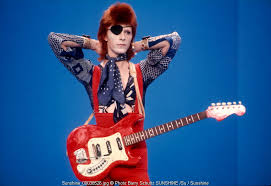
UnknownDavid and Reeves wanted to get piercings. First we grabbed lunch in Japantown (David had pork katsu, and treated everyone. His credit card was in his real name: David Jones.) Then we took them to the Gauntlet, SF’s premier piercing parlor at the time. It was David’s first piercing. He told us that he and his wife-to-be Iman were both getting simple single-ear piercings. It was an old sailor’s tradition, he said: The departing seaman and his love who stayed behind would get matching piercings as a symbol they’d be reunited some day.

David confessed to being a bit scared. As we scaled the stairway to the second floor, he jokingly clutched the bannister as if hauling himself up against the wishes of his legs. Naturally, the guy behind the counter recognized him within milliseconds. He was too hip to make a fuss, but you could literally see his eyes widen. After the guys got their piercings, the wide-eyed dude explained the maintenance procedure, recommending that David rotate the stud to keep the hole from scabbing over. David initially misunderstood and thought he had to remove the stud from his ear. “No,” Piercing Guy explained. “Leave it in there and just rock it.” He paused for two comically perfect seconds. “You know how to do that.”

We drove up and down the city’s hills, climbing out at viewpoints and talking San Francisco lore. David was easy to chat with. Unlike many of the super-famous, he’d actually listen to what you’d say and would usually respond with something fascinating. At the same time, it was exhausting. I felt like 33% of my mind was on the words. Another third was studying his eyes with their famously mismatched pupils. And everything else was OHMYGODI’MTALKINGTODAVIDBOWIE.

Everywhere we went, shy fans would approach David, thanking him or seeking autographs. Without exception, David would pause what he was doing, take a moment to chat, and humbly thank them. It was like a master class on the right way to be a rock star. What a gentleman!
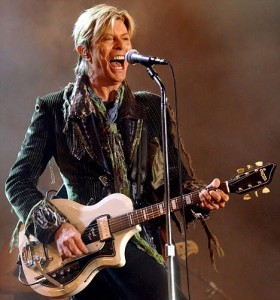
David-BowieBut the gentlemanly feat that most floored me was purely physical. By that point, Elise insisted that David, the out-of-towner, sit up front while she sat on the hump. When we got out to enjoy some view, David helped her out of the rear seat. It wasn’t just extending a hand — it was a deft and complex balletic gesture, as if levitating her out of the car, bowing slightly, and ushering her on her way. I can’t quite describe the impossibly graceful maneuver, and I couldn’t begin to replicate it. It was like something a 17th-century French courtier might do.

Our last stop was a funky hat shop in North Beach. I jokingly urged David to try on an orange plastic pith helmet with a Grateful Dead sticker front and center. Instead, he asked to see a green felt fedora. “How does this look?” he asked, turning and striking a smoky 1940s film star pose. Elise and I swear we felt an electrical shock. We’d almost relaxed by that point, and suddenly David Bowie was standing there! (And yes, he bought the hat.)

Later, back home, we were exhausted. Elise theorized that there’s something vampiric about that sort of charisma. David didn’t just emanate energy — he seemed to soak it up it from those around him. Yeah, woo-woo again. But that’s how it felt.

My second encounter was in 1995, when I flew to NYC to interview Reeves and David separately and together for a Guitar Player cover story. I got to sit in on a rehearsal, where David was calm, kind, and focused with his band. We also went to a Rosie O’Donnell Show taping where the group played live at some decidedly un-rock n’ roll morning hour. Again, David was the very picture of modesty and graciousness.

My solo interview with David was as fascinating as you’d imagine. The focus, of course, was guitar playing. He had compelling things to say about his great accompanists: Mick, Earl, Carlos, Robert, Stevie Ray, Adrian, and, of course, Reeves. But we also spent a lot of time talking about David’s own underrated playing. Did you know he was the sole guitarist on the Diamond Dogs album? And have you listened to that record lately? Those grinding, clanking guitars are like Sonic Youth 15 years ahead of schedule. And that’s David playing the immortal riff from “Rebel Rebel.” He said it came to him in a flash, and when it did, he looked up at the sky and thanked God.
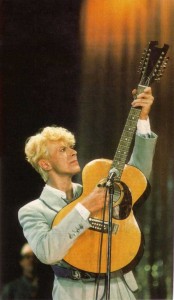
2001-07TotalGuitar-BowiewithEccleshall12-stringAt one point David made an arch comment about a then-huge band he’d shared a flight with — something like, “They were nice enough kids, and I’m told they’re quite popular.” Back in my hotel room after the interview, the phone rang. “Oh, one thing,” said David. “Would you be so kind as to leave that comment out of the story? It wasn’t a nice thing to say, and I wouldn’t want to hurt anyone’s feelings.” I did as asked.

I almost had a third encounter later that year when I was touring with PJ Harvey. David contacted Polly, asking her to duet with him and his band on “The Man Who Stole the World” for some TV or award show. Polly being Polly, she said she’d only do it if she could use her own band, and we even rehearsed a dirge-like version of the tune. (Without David, of course.) In the end David nixed the idea, opting to perform his song with the musicians of his choice.

I could write reams about David’s music from the perspective of a naïve young fan (I’m old enough to have had Hunky Dory on my radar when it was new), as an aspiring music student during his Berlin era, and from the jaded perspective of a middle-aged music journalist. I probably will at some point. But now I’m just feeling grief for our collective loss, and gratitude for my brushes with Bowie — and getting to spend some time with that remarkable gentleman genius.
Categories
Music

Stir It Up vs. Crimson and Clover

Oh, no, the mistletoe! On a rainy December afternoon I prepared a little antidote to holiday music poisoning: a mashup of two of the most summery songs ever. It’s Bob Marley’s “Stir It Up” vs. “Crimson and Clover” by Tommy James and the Shondells.

Categories
Pickups

What’s Your Favorite Note?

No, I don’t mean like, “What’s better: B-flat or F-sharp?” Rather, is there a single note from a great recording or performance that haunts your dreams?

Here’s what go me on the topic: One of my Premier Guitar colleagues, Gary Ciocci, recently turned me on to El Twanguero (aka Diego Garcia), a brilliant Spanish-born, Argentina-based electric guitarist who’s created a head-spinning fusion of classic Latin jazz and rockabilly guitar. The only thing I don’t worship about the great Afro-Caribbean music of the 1950s and ’60s is the fact that it rarely includes guitar. But in Garcia’s retro fantasia, it’s as if the great Cuban and Puerto Rican mambo kings had migrated to Memphis instead of settling in NYC.

¡Bien tocado, señor!
Diego “El Twanguero” Garcia: ¡Bien tocado, señor!

When I explored Garcia’s YouTube channel, I immediately clicked on his version of “Cherry Pink and Apple Blossom White,” a Perez Prado classic that topped the charts in 1955. (You probably know the tune even if you don’t recognize the title — it’s been in a zillion movie soundtracks.) I was eager to hear how Garcia would interpret the famous trumpet slur — perhaps the booziest single note ever recorded. (Yes, theory sticklers — I’m using the word “note” to mean a single articulated note, even when it spans multiple pitches over its duration.)

The tipsy note appears right at the top — it’s the fourth pitch in the trumpet melody. But it gets boozier and woozier with each repetition, and by its dead-drunk appearance at 2’27”, it’s amazing anyone’s still standing up.

Okay, try to convince me that it isn’t the sleaziest note ever! (Just for fun, here’s a live performance, where you can see what Prado looks like when emitting his signature grunt.)

How the hell would you render that on guitar without period-inappropriate distortion and locking tremolo? Take it away, Sr. Garcia!

Love it! ¡Bien tocado, Señor!

That got me thinking about other favorite notes. My #1 choice was easy — it comes at the end of this post. But two others also sprang to mind.

George Harrison’s “It’s All Too Much” used to be considered one of the Beatles’ least important tracks, though it seems to have been critically rehabilitated over of the course of the last few psychedelic revivals. It was cut in 1967 between the recording and release of Sgt. Pepper, just when the Beatles were discovering LSD. (It shows). But it wasn’t issued until 1969, when it appeared as a throwaway on the Yellow Submarine soundtrack — the first album I ever purchased with my own money. (And I’ve never recovered from the horror of discovering that side B features no Beatles material — just George Martin’s twee orchestral soundtrack.) But that blast of sustained feedback carved its way into my consciousness.

The experts say George played it, though I doubt anyone present was coherent enough to recall. I’m not saying it ain’t George, though I can’t help noting that whenever you investigate a particularly ferocious bit of Beatles guitar work, the perpetrator always seems to be Paul. (Examples: “Helter Skelter” and the solos on “Taxman” and “Good Morning.”) I dunno — maybe acid unleashed Harrison’s inner beast.

Another note that’s possessed me for decades is from Miles Davis’s heartbreaking take on Rogers and Hart’s “It Never Entered My Mind.” (From Workin’ — the first jazz album I bought with my own cash, at age 14.) Man, you could write a dissertation on the first eight bars of Miles’ solo, and someone probably has. Even though the notes are few and far between, I dare you to try playing along, matching the trumpet phrasing. But the highlight for me is the sublimely out-of-tune note in the fifth bar of the trumpet head. (It first appears at 0’33” in this clip.)

The performance is in A-flat, and the special note is a very flat E-flat — about halfway to D-natural. Man, how does something so wrong feel so … not just right, but transcendent?

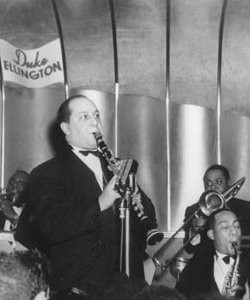
That was my favorite note for many years, until I became a born-again Ellingtonian. Friend/genius Stephen Yerkey turned me on to Ellington’s 1938 remake of his own “Black and Tan Fantasy,” whose original 1927 version is universally regarded as one of the most important early jazz discs. But the 1938 remake is equally brilliant. Duke’s band was at or near the height of its powers. The orchestration is sublime. The piano work is radical. Each solo is a jewel. And then there’s THE NOTE.

Now, there’s nothing I find more musically distasteful than a cheesy, star-searchin’ vocalist wowing the crowd with a long sustained note. I hate it just as much when operatic singers do it (as did many of the great opera composers). And using the national anthem at ball games as a pretext is just plain nauseating.

Did Barney Bigard play the greatest note ever?

Yes, THE NOTE is impossibly long and difficult. But there’s more here than sheer virtuosity. The painfully slow glissando literally makes you dizzy, as if the world were tilting off-axis. (It’s more psychoactive than the Beatles on acid!) It exerts exquisite tension against the backing harmonies, and it lets Duke display his most Debussy-like side in his watery, chromatic piano accompaniment. And the dismount is astonishing: Another wind player would be gasping on the floor, but incomparable clarinetist Barney Bigard (also featured on the 1927 original) concludes with a soft, casual phrase, as if he had all the time and breath in the world. For me, this is the ultimate musical embodiment of “cool” in its most profound African diaspora sense.

Play it, Mr. Bigard! The miracle commences right after 1’15” (but please, treat yourself to the entire performance).

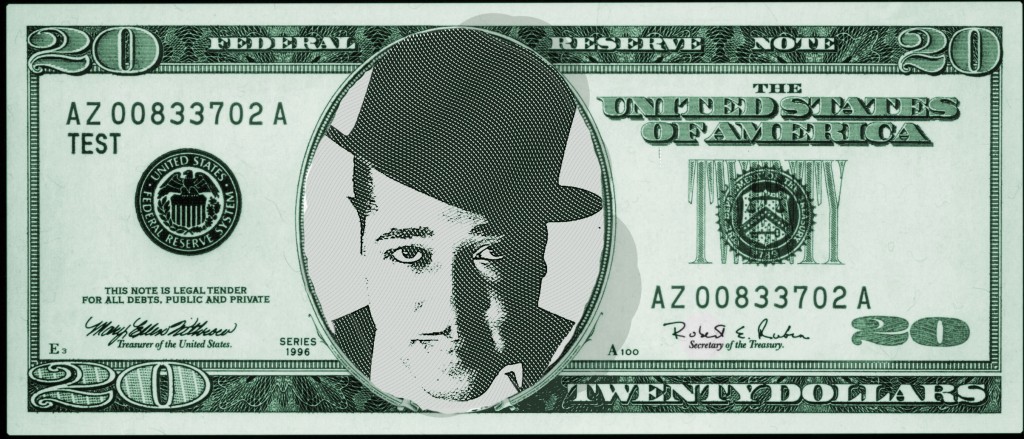
(I know I’ve said this about 50 times on this blog, but I repeat it whenever possible: In much of the civilized world — Europe in particular — the arts are considered precious, and musicians routinely appear on currency. If Americans gave a crap about culture, our greatest composer would grace the $20 bill, not genocidal Jackson. Though admittedly, there’s a strong case for Harriet Tubman.)

duke_dollars

Okay, enough of my yakkin’! What’s your favorite note?

Categories
guitar Music Technique

My Favorite Rock ’n’ Roll Solo (It’s Not on Guitar)

I’ve long been obsessed with Sam “The Man” Taylor’s epic sax solo on the Chords seminal 1954 rock ’n’ roll hit, “Sh-Boom.” But I never got around to learning, transcribing, and analyzing it till now. I heard it about 100 times while making and editing this video, and it still thrills me on every listen.

If you’re like me, you know it’s wise to study performances by non-guitarists, but seldom get around to doing it systematically. For once I followed through, and — at risk of sounding like a pedantic dork — I’ve analyzed what I heard and suggested ways to incorporate the concepts in styles far removed from the original doo-wop context.

You can download my transcription (in standard notation and guitar tab) here.

The final part of the video is a rant about how segregation shaped the course of early rock and roll, in which I piss all over the Crew Cuts’ tepid cover version of “Sh-Boom.” (Spoiler alert: It blows.) This was partially inspired by recent despicable comments from musical felon Pat Boone. I’ve linked to the following videos before, but I’m posting them again because the cost of quality music is eternal vigilance against sonic shit-shovelers.

Holy crap! It’s the coolest man in the universe! This foreshadows Hendrix, Prince, and the Beatles. Even lip-synched, it’s everything badass in one minute and 50 seconds. (And it speaks volumes about segregation in midcentury America.)

And then there’s this:

Unholy crap! It’s the least cool man in the universe. And this foreshadows nothing except the worst music of the last 60 years (though it too speaks volumes about race in 20th-century America).

Why beat this dead horse? Why pick on ol’ Pat 60 years after the fact? Maybe he regrets his musical misdeeds. Maybe he’s even developed a more nuanced view of race and racism.

Naw. When self-avowed white supremacist Dylann Roof murdered nine African-American churchgoers on June 17th, 2015, Boone leapt into action, penning an angry editorial that condemned … politicians who dared to refer to the atrocity as “racist.”

FUPB. There’s no statute of limitations on your crimes.

Categories
Digital guitar Music Technique

Less-Boring Looping (“Pumped-Up Kicks” Cover)

For a while I’ve been playing this loop-based cover of Foster the People’s “Pumped-Up Kicks” at solo gigs and with my duo band, Mental 99. At risk of sounding like a pompous dick, I’ve annotated the performance, highlighting techniques I’ve found useful for making loop-based performances livelier and less predictable.

I’ve covered some of this ground before, particularly in this Premier Guitar looping-technique article. But here I call out the techniques mid-performance, and I’ve included a few new ones. I hope you find some of them useful.

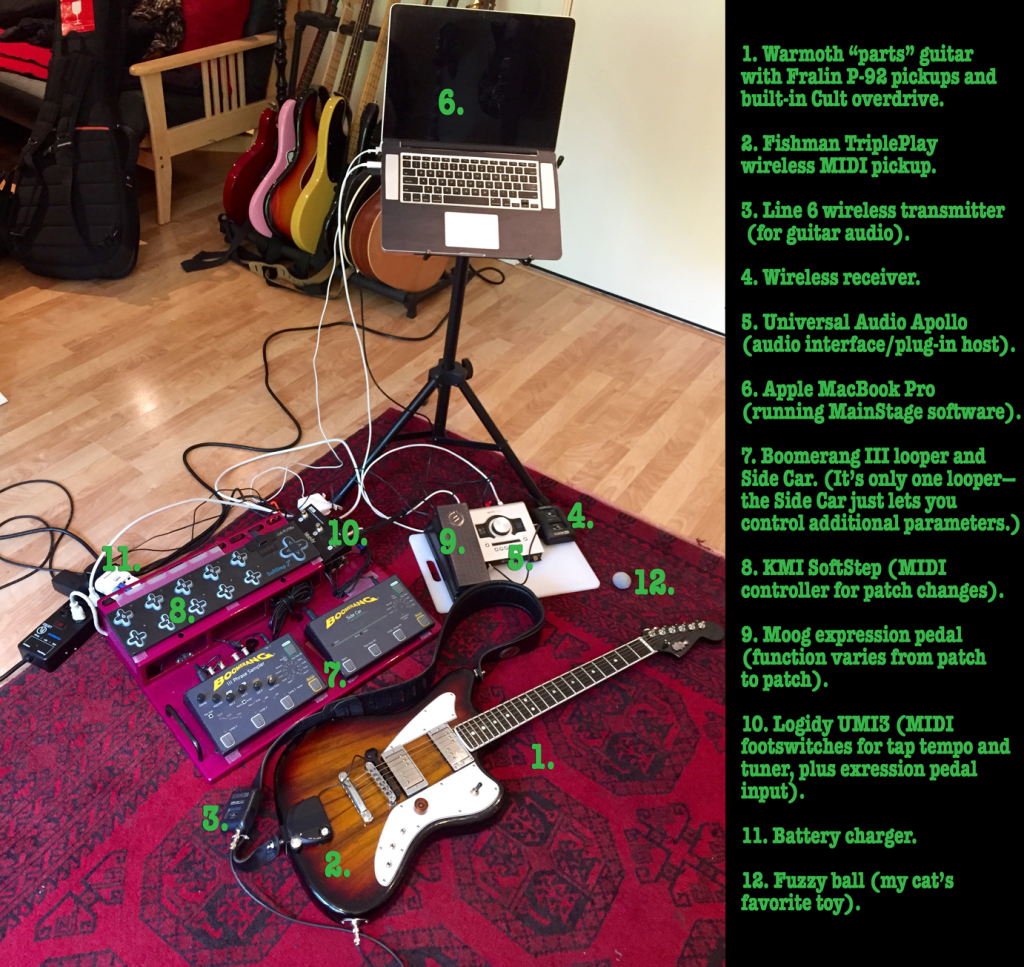
Likewise, I’ve already written about my live looping rig, but it’s changed a bit since then, and I’ve recently integrated a Universal Audio Apollo Twin interface (plus the stellar plug-ins it allows me to run). An updated overview:

Pedalboard-Diagram

The arrangement perform nicely, and I dig the individual components. But I dislike the system’s Rube Goldberg complexity—it’s a royal pain to set up and schlep. I’m always looking for ways to simply. (Other than, you know, just plugging the guitar into a frickin’ amp.) I’m open to suggestions for streamlining!

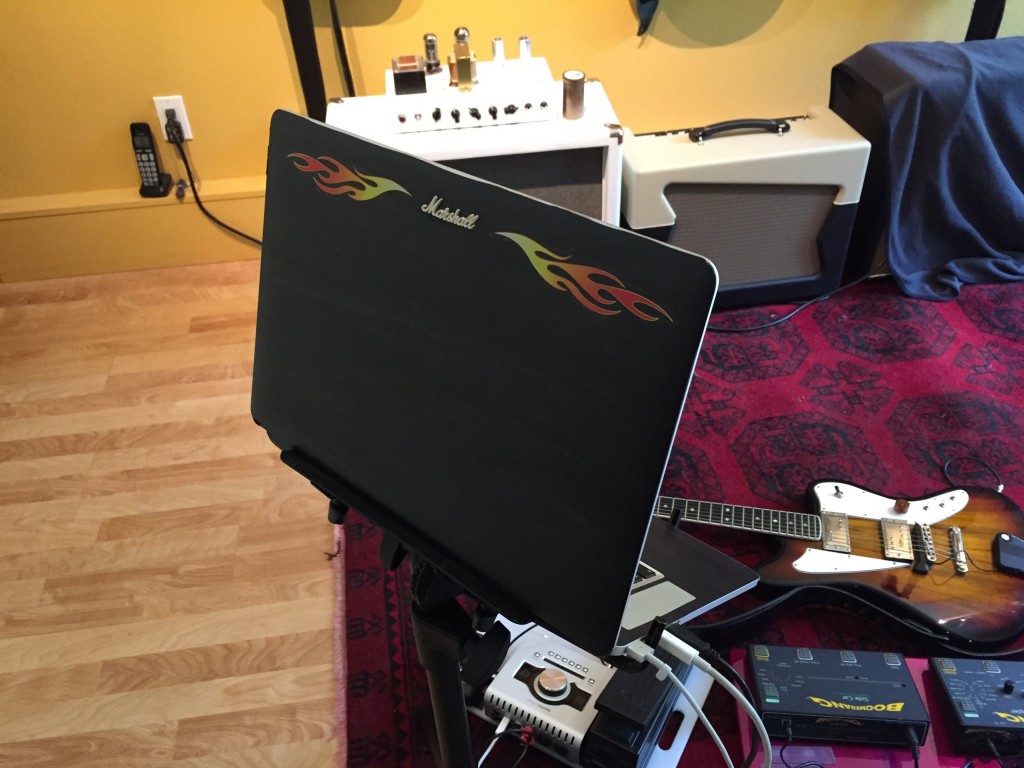
Black Mac
I love Apple products, but I hate having Macs onstage (mainly ’cause they’re so much better looking than me). Covering it in black wrap makes it less obtrusive. The Marshall logo is from one of those “toy” stacks (which, of course, can be far more than toys in the studio).
Categories
guitar

Those $24 Acoustic Strings

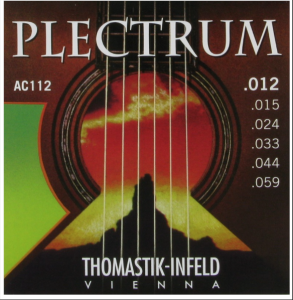
As if I weren’t already blowing enough money on arcane strings, I’ve got a new obsession: Thomastik-Infeld Plectrum series acoustic strings (which sell for $24 in the U.S.).

If you hang out here much, you’ve heard me bitch incessantly about acoustic strings. I hate the way most modern strings are all hyped treble zing and blaring volume, at the expense of deep, decisive fundamentals. With due respect to my vegetarian friends, too many strings are all sizzle and no steak.

Screenshot 2015-06-03 14.55.56

Yeah, bright strings can seem energizing in a cocaine-binge sort of way. But all that glassy presence gets fatiguing. Meanwhile, darker bass strings leave sonic space for the treble strings to shine. Even on my teensy-tiny Martin 0-17, these low strings sing in a warm baritone voice, not like some squeaky, poorly Auto-Tuned teen idol.

This pricy Austrian set features brass-coated steel 1st and 2nd strings, while the bass strings are bronze, but with both silk inlays and flexible steel cores. The flatwound 3rd, 4th, and 5th strings nix finger noise and minimize tone contrasts between wound and unwound strings. The polished roundwound 6th string adds a touch of focus to the lowest register, yet introduces no awkward contrasts on melodies played across multiple strings.

The set is low in both tension and volume relative to most U.S.-made strings. Even though the low E is a chunky .059, it has a soft, relaxed feel that makes me want to linger over notes, shaping them. The harmonic range is fantastic, the dynamic range even more so. They’re long-lasting too — this video was recorded three weeks and many playing hours after installing the set.

I’m hooked. Damn it.

(Hey, Mr. Tambourine Man — I don’t want you getting your nasty treble overtones all over my acoustic strings, no matter how frickin’ jingle-jangle the morning happens to be. Just back off, pendejo.)

Categories
Effects

Heaviest. Stompbox. Ever.

I’ve been breathlessly awaiting one of these since I saw this. It’s Korg’s Miku Stomp, a spinoff from the company’s Vocaloid voice synthesizer. It tracks your pitch as you play and responds with a synthetic voice that forms various syllables and phrases.

There’s some cheating here: The effect’s latency is quite severe, so I had to slide the Miku track back in time while mixing. Its triggering is also inconsistent, so I replaced a few notes. Miku tracks best when playing melodies on a single string, hence my awkward, position-jumping fingering. (Actually, it tracks pretty well when you play slow melodies full of sustained notes. But steady eighth-notes at 155 BPM as heard here is a major challenge.)

One of the pedal’s most interesting aspects is the way it interprets slurs. When there’s no break between notes, Miku sings a sort of pseudo diphthong. Detached notes get a syllable with a clear transient.

IMHO, the inescapable facts that Miku is silly and doesn’t work terribly well doesn’t diminish her total awesomeness. No doubt about it: heaviest stompbox ever.

The tune, of course, is “Georgy Girl,” which I’ve loved since forever. It was a blast recording the backing tracks with classical guitar, ukulele, ukulele bass, 12-string, toy piano, M-Tron Pro, and a mix of live and sampled percussion. And of course, gobs of my favorite reverb effect: Universal Audio’s EMT140 plate simulation. Yum.

Categories
Recording

In Search of Ancient Ambience

Screenshot 2015-03-31 10.29.54

Premier Guitar just posted my latest Recording Guitarist column. The subject: Capturing the haunting reverbs of Southwestern ruins via impulse-response reverbs.

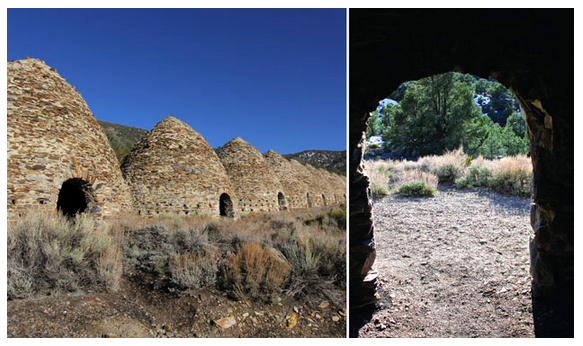
Many years ago I marveled at the eerie reflections within the stone-walled ball court at Wupatki, an hour north of Flagstaff, Arizona. On this visit, I attempted to clone the tone. I did the same at the Wildrose charcoal kilns in a remote, mountainous corner of Death Valley. The article includes audio clips, tech notes, and a download link for the impulse responses, suitable for use in any IR reverb program (or in the Logidy EPSi stompbox).

Screenshot 2015-03-31 10.42.24
The 1870s charcoal kilns of Death Valley generate a spooky,, flange-like reverb.

Like a dope, I’d forgotten to bring the relatively high-quality recorder I’d intended to use, so I worked with noisy, lo-fi recordings from my iPhone 6’s Voice Memos app. After some digital cleanup (detailed in the article), the results were cool and compelling, though not a completely accurate audio snapshot due to various types of distortion.

(Actually, I had an earlier experience capturing quick-and-dirty reverbs when I visited the Neolithic caves of France and Spain last year. It wasn’t my idea—I just happened to wind up on a tour group with composer Craig Safan, who was conceptualizing a piece inspired by those evocative spaces. He’d packed a proper Zoom mobile recorder, and we made ad hoc impulse responses by clacking small stones together. Craig has since completed the work, Rough Magic, and he tells me his mixing engineer wound up using our IRs a great deal. I’ve heard the piece, and it’s awesome. It’s not public yet, but I’ll tell you when it is.)

Since writing this Premier Guitar piece, I’ve been pondering whether damaged/distorted impulse response files might be an interesting avenue for sonic exploration. Generating cool sounds via weird IRs isn’t a new idea—the Space Designer plug-in in Apple’s Logic Pro includes a little-known IR preset folder titled “Warped,” which uses unusual sources like synth tones and noise bursts to generate reverbs not found in nature. But my interests are reverbs that are both familiar and surreal—the echoes of distorted reality.

And coincidentally, just as I was writing this post, a friend sent this wonderful video: an old Teletubbies clip, processed through a smeary, distorted black-and-white filter and paired with Joy Division’s “Atmosphere.”

I’m pretty much talking about an audio equivalent to that video processing. Has anyone else thought about or explored this idea?